Rule-Based Promotions for Ecommerce: Complete Guide
Summary
Rule-based promotions apply offers only when specific conditions are met, such as cart value, products, customer type, location, or timing. This guide explains how triggers and actions work, compares 12 rule types with examples, and covers the features to look for in a promotion engine. It also covers how to run rule-based offers on Shopify without eroding margin.

Senior Content Writer
Key Takeaways
Rule-based promotions apply offers only when specific conditions are met, such as cart value, products, customer type, location, or timing. This guide explains how triggers and actions work, compares 12 rule types with examples, and covers the features to look for in a promotion engine. It also covers how to run rule-based offers on Shopify without eroding margin.
Picture two stores selling the same product at the same price. One runs a flat 10% discount for everyone. The other shows first-time visitors a welcome offer, gives returning customers a free gift with purchase on Shopify once their cart crosses $100, and tells a shopper they’re $15 away from free shipping. The second store converts more shoppers and protects its margin.
That store is running rule-based promotions: offers that apply only when specific conditions are met. This guide covers how they work, the 12 rule types ecommerce stores use (from BOGO offers on Shopify to tiered cart rewards), what to look for in a promotion engine, and how to set up rule-based offers on your store.
What Are Rule-Based Promotions in Ecommerce?
Rule-based promotions are discount or reward logic built on “if this, then that” conditions. Instead of one blanket coupon code that everyone uses, the store sets rules: if a customer’s cart crosses $75, give them free shipping; if someone buys a moisturizer, offer a free sunscreen sample; if a shopper is buying for the first time, show a 10% welcome discount automatically.
The key difference from a generic discount is precision. A flat sale discounts everything for everyone, which cuts margins fast. A rule-based promotion only applies when specific conditions are met, so the store controls exactly who gets what, and why.
Why Ecommerce Brands Use Rule-Based Promotions
Margins are tight in ecommerce, and blanket discounts are one of the fastest ways to shrink them without growing the business. Rule-based promotions reverse that. A brand can protect margin on low-value orders while rewarding customers who spend more, buy more often, or need a nudge to convert.
There’s also personalization. A customer who has bought three times doesn’t need the same first-order discount as a new visitor, and an irrelevant offer isn’t persuasive. Rules let a store match the offer to the moment: urgency for someone hesitating at checkout, a loyalty reward for someone who has bought five times, a bundle suggestion for someone who just added a phone case to their cart.
Then there’s the operational side. Creating and managing dozens of coupon codes for different customer segments is hard to track. Once set, rules run on their own, checking conditions and applying offers automatically, 24/7, without a marketing team stepping in.
How Rule-Based Promotions Work
Every rule-based promotion has two parts: a trigger condition and a promotion action. The trigger is the “if,” the condition that must be true. The action is the “then,” what happens once that condition is met. The store owner combines the two to build a rule, and the system checks it in real time as customers browse and shop.
Trigger Conditions
Triggers decide whether a customer qualifies for an offer. Common triggers include:
Cart value and item quantity: Rewards based on spending over a set amount or adding a minimum number of items.
Product category: Specific products or entire collections, such as a discount only on the Winter Wear collection.
Customer behavior: Adding something to a wishlist, time spent browsing, customer tags, or being an email subscriber.
Purchase history: Order frequency, first-time buyer status, lifetime value, or loyalty tier.
Location or device: Language, region, currency, or country, so a shopper in one market sees a different offer than one in another.
A single rule can use one trigger or combine several for a tiered rewards featuring Cart progress bars. For example, “first-time buyer” AND “cart value over $100” is a valid combined trigger.
Promotion Actions
Once a trigger is met, the action decides what the customer gets. The most common actions are:
Percentage discounts: 15% off the order or a specific product.
Buy One Get One (BOGO): Buy a product and get the same or a different one free or discounted.
Free gifts: A bonus item added to the order for meeting a condition.
Free shipping: Waiving delivery charges once a cart hits a set value.
Upsell and cross-sell offers: Suggesting a higher-value version of a product or a complementary item.
Every promotion type below is built from this trigger-action pairing. The variety comes from how a brand combines them.
Types of Rule-Based Promotions Ecommerce Stores Can Use
Here are the 12 rule types:
Rule type | Trigger | Example | Best for |
|---|---|---|---|
Cart-based | Cart value, item count, or contents | Spend $150, get a free gift | Raising AOV |
Product-based | Specific product or collection | Buy shampoo, get conditioner free | Cross-sells, launches |
Quantity-based | Units of a product | Buy 2, get 1 free | Consumables |
Customer-based | Customer type, tag, or segment | Welcome offer for first-time buyers | Segmented offers |
Purchase history | Past orders | Discounted shaker after a protein purchase | Repeat purchases |
Behavior-based | Live session actions | Exit-intent discount | Saving hesitant sales |
Location-based | Country, region, currency | Sale in one market only | International stores |
Time-based | Date or time window | 6-hour flash sale | Urgency, seasonal campaigns |
Code-based | Code or link | WELCOME10 for 10% off | Influencer, email campaigns |
Reward-based | Qualifying purchase | Choose a free gift | Perceived value |
Shipping-based | Cart value or destination | Free delivery over $50 | Reducing abandonment |
Hybrid | Multiple conditions combined | Returning customer + cart over $150 gets a gift | Highly targeted offers |
Cart-Based Rules
These rules respond to what’s in the shopping cart: its total value, the number of items, or specific contents. A skincare brand might offer “Spend $100, get $15 off” or “Spend $150, get a free gift.” Tiered cart rewards go further: spend $75 and get 5% off, spend $150 and get 10% off. Some stores also trigger an offer when a cart contains a specific product, like adding a free trial-size serum whenever a customer buys a full-size moisturizer.
Product-Based Rules
Here, the trigger is tied to specific products or collections rather than the cart as a whole. The classic example is Buy X Get Y: buy a specific shampoo and get the matching conditioner free. A store might also unlock a reward for buying from a particular collection, discount a pre-set bundle, or trigger a free gift when a specific SKU lands in the cart.
Quantity-Based Rules
These rules care about how many units a customer buys, not what they’re worth. “Buy 2, get 1 free” and “Buy 3, get 20% off” are the most familiar versions. Tiered quantity offers go further: buy 2 for a small discount, buy 4 for a bigger one, buy 6 for the best deal. This works especially well for consumables like coffee pods, candles, or skincare that people repurchase anyway.
Customer-Based Rules
Customer-based rules treat shoppers differently depending on who they are. A first-time visitor might see a welcome discount they’d never get again. A returning customer might unlock a thank-you offer. VIP or high-spend customers can get rewards regular shoppers don’t see, and tag-based promotions let a brand target a specific group, such as everyone tagged “newsletter subscriber.” Logged-in shoppers can also see different offers than guests.
Purchase History-Based Rules
These rules look at what a customer has already bought. If someone bought protein powder a month ago, the store can suggest a related shaker bottle at a discount. Repeat-purchase discounts reward loyalty directly, like a better price on the same product the third time. Subscription upsells work well right after a first purchase, when interest is highest, and win-back offers give lapsed customers an incentive to return.
Behavior-Based Rules (Real-Time)
Behavior-based rules react to what a shopper is doing in the current session. Viewing a product three times without buying can trigger a discount pop-up. Add-to-cart triggers can launch a cross-sell the moment an item lands in the cart. Exit-intent offers appear when the cursor moves to close the tab, often the last chance to save a sale. Time-on-site and scroll-depth triggers fire offers once a visitor shows real interest, rather than showing a discount to someone who just landed.
Location-Based Rules
Geography changes what a promotion should look like. Country-specific discounts let a brand run a sale in one market without affecting global pricing. Region-based offers account for local purchasing power, and currency-based promotions adjust an offer’s value depending on whether a customer pays in USD, EUR, or another currency.
Time-Based Rules
These rules are triggered by timing alone. Flash sales create urgency around a short, fixed window, such as 6 hours. Happy-hour discounts apply during specific hours of the day, which helps drive traffic during slow periods. Seasonal campaigns tie offers to events like holiday sales or end-of-season clearance, and countdown offers pair a visible timer with the discount to push hesitant shoppers to checkout.
Coupon / Code-Based Rules
Sometimes the trigger is simply entering a code or clicking a specific link. “Enter WELCOME10 for 10% off” is the most familiar form. URL-based promotions apply a discount automatically when a customer arrives through a specific link, often used in influencer or affiliate campaigns. Hidden or gated offers only appear to customers who know where to look, which rewards a specific community or email list without showing the discount publicly.
Reward-Based Rules
Reward-based rules focus on incentives rather than straight discounts. A free gift with purchase is the most common form, and gift selection lets customers choose their reward from a set of options. Loyalty rewards build up over repeat purchases, and cashback or store credit gives customers a reason to come back and spend again rather than saving money once.
Shipping-Based Rules
Extra costs like shipping, taxes, and fees are the leading reason shoppers abandon checkout, according to Baymard Institute’s research, so rules built around delivery carry outsized impact. A free shipping threshold (“free delivery over $50”) is the most widely used version, and one of the easiest ways to lift average order value, since shoppers often add one more item to cross the line.
Expedited shipping offers can reward high-value customers with faster delivery, and region-specific shipping discounts adjust delivery pricing based on where the order is going.
Hybrid / Advanced Rules
Hybrid rules combine multiple conditions into one offer. A returning customer with a cart over $150 might unlock a free gift that a first-time buyer with the same cart wouldn’t see. A shopper buying from a specific collection in the US might get a different discount than someone buying the same item from outside the US. A customer who viewed a product earlier and then added it to their cart might see an upsell they wouldn’t otherwise get. Hybrid rules let a brand layer behavior, history, location, and cart value into a single targeted offer.
Benefits of Rule-Based Promotion Engines
The clearest benefit of rule-based promotions is margin protection. Instead of discounting every order, a brand spends its promotional budget only on the customers and carts that need a nudge to convert or upgrade. Other benefits include:
Higher average order value: Tiered offers and free shipping thresholds give shoppers a reason to add one more item, and that small nudge adds up across thousands of orders.
No manual work: Once a rule is set, no one needs to check carts or apply discounts. The system handles it instantly and consistently.
Personalization at scale: A store with ten thousand monthly visitors can’t decide what each person should see, but a rules engine can show each one a relevant offer automatically.
Less abuse than open coupon codes: A code shared on a coupon site can drain margin from people it was never meant for. Rules tied to real customer or cart conditions close that gap, because the offer only applies when the condition is met.
Key Features to Keep in Mind
Look for these features:
Condition stacking: Combine multiple triggers (cart value + customer tag + location) into one rule instead of running them as separate, conflicting promotions.
Real-time evaluation: Rules check conditions instantly as the customer shops, not with a delay or after checkout.
Flexible reward types: Discounts, BOGO, free gifts, free shipping, and upsells in one system, instead of a separate app for each.
Priority and exclusivity controls: Decide which rule wins when a customer qualifies for more than one offer, so discounts don’t stack unintentionally.
Analytics and reporting: See which rules drive conversions and revenue, so underperforming offers can be retired quickly.
Easy rule management: Create, pause, or edit rules without a developer.
Why Use Monk Free Gift + BOGO to Create Rule-Based Promotions in Shopify
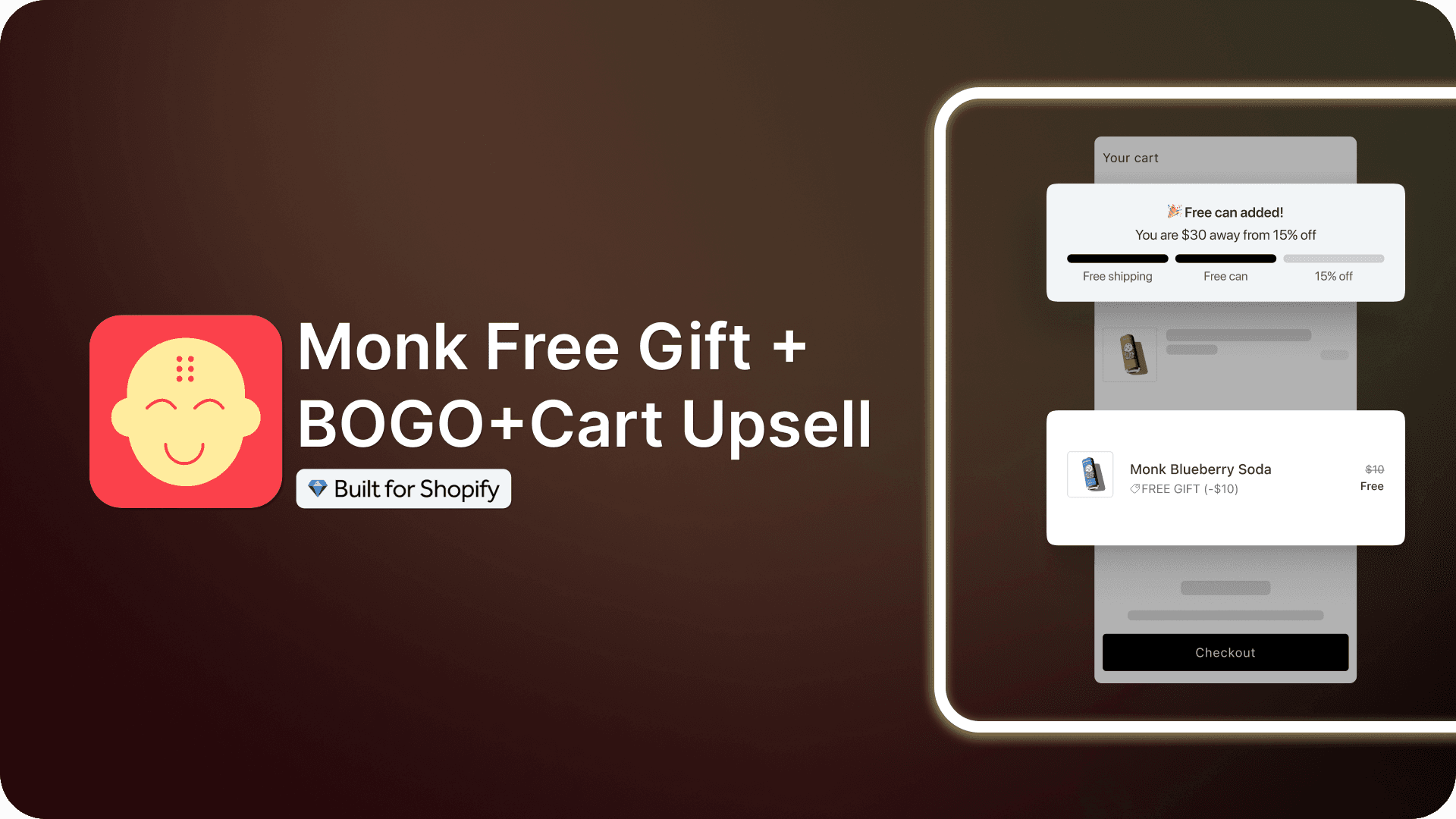
Shopify’s native discounts cover automatic discounts, Buy X Get Y, and free shipping, but they can’t add gifts to the cart automatically, run tiered rewards in one offer, or show customers a banner or progress bar. Monk Free Gift + BOGO, more commonly known as Monk Free Gift, fills those gaps without code.

Monk Free Gift handles cart-based, product-based, quantity-based, location-based, and discount code rules. It can also target customer segments you create in Shopify, such as returning customers or VIPs, so a store can run hybrid rules like “returning customer + cart over $150 gets a free gift.” A brand can run a tiered cart reward, a Buy 2 Get 1 Free rule on one collection, and a free gift threshold at the same time, each aimed at a different customer scenario. Real-time behavior rules like exit intent or scroll depth need a separate tool.
BFCM 2026: Monk Free Gift for $1
Get your first month for just $1 after a 7-day free trial, with all features included. Regular pricing applies after that. Offer ends November 30, 2026.
Best Practices for Running Rule-Based Promotions
Keep these in mind when you start with rule-based promotions:
Start narrow before going broad: Test a single rule, like a free shipping threshold on one collection, before rolling out five overlapping promotions across the store. It’s easier to see what’s working with less noise.
Set clear priority logic when rules overlap: If a customer qualifies for both a 10% discount and a free gift, decide in advance which one applies or whether both should stack.
Watch margin, not just conversion rate: A promotion that lifts conversions by 5% but cuts margin by 15% isn’t a win. Track the net effect on profit.
Refresh offers regularly: A flash sale that runs every week stops feeling urgent and starts feeling like the regular price. Rotate triggers and timing so promotions keep their pull.
Final Thoughts
Rule-based promotions turn discounting from a guessing game into a system. Instead of hoping a flat sale works, a brand can build logic that responds to who’s shopping, what’s in their cart, and how they’re behaving, protecting margin while still giving customers a real reason to buy more.
Start with one or two rules, such as a free shipping threshold or a tiered cart reward, measure the margin impact, and expand from there. Monk Free Gift sets these up on Shopify in minutes.
FAQs
What are rule-based promotions in ecommerce?
Rule-based promotions are automated discount or reward systems built on if-this-then-that logic, where an offer only applies when specific conditions are met, such as a minimum cart value, a particular product, or a customer’s purchase history. Unlike a one-size-fits-all coupon, they target the right offer to the right shopper without manual work.
How do automated promotions work in Shopify?
On Shopify, automated promotions run through native automatic discounts or apps that check customer and cart data in real time against rules set by the store owner. When a customer’s cart, behavior, or profile matches a rule, the reward applies automatically, with no code to enter.
How do rule-based promotions increase sales?
They show relevant offers at moments that influence buying decisions, such as a free shipping nudge when a cart is just short of the threshold, or a tiered discount that encourages one more item. Because offers respond to real customer behavior, they convert hesitant shoppers better than a blanket sitewide discount.
Can Shopify stores have automated promotions?
Yes. Shopify’s native automatic discounts handle basic automated offers, such as Buy X Get Y and free shipping. For gifts added to the cart automatically, tiered rewards, and on-site banners, stores use apps like Monk Free Gift, which apply offers based on preset conditions with no manual work after setup.
Are rule-based promotions good for increasing AOV?
Yes. Tiered cart rewards and free shipping thresholds are among the most effective ways to raise average order value. Because the reward only applies once a spending target is reached, customers are nudged to spend more than they planned.
How do personalized promotions improve conversions?
Personalized promotions match the offer to the customer’s situation, so it feels relevant rather than random. That relevance reduces the hesitation that often leads to cart abandonment.
What features should a promotion engine have?
A strong promotion engine should support condition stacking (combining triggers like cart value and customer tag), real-time rule evaluation, multiple reward types such as discounts, BOGO, and free gifts in one system, priority controls for overlapping offers, and analytics to track which rules drive revenue.
Can AI improve ecommerce promotions on Shopify?
Yes. AI can analyze customer behavior to predict which offers are most likely to convert specific shoppers, and adjust trigger thresholds based on real performance data instead of fixed guesses. This makes promotions more accurate over time rather than relying on static rules.
Are rule-based promotions suitable for small Shopify stores?
Yes. They don’t need a large marketing team to manage, because once a rule is set up, it runs automatically. Small stores can start with one or two simple rules, such as a free shipping threshold or a BOGO offer, and expand as they see what drives results.
How do cart-based promotions work in Shopify?
Cart-based promotions monitor the total value, item count, or specific contents of a customer’s cart in real time and apply a reward automatically once a condition is met. For example, a rule might add a free gift once the cart total crosses $150, or unlock a discount when a customer adds a third item.
Rule-Based Promotions for Ecommerce: Complete Guide
Summary
Rule-based promotions apply offers only when specific conditions are met, such as cart value, products, customer type, location, or timing. This guide explains how triggers and actions work, compares 12 rule types with examples, and covers the features to look for in a promotion engine. It also covers how to run rule-based offers on Shopify without eroding margin.
Picture two stores selling the same product at the same price. One runs a flat 10% discount for everyone. The other shows first-time visitors a welcome offer, gives returning customers a free gift with purchase on Shopify once their cart crosses $100, and tells a shopper they’re $15 away from free shipping. The second store converts more shoppers and protects its margin.
That store is running rule-based promotions: offers that apply only when specific conditions are met. This guide covers how they work, the 12 rule types ecommerce stores use (from BOGO offers on Shopify to tiered cart rewards), what to look for in a promotion engine, and how to set up rule-based offers on your store.
What Are Rule-Based Promotions in Ecommerce?
Rule-based promotions are discount or reward logic built on “if this, then that” conditions. Instead of one blanket coupon code that everyone uses, the store sets rules: if a customer’s cart crosses $75, give them free shipping; if someone buys a moisturizer, offer a free sunscreen sample; if a shopper is buying for the first time, show a 10% welcome discount automatically.
The key difference from a generic discount is precision. A flat sale discounts everything for everyone, which cuts margins fast. A rule-based promotion only applies when specific conditions are met, so the store controls exactly who gets what, and why.
Why Ecommerce Brands Use Rule-Based Promotions
Margins are tight in ecommerce, and blanket discounts are one of the fastest ways to shrink them without growing the business. Rule-based promotions reverse that. A brand can protect margin on low-value orders while rewarding customers who spend more, buy more often, or need a nudge to convert.
There’s also personalization. A customer who has bought three times doesn’t need the same first-order discount as a new visitor, and an irrelevant offer isn’t persuasive. Rules let a store match the offer to the moment: urgency for someone hesitating at checkout, a loyalty reward for someone who has bought five times, a bundle suggestion for someone who just added a phone case to their cart.
Then there’s the operational side. Creating and managing dozens of coupon codes for different customer segments is hard to track. Once set, rules run on their own, checking conditions and applying offers automatically, 24/7, without a marketing team stepping in.
How Rule-Based Promotions Work
Every rule-based promotion has two parts: a trigger condition and a promotion action. The trigger is the “if,” the condition that must be true. The action is the “then,” what happens once that condition is met. The store owner combines the two to build a rule, and the system checks it in real time as customers browse and shop.
Trigger Conditions
Triggers decide whether a customer qualifies for an offer. Common triggers include:
Cart value and item quantity: Rewards based on spending over a set amount or adding a minimum number of items.
Product category: Specific products or entire collections, such as a discount only on the Winter Wear collection.
Customer behavior: Adding something to a wishlist, time spent browsing, customer tags, or being an email subscriber.
Purchase history: Order frequency, first-time buyer status, lifetime value, or loyalty tier.
Location or device: Language, region, currency, or country, so a shopper in one market sees a different offer than one in another.
A single rule can use one trigger or combine several for a tiered rewards featuring Cart progress bars. For example, “first-time buyer” AND “cart value over $100” is a valid combined trigger.
Promotion Actions
Once a trigger is met, the action decides what the customer gets. The most common actions are:
Percentage discounts: 15% off the order or a specific product.
Buy One Get One (BOGO): Buy a product and get the same or a different one free or discounted.
Free gifts: A bonus item added to the order for meeting a condition.
Free shipping: Waiving delivery charges once a cart hits a set value.
Upsell and cross-sell offers: Suggesting a higher-value version of a product or a complementary item.
Every promotion type below is built from this trigger-action pairing. The variety comes from how a brand combines them.
Types of Rule-Based Promotions Ecommerce Stores Can Use
Here are the 12 rule types:
Rule type | Trigger | Example | Best for |
|---|---|---|---|
Cart-based | Cart value, item count, or contents | Spend $150, get a free gift | Raising AOV |
Product-based | Specific product or collection | Buy shampoo, get conditioner free | Cross-sells, launches |
Quantity-based | Units of a product | Buy 2, get 1 free | Consumables |
Customer-based | Customer type, tag, or segment | Welcome offer for first-time buyers | Segmented offers |
Purchase history | Past orders | Discounted shaker after a protein purchase | Repeat purchases |
Behavior-based | Live session actions | Exit-intent discount | Saving hesitant sales |
Location-based | Country, region, currency | Sale in one market only | International stores |
Time-based | Date or time window | 6-hour flash sale | Urgency, seasonal campaigns |
Code-based | Code or link | WELCOME10 for 10% off | Influencer, email campaigns |
Reward-based | Qualifying purchase | Choose a free gift | Perceived value |
Shipping-based | Cart value or destination | Free delivery over $50 | Reducing abandonment |
Hybrid | Multiple conditions combined | Returning customer + cart over $150 gets a gift | Highly targeted offers |
Cart-Based Rules
These rules respond to what’s in the shopping cart: its total value, the number of items, or specific contents. A skincare brand might offer “Spend $100, get $15 off” or “Spend $150, get a free gift.” Tiered cart rewards go further: spend $75 and get 5% off, spend $150 and get 10% off. Some stores also trigger an offer when a cart contains a specific product, like adding a free trial-size serum whenever a customer buys a full-size moisturizer.
Product-Based Rules
Here, the trigger is tied to specific products or collections rather than the cart as a whole. The classic example is Buy X Get Y: buy a specific shampoo and get the matching conditioner free. A store might also unlock a reward for buying from a particular collection, discount a pre-set bundle, or trigger a free gift when a specific SKU lands in the cart.
Quantity-Based Rules
These rules care about how many units a customer buys, not what they’re worth. “Buy 2, get 1 free” and “Buy 3, get 20% off” are the most familiar versions. Tiered quantity offers go further: buy 2 for a small discount, buy 4 for a bigger one, buy 6 for the best deal. This works especially well for consumables like coffee pods, candles, or skincare that people repurchase anyway.
Customer-Based Rules
Customer-based rules treat shoppers differently depending on who they are. A first-time visitor might see a welcome discount they’d never get again. A returning customer might unlock a thank-you offer. VIP or high-spend customers can get rewards regular shoppers don’t see, and tag-based promotions let a brand target a specific group, such as everyone tagged “newsletter subscriber.” Logged-in shoppers can also see different offers than guests.
Purchase History-Based Rules
These rules look at what a customer has already bought. If someone bought protein powder a month ago, the store can suggest a related shaker bottle at a discount. Repeat-purchase discounts reward loyalty directly, like a better price on the same product the third time. Subscription upsells work well right after a first purchase, when interest is highest, and win-back offers give lapsed customers an incentive to return.
Behavior-Based Rules (Real-Time)
Behavior-based rules react to what a shopper is doing in the current session. Viewing a product three times without buying can trigger a discount pop-up. Add-to-cart triggers can launch a cross-sell the moment an item lands in the cart. Exit-intent offers appear when the cursor moves to close the tab, often the last chance to save a sale. Time-on-site and scroll-depth triggers fire offers once a visitor shows real interest, rather than showing a discount to someone who just landed.
Location-Based Rules
Geography changes what a promotion should look like. Country-specific discounts let a brand run a sale in one market without affecting global pricing. Region-based offers account for local purchasing power, and currency-based promotions adjust an offer’s value depending on whether a customer pays in USD, EUR, or another currency.
Time-Based Rules
These rules are triggered by timing alone. Flash sales create urgency around a short, fixed window, such as 6 hours. Happy-hour discounts apply during specific hours of the day, which helps drive traffic during slow periods. Seasonal campaigns tie offers to events like holiday sales or end-of-season clearance, and countdown offers pair a visible timer with the discount to push hesitant shoppers to checkout.
Coupon / Code-Based Rules
Sometimes the trigger is simply entering a code or clicking a specific link. “Enter WELCOME10 for 10% off” is the most familiar form. URL-based promotions apply a discount automatically when a customer arrives through a specific link, often used in influencer or affiliate campaigns. Hidden or gated offers only appear to customers who know where to look, which rewards a specific community or email list without showing the discount publicly.
Reward-Based Rules
Reward-based rules focus on incentives rather than straight discounts. A free gift with purchase is the most common form, and gift selection lets customers choose their reward from a set of options. Loyalty rewards build up over repeat purchases, and cashback or store credit gives customers a reason to come back and spend again rather than saving money once.
Shipping-Based Rules
Extra costs like shipping, taxes, and fees are the leading reason shoppers abandon checkout, according to Baymard Institute’s research, so rules built around delivery carry outsized impact. A free shipping threshold (“free delivery over $50”) is the most widely used version, and one of the easiest ways to lift average order value, since shoppers often add one more item to cross the line.
Expedited shipping offers can reward high-value customers with faster delivery, and region-specific shipping discounts adjust delivery pricing based on where the order is going.
Hybrid / Advanced Rules
Hybrid rules combine multiple conditions into one offer. A returning customer with a cart over $150 might unlock a free gift that a first-time buyer with the same cart wouldn’t see. A shopper buying from a specific collection in the US might get a different discount than someone buying the same item from outside the US. A customer who viewed a product earlier and then added it to their cart might see an upsell they wouldn’t otherwise get. Hybrid rules let a brand layer behavior, history, location, and cart value into a single targeted offer.
Benefits of Rule-Based Promotion Engines
The clearest benefit of rule-based promotions is margin protection. Instead of discounting every order, a brand spends its promotional budget only on the customers and carts that need a nudge to convert or upgrade. Other benefits include:
Higher average order value: Tiered offers and free shipping thresholds give shoppers a reason to add one more item, and that small nudge adds up across thousands of orders.
No manual work: Once a rule is set, no one needs to check carts or apply discounts. The system handles it instantly and consistently.
Personalization at scale: A store with ten thousand monthly visitors can’t decide what each person should see, but a rules engine can show each one a relevant offer automatically.
Less abuse than open coupon codes: A code shared on a coupon site can drain margin from people it was never meant for. Rules tied to real customer or cart conditions close that gap, because the offer only applies when the condition is met.
Key Features to Keep in Mind
Look for these features:
Condition stacking: Combine multiple triggers (cart value + customer tag + location) into one rule instead of running them as separate, conflicting promotions.
Real-time evaluation: Rules check conditions instantly as the customer shops, not with a delay or after checkout.
Flexible reward types: Discounts, BOGO, free gifts, free shipping, and upsells in one system, instead of a separate app for each.
Priority and exclusivity controls: Decide which rule wins when a customer qualifies for more than one offer, so discounts don’t stack unintentionally.
Analytics and reporting: See which rules drive conversions and revenue, so underperforming offers can be retired quickly.
Easy rule management: Create, pause, or edit rules without a developer.
Why Use Monk Free Gift + BOGO to Create Rule-Based Promotions in Shopify
Shopify’s native discounts cover automatic discounts, Buy X Get Y, and free shipping, but they can’t add gifts to the cart automatically, run tiered rewards in one offer, or show customers a banner or progress bar. Monk Free Gift + BOGO, more commonly known as Monk Free Gift, fills those gaps without code.
Monk Free Gift handles cart-based, product-based, quantity-based, location-based, and discount code rules. It can also target customer segments you create in Shopify, such as returning customers or VIPs, so a store can run hybrid rules like “returning customer + cart over $150 gets a free gift.” A brand can run a tiered cart reward, a Buy 2 Get 1 Free rule on one collection, and a free gift threshold at the same time, each aimed at a different customer scenario. Real-time behavior rules like exit intent or scroll depth need a separate tool.
BFCM 2026: Monk Free Gift for $1
Get your first month for just $1 after a 7-day free trial, with all features included. Regular pricing applies after that. Offer ends November 30, 2026.
Best Practices for Running Rule-Based Promotions
Keep these in mind when you start with rule-based promotions:
Start narrow before going broad: Test a single rule, like a free shipping threshold on one collection, before rolling out five overlapping promotions across the store. It’s easier to see what’s working with less noise.
Set clear priority logic when rules overlap: If a customer qualifies for both a 10% discount and a free gift, decide in advance which one applies or whether both should stack.
Watch margin, not just conversion rate: A promotion that lifts conversions by 5% but cuts margin by 15% isn’t a win. Track the net effect on profit.
Refresh offers regularly: A flash sale that runs every week stops feeling urgent and starts feeling like the regular price. Rotate triggers and timing so promotions keep their pull.
Final Thoughts
Rule-based promotions turn discounting from a guessing game into a system. Instead of hoping a flat sale works, a brand can build logic that responds to who’s shopping, what’s in their cart, and how they’re behaving, protecting margin while still giving customers a real reason to buy more.
Start with one or two rules, such as a free shipping threshold or a tiered cart reward, measure the margin impact, and expand from there. Monk Free Gift sets these up on Shopify in minutes.
FAQs
What are rule-based promotions in ecommerce?
Rule-based promotions are automated discount or reward systems built on if-this-then-that logic, where an offer only applies when specific conditions are met, such as a minimum cart value, a particular product, or a customer’s purchase history. Unlike a one-size-fits-all coupon, they target the right offer to the right shopper without manual work.
How do automated promotions work in Shopify?
On Shopify, automated promotions run through native automatic discounts or apps that check customer and cart data in real time against rules set by the store owner. When a customer’s cart, behavior, or profile matches a rule, the reward applies automatically, with no code to enter.
How do rule-based promotions increase sales?
They show relevant offers at moments that influence buying decisions, such as a free shipping nudge when a cart is just short of the threshold, or a tiered discount that encourages one more item. Because offers respond to real customer behavior, they convert hesitant shoppers better than a blanket sitewide discount.
Can Shopify stores have automated promotions?
Yes. Shopify’s native automatic discounts handle basic automated offers, such as Buy X Get Y and free shipping. For gifts added to the cart automatically, tiered rewards, and on-site banners, stores use apps like Monk Free Gift, which apply offers based on preset conditions with no manual work after setup.
Are rule-based promotions good for increasing AOV?
Yes. Tiered cart rewards and free shipping thresholds are among the most effective ways to raise average order value. Because the reward only applies once a spending target is reached, customers are nudged to spend more than they planned.
How do personalized promotions improve conversions?
Personalized promotions match the offer to the customer’s situation, so it feels relevant rather than random. That relevance reduces the hesitation that often leads to cart abandonment.
What features should a promotion engine have?
A strong promotion engine should support condition stacking (combining triggers like cart value and customer tag), real-time rule evaluation, multiple reward types such as discounts, BOGO, and free gifts in one system, priority controls for overlapping offers, and analytics to track which rules drive revenue.
Can AI improve ecommerce promotions on Shopify?
Yes. AI can analyze customer behavior to predict which offers are most likely to convert specific shoppers, and adjust trigger thresholds based on real performance data instead of fixed guesses. This makes promotions more accurate over time rather than relying on static rules.
Are rule-based promotions suitable for small Shopify stores?
Yes. They don’t need a large marketing team to manage, because once a rule is set up, it runs automatically. Small stores can start with one or two simple rules, such as a free shipping threshold or a BOGO offer, and expand as they see what drives results.
How do cart-based promotions work in Shopify?
Cart-based promotions monitor the total value, item count, or specific contents of a customer’s cart in real time and apply a reward automatically once a condition is met. For example, a rule might add a free gift once the cart total crosses $150, or unlock a discount when a customer adds a third item.
Contents
Related Articles
Tiered Rewards Strategy to Boost Ecommerce Loyalty
How to Set Up Shopify Free Gift With Purchase Based On Cart Value?
How to Create a “Buy X Products And Get The Cheapest Item For Free” Promotion on Shopify
Get Monk Free Gift app for just $1/month this Black Friday
First month: $1 after your 7-day free trial. All features included. Offer live!
Claim offer now

Get Monk Free Gift app for just $1/month this Black Friday
First month: $1 after your 7-day free trial. All features included. Offer live!
Claim offer now
Get Monk Free Gift app for just $1/month this Black Friday
First month: $1 after your 7-day free trial. All features included. Offer live!
Claim offer now