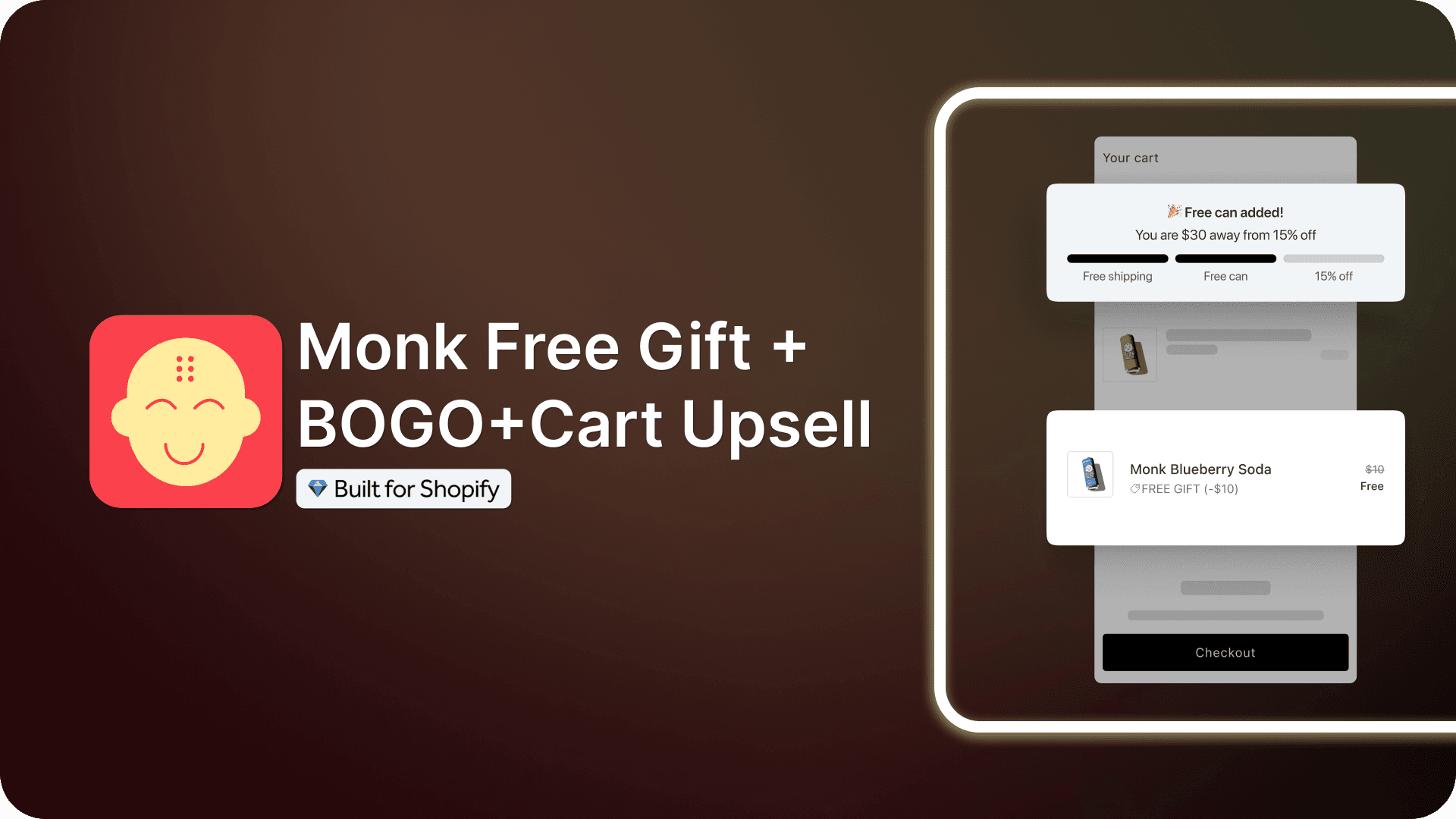
Upsell vs Cross-Sell in Shopify: Key Differences, Examples & Strategies
Summary
Upselling and cross-selling are core ecommerce strategies to raise average order value. Upselling encourages customers to choose a higher-value version of the same product, such as larger sizes or premium tiers. Cross-selling suggests complementary products that enhance the purchase, like accessories or related items. Both work because customers are already in a buying mindset. Upsells fit best on product pages, carts, and checkout while cross-sells work on product pages, carts, post-purchase, and email. Together they increase revenue, improve experience, and reduce acquisition pressure by using existing traffic. Success depends on relevance, timing, and product fit in Shopify stores.

Ravish (RV)
Senior Content Writer
Ravish is an ecommerce and SaaS marketing expert with 6+ years of experience in Shopify and ecommerce and 10+ years of experience in marketing, and growth strategy. He has worked closely with Shopify merchants to solve real ecommerce challenges and shares practical, research-backed insights, industry best practices, and emerging trends.
Key Takeaways
Upselling and cross-selling are core ecommerce strategies to raise average order value. Upselling encourages customers to choose a higher-value version of the same product, such as larger sizes or premium tiers. Cross-selling suggests complementary products that enhance the purchase, like accessories or related items. Both work because customers are already in a buying mindset. Upsells fit best on product pages, carts, and checkout while cross-sells work on product pages, carts, post-purchase, and email. Together they increase revenue, improve experience, and reduce acquisition pressure by using existing traffic. Success depends on relevance, timing, and product fit in Shopify stores.
Acquiring a new customer is expensive. Convincing the one already on your site to spend a little more? That is one of the most cost-effective moves in ecommerce.
Cross-sells and upsells are two of the most effective tools for doing exactly that including gifting, discounting and buy one get one offers.
While both strategies serve the same end goal, they work very differently. An upsell nudges a customer toward a better, higher-priced version of what they are already considering. A cross-sell brings in a product that pairs naturally with what is already in their cart.
So which one should you be using and when? Let us break down how each strategy works, where it fits, and how to use both to meaningfully increase your average order value.
What is Upselling in Shopify?
Upselling is the practice of encouraging a customer to purchase a higher-value version of the product they are already considering. This could be a premium edition, a larger pack, an upgraded plan, or a bundle that gives them more for a slightly higher price. Upselling is essentially nudging the customer to buy better.
Think of it like a barista asking if you want to upsize your coffee. You walked in wanting a medium, but for fifty cents more, you can get a large. You were already buying, now you are just buying more of the same thing. That is upselling in its simplest form, and it works just as naturally in ecommerce as it does behind a coffee counter.
Why Upselling Works
The reason upselling is so effective comes down to timing. The customer is already in a buying mindset, so the hardest part of the sale is done. Presenting a better option at that moment, framed around value rather than price, does the job.
You are not selling to a new person. You are simply helping the one already in front of you make a better decision, and that is a much easier conversation to have.
What is Cross-Selling in Shopify?
Cross-selling is the practice of suggesting complementary products to a customer based on what they are already buying. Unlike upselling, which steers a customer toward a better version of the same product, cross-selling expands the basket by adding something else. This could be an accessory, a related item, or a bundle that completes the original purchase.
If upselling is the barista asking if you want to upsize your coffee, cross-selling is them asking if you would like a pastry to go with it. You were not thinking about a pastry when you walked in. But now that it is sitting right there next to your coffee order, it makes perfect sense.
Why Cross-Selling Works
Cross-selling works because it meets customers at the point of highest intent and makes their purchase feel more complete. A customer who just added a phone to their cart is already thinking about using it. Showing them a case and a screen protector at that moment is not an interruption; it is a helpful nudge.
That relevance is what makes cross-selling feel natural rather than pushy, and it is what consistently drives customers to add more to their cart without needing to be convinced. More items per order means a higher average order value.
Why Upsell and Cross-Sell Matter for Shopify Stores
Upsells and cross-sells can significantly boost sales for a Shopify store. In fact, upselling and cross-selling increase total revenue by 10–30%. Here is how these strategies directly benefit Shopify stores:
Increase revenue without increasing ad spend
Every sale you close through upselling or cross-selling costs you nothing extra in acquisition. The customer is already there, already buying. These strategies simply make the most of the traffic you have already paid to bring in, which matters enormously for Shopify brands where ad costs are high.
Directly raise average order value
A higher average order value means more revenue from the same number of transactions. For Shopify stores operating on tight margins, moving a customer from a $40 order to a $60 order through a well-placed upsell or cross-sell can be the difference between a profitable month and a break-even one.
Improve the customer experience
A relevant upsell or cross-sell does not feel like a sales tactic, but good service. Suggesting a complementary product or a better version of something a customer is already buying adds genuine value to their purchase. Customers leave feeling like the brand understood what they needed, not like they were sold to.
Reduce the pressure of customer acquisition
Acquiring new customers is expensive and increasingly competitive. Upsells and cross-sells shift some of the revenue burden onto your existing customer base, where conversion is easier, trust is already established, and the cost of making the sale is a fraction of what it takes to win a new one.
Provide better data on customer preferences
Every upsell accepted and every cross-sell clicked, tells you something about what your customers value and how they shop. That data feeds into your product strategy, bundling decisions, and marketing. This gives you a clearer picture of what to promote, what to pair, and where the real purchase intent lives in your catalog.
Upsell vs. Cross-Sell: When To Choose Which
Both strategies increase revenue, but they do it differently, and using the wrong one at the wrong moment can put off the customer. Here is a quick breakdown of how they compare before getting into when to use each one.
Factor | Upselling | Cross-Selling |
Goal | Increase the value of the single item being purchased | Increase the number of items in the order |
Strategy | Upgrade the customer to a better or higher-priced version | Suggest complementary or related products |
Example | A customer buying a 250ml serum is offered the 500ml version | A customer buying a serum is offered a matching moisturiser |
Impact | Higher spending on one product | More products added to the cart |
Customer Mindset | Already decided on the product, open to getting more value | Already buying, open to completing the experience |
When to Use Upselling
When a customer is still on the product page: This is the moment they are actively evaluating their options. Showing a premium version or a larger pack while they are still deciding makes the upgrade feel like a natural part of the decision.
When there is a value gap between versions: Upselling works best when the higher-priced option offers a clear, tangible benefit. This could take the form of more product at a better per-unit price, a longer warranty, or features that the standard version does not offer. If the difference is not obvious, the upgrade will not land.
When your product has natural size or tier variations: Supplements, skincare, software plans, and subscription products are all well-suited to upselling because the upgrade path is intuitive. A customer buying a starter plan already understands the concept of a premium tier.
When average order value is your primary lever: If your catalog is focused and cross-sell options are limited, upselling is the more reliable way to move the revenue needle on each transaction.
When to Use Cross-Selling
When a customer has already committed to a purchase: The cart page is prime cross-sell territory. The decision has been made, so now is the time to show them which pairs go well with what they are already buying. A customer adding a fitness tracker to their cart is a natural candidate to be shown a replacement strap or a carrying case.
When your catalog has strong product relationships: Cross-selling works best when the suggested product genuinely complements the original. A coffee brand cross-selling a reusable cup makes sense. A coffee brand cross-selling a phone case does not.
When you want to introduce customers to more of your range: Cross-sells are one of the most effective ways to expand a customer's relationship with your brand beyond the one product they came for. Done well, they turn a single-product buyer into someone who shops across your catalog.
When post-purchase engagement is part of your strategy, a follow-up email suggesting complementary products a few days after delivery is one of the highest-converting cross-sell placements. The customer has received their order, they are engaged with the product, and their next purchase decision is already forming.
Best Placement for Upsell & Cross-Sell in Shopify Funnel
Knowing what to offer is only half the equation. Where you place the offer in the customer journey determines whether it feels helpful or intrusive and ultimately whether it converts. Let's look at some of the best placements for both these strategies:
Upsell Placements
Product Page
The product page is where a customer is still forming their decision. They have not committed yet, which makes it the ideal moment to introduce a better option. At this stage, an upsell feels like useful information arriving at exactly the right time.
Cart Page
By the time a customer reaches the cart, the purchase decision is effectively made. That commitment is what makes this placement so valuable for upselling. Showing an upgrade at this point, framed around value rather than price, lands far more naturally than it would earlier in the journey.
Checkout
Checkout is the highest-intent moment in the entire funnel. The customer has their payment details ready, and their mind is made up. A well-placed one-click upsell here (an extended warranty, a subscription upgrade, or a priority service add-on) requires almost no additional decision-making effort, which is exactly why conversion rates at this stage tend to be strong.
Cross-Sell Placements
Product Page
On the product page, the customer is still in exploration mode. This makes it the right moment to surface complementary products through "frequently bought together" or "you might also like" recommendations. The customer has not yet narrowed their focus to just getting through checkout, so they are far more receptive to additional suggestions at this stage than they will be later.
Cart Page
The cart page sits at a natural pause in the journey where the customer has chosen their product and is about to commit. That brief moment of review is a prime opportunity to present one well-chosen complementary product. The key is relevance, simplicity, and limited choices.
Post-Purchase
The post-purchase page is underused by most Shopify brands, which makes it an opportunity. The customer has just completed a transaction and is pleased with it. At this point, their guard is down, and their attention is high.
Showing them a complementary product at this exact moment, with a frictionless add-on option, capitalises on a window of buying momentum that closes quickly once they leave the page.
Email Follow-Up
Unlike on-site placements, email cross-sells have the advantage of timing. A follow-up sent a few days after delivery catches the customer when they are actively using the product and are most likely to recognise what pairs well with it.
This placement turns a completed order into a conversation, and when done well, it becomes the starting point for the next purchase.
Real Shopify Examples of Upselling vs. Cross-Selling
The best way to understand how these strategies work in practice is to see how real Shopify brands are using them. Here are some examples of each:
Upselling Examples
1. Sephora
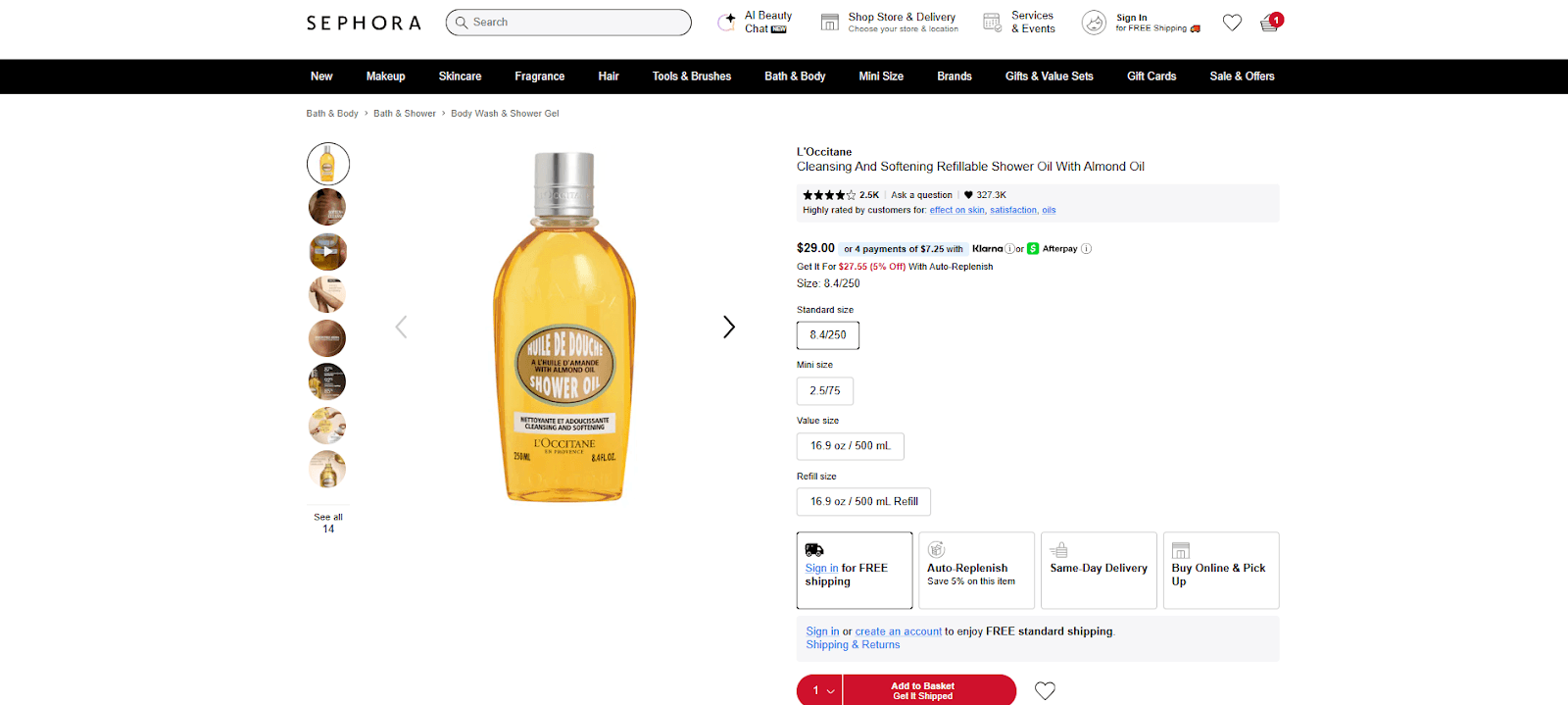
Sephora offers customers a range of upselling options when purchasing a cleansing shower oil. They offer small, standard, value, and refill sizes, so a customer buying a small or regular size can look up the value pack and reconsider.
2. Huel
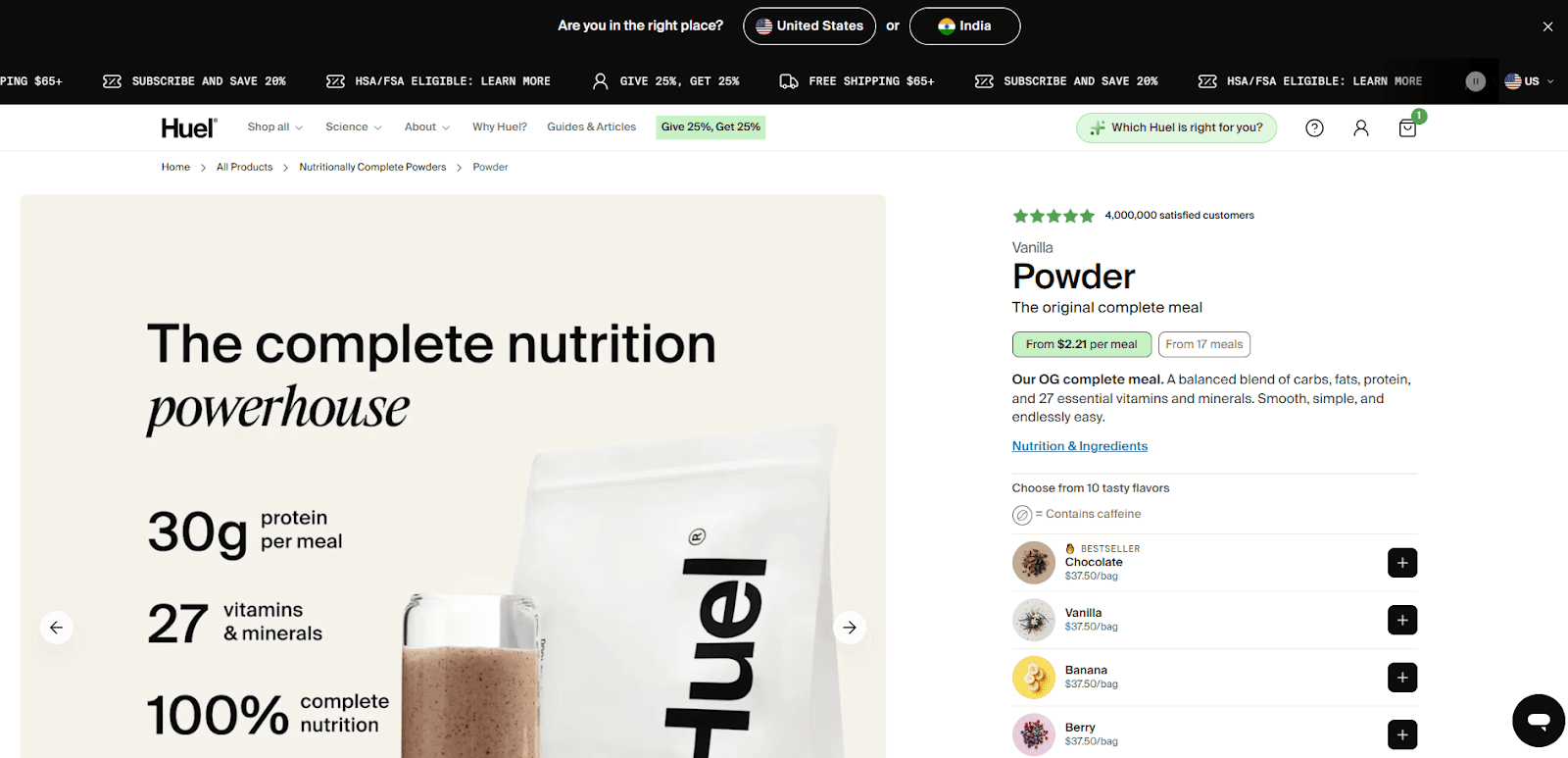
When buying a protein powder pack, Huel offers customers the option to upgrade and get the powder for 17 meals at once. This is soft-launched just next to the one-meal option, so customers notice and most likely add it because of the better value.
Cross-Sell Examples
1. Dollar Shave Club
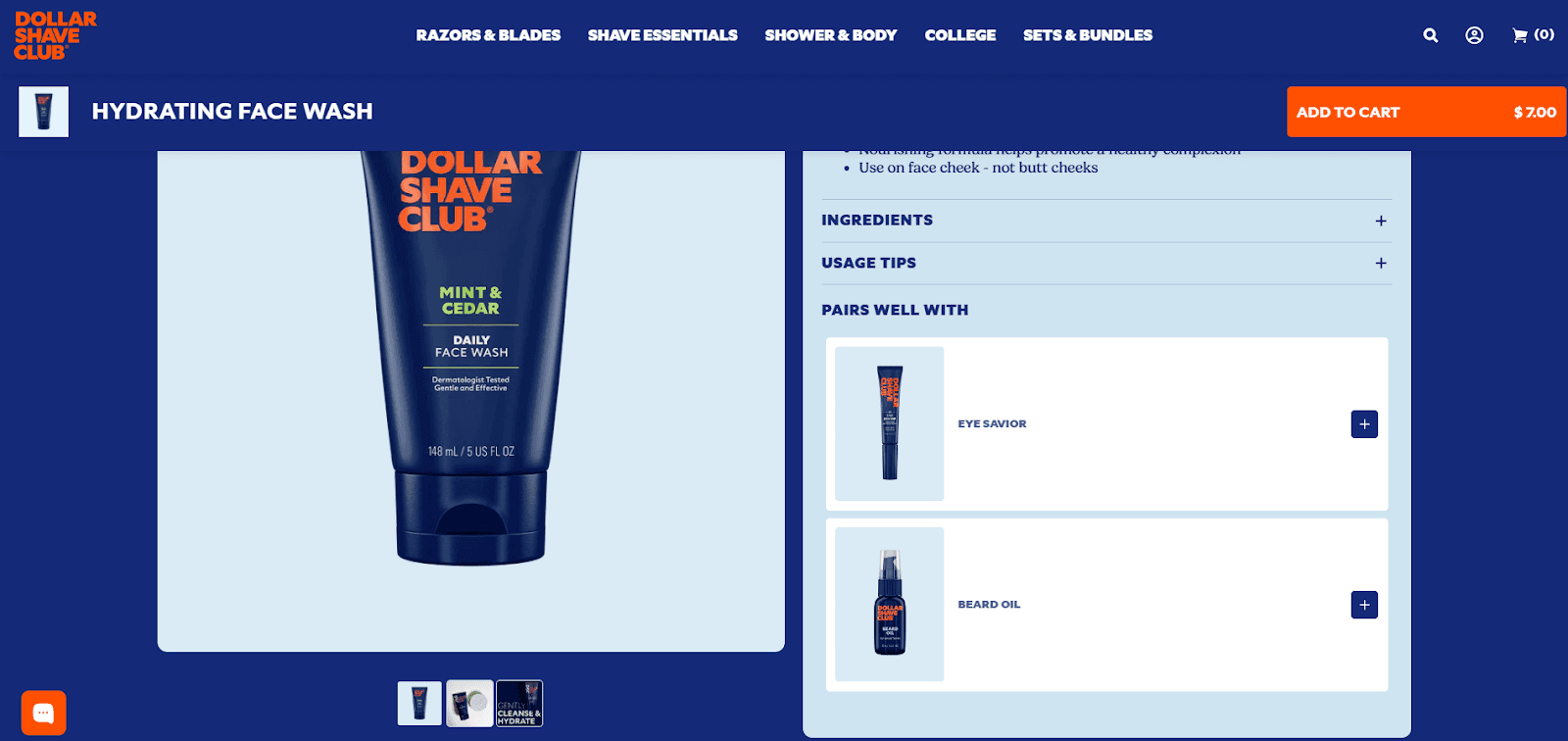
Dollar Shave Club keeps its cross-sell simple but effective. On the face wash product page, a section titled "Pairs Well With" sits naturally below the product details, surfacing the Eye Saviour and Beard Oil as companion products.
2. Pela
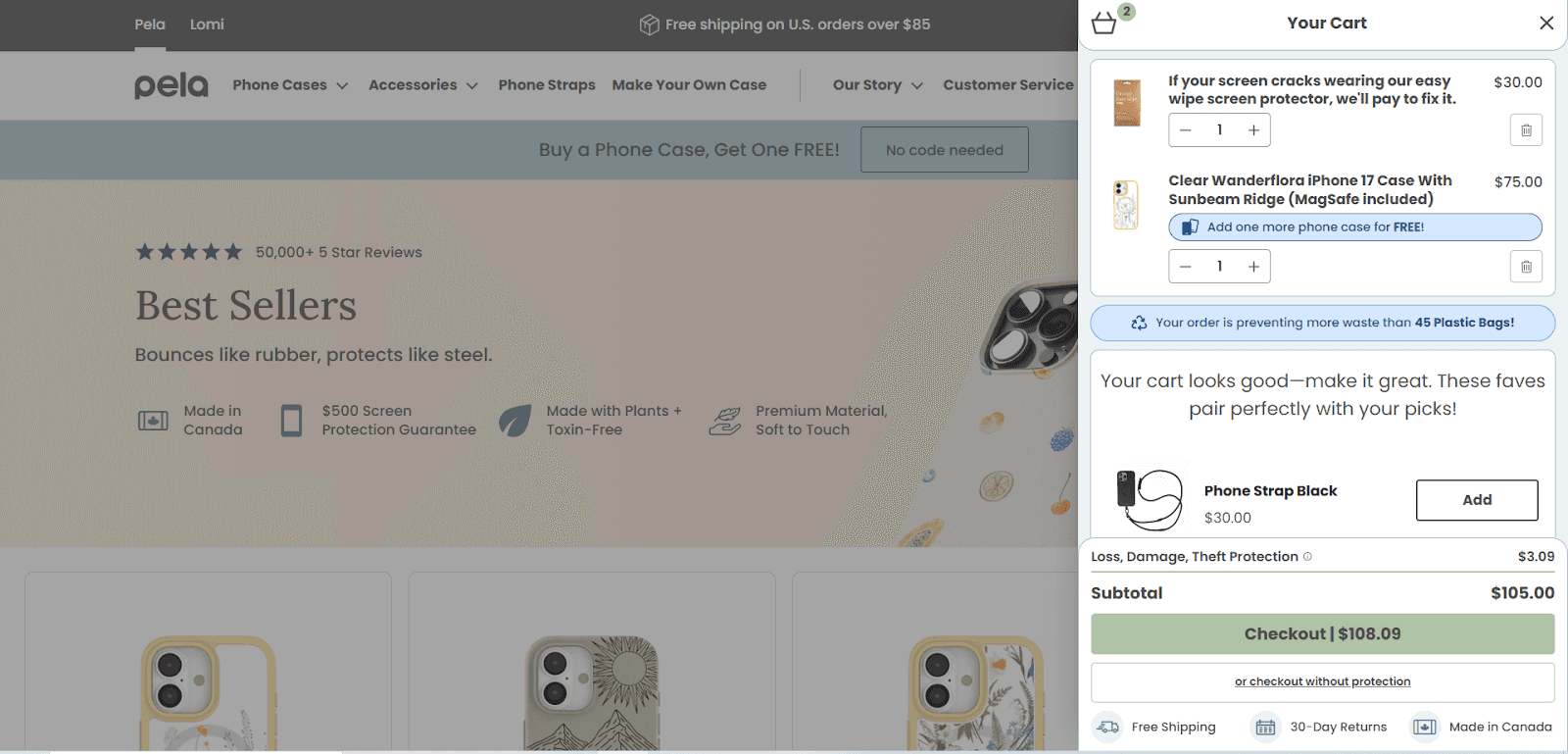
Pela, a phone cover brand on Shopify, presents cross-sell options to its customers at the cart page. When buying a phone case, you can add a phone strap at the last minute. This suggestion is highly relevant for someone purchasing a cover, does not feel intrusive, and has a good chance of landing in the customer's cart.
How to Implement Upsell & Cross-Sell in Shopify
Now that we know all about upsell and cross-sell, the next imperative question is the technical aspect of adding these options to your Shopify store.
There are two ways to build upsell and cross-sell into your Shopify store: manually through Shopify's native features, or through a dedicated app. Here is what each can actually do:
Manual Methods
Shopify's built-in features give you a starting point, but not much beyond that. Here are some of its features:
Assign related products to listings using the "frequently bought together" or "related products" functionality built into most Shopify themes
Create product variants such as different sizes, tiers, or bundles on a single product page to encourage customers toward a higher-value option
Structure pricing and descriptions manually to make an upgrade feel like the smarter choice
It works at a small scale with a tight catalog. Beyond that, it becomes difficult to manage, inconsistent across listings, and limited to the product page only.
Third-party apps like Monk Free Gift + BOGO
A dedicated app removes the ceiling that manual methods hit quickly. It helps:
Place upsells and cross-sells at every stage of the funnel (product page, cart, checkout, and post-purchase), not just on the product listing
Set rules that automatically trigger the right offer based on cart contents, order value, or the specific product being viewed
Add cart progress bars that show customers how close they are to a free shipping threshold or a gift, naturally encouraging them to add more
Target specific customer segments with relevant offers rather than showing the same recommendation to everyone
Track which placements and offers are actually converting and what they are contributing to the average order value
The manual route is fine for getting started. But for brands that want upsells and cross-sells working across the full funnel with targeting, automation, and real performance data, an app is the only practical way to get there.
Common Mistakes to Avoid And How to Fix Them
While creating upsell and cross-sell options, it is essential to keep a few things in mind, or the effort gets wasted. Here are some common mistakes to avoid, along with ways to optimize your efforts:
1. Showing too many options at once
Presenting three or four upsell and cross-sell offers simultaneously overwhelms the customer and kills the decision entirely. Too much choice leads to no choice.
Solution: Stick to one strong, well-timed offer per placement. A single relevant recommendation will always outperform a cluttered carousel of suggestions.
2. Recommending products with no logical connection
A customer buying a coffee grinder does not need to be shown a phone case. Irrelevant suggestions break trust and make the brand look like it does not understand its own customers.
Solution: Build offers around genuine product relationships, such as what the customer is buying, what complements it, and what a logical upgrade looks like. Relevance is what makes an offer feel helpful rather than opportunistic.
3. Pitching a price jump that is too steep
An upsell that doubles the order value asks for too much too fast. Customers are hesitant of large price gaps, and the offer ends up converting nobody.
Solution: Keep upsells within a reasonable price range of the original product, typically no more than 25 to 40 percent above what the customer is already spending. The upgrade should feel like a small step, not a leap.
4. Ignoring mobile experience
An upsell widget that works cleanly on desktop but clutters the screen on mobile will frustrate customers and hurt conversion. Most Shopify traffic is mobile-first.
Solution: Test every placement on mobile before going live. Offers should load cleanly, display clearly, and require minimal taps to act on.
Why Monk is Ideal for Upsell & Cross-Sell on Shopify
Most Shopify brands run out of native features pretty quickly.
Monk Free Gift + BOGO is built specifically to push past that limitation, giving you full control over upsell and cross-sell offers across every stage of the funnel without touching a single line of code.
Here are some of the top features of Monk Free Gift + BOGO that stand out:
Full funnel placement flexibility: Monk Free Gift lets you place cross-sell and upsell offers on the product page, cart page, checkout, and post-purchase, covering every meaningful touchpoint in the customer journey. Checkout placements are available exclusively for Shopify Plus stores, but for every other stage, setup is straightforward and works seamlessly across all theme types, including cart drawers, cart popups, and cart pages.
AI-powered product recommendations: Rather than manually assigning cross-sell products to every listing, Monk Free Gift uses Shopify's AI algorithm to automatically recommend products based on your store's bestsellers and previous customer purchases. For stores processing over 10,000 orders a month, this means your recommendations get smarter over time without any manual intervention.
Granular targeting and eligibility rules: Offers can be configured based on specific eligibility criteria triggered by items in the cart, cart value, the product being viewed, or a combination of factors. You can also schedule offers for specific date ranges, making it easy to align upsell and cross-sell activity with promotions or seasonal campaigns.
Flexible discount controls: Monk Free Gift + BOGO gives you precise control over how discounts are applied within offers, whether as a percentage or flat amount, on the original price or compare-at price, and on limited quantities if needed. Pricing can also be displayed as rounded up or down, keeping the numbers clean and the offer visually sharp.
Customisable display and design: Every widget is fully customisable, including fonts, colors, spacing, layout, and text across both desktop and mobile independently. Multiple layout options are available for each placement, and if your mobile experience needs a different treatment than desktop, it handles that without any additional development work.
Smart display logic: The app lets you control whether a cross-sell product disappears from the widget once a customer adds it to their cart, whether variant pickers are shown, and whether clicking on a product redirects to the product page or adds it directly to the cart. These small configuration details are what make the difference between an offer that feels polished and one that feels like an afterthought.
For Shopify brands aspiring to use upsells and cross-sells to move average order value, Monk Free Gift + BOGO removes the limitations of the manual route and replaces them with a flexible, data-driven setup that works across the full customer journey.
Conclusion
Upselling and cross-selling are not competing strategies; they are complementary ones. Used together, they cover every angle of increasing order value without spending an extra dollar on acquisition.
The brands that get the most out of both understand their products well enough to know what makes a logical upgrade and what pairs naturally together, and they place those offers where customers are most receptive to them.
The other thing to keep in mind is consistency. What works today may not work six months from now as your catalog grows and customer behavior shifts. Keep monitoring your offer performance, test new placements, and adjust based on what the data tells you.
FAQs
Which is better for increasing AOV: upsell or cross-sell?
To increase the AOV of your Shopify store, both upsell and cross-sell work differently and are best used together. Upsells increase the value of a single item while cross-sells add more items to the order. If you have strong product relationships, lean into cross-sells. If your products have natural upgrade paths, upsells will do more work.
Where should I place upsell offers in Shopify?
The four most effective placements for upsell offers are the product page, the cart, the checkout page, and the post-purchase page. Using a third-party app like Monk lets you place cross-sells across various stages of your customer journey, analyze performance, and refine your strategy.
How do I create cross-sell bundles in Shopify?
You can create cross-sell bundles in Shopify by either using the naive features or a third-party application. Natively, Shopify lets you group products through the product listing or built-in theme functionality. For more control over how bundles are presented, priced, and triggered, an app like Monk Free Gift + BOGO lets you configure cross-sell bundles with custom eligibility rules, discount logic, and multi-placement support without any development work.
Can I use upsell and cross-sell together?
Yes, you can use upsell and cross-sell together. The best way is to deploy them at different placements so they do not compete for attention. An upsell on the product page paired with a cross-sell in the cart is one of the most effective combinations for consistently moving average order value.
What apps help with upselling and cross-selling in Shopify?
Monk Free Gift + BOGO covers the full funnel, including product page, cart, checkout, and post-purchase with targeting rules, AI recommendations, and design customisation. Other popular options include Zipify OneClickUpsell, ReConvert, and Frequently Bought Together.
Can I offer a discount on cross-sell or upsell products?
Yes, discounts can be applied as a percentage or a flat amount to the original or compare-at price, and may be limited to specific quantities. Note that discounts cannot be combined with the auto recommendation setting due to a Shopify platform limitation.
Is it possible to set up a post-purchase upsell or cross-sell?
Yes, you can send offers that customers can accept with a single click, without needing to re-enter payment details, making it one of the most frictionless and highest-converting placements in the funnel.
Can I set up cross-sells based on previous purchases or store bestsellers?
Yes, you can suggest products based on bestsellers and past purchase data. It works best for stores processing large orders, where the data set is large enough to generate accurate recommendations.
Upsell vs Cross-Sell in Shopify: Key Differences, Examples & Strategies
Summary
Upselling and cross-selling are core ecommerce strategies to raise average order value. Upselling encourages customers to choose a higher-value version of the same product, such as larger sizes or premium tiers. Cross-selling suggests complementary products that enhance the purchase, like accessories or related items. Both work because customers are already in a buying mindset. Upsells fit best on product pages, carts, and checkout while cross-sells work on product pages, carts, post-purchase, and email. Together they increase revenue, improve experience, and reduce acquisition pressure by using existing traffic. Success depends on relevance, timing, and product fit in Shopify stores.
Acquiring a new customer is expensive. Convincing the one already on your site to spend a little more? That is one of the most cost-effective moves in ecommerce.
Cross-sells and upsells are two of the most effective tools for doing exactly that including gifting, discounting and buy one get one offers.
While both strategies serve the same end goal, they work very differently. An upsell nudges a customer toward a better, higher-priced version of what they are already considering. A cross-sell brings in a product that pairs naturally with what is already in their cart.
So which one should you be using and when? Let us break down how each strategy works, where it fits, and how to use both to meaningfully increase your average order value.
What is Upselling in Shopify?
Upselling is the practice of encouraging a customer to purchase a higher-value version of the product they are already considering. This could be a premium edition, a larger pack, an upgraded plan, or a bundle that gives them more for a slightly higher price. Upselling is essentially nudging the customer to buy better.
Think of it like a barista asking if you want to upsize your coffee. You walked in wanting a medium, but for fifty cents more, you can get a large. You were already buying, now you are just buying more of the same thing. That is upselling in its simplest form, and it works just as naturally in ecommerce as it does behind a coffee counter.
Why Upselling Works
The reason upselling is so effective comes down to timing. The customer is already in a buying mindset, so the hardest part of the sale is done. Presenting a better option at that moment, framed around value rather than price, does the job.
You are not selling to a new person. You are simply helping the one already in front of you make a better decision, and that is a much easier conversation to have.
What is Cross-Selling in Shopify?
Cross-selling is the practice of suggesting complementary products to a customer based on what they are already buying. Unlike upselling, which steers a customer toward a better version of the same product, cross-selling expands the basket by adding something else. This could be an accessory, a related item, or a bundle that completes the original purchase.
If upselling is the barista asking if you want to upsize your coffee, cross-selling is them asking if you would like a pastry to go with it. You were not thinking about a pastry when you walked in. But now that it is sitting right there next to your coffee order, it makes perfect sense.
Why Cross-Selling Works
Cross-selling works because it meets customers at the point of highest intent and makes their purchase feel more complete. A customer who just added a phone to their cart is already thinking about using it. Showing them a case and a screen protector at that moment is not an interruption; it is a helpful nudge.
That relevance is what makes cross-selling feel natural rather than pushy, and it is what consistently drives customers to add more to their cart without needing to be convinced. More items per order means a higher average order value.
Why Upsell and Cross-Sell Matter for Shopify Stores
Upsells and cross-sells can significantly boost sales for a Shopify store. In fact, upselling and cross-selling increase total revenue by 10–30%. Here is how these strategies directly benefit Shopify stores:
Increase revenue without increasing ad spend
Every sale you close through upselling or cross-selling costs you nothing extra in acquisition. The customer is already there, already buying. These strategies simply make the most of the traffic you have already paid to bring in, which matters enormously for Shopify brands where ad costs are high.
Directly raise average order value
A higher average order value means more revenue from the same number of transactions. For Shopify stores operating on tight margins, moving a customer from a $40 order to a $60 order through a well-placed upsell or cross-sell can be the difference between a profitable month and a break-even one.
Improve the customer experience
A relevant upsell or cross-sell does not feel like a sales tactic, but good service. Suggesting a complementary product or a better version of something a customer is already buying adds genuine value to their purchase. Customers leave feeling like the brand understood what they needed, not like they were sold to.
Reduce the pressure of customer acquisition
Acquiring new customers is expensive and increasingly competitive. Upsells and cross-sells shift some of the revenue burden onto your existing customer base, where conversion is easier, trust is already established, and the cost of making the sale is a fraction of what it takes to win a new one.
Provide better data on customer preferences
Every upsell accepted and every cross-sell clicked, tells you something about what your customers value and how they shop. That data feeds into your product strategy, bundling decisions, and marketing. This gives you a clearer picture of what to promote, what to pair, and where the real purchase intent lives in your catalog.
Upsell vs. Cross-Sell: When To Choose Which
Both strategies increase revenue, but they do it differently, and using the wrong one at the wrong moment can put off the customer. Here is a quick breakdown of how they compare before getting into when to use each one.
Factor | Upselling | Cross-Selling |
Goal | Increase the value of the single item being purchased | Increase the number of items in the order |
Strategy | Upgrade the customer to a better or higher-priced version | Suggest complementary or related products |
Example | A customer buying a 250ml serum is offered the 500ml version | A customer buying a serum is offered a matching moisturiser |
Impact | Higher spending on one product | More products added to the cart |
Customer Mindset | Already decided on the product, open to getting more value | Already buying, open to completing the experience |
When to Use Upselling
When a customer is still on the product page: This is the moment they are actively evaluating their options. Showing a premium version or a larger pack while they are still deciding makes the upgrade feel like a natural part of the decision.
When there is a value gap between versions: Upselling works best when the higher-priced option offers a clear, tangible benefit. This could take the form of more product at a better per-unit price, a longer warranty, or features that the standard version does not offer. If the difference is not obvious, the upgrade will not land.
When your product has natural size or tier variations: Supplements, skincare, software plans, and subscription products are all well-suited to upselling because the upgrade path is intuitive. A customer buying a starter plan already understands the concept of a premium tier.
When average order value is your primary lever: If your catalog is focused and cross-sell options are limited, upselling is the more reliable way to move the revenue needle on each transaction.
When to Use Cross-Selling
When a customer has already committed to a purchase: The cart page is prime cross-sell territory. The decision has been made, so now is the time to show them which pairs go well with what they are already buying. A customer adding a fitness tracker to their cart is a natural candidate to be shown a replacement strap or a carrying case.
When your catalog has strong product relationships: Cross-selling works best when the suggested product genuinely complements the original. A coffee brand cross-selling a reusable cup makes sense. A coffee brand cross-selling a phone case does not.
When you want to introduce customers to more of your range: Cross-sells are one of the most effective ways to expand a customer's relationship with your brand beyond the one product they came for. Done well, they turn a single-product buyer into someone who shops across your catalog.
When post-purchase engagement is part of your strategy, a follow-up email suggesting complementary products a few days after delivery is one of the highest-converting cross-sell placements. The customer has received their order, they are engaged with the product, and their next purchase decision is already forming.
Best Placement for Upsell & Cross-Sell in Shopify Funnel
Knowing what to offer is only half the equation. Where you place the offer in the customer journey determines whether it feels helpful or intrusive and ultimately whether it converts. Let's look at some of the best placements for both these strategies:
Upsell Placements
Product Page
The product page is where a customer is still forming their decision. They have not committed yet, which makes it the ideal moment to introduce a better option. At this stage, an upsell feels like useful information arriving at exactly the right time.
Cart Page
By the time a customer reaches the cart, the purchase decision is effectively made. That commitment is what makes this placement so valuable for upselling. Showing an upgrade at this point, framed around value rather than price, lands far more naturally than it would earlier in the journey.
Checkout
Checkout is the highest-intent moment in the entire funnel. The customer has their payment details ready, and their mind is made up. A well-placed one-click upsell here (an extended warranty, a subscription upgrade, or a priority service add-on) requires almost no additional decision-making effort, which is exactly why conversion rates at this stage tend to be strong.
Cross-Sell Placements
Product Page
On the product page, the customer is still in exploration mode. This makes it the right moment to surface complementary products through "frequently bought together" or "you might also like" recommendations. The customer has not yet narrowed their focus to just getting through checkout, so they are far more receptive to additional suggestions at this stage than they will be later.
Cart Page
The cart page sits at a natural pause in the journey where the customer has chosen their product and is about to commit. That brief moment of review is a prime opportunity to present one well-chosen complementary product. The key is relevance, simplicity, and limited choices.
Post-Purchase
The post-purchase page is underused by most Shopify brands, which makes it an opportunity. The customer has just completed a transaction and is pleased with it. At this point, their guard is down, and their attention is high.
Showing them a complementary product at this exact moment, with a frictionless add-on option, capitalises on a window of buying momentum that closes quickly once they leave the page.
Email Follow-Up
Unlike on-site placements, email cross-sells have the advantage of timing. A follow-up sent a few days after delivery catches the customer when they are actively using the product and are most likely to recognise what pairs well with it.
This placement turns a completed order into a conversation, and when done well, it becomes the starting point for the next purchase.
Real Shopify Examples of Upselling vs. Cross-Selling
The best way to understand how these strategies work in practice is to see how real Shopify brands are using them. Here are some examples of each:
Upselling Examples
1. Sephora
Sephora offers customers a range of upselling options when purchasing a cleansing shower oil. They offer small, standard, value, and refill sizes, so a customer buying a small or regular size can look up the value pack and reconsider.
2. Huel
When buying a protein powder pack, Huel offers customers the option to upgrade and get the powder for 17 meals at once. This is soft-launched just next to the one-meal option, so customers notice and most likely add it because of the better value.
Cross-Sell Examples
1. Dollar Shave Club
Dollar Shave Club keeps its cross-sell simple but effective. On the face wash product page, a section titled "Pairs Well With" sits naturally below the product details, surfacing the Eye Saviour and Beard Oil as companion products.
2. Pela
Pela, a phone cover brand on Shopify, presents cross-sell options to its customers at the cart page. When buying a phone case, you can add a phone strap at the last minute. This suggestion is highly relevant for someone purchasing a cover, does not feel intrusive, and has a good chance of landing in the customer's cart.
How to Implement Upsell & Cross-Sell in Shopify
Now that we know all about upsell and cross-sell, the next imperative question is the technical aspect of adding these options to your Shopify store.
There are two ways to build upsell and cross-sell into your Shopify store: manually through Shopify's native features, or through a dedicated app. Here is what each can actually do:
Manual Methods
Shopify's built-in features give you a starting point, but not much beyond that. Here are some of its features:
Assign related products to listings using the "frequently bought together" or "related products" functionality built into most Shopify themes
Create product variants such as different sizes, tiers, or bundles on a single product page to encourage customers toward a higher-value option
Structure pricing and descriptions manually to make an upgrade feel like the smarter choice
It works at a small scale with a tight catalog. Beyond that, it becomes difficult to manage, inconsistent across listings, and limited to the product page only.
Third-party apps like Monk Free Gift + BOGO
A dedicated app removes the ceiling that manual methods hit quickly. It helps:
Place upsells and cross-sells at every stage of the funnel (product page, cart, checkout, and post-purchase), not just on the product listing
Set rules that automatically trigger the right offer based on cart contents, order value, or the specific product being viewed
Add cart progress bars that show customers how close they are to a free shipping threshold or a gift, naturally encouraging them to add more
Target specific customer segments with relevant offers rather than showing the same recommendation to everyone
Track which placements and offers are actually converting and what they are contributing to the average order value
The manual route is fine for getting started. But for brands that want upsells and cross-sells working across the full funnel with targeting, automation, and real performance data, an app is the only practical way to get there.
Common Mistakes to Avoid And How to Fix Them
While creating upsell and cross-sell options, it is essential to keep a few things in mind, or the effort gets wasted. Here are some common mistakes to avoid, along with ways to optimize your efforts:
1. Showing too many options at once
Presenting three or four upsell and cross-sell offers simultaneously overwhelms the customer and kills the decision entirely. Too much choice leads to no choice.
Solution: Stick to one strong, well-timed offer per placement. A single relevant recommendation will always outperform a cluttered carousel of suggestions.
2. Recommending products with no logical connection
A customer buying a coffee grinder does not need to be shown a phone case. Irrelevant suggestions break trust and make the brand look like it does not understand its own customers.
Solution: Build offers around genuine product relationships, such as what the customer is buying, what complements it, and what a logical upgrade looks like. Relevance is what makes an offer feel helpful rather than opportunistic.
3. Pitching a price jump that is too steep
An upsell that doubles the order value asks for too much too fast. Customers are hesitant of large price gaps, and the offer ends up converting nobody.
Solution: Keep upsells within a reasonable price range of the original product, typically no more than 25 to 40 percent above what the customer is already spending. The upgrade should feel like a small step, not a leap.
4. Ignoring mobile experience
An upsell widget that works cleanly on desktop but clutters the screen on mobile will frustrate customers and hurt conversion. Most Shopify traffic is mobile-first.
Solution: Test every placement on mobile before going live. Offers should load cleanly, display clearly, and require minimal taps to act on.
Why Monk is Ideal for Upsell & Cross-Sell on Shopify
Most Shopify brands run out of native features pretty quickly.
Monk Free Gift + BOGO is built specifically to push past that limitation, giving you full control over upsell and cross-sell offers across every stage of the funnel without touching a single line of code.
Here are some of the top features of Monk Free Gift + BOGO that stand out:
Full funnel placement flexibility: Monk Free Gift lets you place cross-sell and upsell offers on the product page, cart page, checkout, and post-purchase, covering every meaningful touchpoint in the customer journey. Checkout placements are available exclusively for Shopify Plus stores, but for every other stage, setup is straightforward and works seamlessly across all theme types, including cart drawers, cart popups, and cart pages.
AI-powered product recommendations: Rather than manually assigning cross-sell products to every listing, Monk Free Gift uses Shopify's AI algorithm to automatically recommend products based on your store's bestsellers and previous customer purchases. For stores processing over 10,000 orders a month, this means your recommendations get smarter over time without any manual intervention.
Granular targeting and eligibility rules: Offers can be configured based on specific eligibility criteria triggered by items in the cart, cart value, the product being viewed, or a combination of factors. You can also schedule offers for specific date ranges, making it easy to align upsell and cross-sell activity with promotions or seasonal campaigns.
Flexible discount controls: Monk Free Gift + BOGO gives you precise control over how discounts are applied within offers, whether as a percentage or flat amount, on the original price or compare-at price, and on limited quantities if needed. Pricing can also be displayed as rounded up or down, keeping the numbers clean and the offer visually sharp.
Customisable display and design: Every widget is fully customisable, including fonts, colors, spacing, layout, and text across both desktop and mobile independently. Multiple layout options are available for each placement, and if your mobile experience needs a different treatment than desktop, it handles that without any additional development work.
Smart display logic: The app lets you control whether a cross-sell product disappears from the widget once a customer adds it to their cart, whether variant pickers are shown, and whether clicking on a product redirects to the product page or adds it directly to the cart. These small configuration details are what make the difference between an offer that feels polished and one that feels like an afterthought.
For Shopify brands aspiring to use upsells and cross-sells to move average order value, Monk Free Gift + BOGO removes the limitations of the manual route and replaces them with a flexible, data-driven setup that works across the full customer journey.
Conclusion
Upselling and cross-selling are not competing strategies; they are complementary ones. Used together, they cover every angle of increasing order value without spending an extra dollar on acquisition.
The brands that get the most out of both understand their products well enough to know what makes a logical upgrade and what pairs naturally together, and they place those offers where customers are most receptive to them.
The other thing to keep in mind is consistency. What works today may not work six months from now as your catalog grows and customer behavior shifts. Keep monitoring your offer performance, test new placements, and adjust based on what the data tells you.
FAQs
Which is better for increasing AOV: upsell or cross-sell?
To increase the AOV of your Shopify store, both upsell and cross-sell work differently and are best used together. Upsells increase the value of a single item while cross-sells add more items to the order. If you have strong product relationships, lean into cross-sells. If your products have natural upgrade paths, upsells will do more work.
Where should I place upsell offers in Shopify?
The four most effective placements for upsell offers are the product page, the cart, the checkout page, and the post-purchase page. Using a third-party app like Monk lets you place cross-sells across various stages of your customer journey, analyze performance, and refine your strategy.
How do I create cross-sell bundles in Shopify?
You can create cross-sell bundles in Shopify by either using the naive features or a third-party application. Natively, Shopify lets you group products through the product listing or built-in theme functionality. For more control over how bundles are presented, priced, and triggered, an app like Monk Free Gift + BOGO lets you configure cross-sell bundles with custom eligibility rules, discount logic, and multi-placement support without any development work.
Can I use upsell and cross-sell together?
Yes, you can use upsell and cross-sell together. The best way is to deploy them at different placements so they do not compete for attention. An upsell on the product page paired with a cross-sell in the cart is one of the most effective combinations for consistently moving average order value.
What apps help with upselling and cross-selling in Shopify?
Monk Free Gift + BOGO covers the full funnel, including product page, cart, checkout, and post-purchase with targeting rules, AI recommendations, and design customisation. Other popular options include Zipify OneClickUpsell, ReConvert, and Frequently Bought Together.
Can I offer a discount on cross-sell or upsell products?
Yes, discounts can be applied as a percentage or a flat amount to the original or compare-at price, and may be limited to specific quantities. Note that discounts cannot be combined with the auto recommendation setting due to a Shopify platform limitation.
Is it possible to set up a post-purchase upsell or cross-sell?
Yes, you can send offers that customers can accept with a single click, without needing to re-enter payment details, making it one of the most frictionless and highest-converting placements in the funnel.
Can I set up cross-sells based on previous purchases or store bestsellers?
Yes, you can suggest products based on bestsellers and past purchase data. It works best for stores processing large orders, where the data set is large enough to generate accurate recommendations.
Ravish (RV)
Co-Founder, Monk Commerce
Ravish is an ecommerce and SaaS marketing expert with 6+ years of experience in Shopify and ecommerce and 10+ years of experience in marketing, and growth strategy. He has worked closely with Shopify merchants to solve real ecommerce challenges and shares practical, research-backed insights, industry best practices, and emerging trends.
Contents
Related Articles
Cross-Selling Examples That Drive More Revenue in Ecommerce
10 Best Upsell Apps for Shopify to Boost Sales & AOV in 2026
Get Monk Free Gift app for just $1/month this Black Friday
First month: $1 after your 7-day free trial. All features included. Offer live!
Claim offer now

Get Monk Free Gift app for just $1/month this Black Friday
First month: $1 after your 7-day free trial. All features included. Offer live!
Claim offer now
Get Monk Free Gift app for just $1/month this Black Friday
First month: $1 after your 7-day free trial. All features included. Offer live!
Claim offer now