Tiered Rewards Strategy to Boost Ecommerce Loyalty
Summary
A tiered rewards strategy groups customers into levels based on spending, with higher tiers unlocking better benefits. It turns loyalty into progression, encouraging customers to spend more to reach or maintain status. Unlike flat loyalty programs that focus mainly on points or discounts, tiered systems use status, exclusivity, and visible progress to drive repeat purchases and higher engagement. Customers enter a base tier and move up as they spend, often on an annual cycle, which keeps motivation ongoing. These programs improve retention, increase average order value, and strengthen lifetime value by making purchases feel like progress toward rewards. Effective systems use clear thresholds, meaningful tier differences, simple rules, personalization, and real-time progress visibility. Common structures include spend-based, points-based, and subscription-linked tiers. When designed well, tiered rewards create stronger customer loyalty and more consistent long-term revenue growth.

Key Takeaways
A tiered rewards strategy groups customers into levels based on spending, with higher tiers unlocking better benefits. It turns loyalty into progression, encouraging customers to spend more to reach or maintain status. Unlike flat loyalty programs that focus mainly on points or discounts, tiered systems use status, exclusivity, and visible progress to drive repeat purchases and higher engagement. Customers enter a base tier and move up as they spend, often on an annual cycle, which keeps motivation ongoing. These programs improve retention, increase average order value, and strengthen lifetime value by making purchases feel like progress toward rewards. Effective systems use clear thresholds, meaningful tier differences, simple rules, personalization, and real-time progress visibility. Common structures include spend-based, points-based, and subscription-linked tiers. When designed well, tiered rewards create stronger customer loyalty and more consistent long-term revenue growth.
Customers have endless options when shopping online. And if you're not giving them a reason to pick you (and come back), other brands will, by leveraging strategies like discounting, free shipping, free gifts with purchase, recommending personalized products, and even offering loyalty points.
That's where a tiered rewards strategy earns its keep. Instead of a flat "spend points, get discount" setup, you're building something customers actually want to climb. Better tier, better rewards that make loyalty become a game they're invested in winning.
Want to unlock the secret to keeping your customers coming back? Let's look at how a tiered reward strategy works in ecommerce and how to design it for your store.
What Is a Tiered Rewards Strategy in Ecommerce
A tiered rewards strategy is a loyalty program that groups customers into levels based on their spending. Each level, or tier, unlocks a different set of rewards, and the higher the tier, the better the rewards. The idea is simple: the more a customer spends with you, the more you give back to them.
Let's use a skincare brand as an example to better understand this. They split their loyalty program into three tiers, including Silver, Gold, and Platinum. A customer who spends up to $200 a year sits in Silver and earns basic points on every purchase.
Spend $500, and they move into Gold, where they now earn double points, get free shipping, and have early access to new launches. Hit $1000, and they reach Platinum, which offers exclusive discounts, a free product every quarter, and a dedicated support line.
How a Tiered Rewards Strategy Works
Now, let's explore how the loyalty program works on the back end.
A customer signs up for your loyalty program and automatically enters the base tier. Every time they make a purchase, they accumulate points or spending credit that counts toward their tier status. Once they cross the threshold for the next tier, they move up and immediately start receiving the rewards that come with it.
The thresholds are what drive behavior. A customer sitting at $380 in annual spend, knowing Gold unlocks at $500, is not going to let $120 stop them. They will find a reason to place another order. That is the strategy working exactly as intended.
Most programs also operate on an annual cycle, requiring customers to maintain their spending to retain their tier.
For example, a Platinum customer who slows down drops back to Gold the following year. This keeps the urgency alive even for customers who have already reached the top, as they try to stay.
As a result, this program does not just reward purchases; it shapes how and how often customers buy from you. This is why over 60% of Shopify stores already have a tiered rewards strategy in place.
Tiered Rewards Strategy vs. Traditional Loyalty Programs
Businesses often confuse a tiered rewards strategy with traditional loyalty programs because their point structures are similar. But there is a significant difference between a program that passively exists and one that actively drives behavior.
Here is how tiered rewards stack up against traditional loyalty programs across the areas that matter most:
Aspect | Tiered Rewards Program | Traditional Loyalty Program |
Customer Engagement | High and ongoing because customers are always aware of their tier status and what they stand to gain by moving up | Engagement tends to drop off after the initial sign-up once the novelty wears off |
Retention Impact | Strong; tier status and the fear of losing it give customers a structural reason to keep returning | Moderate; customers return for discounts but leave the moment a competitor offers a better deal |
Motivation Mechanism | Status, progression, and exclusivity drive behavior beyond just the monetary reward | Customers engage primarily for the discount or points, with little emotional attachment |
Customer Segmentation | The tier structure naturally separates casual buyers from high-value loyal customers | All customers are treated the same, regardless of how much or how often they spend |
Lifetime Value Impact | Customers spend more consistently to maintain or improve their tier over time | Spending is often concentrated around promotions and point redemption windows |
When It Works Best | Brands with repeat purchase potential, a defined customer base, and meaningful rewards to offer at each level | Simple, low-complexity programs where customers just want a straightforward discount or cashback |
Primary Limitation | Requires more thoughtful design, ongoing management, and the right tech stack to execute well | Offers little differentiation, as customers have no reason to stay loyal beyond the next best offer |
Traditional loyalty programs are limited. They work well as a baseline, but do little to separate your best customers from everyone else or give people a compelling reason to keep choosing you. A tiered model builds on the same foundation but adds the progression, status, and personalisation that turn a passive program into one that customers are genuinely invested in.
Why Tiered Rewards Matter for Shopify Brands
Now that the mechanics of the strategy are clear, here is why it is worth taking seriously for Shopify brands. You must note that brands running tiered loyalty programs see close to double the ROI of those running flat programs, and nearly all companies that invest in loyalty report a positive return.
Directly impacts customer retention and repeat purchases
It goes without saying that acquiring a new customer is way more tedious than retaining an existing one, both financially and strategically. A tiered rewards program gives customers a structural reason to return. They are not coming back just because they like your product. They are coming back because they have a tier to maintain, points sitting in their account, and rewards they have not used yet.
Tiers give a psychological benefit
Customers do not just want the discount; they want to become Gold members. That label carries weight. It signals that they are valued, that they have earned something, and that dropping down would feel like a loss. Shopify brands can use this to their advantage by designing tiers that feel aspirational rather than transactional.
Builds lifetime value in a way discounts never will
A tiered rewards program gets you a customer who keeps coming back for years. When customers are invested in their tier, their spending compounds over time. Each purchase is not just a sale; it is a step toward their next reward. For Shopify brands trying to grow sustainably without relying on constant promotions, it's that compounding loyalty that actually moves the needle on lifetime value.
Key Elements of a High-Performing Tiered Loyalty Program
While a tiered loyalty program can significantly boost sales and keep your customers hooked, you must ensure the tiers are appropriately differentiated and that there is transparency. Here are the key elements that make a high-performing tiered loyalty program:
Clear Tier Criteria and Progression
The number of tiers, the thresholds between them, and what each level represents should all be immediately clear. Three to four tiers work well for most Shopify brands. Fewer than that, and there is not enough to work toward. More than that, and the program starts to feel complicated.
The thresholds themselves need to be calibrated carefully. The base tier should be easy to enter, so a customer who makes one or two purchases should qualify without much effort. That early entry matters because it gets them inside the program. From there, each subsequent threshold should feel achievable but not effortless. That "little extra effort” is what drives the customer to spend more.
Meaningful and Differentiated Rewards
This is among the most critical factors that directly impact the customers' motivation. Offering the same type of reward across every tier, just in slightly higher amounts, does not create real motivation. A customer earning 5% back at the base tier and 8% back at the top tier won't feel the difference in any meaningful way.
The rewards at each tier should feel qualitatively different, not just quantitatively better. The base tier might offer free shipping and basic points. The middle tier adds early access to new launches and double points. The top tier brings in exclusive products, a personal discount, priority support, and a free gift every quarter. Each step up should feel like entering a different level of the relationship.
Personalization Across Customer Segments
A tiered program becomes significantly more powerful when the rewards and communication inside it reflect who the customer actually is. A customer who consistently buys skincare should not be receiving rewards centered around haircare. A customer who shops every two weeks should not be receiving the same re-engagement email as someone who has not ordered in four months.
Shopify brands can use purchase history, browsing behavior, and tier data together to make the program feel tailored rather than generic. This might mean offering tier-specific birthday rewards based on a customer's favorite category, or sending a personalized push when a customer is close to moving up.
Transparency and Real-Time Progress Tracking
Customers cannot be motivated by progress they cannot see. Every customer in your program should know their current tier, their point balance, how far they are from the next tier, and what they unlock when they get there. This information should show up at every relevant touchpoint. On the account page, in the post-purchase email, at checkout, and in any loyalty-specific communication.
When a customer can see that they are 200 points away from Gold, that visibility alone changes their next purchase decision. Real-time tracking turns the program from a passive background feature into something customers are actively aware of and engaged with throughout their journey with your brand.
Common Tier Structures Used in Shopify
By now, you would be convinced of the benefits of tiered loyalty programs. However, it's also important to note that there is no fixed way to create a tiered structure. The right structure depends on your product, your average order value, and how your customers naturally shop.
Here are some common frameworks that most Shopify brands use:
Spend-Based Tiers
This is the most straightforward structure. Customers move up tiers based on how much they spend within a set period, usually annually. It is easy to understand, easy to communicate, and directly tied to revenue, which makes it the most commonly used model.
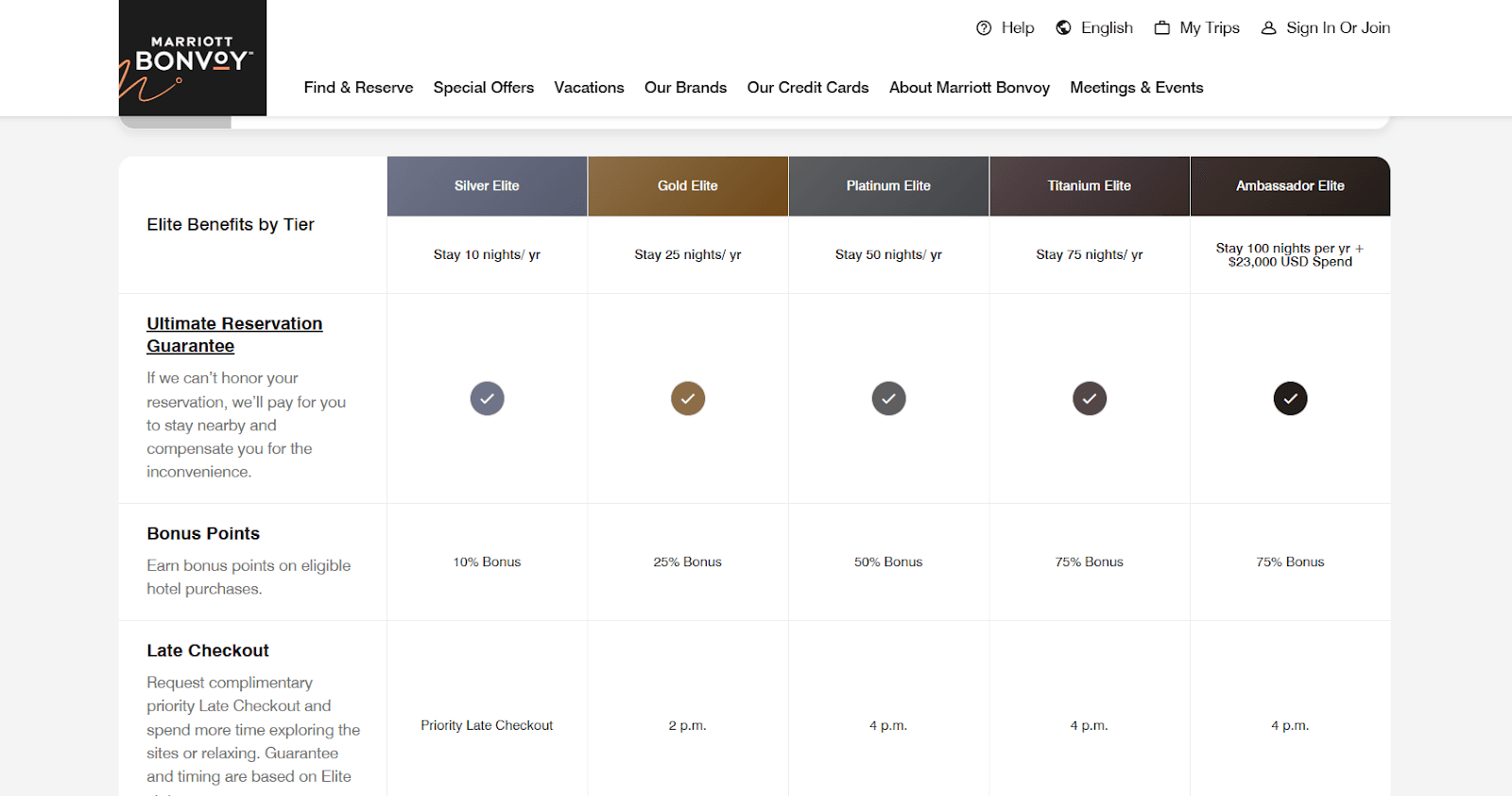
For example, Marriott Bonvoy moves members through Silver, Gold, Platinum, Titanium, and Ambassador tiers based purely on how many nights they stay, which directly maps to spend. Each tier unlocks meaningfully different perks such as room upgrades, lounge access, late checkout, and a dedicated concierge at the top levels.
Points-Based Tiers
Under this category, customers earn points not just through purchases but also through a range of actions, such as writing reviews, referring friends, following on social media, or completing their profile. Their tier is determined by the number of points they have accumulated over time.
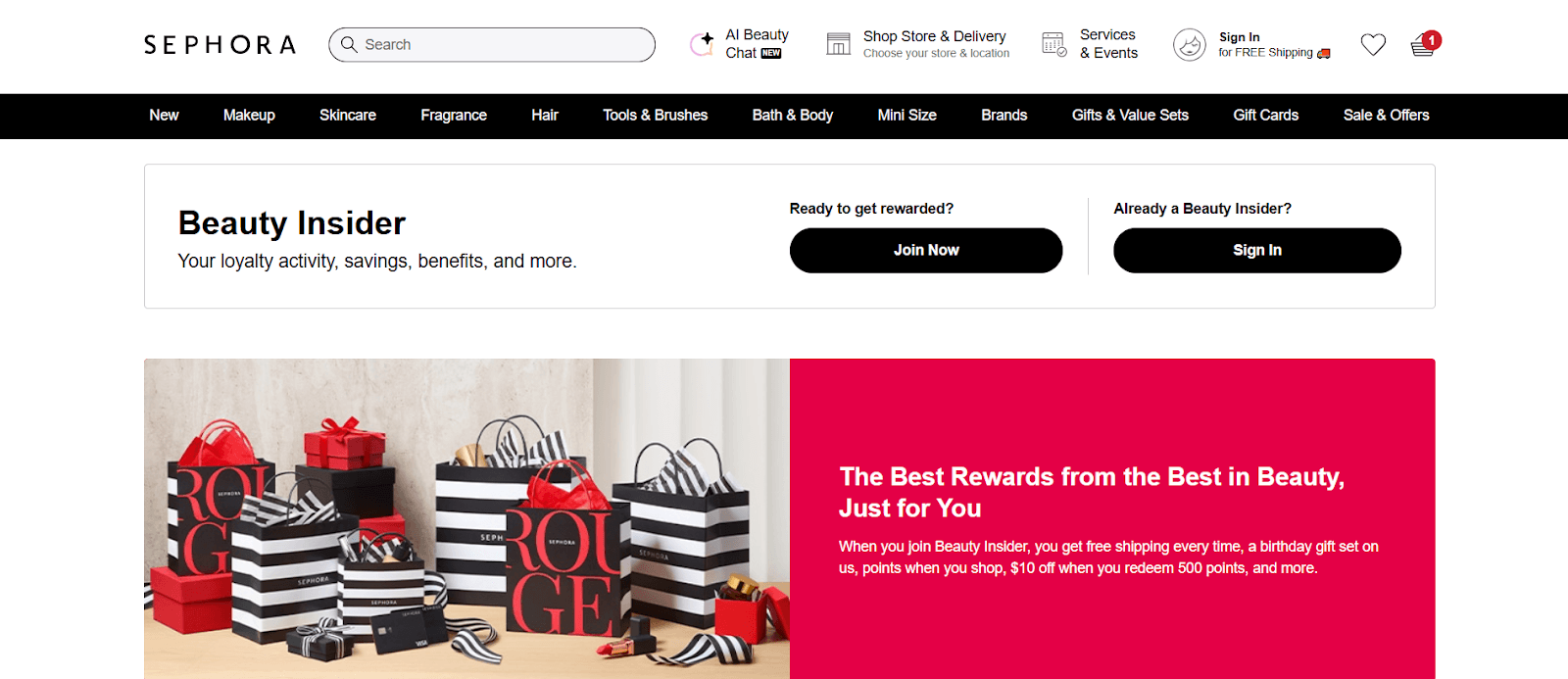
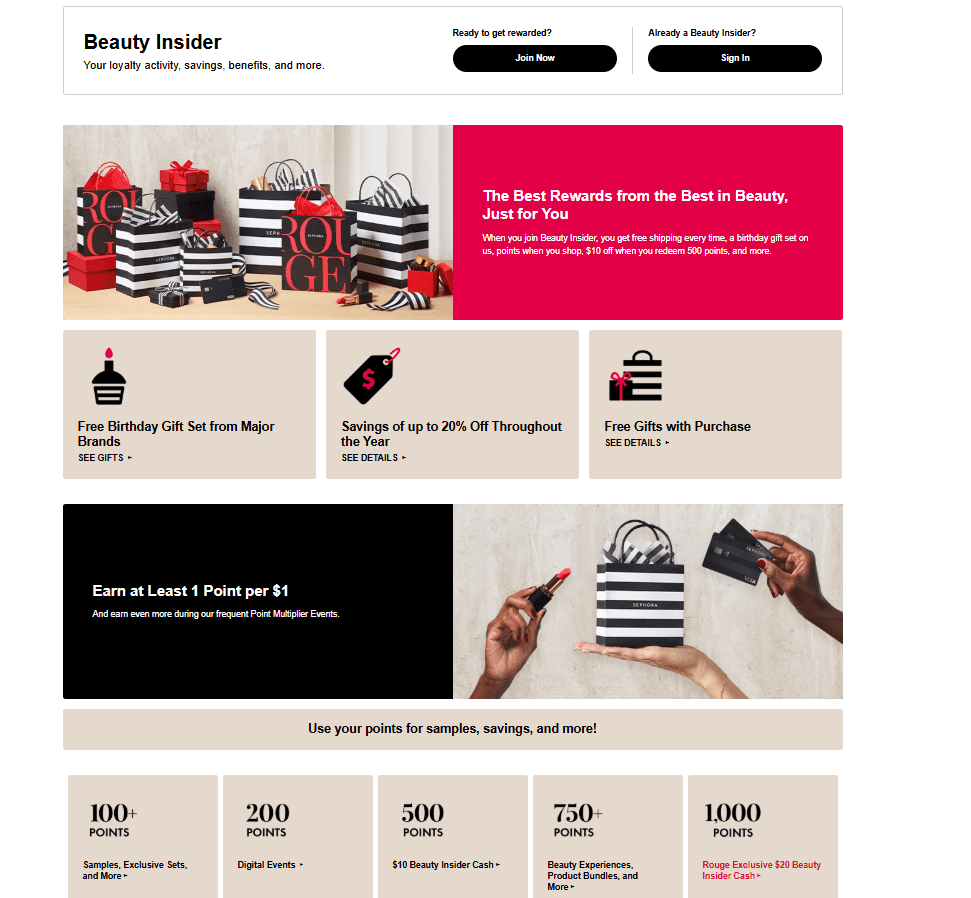
For example, Sephora's Beauty Insider program has a three-tier loyalty system in which customers earn points across multiple touchpoints, and those points provide further incentives. They get samples at 100+ points, digital events at 200 points, and more.
Subscription-Linked Tiers
Some Shopify brands tie their tier program directly to a subscription model. Customers who subscribe to a product automatically move to a higher tier, while non-subscribers remain at the base level. This structure incentivizes subscription sign-ups while rewarding committed customers.
Common Mistakes to Avoid While Designing a Tiered Rewards Strategy for E-commerce
Creating a tiered rewards structure doesn’t deliver results. There are certain things that need to be set appropriately and monitored. Here are some common mistakes that create roadblocks and solutions to get past them:
Setting thresholds that most customers can never reach
If the jump between tiers feels impossible, customers will not bother trying. A program where 90% of your customer base permanently sits at the base tier is not a good loyalty program.
Solution: Build your tier thresholds around how your customers already behave. If your average customer spends $150 a year, a base tier entry point of $500 will kill participation before it starts. Thresholds need to be ambitious enough to drive behavior but realistic enough that a genuine customer can get there.
Making all the rewards feel the same
Offering slightly more points at each tier is not differentiation. If a customer cannot clearly articulate what changes when they move from Silver to Gold, the tiers are not doing their job.
Solution: Each level needs rewards that feel qualitatively different, not just incrementally better. Early access, priority support, and exclusive perks carry high perceived value at relatively low cost and create a clear sense of progression between tiers.
Overcomplicating the earning structure
The moment a customer has to stop and think about how points are calculated, you have lost them. Complexity kills participation.
Solution: Keep it simple enough that a customer can immediately understand what they need to do to move up. The rules for earning, the thresholds for each tier, and the rewards on offer should all be immediately clear without needing to consult a help page.
Launching and leaving it alone
Brands that build a program, switch it on, and never revisit it end up with stale rewards and declining engagement.
Solution: Treat the program as a living part of your business. Track tier progression rates, reward redemption, repeat purchase rates, and churn by tier. Adjust one variable at a time and let the data guide your decisions. Regular review and updated rewards are what keep the program relevant over time.
Not communicating the program well enough
A customer who does not know they are 200 points away from Gold has no reason to place another order this week. Poor communication is one of the most common reasons tiered programs underperform.
Solution: Customers should be reminded of their status, their progress, and what they stand to gain at every relevant touchpoint throughout post-purchase emails, account pages, and checkout.
Future Trends in Tiered Rewards for Ecommerce
Gamification, AI-driven personalization, and experiential rewards are quickly replacing flat discount structures, and customers are beginning to expect programs that feel tailored to them rather than generic. Brands that keep pace with these shifts, rewarding customers for more than just spend and building tiers around individual behavior and brand values, will have a meaningful edge over those still running basic points programs.
A tiered rewards strategy, when built thoughtfully, makes loyalty feel earned rather than bought. Customers are not just collecting points; they are building a relationship with your brand that carries real status and real value. The brands that get this right see stronger retention, higher lifetime value, and a customer base that does not walk away the moment a competitor runs a sale.
FAQs
What is a tiered rewards strategy in ecommerce?
A tiered rewards strategy is a loyalty program that groups customers into levels based on how much they spend or engage with a brand. Each level unlocks a different set of rewards, with better perks at higher tiers. The structure is designed to encourage customers to keep spending in order to reach and maintain a higher tier.
How does a tiered rewards program increase customer retention?
Tiered programs give customers something to protect. Once a customer has reached a tier, the prospect of losing that status and the perks that come with it becomes a powerful reason to keep buying. Combined with visible progress tracking and meaningful rewards at each level, the program creates ongoing engagement rather than one-off transactions.
What are the main benefits of tiered loyalty programs for ecommerce brands?
The core benefits are stronger retention, higher average order value, and improved customer lifetime value. Beyond the numbers, tiered programs also help brands identify and reward their best customers, reduce dependence on discounting, and build genuine emotional loyalty that holds up even when competitors are running promotions.
How many tiers should a Shopify rewards program have?
Three to four tiers are ideal for a rewards program, as they work well for most Shopify brands. Fewer than three does not create enough progression to motivate customers. More than four tends to overcomplicate the program and dilute the sense of achievement at each level. The priority is making each tier feel meaningfully different from the one before it.
What metrics are used to qualify customers for loyalty tiers?
The most common metrics used to qualify customers for loyalty tiers are annual spend, accumulated points, or a combination of both. Some brands also factor in engagement actions like reviews, referrals, and social follows. The right metric depends on your store and how your customers naturally interact with your brand.
How do tiered rewards impact customer lifetime value?
Tiered rewards effeciently drive customer lifetime value, as customers in higher tiers consistently spend more, buy more frequently, and stay longer. The tier structure incentivizes ongoing spending rather than one-off purchases, which compounds over time into significantly higher lifetime value. Brands with well-designed tiered programs typically see a clear gap in lifetime value between tier levels.
How can small Shopify businesses implement tiered rewards effectively?
Small Shopify businesses can implement tiered rewards effectively by creating at least three tiers with clear thresholds, straightforward rewards, and clean communication, which is more effective than an overly complex program with too many moving parts. The key is to design around your actual customer data.
Tiered Rewards Strategy to Boost Ecommerce Loyalty
Summary
A tiered rewards strategy groups customers into levels based on spending, with higher tiers unlocking better benefits. It turns loyalty into progression, encouraging customers to spend more to reach or maintain status. Unlike flat loyalty programs that focus mainly on points or discounts, tiered systems use status, exclusivity, and visible progress to drive repeat purchases and higher engagement. Customers enter a base tier and move up as they spend, often on an annual cycle, which keeps motivation ongoing. These programs improve retention, increase average order value, and strengthen lifetime value by making purchases feel like progress toward rewards. Effective systems use clear thresholds, meaningful tier differences, simple rules, personalization, and real-time progress visibility. Common structures include spend-based, points-based, and subscription-linked tiers. When designed well, tiered rewards create stronger customer loyalty and more consistent long-term revenue growth.
Customers have endless options when shopping online. And if you're not giving them a reason to pick you (and come back), other brands will, by leveraging strategies like discounting, free shipping, free gifts with purchase, recommending personalized products, and even offering loyalty points.
That's where a tiered rewards strategy earns its keep. Instead of a flat "spend points, get discount" setup, you're building something customers actually want to climb. Better tier, better rewards that make loyalty become a game they're invested in winning.
Want to unlock the secret to keeping your customers coming back? Let's look at how a tiered reward strategy works in ecommerce and how to design it for your store.
What Is a Tiered Rewards Strategy in Ecommerce
A tiered rewards strategy is a loyalty program that groups customers into levels based on their spending. Each level, or tier, unlocks a different set of rewards, and the higher the tier, the better the rewards. The idea is simple: the more a customer spends with you, the more you give back to them.
Let's use a skincare brand as an example to better understand this. They split their loyalty program into three tiers, including Silver, Gold, and Platinum. A customer who spends up to $200 a year sits in Silver and earns basic points on every purchase.
Spend $500, and they move into Gold, where they now earn double points, get free shipping, and have early access to new launches. Hit $1000, and they reach Platinum, which offers exclusive discounts, a free product every quarter, and a dedicated support line.
How a Tiered Rewards Strategy Works
Now, let's explore how the loyalty program works on the back end.
A customer signs up for your loyalty program and automatically enters the base tier. Every time they make a purchase, they accumulate points or spending credit that counts toward their tier status. Once they cross the threshold for the next tier, they move up and immediately start receiving the rewards that come with it.
The thresholds are what drive behavior. A customer sitting at $380 in annual spend, knowing Gold unlocks at $500, is not going to let $120 stop them. They will find a reason to place another order. That is the strategy working exactly as intended.
Most programs also operate on an annual cycle, requiring customers to maintain their spending to retain their tier.
For example, a Platinum customer who slows down drops back to Gold the following year. This keeps the urgency alive even for customers who have already reached the top, as they try to stay.
As a result, this program does not just reward purchases; it shapes how and how often customers buy from you. This is why over 60% of Shopify stores already have a tiered rewards strategy in place.
Tiered Rewards Strategy vs. Traditional Loyalty Programs
Businesses often confuse a tiered rewards strategy with traditional loyalty programs because their point structures are similar. But there is a significant difference between a program that passively exists and one that actively drives behavior.
Here is how tiered rewards stack up against traditional loyalty programs across the areas that matter most:
Aspect | Tiered Rewards Program | Traditional Loyalty Program |
Customer Engagement | High and ongoing because customers are always aware of their tier status and what they stand to gain by moving up | Engagement tends to drop off after the initial sign-up once the novelty wears off |
Retention Impact | Strong; tier status and the fear of losing it give customers a structural reason to keep returning | Moderate; customers return for discounts but leave the moment a competitor offers a better deal |
Motivation Mechanism | Status, progression, and exclusivity drive behavior beyond just the monetary reward | Customers engage primarily for the discount or points, with little emotional attachment |
Customer Segmentation | The tier structure naturally separates casual buyers from high-value loyal customers | All customers are treated the same, regardless of how much or how often they spend |
Lifetime Value Impact | Customers spend more consistently to maintain or improve their tier over time | Spending is often concentrated around promotions and point redemption windows |
When It Works Best | Brands with repeat purchase potential, a defined customer base, and meaningful rewards to offer at each level | Simple, low-complexity programs where customers just want a straightforward discount or cashback |
Primary Limitation | Requires more thoughtful design, ongoing management, and the right tech stack to execute well | Offers little differentiation, as customers have no reason to stay loyal beyond the next best offer |
Traditional loyalty programs are limited. They work well as a baseline, but do little to separate your best customers from everyone else or give people a compelling reason to keep choosing you. A tiered model builds on the same foundation but adds the progression, status, and personalisation that turn a passive program into one that customers are genuinely invested in.
Why Tiered Rewards Matter for Shopify Brands
Now that the mechanics of the strategy are clear, here is why it is worth taking seriously for Shopify brands. You must note that brands running tiered loyalty programs see close to double the ROI of those running flat programs, and nearly all companies that invest in loyalty report a positive return.
Directly impacts customer retention and repeat purchases
It goes without saying that acquiring a new customer is way more tedious than retaining an existing one, both financially and strategically. A tiered rewards program gives customers a structural reason to return. They are not coming back just because they like your product. They are coming back because they have a tier to maintain, points sitting in their account, and rewards they have not used yet.
Tiers give a psychological benefit
Customers do not just want the discount; they want to become Gold members. That label carries weight. It signals that they are valued, that they have earned something, and that dropping down would feel like a loss. Shopify brands can use this to their advantage by designing tiers that feel aspirational rather than transactional.
Builds lifetime value in a way discounts never will
A tiered rewards program gets you a customer who keeps coming back for years. When customers are invested in their tier, their spending compounds over time. Each purchase is not just a sale; it is a step toward their next reward. For Shopify brands trying to grow sustainably without relying on constant promotions, it's that compounding loyalty that actually moves the needle on lifetime value.
Key Elements of a High-Performing Tiered Loyalty Program
While a tiered loyalty program can significantly boost sales and keep your customers hooked, you must ensure the tiers are appropriately differentiated and that there is transparency. Here are the key elements that make a high-performing tiered loyalty program:
Clear Tier Criteria and Progression
The number of tiers, the thresholds between them, and what each level represents should all be immediately clear. Three to four tiers work well for most Shopify brands. Fewer than that, and there is not enough to work toward. More than that, and the program starts to feel complicated.
The thresholds themselves need to be calibrated carefully. The base tier should be easy to enter, so a customer who makes one or two purchases should qualify without much effort. That early entry matters because it gets them inside the program. From there, each subsequent threshold should feel achievable but not effortless. That "little extra effort” is what drives the customer to spend more.
Meaningful and Differentiated Rewards
This is among the most critical factors that directly impact the customers' motivation. Offering the same type of reward across every tier, just in slightly higher amounts, does not create real motivation. A customer earning 5% back at the base tier and 8% back at the top tier won't feel the difference in any meaningful way.
The rewards at each tier should feel qualitatively different, not just quantitatively better. The base tier might offer free shipping and basic points. The middle tier adds early access to new launches and double points. The top tier brings in exclusive products, a personal discount, priority support, and a free gift every quarter. Each step up should feel like entering a different level of the relationship.
Personalization Across Customer Segments
A tiered program becomes significantly more powerful when the rewards and communication inside it reflect who the customer actually is. A customer who consistently buys skincare should not be receiving rewards centered around haircare. A customer who shops every two weeks should not be receiving the same re-engagement email as someone who has not ordered in four months.
Shopify brands can use purchase history, browsing behavior, and tier data together to make the program feel tailored rather than generic. This might mean offering tier-specific birthday rewards based on a customer's favorite category, or sending a personalized push when a customer is close to moving up.
Transparency and Real-Time Progress Tracking
Customers cannot be motivated by progress they cannot see. Every customer in your program should know their current tier, their point balance, how far they are from the next tier, and what they unlock when they get there. This information should show up at every relevant touchpoint. On the account page, in the post-purchase email, at checkout, and in any loyalty-specific communication.
When a customer can see that they are 200 points away from Gold, that visibility alone changes their next purchase decision. Real-time tracking turns the program from a passive background feature into something customers are actively aware of and engaged with throughout their journey with your brand.
Common Tier Structures Used in Shopify
By now, you would be convinced of the benefits of tiered loyalty programs. However, it's also important to note that there is no fixed way to create a tiered structure. The right structure depends on your product, your average order value, and how your customers naturally shop.
Here are some common frameworks that most Shopify brands use:
Spend-Based Tiers
This is the most straightforward structure. Customers move up tiers based on how much they spend within a set period, usually annually. It is easy to understand, easy to communicate, and directly tied to revenue, which makes it the most commonly used model.
For example, Marriott Bonvoy moves members through Silver, Gold, Platinum, Titanium, and Ambassador tiers based purely on how many nights they stay, which directly maps to spend. Each tier unlocks meaningfully different perks such as room upgrades, lounge access, late checkout, and a dedicated concierge at the top levels.
Points-Based Tiers
Under this category, customers earn points not just through purchases but also through a range of actions, such as writing reviews, referring friends, following on social media, or completing their profile. Their tier is determined by the number of points they have accumulated over time.
For example, Sephora's Beauty Insider program has a three-tier loyalty system in which customers earn points across multiple touchpoints, and those points provide further incentives. They get samples at 100+ points, digital events at 200 points, and more.
Subscription-Linked Tiers
Some Shopify brands tie their tier program directly to a subscription model. Customers who subscribe to a product automatically move to a higher tier, while non-subscribers remain at the base level. This structure incentivizes subscription sign-ups while rewarding committed customers.
Common Mistakes to Avoid While Designing a Tiered Rewards Strategy for E-commerce
Creating a tiered rewards structure doesn’t deliver results. There are certain things that need to be set appropriately and monitored. Here are some common mistakes that create roadblocks and solutions to get past them:
Setting thresholds that most customers can never reach
If the jump between tiers feels impossible, customers will not bother trying. A program where 90% of your customer base permanently sits at the base tier is not a good loyalty program.
Solution: Build your tier thresholds around how your customers already behave. If your average customer spends $150 a year, a base tier entry point of $500 will kill participation before it starts. Thresholds need to be ambitious enough to drive behavior but realistic enough that a genuine customer can get there.
Making all the rewards feel the same
Offering slightly more points at each tier is not differentiation. If a customer cannot clearly articulate what changes when they move from Silver to Gold, the tiers are not doing their job.
Solution: Each level needs rewards that feel qualitatively different, not just incrementally better. Early access, priority support, and exclusive perks carry high perceived value at relatively low cost and create a clear sense of progression between tiers.
Overcomplicating the earning structure
The moment a customer has to stop and think about how points are calculated, you have lost them. Complexity kills participation.
Solution: Keep it simple enough that a customer can immediately understand what they need to do to move up. The rules for earning, the thresholds for each tier, and the rewards on offer should all be immediately clear without needing to consult a help page.
Launching and leaving it alone
Brands that build a program, switch it on, and never revisit it end up with stale rewards and declining engagement.
Solution: Treat the program as a living part of your business. Track tier progression rates, reward redemption, repeat purchase rates, and churn by tier. Adjust one variable at a time and let the data guide your decisions. Regular review and updated rewards are what keep the program relevant over time.
Not communicating the program well enough
A customer who does not know they are 200 points away from Gold has no reason to place another order this week. Poor communication is one of the most common reasons tiered programs underperform.
Solution: Customers should be reminded of their status, their progress, and what they stand to gain at every relevant touchpoint throughout post-purchase emails, account pages, and checkout.
Future Trends in Tiered Rewards for Ecommerce
Gamification, AI-driven personalization, and experiential rewards are quickly replacing flat discount structures, and customers are beginning to expect programs that feel tailored to them rather than generic. Brands that keep pace with these shifts, rewarding customers for more than just spend and building tiers around individual behavior and brand values, will have a meaningful edge over those still running basic points programs.
A tiered rewards strategy, when built thoughtfully, makes loyalty feel earned rather than bought. Customers are not just collecting points; they are building a relationship with your brand that carries real status and real value. The brands that get this right see stronger retention, higher lifetime value, and a customer base that does not walk away the moment a competitor runs a sale.
FAQs
What is a tiered rewards strategy in ecommerce?
A tiered rewards strategy is a loyalty program that groups customers into levels based on how much they spend or engage with a brand. Each level unlocks a different set of rewards, with better perks at higher tiers. The structure is designed to encourage customers to keep spending in order to reach and maintain a higher tier.
How does a tiered rewards program increase customer retention?
Tiered programs give customers something to protect. Once a customer has reached a tier, the prospect of losing that status and the perks that come with it becomes a powerful reason to keep buying. Combined with visible progress tracking and meaningful rewards at each level, the program creates ongoing engagement rather than one-off transactions.
What are the main benefits of tiered loyalty programs for ecommerce brands?
The core benefits are stronger retention, higher average order value, and improved customer lifetime value. Beyond the numbers, tiered programs also help brands identify and reward their best customers, reduce dependence on discounting, and build genuine emotional loyalty that holds up even when competitors are running promotions.
How many tiers should a Shopify rewards program have?
Three to four tiers are ideal for a rewards program, as they work well for most Shopify brands. Fewer than three does not create enough progression to motivate customers. More than four tends to overcomplicate the program and dilute the sense of achievement at each level. The priority is making each tier feel meaningfully different from the one before it.
What metrics are used to qualify customers for loyalty tiers?
The most common metrics used to qualify customers for loyalty tiers are annual spend, accumulated points, or a combination of both. Some brands also factor in engagement actions like reviews, referrals, and social follows. The right metric depends on your store and how your customers naturally interact with your brand.
How do tiered rewards impact customer lifetime value?
Tiered rewards effeciently drive customer lifetime value, as customers in higher tiers consistently spend more, buy more frequently, and stay longer. The tier structure incentivizes ongoing spending rather than one-off purchases, which compounds over time into significantly higher lifetime value. Brands with well-designed tiered programs typically see a clear gap in lifetime value between tier levels.
How can small Shopify businesses implement tiered rewards effectively?
Small Shopify businesses can implement tiered rewards effectively by creating at least three tiers with clear thresholds, straightforward rewards, and clean communication, which is more effective than an overly complex program with too many moving parts. The key is to design around your actual customer data.
Contents
Related Articles
How to Increase Average Order Value in E-commerce
Boost Your Checkout Conversion Fast: 8 Proven Techniques
How to Run a Profitable Buy One Get One Free (BOGO) Campaign in 2026
Get Monk Free Gift app for just $1/month this Black Friday
First month: $1 after your 7-day free trial. All features included. Offer live!
Claim offer now

Get Monk Free Gift app for just $1/month this Black Friday
First month: $1 after your 7-day free trial. All features included. Offer live!
Claim offer now
Get Monk Free Gift app for just $1/month this Black Friday
First month: $1 after your 7-day free trial. All features included. Offer live!
Claim offer now