Free Gift Campaigns for Shopify Stores: Tips, Strategies & Benefits
Summary
Free gift campaigns help Shopify stores increase conversions and average order value without cutting prices. Instead of discounts, they add perceived value by offering a free product when customers meet conditions like spending a certain amount or buying specific items. These offers work because they feel tangible and rewarding.Effective campaigns rely on the right threshold, relevant gifts, and simple rules. Common mistakes include poor gift choice, unclear conditions, and overlapping promotions. Tracking metrics like conversion rate, AOV, redemption, and repeat purchases is essential to measure long term impact and profitability.

Key Takeaways
Free gift campaigns help Shopify stores increase conversions and average order value without cutting prices. Instead of discounts, they add perceived value by offering a free product when customers meet conditions like spending a certain amount or buying specific items. These offers work because they feel tangible and rewarding.Effective campaigns rely on the right threshold, relevant gifts, and simple rules. Common mistakes include poor gift choice, unclear conditions, and overlapping promotions. Tracking metrics like conversion rate, AOV, redemption, and repeat purchases is essential to measure long term impact and profitability.
Margins are tighter than ever for Shopify stores in 2026. Paid ads cost more. Conversions don’t always follow. And most discounts just eat into profit without building real loyalty.
Many stores rely on percentage discounts to boost sales. But customers have seen it all before. It doesn’t stand out, and it trains people to wait for the next sale.
However, free gifts with purchase work differently. They add value without cutting your product price. And when done right, they can lift average order value, improve conversion rates, and make the offer feel more tangible.
In this guide, we’ll break down:
What are free gift campaigns, and how do they work for Shopify stores
Benefits and opportunities of free gift campaigns in Shopify
Best practices and mistakes to avoid
How to track the important metrics
What Are Free Gift Campaigns in Ecommerce?
Free gift campaigns are simple: a customer gets a free product when they meet a condition. Usually, that condition is spending a certain amount or buying a specific item.
Instead of lowering your prices, you add extra value to the order.
For example,
‘Spend $50 and get a free skincare sample’ or ‘Buy 2 t-shirts and get a free cap.’ The core product price stays the same, but the offer feels better.
For Shopify free gifts with purchase helps brands improve the perceived value of the purchase for the customer.
Why customers respond better to free gifts than discounts
People don’t evaluate gifts the same way they evaluate discounts. A 10% discount feels small and easy to ignore.
But a free item feels like a bonus. It’s more tangible. Customers can picture what they are getting.
There’s also a perception shift: Discounts tend to signal an intent to sell, whereas gifts convey the impression of offering additional value.
For example:
For your coffee store on Shopify, you are considering the following promotions
Option A: 10% off on the next purchase for orders above $30
Option B: Free premium mug on orders above $30
Both may cost you the same. But most customers will pick the second one. The discount just feels like a tactic to get you to come back, and it doesn't give the buyer anything right now. The mug feels like a real win at the moment, and it is tangible.
Learn More: Create Gift Cards for Shopify Stores
Why free gift campaigns work for Shopify brands?
Free gift campaigns are effective because they shift the customer’s focus from price to perceived value. Instead of evaluating whether the purchase justifies the cost, customers begin to consider the additional benefits they will receive.
That small change can improve how people see your offer without touching your margins. They also help reduce hesitation.
Here’s where they make a real difference:
Reduce dependency on constant discounting
Help move slow or excess inventory as ‘gift items’
Improve conversion rates, especially for first-time visitors
Increase average order value (AOV) by setting a spend threshold
Make offers feel more tangible compared to percentage discounts
Create a stronger post-purchase experience (customers feel rewarded)
There is also a compounding effect. Once customers associate your brand with 'getting something extra,' it becomes easier to bring them back with similar offers.
Learn More: Best Shopify Discount Apps to Boost Sales in 2026
Common Types of Free Gift Campaigns
There isn’t just one way to run a free gift campaign. The structure you choose affects margins, conversion rates, and customer responses.
Some formats push AOV. Others help you clear inventory. And some are better for first-time buyers.
Here are the most common types used by Shopify stores.
Gift with Purchase (GWP)
This is the most widely used format. Customers get a free item when there's a certain item quantity present in the basket. Here is what a free gift with purchase looks like in a store:
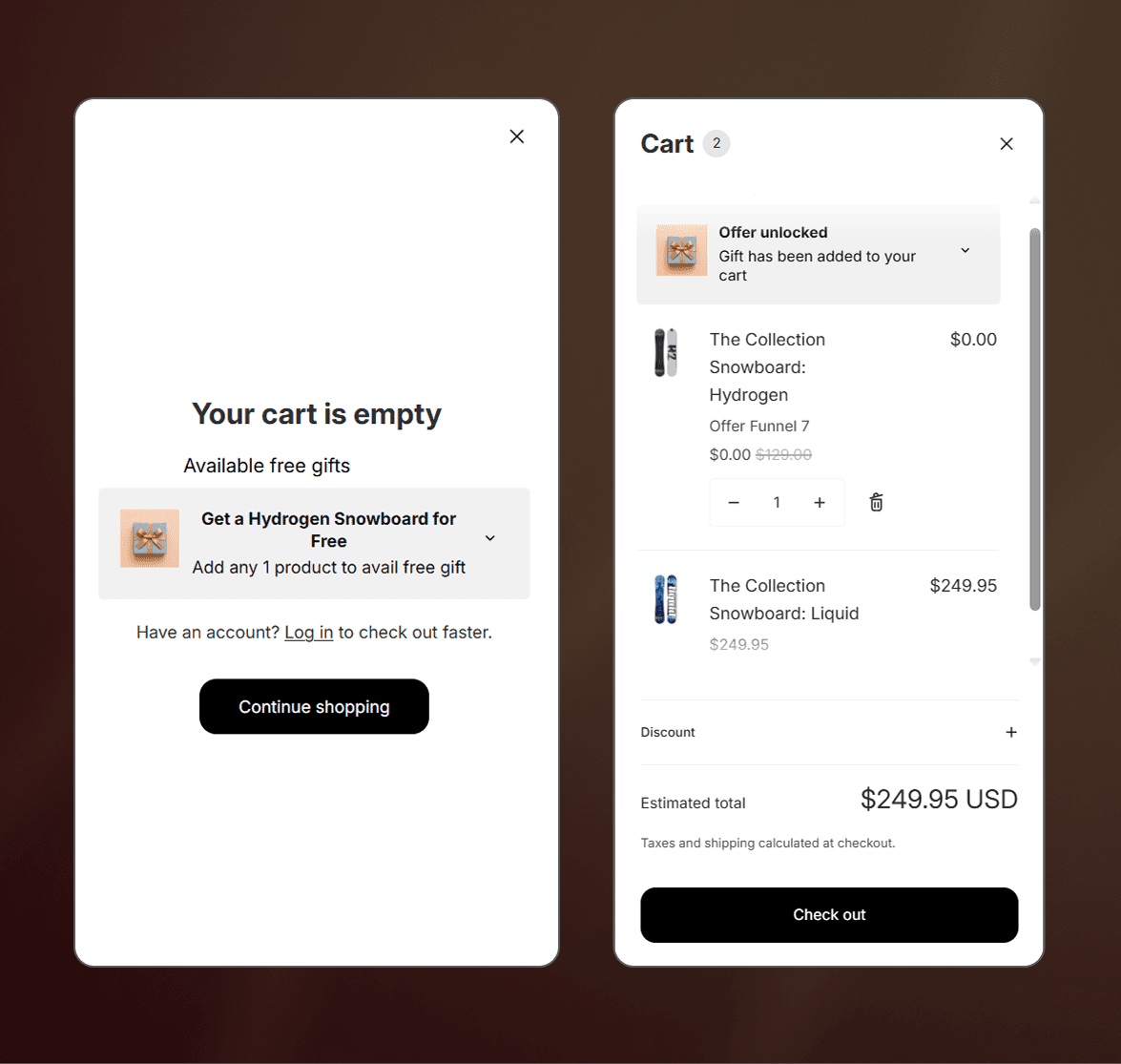
For example: ‘Spend $75 and get a free tote bag.’
It works because it directly increases average order value. Customers who are close to the threshold often add one more item to qualify for the offer. Setting up a free gift-with-purchase offer in Shopify is an effective way to encourage customers to come back for more.
Where does the GWP format work the best?
|
Pro Tip:
Make the free product feel like it belongs with the main purchase. If the gift feels random, it gets ignored. But when it clearly complements the product, it instantly increases perceived value.
Use Shopify apps like Monk to display multiple complementary product recommendations customers can choose from on the product or cart page.
Buy X Get Y Free Offers
This type of free gift is more direct than most other gift campaigns. Instead of asking customers to reach a cart value, you tie the reward to a specific product or quantity.
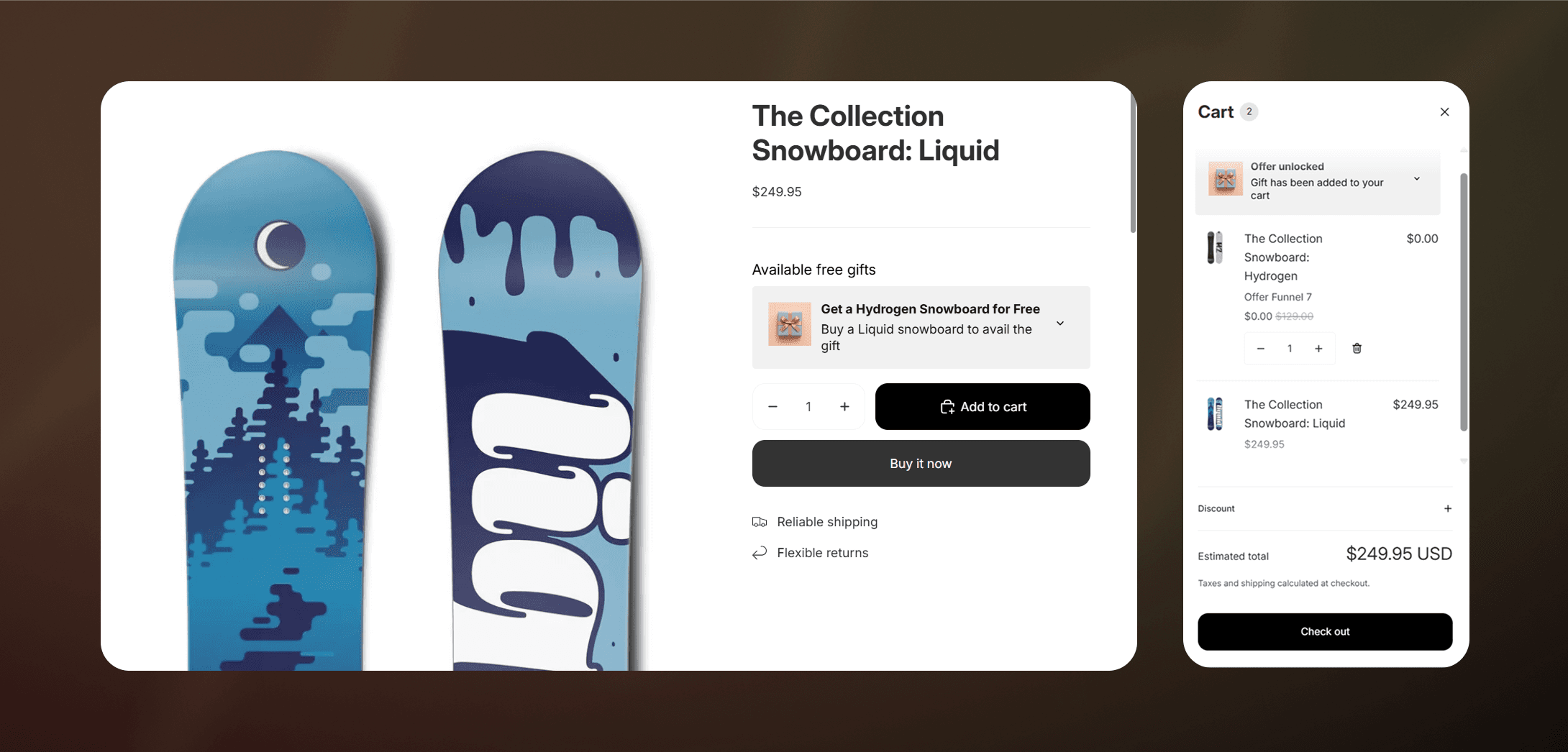
The gift is triggered by what they buy, not by how much they spend. For example:
Buy 2 t-shirts and get 1 free
Buy a laptop and get a free mouse
Where does the GWP format work the best?
This format is also useful for clearing slow-moving inventory without discounting it directly. |
Learn More: How to Run a BOGO Sale on Shopify
This is a more advanced version of GWP. Instead of one threshold, you offer multiple levels of rewards.
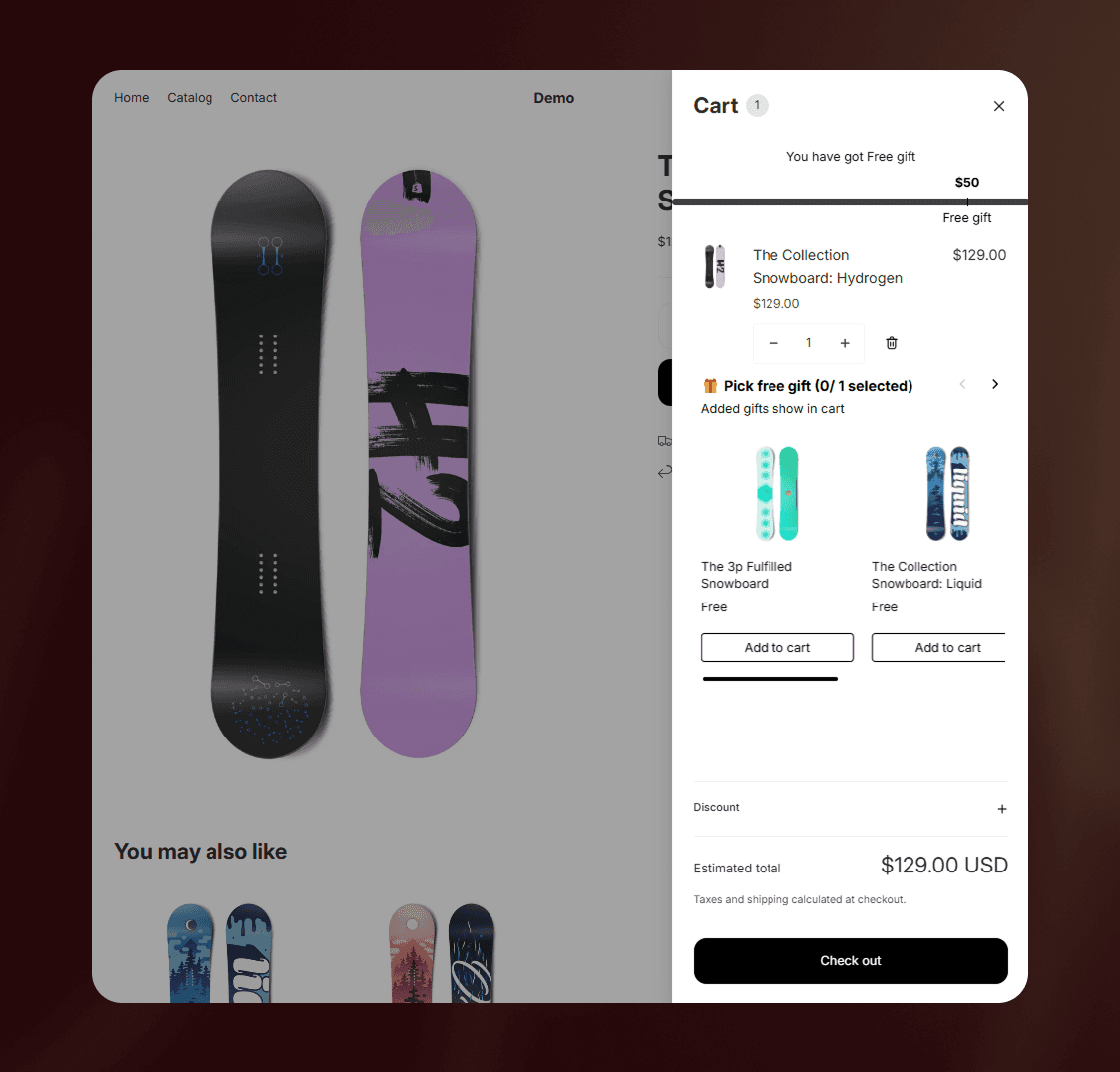
For example:
Spend $50, get a free sample
Spend $150, get a free bundle
With this type of offer, buyers do not just purchase to qualify. They begin upgrading to earn more rewards as they reach the next tier. It pushes average order value higher without forcing it.
Where does the format work the best?
If done right, this format can push AOV much higher than a single-threshold campaign. |
Pro Tip:
Don’t make every tier feel equal. The jump between tiers should feel worth it. If the $50 and $100 gifts look similar, most customers will stop early. But if the higher tier feels like a clear upgrade, people will stretch their cart to reach it.
Monk lets you show a tiered rewards bar inside your theme's native cart. You can even combine it with other upsell offers.
How to Structure a High-Converting Free Gift Campaign?
A free gift campaign doesn’t fail because the idea is bad. It usually fails because of how it’s set up.
If the threshold is set too high, people won’t reach it. If the gift feels weak, they won’t care. And if the rules are confusing, they won’t bother. And with a cart abandonment rate 70.22%, online stores can no longer afford to make any mistakes.
Here is how you can structure a high-converting free gift campaign on your Shopify store in 2026:
Step 1: Set the Right Spend Threshold
This is where most of the impact comes from. Set it too low, and you lose margin without increasing order value. Set it too high, and customers drop off before they get there.
The goal is to place the threshold just above your current average order value (AOV). For example:
If your AOV is $40, test thresholds at $50–$60
If your AOV is $75, test $90–$110
This creates a small stretch, not a big jump. You want customers to feel that they are already close to completion, making it worthwhile to add one more item.
Here are a few key elements to consider when setting up the threshold:
Factor | What to Check | Why It Matters |
Current AOV | Your average order value over the last 30–60 days | Sets your baseline for where the threshold should sit |
Product Pricing | Range of your product prices | Determines if customers can easily add items to reach the threshold |
Natural Add-ons | Availability of low-cost complementary products | Helps customers increase cart value without friction |
Cart Behavior | Average number of items per order | Shows whether customers are already inclined to add more items |
Margin at Threshold | Profit after adding gift + shipping costs | Ensures the campaign actually improves profitability |
A simple add-on strategy helps here. If your store has low-priced complementary items, customers can reach the threshold without friction.
Step 2: Choose the Right Gift Product
When adding a free gift to a cart, you are using the gift as the hook. If it doesn’t feel valuable, the campaign won’t move the needle. But ‘valuable’ doesn’t mean expensive. It means relevant.
Here is how you can check if the free gift option is the right one for the product:
Criteria | What to Look For | Why It Matters |
Relevance | Matches the main product or category | Feels useful, not random |
Perceived Value | Looks premium or desirable | Drives action without high cost |
Cost to You | Low production or inventory cost | Protects margins |
Size/Logistics | Easy to ship and store | Avoids operational issues |
Upsell Potential | Leads to future purchases | Extends customer value |
A good gift should feel like something customers would consider buying on its own. If it feels like leftover stock, it won’t work.
Pro Tip:
Offering gift choices manually gets complicated fast. Hence, use tools or plugins that let you display multiple, related products on the store. This helps you ensure better product match and user satisfaction.
Monk automatically allows you to display multiple gifts on the product page, in the cart, or at checkout.
Step 3: Defining Clear Eligibility Rules
You need to set clear eligibility criteria. Customers should understand the offer in seconds. If they have to think, conversions drop.
For example:
'Spend $75, get a free gift.'
'Buy 2 items, get 1 free.'
Avoid stacking conditions or adding exceptions unless necessary. Here are a few best practices you can adopt to set clear eligibility rules:
State the condition in one line
Avoid hidden exclusions or fine print
Apply the gift automatically at checkout
Show the gift visually (don’t just describe it)
Show progress in cart ($10 away from your gift)
The easier it is to understand offer eligibility, the more people will follow through. You want to earn your customers' confidence and not trick them into buying more.
Remember, your goal is sustainable business and not one-shot checkouts.
Best Practices for Free Gift Campaigns
Free gift campaigns are easy to launch. But small mistakes can quietly kill performance. Most issues come down to value, clarity, visibility, and execution.
If the customer has to think too much, the offer loses impact. Here’s how to avoid that:
Keep the Offer Simple and Transparent
If someone can’t understand your offer in a few seconds, it’s already too complex. Before you set up the offer, answer the following questions:
Can a first-time visitor understand this instantly?
Does the offer fit in one sentence?
If one of the answers to the questions above is no, you need to rethink your offer strategy. Let’s try to understand this with good and bad examples:
Good example:
‘Buy 2, get 1 free.’
Bad example:
‘Spend $50 on selected items and $20 on accessories to unlock a free gift.’
As you can see, the first examples are short and direct with a clear reward. The buyer does not need to do any mental math either.
On the other hand, the second one is long and complex. The buyer may need to read it twice to understand what’s happening with the offer. And at the end, the free gift is not specific. All these can make the buyer less confident about using the offer.
Hence, always keep the offer simple and transparent to encourage buyers to take advantage of the opportunity.
Clearly Display the Gift in the Cart and Checkout
A hidden gift is a wasted incentive. Customers shouldn’t have to guess what they are getting. Or whether they have even qualified.
Hence, you need to show what the gift is and if the user is qualified to use the free gift at places that matter.
At a minimum, you must display:
The name and image of the gift
Progress bar showing the threshold to unlock it
Confirmation when the user has added the gift to their cart
Most businesses fail to show these details on the cart and checkout pages, where decisions are made. They mention the offer on a banner but don’t reinforce it where decisions happen.
Showing the gifts on the cart and checkout pages increases the likelihood that users will actually take advantage of the offers.
Pro Tip:
Don’t just show the gift. You need to also show it updating in real time. When customers see progress (‘$10 away’) turn into confirmation (‘Gift added’), it reinforces the reward and pushes them to complete the purchase.
Use free gifting apps like Monk to display progress bars and gift banners on checkout and cart pages based on user behavior to increase sales.
Avoid Surprise Conditions
Nothing kills trust faster than hidden rules. If customers discover conditions late (or worse, at checkout), they drop off.
Many Shopify stores make the following mistakes when setting up their gift campaigns:
Excluding products without clearly stating it
Requiring discount codes to activate the gift
Removing the gift when another offer is applied
When setting up free gift campaigns, you need to be upfront about the conditions. Let your customers know:
The amount they need to spend
The conditions to be eligible for the offer
Other requirements to take advantage of the gift
And display the condition in the offer so that buyers can read and understand it right away:
Clear offer: ‘Free shipping on orders above $75 (excluding sale items)’
Confusing offer: ‘Free gift applied at checkout’ (some products may be excluded)
Showing the conditions right away helps buyers decide whether to go ahead with the offer. This also saves them the hassle of removing the offer at the end if they do not meet the conditions.
Use Urgency Without Misleading Claims
Urgency works. But fake urgency backfires. Saying “limited time” when the offer runs all year trains customers to ignore you.
Many Shopify stores fall victim to this. Staying true to your claims is vital to building buyers' trust in your brand. If you say things that you don't follow through on, customers will stop caring about what you say.
So, always use real triggers and follow through, such as:
Stock limits (‘Only 120 gifts available’)
Time-bound campaigns (weekend, holiday, launch)
When trying to setup time-sensitive offers, avoid:
Fake countdown timers
Constant “ending soon” messaging
While urgency is a great sales technique for leveraging fear of missing out, you need to use it strategically.
A simple, honest approach works better, such as 'This week only' or 'Until stock runs out.' This approach creates pressure without damaging trust.
Monitor Performance Beyond Short-term Sales
A campaign can increase revenue and still hurt your business. Staying overly focused on short-term wins may harm your brand in the long term.
Hence, try to track metrics, like:
Did AOV actually increase, or was it just order volume?
Are customers coming back after receiving the gift?
Did margins hold after adding the cost of the gift?
Which gifts lead to repeat purchases?
These metrics help you understand if a campaign can work in the long term, even if it brings short-term sales.
Pro Tip
Test multiple BOGO and upsell offers with your highest-selling products. Test these combinations over time. Collect data and analyze it to drive insights that you can use to improve your upsell strategies
Shopify BOGO apps like Monk offer detailed merchant dashboards with insights into your upsell and discount campaigns.
Mistakes E-commerce Brands Make with Free Gift Offers
Many free gift campaigns on Shopify may not live up to expectations because the execution falls short.
Here are four common mistakes brands make with free gift campaigns and how to avoid them:
Offering Irrelevant or Low-quality Gifts
Many brands offer free gifts that are low-quality or irrelevant to the buyers. If the gift feels useless, the offer loses impact. Customers won’t say it, but they can tell when something is being ‘offloaded’ as a freebie.
Here are three key types of mistakes that brands make in this category:
Giving away unrelated products
Using leftover or outdated inventory
Choosing items with low perceived value
When buyers realize this, they will realize that the gift was a trick, not a reward. And then will not return.
How to avoid it?
|
Poor Communication of Gifting Terms
Even a strong offer won’t work if people don’t understand it. Most stores assume customers will figure it out. But they don’t.
This leads to the following mistakes:
Hiding conditions in fine print
Not showing exclusions clearly
Making users guess if they’ve qualified
This confuses buyers, leading to hesitation and drop-offs.
How to avoid it?
|
This is where Shopify upsell tools like Monk come in handy. It can automatically show qualification, progress, and gift details in the cart, instead of static messages.
Overlapping Discounts That Dilute Value
Stacking multiple offers sounds attractive. In reality, it weakens all the offers. For example, if you display an offer, like '20% discount + free gift + coupon code,' it confuses the customer.
Instead of being clear and direct, the offer feels messy. This happens due to the following reasons:
Running many promotions at once
Mixing many incentives in one campaign
Letting discounts override gift logic and rules
Running too many offers can also affect your bottom line and make the offers feel less special.
How to avoid it?
|
Having a clean offer almost always performs better than a crowded one. It will also help you manage campaigns more effectively, and you can manage fewer offers more effectively.
Pro Tip:
Don’t let discounts and gifts compete for attention. If the discount already feels strong, the gift won’t add much, and vice versa. Pick the one you want customers to care about, and build the campaign around that.
Ignoring Inventory and Fulfillment Planning
This mistake can cause the campaigns to fail after the launch. This is because the offer may work for customers, but operations cannot keep up with demand.
This is chiefly because the store has failed to consider inventory and fulfillment.
Here are a few issues that can come up because of this mistake:
Running out of gift stock mid-campaign
Failing to reserve inventory for qualified orders
Adding gifts that complicate packaging and shipping
These issues can lead to broken promises and delayed shipments. It can also give rise to support and refund issues that may further tarnish the brand image.
How to avoid it?
Shopify upsell software like Monk helps you control when gifts are applied, manage eligibility rules, and reduce manual errors during checkout. |
Learn More: Steps to Offer Free Gift With Purchase (FGWP): A Complete Guide
Measuring the Success of Free Gift Campaigns: Key Metrics to Track
Running a free gift campaign without tracking is guesswork. You might see more orders, but that doesn’t mean the campaign is profitable or sustainable.
These are the metrics that actually tell you what’s working and what’s not.
Here are a few key metrics to track:
Conversion Rate
It is the percentage of visitors who complete a purchase. This tells you if the free gift is actually helping people decide to buy.
Formula: Conversion Rate = (Total Orders ÷ Total Visitors) × 100 |
Let’s take an example to calculate for a store with 10,000 visitors and 300 orders.
Conversion Rate = (300 ÷ 10,000) × 100 = 3%
What does it tell you?
|
2. Average Order Value (AOV)
AOV is the average amount spent per order. This is one of the main reasons to run free gift campaigns.
Formula: AOV = Total Revenue ÷ Total Orders |
Let's calculate the AOV for $15,000 in revenue from 200 orders.
AOV = 15,000 ÷ 200 = $75
What does the AOV tell you?
You can also compare AOV before and during the campaign to see whether it is working. If you see an increase in AOV for users who received the gift vs those who didn’t, it also means you are on the right track. |
3. Redemption Rate
It is the percentage of eligible orders that actually redeemed the free gift. It helps brands understand if people are engaging with the offer or ignoring it.
Formula: Redemption Rate = (Orders with Gift ÷ Eligible Orders) × 100 |
Let's calculate the redemption rate for 500 qualified orders, if 350 orders redeemed the gifts.
Redemption Rate = (350 ÷ 500) × 100 = 70%
What does the redemption rate tell you?If the redemption rate is high, the offer is clear and attractive. If the rate is low, there offer has issues in visibility, clarity, or setup. |
4. Repeat Purchase Behavior
It is the percentage of customers who come back and buy again after receiving a gift. This shows long-term impact and not just immediate sales.
Formula: Repeat Purchase Rate = (Returning Customers ÷ Total Customers) × 100 |
Let's take an example:
200 customers placed an order, and 60 came back to buy again.
Repeat Purchase Rate = (60 ÷ 200) × 100 = 30%
What does it tell you?
You can also check if customers who received samples come back more often, and which types of gifts lead to more repeat purchases. |
How Monk Helps Shopify Brands Run Free Gift Campaigns
Running a free gift campaign sounds simple until you try to manage it. There are a lot of things you need to manage, such as:
Tracking gift eligibility
Applying the right gift
Handling edge cases
Ensuring offers are displayed well in the cart and checkout
Doing this manually (or with basic setups) often leads to errors and missed opportunities. This is where upsell and bundle apps like Monk come in.
They handle the logic behind the scenes so the campaign runs smoothly on the front end.
Automating Gift Rules and Thresholds
Instead of manually configuring each scenario, it lets you set rules once and let the system handle the rest. This allows you to:
Set spend thresholds (like, $50, $100, or $150)
Define which gifts apply at each level
Automatically trigger gifts based on cart value or product conditions
With Monk, you can remove manual intervention during checkout and ensure consistency across all orders. You can also easily set up and test different campaign configurations using Monk.
The moment a customer updates their cart, the offer should respond instantly. Without an upsell app like Monk, implementing real-time gift logic is highly challenging.
However, with Monk's real-time gift logic, you can:
Show progress toward unlocking a gift
Auto-add or remove gifts based on eligibility
Display confirmation when conditions are met
This keeps the experience smooth and avoids confusion about whether the offer is applied.
Flexibility Across Product Types and Collections
Different campaigns need different setups. A fixed system limits what you can test. But with Monkf, you have plenty of options to set up and test different setups.
Here is a quick table to help you understand this better:
Use Case | What Monk Lets You Do | Outcome |
Product-specific offers | Trigger gifts based on selected SKUs | Push specific inventory |
Collection-based rules | Apply gifts to entire categories | Scale campaigns easily |
Variant-level control | Let users choose the size/color of gifts | Better customer experience |
Mixed conditions | Combine cart value + product rules | More targeted campaigns |
This flexibility lets you align the campaign with your actual business goals and makes it easier for buyers to use the offer.
Reducing manual errors and customer support issues
Most problems with free gift campaigns show up after checkout. Most merchants come across issues, such as:
Gifts not added correctly
Wrong variants selected
Customers are confused about eligibility
This leads to drop-offs, abandoned carts, and dissatisfied customers. However, with Monk, you can ensure structured automation, which leads to:
Fewer support tickets
Fewer refunds or corrections
A more predictable campaign outcome
Instead of fixing issues after they happen, Monk helps prevent them in the first place.
Pro Tip: To get the most out of Monk, set up multiple gift tiers, such as a free sticker at $50 and a premium tote at $100. This creates a ‘gamified’ progress bar in the cart that nudges customers to add one more item to reach the next level. |
Improve Free Gift Campaigns in Shopify with Data-driven Decisions
Free gift campaigns work because they shift the focus from price to value. When done right, they can improve Average Order Value, improve conversions, and give customers a reason to come back.
But execution matters. Many Shopify stores still rely on manual setups to manage gifts and offers. That works at a small scale, but it quickly breaks when traffic increases or campaigns become more complex. Errors creep in, gifts don’t apply correctly, and the experience becomes inconsistent.
This is where tools like Monk make a difference. Instead of managing everything manually, you can set up clear rules, automate gift logic, and run campaigns that scale without constant oversight.
The goal is not just to run a campaign. It’s to run one that holds up as your store grows.
Try Monk for free to improve your sales with upsell and cross-sell offers on product pages, carts, checkout pages, and more.
Frequently Asked Questions
What is a free gift campaign in e-commerce?
A free gift campaign in e-commerce is a promotional strategy where customers receive an additional product at no extra cost when they meet specific purchase conditions.
Are free gift campaigns better than discounts?
Yes, free gift campaigns are often better than discounts. Discounts directly reduce your margins, while gifts shift the focus to value, as customers respond better to getting something extra than saving a small percentage.
What products work best as free gifts for Shopify stores?
For effective free gift promotions for Shopify stores, pick products that actually make sense with what you are selling. Think add-ons, accessories, samples, or low-cost items that feel useful.
How do free gift campaigns impact customer loyalty?
Free gift campaigns have a positive impact on customer loyalty by changing the customer perception. Instead of just buying a product, they feel like they got a little more than expected without spending extra.
Can free gift campaigns be automated?
Yes, free gift campaigns can be automated. Many stores automate the handling of offer rules, gift additions, condition management, and sales tracking with upsell apps like Monk.
How do free gift campaigns fit into long-term retention strategies?
Yes, free gift campaigns are in fact a great long-term retention strategy. If you use the right gifts, such as samples or complementary products, you introduce customers to more of your catalog. That increases the chances they come back and buy again later.
Free Gift Campaigns for Shopify Stores: Tips, Strategies & Benefits
Summary
Free gift campaigns help Shopify stores increase conversions and average order value without cutting prices. Instead of discounts, they add perceived value by offering a free product when customers meet conditions like spending a certain amount or buying specific items. These offers work because they feel tangible and rewarding.Effective campaigns rely on the right threshold, relevant gifts, and simple rules. Common mistakes include poor gift choice, unclear conditions, and overlapping promotions. Tracking metrics like conversion rate, AOV, redemption, and repeat purchases is essential to measure long term impact and profitability.
Margins are tighter than ever for Shopify stores in 2026. Paid ads cost more. Conversions don’t always follow. And most discounts just eat into profit without building real loyalty.
Many stores rely on percentage discounts to boost sales. But customers have seen it all before. It doesn’t stand out, and it trains people to wait for the next sale.
However, free gifts with purchase work differently. They add value without cutting your product price. And when done right, they can lift average order value, improve conversion rates, and make the offer feel more tangible.
In this guide, we’ll break down:
What are free gift campaigns, and how do they work for Shopify stores
Benefits and opportunities of free gift campaigns in Shopify
Best practices and mistakes to avoid
How to track the important metrics
What Are Free Gift Campaigns in Ecommerce?
Free gift campaigns are simple: a customer gets a free product when they meet a condition. Usually, that condition is spending a certain amount or buying a specific item.
Instead of lowering your prices, you add extra value to the order.
For example,
‘Spend $50 and get a free skincare sample’ or ‘Buy 2 t-shirts and get a free cap.’ The core product price stays the same, but the offer feels better.
For Shopify free gifts with purchase helps brands improve the perceived value of the purchase for the customer.
Why customers respond better to free gifts than discounts
People don’t evaluate gifts the same way they evaluate discounts. A 10% discount feels small and easy to ignore.
But a free item feels like a bonus. It’s more tangible. Customers can picture what they are getting.
There’s also a perception shift: Discounts tend to signal an intent to sell, whereas gifts convey the impression of offering additional value.
For example:
For your coffee store on Shopify, you are considering the following promotions
Option A: 10% off on the next purchase for orders above $30
Option B: Free premium mug on orders above $30
Both may cost you the same. But most customers will pick the second one. The discount just feels like a tactic to get you to come back, and it doesn't give the buyer anything right now. The mug feels like a real win at the moment, and it is tangible.
Learn More: Create Gift Cards for Shopify Stores
Why free gift campaigns work for Shopify brands?
Free gift campaigns are effective because they shift the customer’s focus from price to perceived value. Instead of evaluating whether the purchase justifies the cost, customers begin to consider the additional benefits they will receive.
That small change can improve how people see your offer without touching your margins. They also help reduce hesitation.
Here’s where they make a real difference:
Reduce dependency on constant discounting
Help move slow or excess inventory as ‘gift items’
Improve conversion rates, especially for first-time visitors
Increase average order value (AOV) by setting a spend threshold
Make offers feel more tangible compared to percentage discounts
Create a stronger post-purchase experience (customers feel rewarded)
There is also a compounding effect. Once customers associate your brand with 'getting something extra,' it becomes easier to bring them back with similar offers.
Learn More: Best Shopify Discount Apps to Boost Sales in 2026
Common Types of Free Gift Campaigns
There isn’t just one way to run a free gift campaign. The structure you choose affects margins, conversion rates, and customer responses.
Some formats push AOV. Others help you clear inventory. And some are better for first-time buyers.
Here are the most common types used by Shopify stores.
Gift with Purchase (GWP)
This is the most widely used format. Customers get a free item when there's a certain item quantity present in the basket. Here is what a free gift with purchase looks like in a store:
For example: ‘Spend $75 and get a free tote bag.’
It works because it directly increases average order value. Customers who are close to the threshold often add one more item to qualify for the offer. Setting up a free gift-with-purchase offer in Shopify is an effective way to encourage customers to come back for more.
Where does the GWP format work the best?
|
Pro Tip:
Make the free product feel like it belongs with the main purchase. If the gift feels random, it gets ignored. But when it clearly complements the product, it instantly increases perceived value.
Use Shopify apps like Monk to display multiple complementary product recommendations customers can choose from on the product or cart page.
Buy X Get Y Free Offers
This type of free gift is more direct than most other gift campaigns. Instead of asking customers to reach a cart value, you tie the reward to a specific product or quantity.
The gift is triggered by what they buy, not by how much they spend. For example:
Buy 2 t-shirts and get 1 free
Buy a laptop and get a free mouse
Where does the GWP format work the best?
This format is also useful for clearing slow-moving inventory without discounting it directly. |
Learn More: How to Run a BOGO Sale on Shopify
This is a more advanced version of GWP. Instead of one threshold, you offer multiple levels of rewards.
For example:
Spend $50, get a free sample
Spend $150, get a free bundle
With this type of offer, buyers do not just purchase to qualify. They begin upgrading to earn more rewards as they reach the next tier. It pushes average order value higher without forcing it.
Where does the format work the best?
If done right, this format can push AOV much higher than a single-threshold campaign. |
Pro Tip:
Don’t make every tier feel equal. The jump between tiers should feel worth it. If the $50 and $100 gifts look similar, most customers will stop early. But if the higher tier feels like a clear upgrade, people will stretch their cart to reach it.
Monk lets you show a tiered rewards bar inside your theme's native cart. You can even combine it with other upsell offers.
How to Structure a High-Converting Free Gift Campaign?
A free gift campaign doesn’t fail because the idea is bad. It usually fails because of how it’s set up.
If the threshold is set too high, people won’t reach it. If the gift feels weak, they won’t care. And if the rules are confusing, they won’t bother. And with a cart abandonment rate 70.22%, online stores can no longer afford to make any mistakes.
Here is how you can structure a high-converting free gift campaign on your Shopify store in 2026:
Step 1: Set the Right Spend Threshold
This is where most of the impact comes from. Set it too low, and you lose margin without increasing order value. Set it too high, and customers drop off before they get there.
The goal is to place the threshold just above your current average order value (AOV). For example:
If your AOV is $40, test thresholds at $50–$60
If your AOV is $75, test $90–$110
This creates a small stretch, not a big jump. You want customers to feel that they are already close to completion, making it worthwhile to add one more item.
Here are a few key elements to consider when setting up the threshold:
Factor | What to Check | Why It Matters |
Current AOV | Your average order value over the last 30–60 days | Sets your baseline for where the threshold should sit |
Product Pricing | Range of your product prices | Determines if customers can easily add items to reach the threshold |
Natural Add-ons | Availability of low-cost complementary products | Helps customers increase cart value without friction |
Cart Behavior | Average number of items per order | Shows whether customers are already inclined to add more items |
Margin at Threshold | Profit after adding gift + shipping costs | Ensures the campaign actually improves profitability |
A simple add-on strategy helps here. If your store has low-priced complementary items, customers can reach the threshold without friction.
Step 2: Choose the Right Gift Product
When adding a free gift to a cart, you are using the gift as the hook. If it doesn’t feel valuable, the campaign won’t move the needle. But ‘valuable’ doesn’t mean expensive. It means relevant.
Here is how you can check if the free gift option is the right one for the product:
Criteria | What to Look For | Why It Matters |
Relevance | Matches the main product or category | Feels useful, not random |
Perceived Value | Looks premium or desirable | Drives action without high cost |
Cost to You | Low production or inventory cost | Protects margins |
Size/Logistics | Easy to ship and store | Avoids operational issues |
Upsell Potential | Leads to future purchases | Extends customer value |
A good gift should feel like something customers would consider buying on its own. If it feels like leftover stock, it won’t work.
Pro Tip:
Offering gift choices manually gets complicated fast. Hence, use tools or plugins that let you display multiple, related products on the store. This helps you ensure better product match and user satisfaction.
Monk automatically allows you to display multiple gifts on the product page, in the cart, or at checkout.
Step 3: Defining Clear Eligibility Rules
You need to set clear eligibility criteria. Customers should understand the offer in seconds. If they have to think, conversions drop.
For example:
'Spend $75, get a free gift.'
'Buy 2 items, get 1 free.'
Avoid stacking conditions or adding exceptions unless necessary. Here are a few best practices you can adopt to set clear eligibility rules:
State the condition in one line
Avoid hidden exclusions or fine print
Apply the gift automatically at checkout
Show the gift visually (don’t just describe it)
Show progress in cart ($10 away from your gift)
The easier it is to understand offer eligibility, the more people will follow through. You want to earn your customers' confidence and not trick them into buying more.
Remember, your goal is sustainable business and not one-shot checkouts.
Best Practices for Free Gift Campaigns
Free gift campaigns are easy to launch. But small mistakes can quietly kill performance. Most issues come down to value, clarity, visibility, and execution.
If the customer has to think too much, the offer loses impact. Here’s how to avoid that:
Keep the Offer Simple and Transparent
If someone can’t understand your offer in a few seconds, it’s already too complex. Before you set up the offer, answer the following questions:
Can a first-time visitor understand this instantly?
Does the offer fit in one sentence?
If one of the answers to the questions above is no, you need to rethink your offer strategy. Let’s try to understand this with good and bad examples:
Good example:
‘Buy 2, get 1 free.’
Bad example:
‘Spend $50 on selected items and $20 on accessories to unlock a free gift.’
As you can see, the first examples are short and direct with a clear reward. The buyer does not need to do any mental math either.
On the other hand, the second one is long and complex. The buyer may need to read it twice to understand what’s happening with the offer. And at the end, the free gift is not specific. All these can make the buyer less confident about using the offer.
Hence, always keep the offer simple and transparent to encourage buyers to take advantage of the opportunity.
Clearly Display the Gift in the Cart and Checkout
A hidden gift is a wasted incentive. Customers shouldn’t have to guess what they are getting. Or whether they have even qualified.
Hence, you need to show what the gift is and if the user is qualified to use the free gift at places that matter.
At a minimum, you must display:
The name and image of the gift
Progress bar showing the threshold to unlock it
Confirmation when the user has added the gift to their cart
Most businesses fail to show these details on the cart and checkout pages, where decisions are made. They mention the offer on a banner but don’t reinforce it where decisions happen.
Showing the gifts on the cart and checkout pages increases the likelihood that users will actually take advantage of the offers.
Pro Tip:
Don’t just show the gift. You need to also show it updating in real time. When customers see progress (‘$10 away’) turn into confirmation (‘Gift added’), it reinforces the reward and pushes them to complete the purchase.
Use free gifting apps like Monk to display progress bars and gift banners on checkout and cart pages based on user behavior to increase sales.
Avoid Surprise Conditions
Nothing kills trust faster than hidden rules. If customers discover conditions late (or worse, at checkout), they drop off.
Many Shopify stores make the following mistakes when setting up their gift campaigns:
Excluding products without clearly stating it
Requiring discount codes to activate the gift
Removing the gift when another offer is applied
When setting up free gift campaigns, you need to be upfront about the conditions. Let your customers know:
The amount they need to spend
The conditions to be eligible for the offer
Other requirements to take advantage of the gift
And display the condition in the offer so that buyers can read and understand it right away:
Clear offer: ‘Free shipping on orders above $75 (excluding sale items)’
Confusing offer: ‘Free gift applied at checkout’ (some products may be excluded)
Showing the conditions right away helps buyers decide whether to go ahead with the offer. This also saves them the hassle of removing the offer at the end if they do not meet the conditions.
Use Urgency Without Misleading Claims
Urgency works. But fake urgency backfires. Saying “limited time” when the offer runs all year trains customers to ignore you.
Many Shopify stores fall victim to this. Staying true to your claims is vital to building buyers' trust in your brand. If you say things that you don't follow through on, customers will stop caring about what you say.
So, always use real triggers and follow through, such as:
Stock limits (‘Only 120 gifts available’)
Time-bound campaigns (weekend, holiday, launch)
When trying to setup time-sensitive offers, avoid:
Fake countdown timers
Constant “ending soon” messaging
While urgency is a great sales technique for leveraging fear of missing out, you need to use it strategically.
A simple, honest approach works better, such as 'This week only' or 'Until stock runs out.' This approach creates pressure without damaging trust.
Monitor Performance Beyond Short-term Sales
A campaign can increase revenue and still hurt your business. Staying overly focused on short-term wins may harm your brand in the long term.
Hence, try to track metrics, like:
Did AOV actually increase, or was it just order volume?
Are customers coming back after receiving the gift?
Did margins hold after adding the cost of the gift?
Which gifts lead to repeat purchases?
These metrics help you understand if a campaign can work in the long term, even if it brings short-term sales.
Pro Tip
Test multiple BOGO and upsell offers with your highest-selling products. Test these combinations over time. Collect data and analyze it to drive insights that you can use to improve your upsell strategies
Shopify BOGO apps like Monk offer detailed merchant dashboards with insights into your upsell and discount campaigns.
Mistakes E-commerce Brands Make with Free Gift Offers
Many free gift campaigns on Shopify may not live up to expectations because the execution falls short.
Here are four common mistakes brands make with free gift campaigns and how to avoid them:
Offering Irrelevant or Low-quality Gifts
Many brands offer free gifts that are low-quality or irrelevant to the buyers. If the gift feels useless, the offer loses impact. Customers won’t say it, but they can tell when something is being ‘offloaded’ as a freebie.
Here are three key types of mistakes that brands make in this category:
Giving away unrelated products
Using leftover or outdated inventory
Choosing items with low perceived value
When buyers realize this, they will realize that the gift was a trick, not a reward. And then will not return.
How to avoid it?
|
Poor Communication of Gifting Terms
Even a strong offer won’t work if people don’t understand it. Most stores assume customers will figure it out. But they don’t.
This leads to the following mistakes:
Hiding conditions in fine print
Not showing exclusions clearly
Making users guess if they’ve qualified
This confuses buyers, leading to hesitation and drop-offs.
How to avoid it?
|
This is where Shopify upsell tools like Monk come in handy. It can automatically show qualification, progress, and gift details in the cart, instead of static messages.
Overlapping Discounts That Dilute Value
Stacking multiple offers sounds attractive. In reality, it weakens all the offers. For example, if you display an offer, like '20% discount + free gift + coupon code,' it confuses the customer.
Instead of being clear and direct, the offer feels messy. This happens due to the following reasons:
Running many promotions at once
Mixing many incentives in one campaign
Letting discounts override gift logic and rules
Running too many offers can also affect your bottom line and make the offers feel less special.
How to avoid it?
|
Having a clean offer almost always performs better than a crowded one. It will also help you manage campaigns more effectively, and you can manage fewer offers more effectively.
Pro Tip:
Don’t let discounts and gifts compete for attention. If the discount already feels strong, the gift won’t add much, and vice versa. Pick the one you want customers to care about, and build the campaign around that.
Ignoring Inventory and Fulfillment Planning
This mistake can cause the campaigns to fail after the launch. This is because the offer may work for customers, but operations cannot keep up with demand.
This is chiefly because the store has failed to consider inventory and fulfillment.
Here are a few issues that can come up because of this mistake:
Running out of gift stock mid-campaign
Failing to reserve inventory for qualified orders
Adding gifts that complicate packaging and shipping
These issues can lead to broken promises and delayed shipments. It can also give rise to support and refund issues that may further tarnish the brand image.
How to avoid it?
Shopify upsell software like Monk helps you control when gifts are applied, manage eligibility rules, and reduce manual errors during checkout. |
Learn More: Steps to Offer Free Gift With Purchase (FGWP): A Complete Guide
Measuring the Success of Free Gift Campaigns: Key Metrics to Track
Running a free gift campaign without tracking is guesswork. You might see more orders, but that doesn’t mean the campaign is profitable or sustainable.
These are the metrics that actually tell you what’s working and what’s not.
Here are a few key metrics to track:
Conversion Rate
It is the percentage of visitors who complete a purchase. This tells you if the free gift is actually helping people decide to buy.
Formula: Conversion Rate = (Total Orders ÷ Total Visitors) × 100 |
Let’s take an example to calculate for a store with 10,000 visitors and 300 orders.
Conversion Rate = (300 ÷ 10,000) × 100 = 3%
What does it tell you?
|
2. Average Order Value (AOV)
AOV is the average amount spent per order. This is one of the main reasons to run free gift campaigns.
Formula: AOV = Total Revenue ÷ Total Orders |
Let's calculate the AOV for $15,000 in revenue from 200 orders.
AOV = 15,000 ÷ 200 = $75
What does the AOV tell you?
You can also compare AOV before and during the campaign to see whether it is working. If you see an increase in AOV for users who received the gift vs those who didn’t, it also means you are on the right track. |
3. Redemption Rate
It is the percentage of eligible orders that actually redeemed the free gift. It helps brands understand if people are engaging with the offer or ignoring it.
Formula: Redemption Rate = (Orders with Gift ÷ Eligible Orders) × 100 |
Let's calculate the redemption rate for 500 qualified orders, if 350 orders redeemed the gifts.
Redemption Rate = (350 ÷ 500) × 100 = 70%
What does the redemption rate tell you?If the redemption rate is high, the offer is clear and attractive. If the rate is low, there offer has issues in visibility, clarity, or setup. |
4. Repeat Purchase Behavior
It is the percentage of customers who come back and buy again after receiving a gift. This shows long-term impact and not just immediate sales.
Formula: Repeat Purchase Rate = (Returning Customers ÷ Total Customers) × 100 |
Let's take an example:
200 customers placed an order, and 60 came back to buy again.
Repeat Purchase Rate = (60 ÷ 200) × 100 = 30%
What does it tell you?
You can also check if customers who received samples come back more often, and which types of gifts lead to more repeat purchases. |
How Monk Helps Shopify Brands Run Free Gift Campaigns
Running a free gift campaign sounds simple until you try to manage it. There are a lot of things you need to manage, such as:
Tracking gift eligibility
Applying the right gift
Handling edge cases
Ensuring offers are displayed well in the cart and checkout
Doing this manually (or with basic setups) often leads to errors and missed opportunities. This is where upsell and bundle apps like Monk come in.
They handle the logic behind the scenes so the campaign runs smoothly on the front end.
Automating Gift Rules and Thresholds
Instead of manually configuring each scenario, it lets you set rules once and let the system handle the rest. This allows you to:
Set spend thresholds (like, $50, $100, or $150)
Define which gifts apply at each level
Automatically trigger gifts based on cart value or product conditions
With Monk, you can remove manual intervention during checkout and ensure consistency across all orders. You can also easily set up and test different campaign configurations using Monk.
The moment a customer updates their cart, the offer should respond instantly. Without an upsell app like Monk, implementing real-time gift logic is highly challenging.
However, with Monk's real-time gift logic, you can:
Show progress toward unlocking a gift
Auto-add or remove gifts based on eligibility
Display confirmation when conditions are met
This keeps the experience smooth and avoids confusion about whether the offer is applied.
Flexibility Across Product Types and Collections
Different campaigns need different setups. A fixed system limits what you can test. But with Monkf, you have plenty of options to set up and test different setups.
Here is a quick table to help you understand this better:
Use Case | What Monk Lets You Do | Outcome |
Product-specific offers | Trigger gifts based on selected SKUs | Push specific inventory |
Collection-based rules | Apply gifts to entire categories | Scale campaigns easily |
Variant-level control | Let users choose the size/color of gifts | Better customer experience |
Mixed conditions | Combine cart value + product rules | More targeted campaigns |
This flexibility lets you align the campaign with your actual business goals and makes it easier for buyers to use the offer.
Reducing manual errors and customer support issues
Most problems with free gift campaigns show up after checkout. Most merchants come across issues, such as:
Gifts not added correctly
Wrong variants selected
Customers are confused about eligibility
This leads to drop-offs, abandoned carts, and dissatisfied customers. However, with Monk, you can ensure structured automation, which leads to:
Fewer support tickets
Fewer refunds or corrections
A more predictable campaign outcome
Instead of fixing issues after they happen, Monk helps prevent them in the first place.
Pro Tip: To get the most out of Monk, set up multiple gift tiers, such as a free sticker at $50 and a premium tote at $100. This creates a ‘gamified’ progress bar in the cart that nudges customers to add one more item to reach the next level. |
Improve Free Gift Campaigns in Shopify with Data-driven Decisions
Free gift campaigns work because they shift the focus from price to value. When done right, they can improve Average Order Value, improve conversions, and give customers a reason to come back.
But execution matters. Many Shopify stores still rely on manual setups to manage gifts and offers. That works at a small scale, but it quickly breaks when traffic increases or campaigns become more complex. Errors creep in, gifts don’t apply correctly, and the experience becomes inconsistent.
This is where tools like Monk make a difference. Instead of managing everything manually, you can set up clear rules, automate gift logic, and run campaigns that scale without constant oversight.
The goal is not just to run a campaign. It’s to run one that holds up as your store grows.
Try Monk for free to improve your sales with upsell and cross-sell offers on product pages, carts, checkout pages, and more.
Frequently Asked Questions
What is a free gift campaign in e-commerce?
A free gift campaign in e-commerce is a promotional strategy where customers receive an additional product at no extra cost when they meet specific purchase conditions.
Are free gift campaigns better than discounts?
Yes, free gift campaigns are often better than discounts. Discounts directly reduce your margins, while gifts shift the focus to value, as customers respond better to getting something extra than saving a small percentage.
What products work best as free gifts for Shopify stores?
For effective free gift promotions for Shopify stores, pick products that actually make sense with what you are selling. Think add-ons, accessories, samples, or low-cost items that feel useful.
How do free gift campaigns impact customer loyalty?
Free gift campaigns have a positive impact on customer loyalty by changing the customer perception. Instead of just buying a product, they feel like they got a little more than expected without spending extra.
Can free gift campaigns be automated?
Yes, free gift campaigns can be automated. Many stores automate the handling of offer rules, gift additions, condition management, and sales tracking with upsell apps like Monk.
How do free gift campaigns fit into long-term retention strategies?
Yes, free gift campaigns are in fact a great long-term retention strategy. If you use the right gifts, such as samples or complementary products, you introduce customers to more of your catalog. That increases the chances they come back and buy again later.
Contents
Related Articles
Free Gift With Purchase Shopify Setup in 5 Minutes
20+ Best Free Gift Ideas for Shopify Stores That Drive More Sales
10 Best Free Gift Apps for Shopify to Boost Conversions in 2026
Get Monk Free Gift app for just $1/month this Black Friday
First month: $1 after your 7-day free trial. All features included. Offer live!
Claim offer now

Get Monk Free Gift app for just $1/month this Black Friday
First month: $1 after your 7-day free trial. All features included. Offer live!
Claim offer now
Get Monk Free Gift app for just $1/month this Black Friday
First month: $1 after your 7-day free trial. All features included. Offer live!
Claim offer now