Top 10 Shopify Apps to Raise Average Order Value
Summary
Average Order Value (AOV) is the average spend per order and is used to increase revenue without increasing traffic. Shopify stores improve AOV using upsells, cross-sells, bundles, and post-purchase offers that encourage additional purchases. This article reviews leading Shopify AOV apps including Monk Commerce, Bold Upsell, Candy Rack, Wiser, Honeycomb Upsell, Aftersell, Bundler, Appbrew, Upcart, and LimeSpot. These apps offer features like product recommendations, cart incentives, checkout offers, and post-purchase upsells with different levels of automation and personalization. It also covers how to choose an app based on product type, setup ease, scalability, and customer journey placement, along with best practices like relevant offers, simple messaging, proper placement, and testing.

Key Takeaways
Average Order Value (AOV) is the average spend per order and is used to increase revenue without increasing traffic. Shopify stores improve AOV using upsells, cross-sells, bundles, and post-purchase offers that encourage additional purchases. This article reviews leading Shopify AOV apps including Monk Commerce, Bold Upsell, Candy Rack, Wiser, Honeycomb Upsell, Aftersell, Bundler, Appbrew, Upcart, and LimeSpot. These apps offer features like product recommendations, cart incentives, checkout offers, and post-purchase upsells with different levels of automation and personalization. It also covers how to choose an app based on product type, setup ease, scalability, and customer journey placement, along with best practices like relevant offers, simple messaging, proper placement, and testing.
Average Order Value (AOV) is the average amount customers spend each time they place an order in a store. Increasing AOV is a key part of average order optimization, helping you earn more revenue from each customer without needing more traffic.
Upsells, cross-sells, bundles, and post-purchase offers encourage customers to add relevant products to their order. The right Shopify upsell apps make this easy and increase order value without disrupting the buying experience.
In this article, we compare leading Shopify apps to increase Average Order Value, explain their strengths and limitations, and help you choose the right solution for your store’s growth stage. We’ll also discuss some practical strategies to increase AOV and the common mistakes to avoid when using upsell apps.
10 Top Shopify Apps to Raise Average Order Value
Monk Commerce
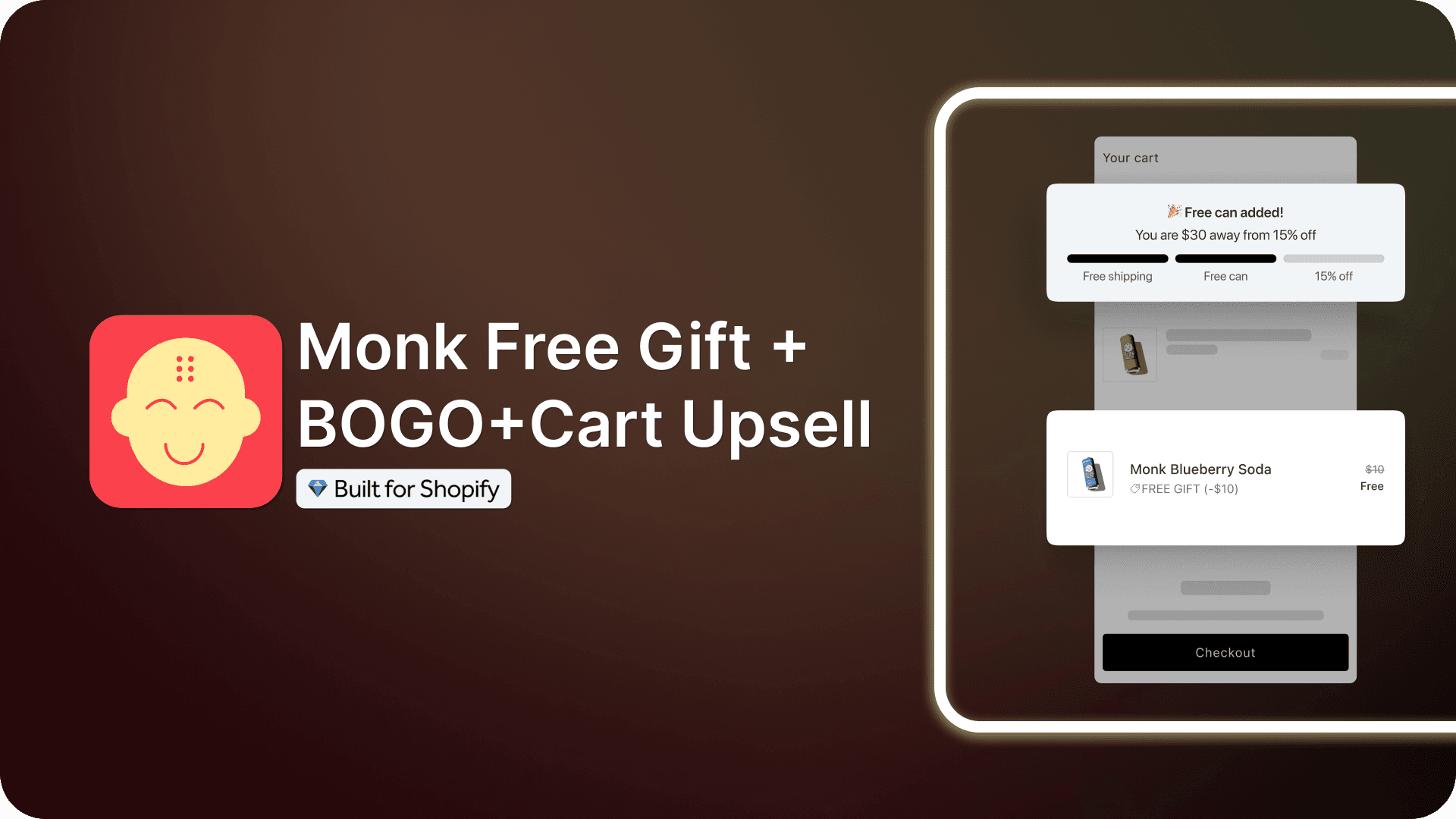
Monk Commerce is a unified conversion optimization app designed to manage free gifts, upsells, cross-sells, cart incentives, and Buy One Get One Free offers on Shopify in one system.
Monk focuses on increasing revenue across the entire buying journey, like product page, cart, checkout, and post-purchase, using a flexible eligibility engine and reward-based incentives.
All-in-one promotion and upsell engine with strong free gift and reward capabilities.
Key features
Free gift with purchase, BOGO, upsells, and cross-sells in one platform
Flexible eligibility rules (cart value, products, collections, customer tags, location, language, etc.)
Tiered rewards and dynamic cart progress bar
Offer placement across product page, cart, checkout, and post-purchase
Checkout offers (Shopify Plus support)
Full widget design customization
Campaign analytics and ROI tracking
Pricing
Table 1: Monk Commerce pricing plans
Plan | Price | Order limit | Key inclusions |
Start | $49/month | 0-1000 orders/month | Full feature access, all offer types, 7-day free trial |
Scale | $149/month | 1000+ orders/month | Full feature access, unlimited campaigns, 7-day free trial |
Development | Free | Dev/Sandbox stores | Full access for testing |
Pros
True all-in-one promotion system (free gifts, BOGO, upsells, cross-sells, rewards).
Highly flexible targeting engine for precise, personalized offers.
Supports offers across the full funnel (product page, cart, checkout, post-purchase).
Strong cart incentive tools, including tiered rewards and progress bars.
Deep design customization to match store branding.
Built-in campaign analytics and ROI tracking.
Cons
Feature-rich interface may feel complex for stores needing only simple upsells.
Initial setup requires rule configuration to unlock full personalization.
Bold Upsell
Bold Upsell is a Shopify-certified upsell app designed to increase AOV across product page, cart, checkout (Shopify Plus), and post-purchase. It combines manual funnels with AI-powered Smart Offers to deliver upsells, cross-sells, downsells, and order bumps throughout the buying journey.
Multi-stage funnel-based upselling with AI automation.
Key features
AI Smart Offers automatically generate personalized upsell and cross-sell recommendations.
Full-funnel placements across product page, cart, pre-purchase, checkout (Plus), and post-purchase.
Advanced funnel builder supports upsells, downsells, order bumps, Buy X Get Y, and true upsell upgrades.
Subscription upsells integrate with Bold Subscriptions for recurring revenue.
Performance analytics track conversions, ROI, and funnel effectiveness.
Pricing
Table 2: Bold Upsell pricing plans
Plan | Price | Key features |
Essential | Free (under 50 orders/month) | Core upsell features |
Standard | $25/month | Advanced reporting + post-purchase offers + conditional logic |
Complete | $50/month | Adds funnels + in-checkout offers (Shopify Plus) + priority support |
Enterprise | $500/month (billed annually) | All features + unlimited offer views + no SmartFlex fees |
Pros
True multi-stage upsell coverage (pre-purchase, checkout, post-purchase)
AI automation reduces manual configuration
Structured funnel builder supports complex offer flows
Subscription upsell capability increases lifetime value
Built-in ROI tracking and analytics
Cons
SmartFlex pricing increases costs based on offer views, requiring active monitoring.
Advanced funnel setup can feel complex, especially for new users.
App scripts may conflict with certain themes or cart customizations.
Offers may occasionally fail to trigger as expected.
Candy Rack
Candy Rack is a design-focused upsell app built for seamless, native-looking offers across the product page, cart, checkout, and post-purchase. It emphasizes fast performance, strong visual integration, and flexible placement options.
Design-first upsell execution with full journey coverage.
Key features
Multi-placement coverage like product page, cart drawer, checkout, post-purchase
AI-powered product suggestions
Built-in slide cart with upsells
A/B testing via Intelligems integration
Theme-matching design customization
Multilingual support
Pricing
Table 3: Candy Rack pricing plans
Plan | Price | Order limit (per month) |
Trial & Dev | Free | For dev stores |
Starter | $39.99/month | 0–200 orders |
Growth | $59.99/month (or $575.88/year) | 201–500 orders |
Scale | $79.99/month (or $767.88/year) | 501–1,000 orders |
Pros
Covers the full purchase journey in one app (product → cart → checkout → post-purchase).
Fast slide cart performance.
Strong value for money, with reported revenue lift exceeding cost.
AI mode can generate upsells automatically.
Multiple placement options with ongoing expansion.
Blends seamlessly with the store theme for native-looking offers.
Simple setup and user-friendly interface.
Cons
Multi-quantity discount recalculation may require manual review if item quantities change after accepting an upsell.
Wiser
Wiser is an AI-driven personalization engine that delivers behavior-based product recommendations across product pages, cart, checkout, post-purchase, popups, search, and email.
Broadest recommendation coverage with deep AI personalization.
Key features
AI-based recommendations using browsing behavior and order history
Full-store placement coverage for upsell cross-sell offers like product page, cart drawer, checkout, post-purchase, thank-you page
Frequently Bought Together & bundles
Cart drawer with upsells + free shipping bar
Smart popups (Wiser Pops)
Email recommendation blocks
Search & discovery recommendations
Analytics dashboard + API access
Multicurrency & multilingual support
Wide third-party integrations
Pricing
Table 4: Wiser pricing plans
Plan (Monthly order range) | Price |
0-50 orders | Free |
51-100 orders | $9/month |
101-300 orders | $19/month |
301-500 orders | $49/month |
Pros
Extremely broad placement coverage (store, cart, checkout, email, search, popups).
Strong AI personalization based on behavioral data.
Comprehensive recommendation system (bundles, FBT, add-ons, cart drawer).
Multilingual and multicurrency support
An extensive ecosystem
Cons
Pricing scales based on total monthly orders, not only revenue generated by recommendations.
Advanced features require paid plans.
Theme compatibility may require testing in some cases.
Billing approval is required before full access.
Honeycomb Upsell
Honeycomb Upsell is a funnel-based upsell app built for structured, multi-step conversion flows across the product page, cart, checkout (Shopify Plus), post-purchase, and thank-you page. It combines A/B testing, AI automation, and true one-click post-purchase upsells.
Funnel-driven upselling with built-in testing.
Key features
Multi-step funnel builder across product, cart, checkout (Plus), and post-purchase
True one-click post-purchase upsells with automatic order merging
Built-in A/B split testing
AI-powered product matching (Autopilot mode)
Discount stacking support
No theme code required
Pixel & tracking integrations
Recharge integration
Pricing
Table 5: Honeycomb Upsell pricing plans
Plan | Price | Funnel Views / Month |
Free | Free | 100 views |
Silver | $54.99/month | 2,000 views |
Gold | $109.99/month | 5,000 views |
Platinum | $169.99/month | Higher limits |
Pros
Structured funnel system (not just single-offer widgets).
True one-click post-purchase functionality.
Built-in A/B testing without third-party tools
Strong branding customization for seamless pop-ups
Supports personalized product cross-sells
Wide range of upsell and discount configurations
Cons
Pricing scales by funnel views, requiring traffic monitoring
Free plan includes branding
Checkout funnels require Shopify Plus
English-only language support
Aftersell
Aftersell is a leader among checkout upsell apps, focused on increasing AOV specifically after the payment is initiated. It combines one-click upsells, Smart Funnels powered by Rokt AI, customizable thank-you pages, and Shopify Plus checkout enhancements.
Post-purchase specialist with AI-powered monetization and ad network access.
Key features
True one-click post-purchase upsell & downsell (no payment re-entry)
Smart Funnels (Rokt AI) for personalized upsell, cross-sell, or ad offers
Advanced targeting rules (product, cart value, tags, language, UTM, etc.)
Custom thank-you pages (reviews, FAQs, cross-sells, ads)
Checkout upsells & social proof (Shopify Plus only)
Mobile-optimized experience
Advanced analytics dashboard
Rokt ad network access for additional revenue stream
Built-in A/B testing
Pricing
Table 6: Aftersell pricing plans
Plan (Monthly order limit) | Price |
Development | Free |
0-500 orders | $34.99/month |
501-1000 orders | $54.99/month |
1001-2000 orders | $99.99/month |
Pros
Strong post-purchase performance focus.
True one-click functionality with seamless order merging.
Advanced personalization rules for precise targeting.
Native-feeling Shopify integration.
Polished UI and brand customization.
Built-in A/B testing for optimization.
Cons
Prices based on total monthly store orders, not just upsell-generated sales.
Checkout upsells limited to Shopify Plus.
Express checkout methods (Apple Pay, Shop Pay, Google Pay) may bypass post-purchase offers.
Limited manual control for precise product-to-product pairing on product pages.
Multi-language support is limited.
Some button translations may require manual adjustment, though support assists quickly.
Design customization options could be expanded further for advanced layout flexibility.
Variant display limitations may affect high-variant product stores.
Bundler
Bundle is a bundle-focused upsell app designed for structured discount strategies like quantity breaks, mix & match bundles, and BUY X Get Y offers. It is one of the most versatile Shopify bundle apps, built for stores prioritizing volume-based pricing and campaign-driven bundle sales.
Highly flexible Shopify bundle app for volume discounts and structured bundle campaigns.
Key features
Classic bundles, Mix & Match, and tiered bundles
Quantity breaks & volume discounts
Buy X Get Y offers
Multiple discount types (percentage, fixed amount, fixed price)
Bundle landing pages & shortcodes
Auto-apply discounts at checkout
Subscription bundle compatibility
Shopify POS support
Bundle analytics (Executive plan)
Pricing
Table 7: Bundle app pricing plans
Plan | Price | Key difference |
Free | Free | Unlimited bundles, volume discounts, and Buy X Get Y. Best for basic bundles. |
Premium | $9.99/month | Mix & Match bundles, custom landing pages, and funnel upsells. Best for flexible "build your own" offers. |
Executive | $19.99/month | Advanced analytics, including revenue tracking, conversion graphs, and popular bundle insights. |
Pros
Extensive bundle variety (Classic, Mix & Match, tiered, BOGO, volume discounts).
Strong discount flexibility with multiple pricing structures.
Auto-apply discounts simplify checkout experience.
Unlimited revenue even on free plan.
Responsive support for layout and branding adjustments.
Cons
Interface feels complex initially, especially for new users.
Subscription and bundle combinations can cause compatibility issues.
Advanced bundle configurations require higher-tier plans.
Appbrew
Appbrew is an AI-native mobile app builder for e-commerce brands that want fully customized iOS and Android apps without developers. It focuses on personalization, automation, retention marketing, and deep analytics to drive higher mobile conversion rates.
Enterprise-grade AI mobile app platform for scaling brands.
Key features
Native iOS & Android apps
Milo (AI growth assistant) for personalization & automation
Unlimited push notifications
Highly customizable UI aligned with brand guidelines
Advanced analytics with drop-off tracking
App-only offers & discount engine
100+ integrations (CRM, subscriptions, analytics, etc.)
Video shopping module
Native subscription management (Enterprise)
Multi-currency & multi-language support (Enterprise)
Dedicated CSM (Enterprise)
Pricing
Table 8: Appbrew pricing plans
Plan | Price | Key difference |
Appbrew Pro | $499/month | Core AI app features + integrations |
Appbrew Enterprise | $999/month | Custom design + global support + subscription engine + dedicated CSM |
Pros
No-code backend management necessary (easy updates without developers).
Deep UI customization flexibility.
Advanced AI personalization capabilities.
Strong integrations ecosystem (100+ tools).
Robust analytics with behavioral tracking.
Custom feature development available.
Cons
Premium pricing (starts at 499$ per month)
Some modules offer limited functional flexibility.
Upcart
Upcart is a custom slide cart designed to turn the cart drawer into a conversion-focused revenue layer. It focuses entirely on in-cart upsells, rewards, add-ons, and deep design control without redirects or stacking multiple apps.
Cart optimization app focused on in-cart upsells, rewards, and cart value boosters.
Key features
In-cart upsells & cross-sells
Sticky slide cart across the store
Rewards module (free shipping bar & progress goals)
In-cart discounts & free gift offers
Add-ons module for complementary products
Full design control (HTML, CSS, JSX support)
Cart announcements module
Optimized for desktop & mobile
Pricing
Table 9: Upcart pricing plans
Plan (Monthly order limit) | Price |
Development | Free |
0-200 orders | $29.99/month |
201-500 orders | $34.99/month |
501-1000 orders | $54.99/month |
Pros
Strong in-cart conversion toolkit (upsells, rewards, add-ons, announcements).
Fast front-end performance, often faster than alternative cart apps.
Replaces Shopify’s native cart cleanly with no stacking or overlay conflicts.
Excellent design flexibility and customization control.
Outstanding support team with proactive assistance.
Reliable ongoing performance after setup.
Cons
Focuses only on cart optimization (no post-purchase or product-page funnels).
Limited built-in multilingual support
May require theme compatibility testing.
Free gift module may need monitoring for consistency.
Limespot
Limespot is an AI-driven personalization and recommendation platform designed to increase AOV through bundles, upsells, cross-sells, and related product suggestions across the entire customer journey, from homepage to checkout and post-purchase. LimeSpot focuses on data-driven recommendations, audience segmentation, and automated bundle creation to deliver personalized shopping experiences.
AI personalization engine that drives upsells, bundles, and recommendations across the full purchase journey
Key features
AI recommendations across all storefront pages
Bundles and frequently bought together offers
Upsells on cart, checkout, and post-purchase
Audience segmentation and personalization (Max plan)
AI bundle and upsell builder
A/B testing and advanced analytics (Max plan)
Email and SMS personalization (Max plan)
70+ integrations with Shopify and marketing tools
Pricing
Table 10: Limespot pricing plans
Plan | Price | Basis | Key inclusions |
Turbo (Free tier) | Free | Up to 10 orders/month | Core recommendation features, dev store access |
Turbo (Paid tiers) | Starts $9.99/month | Scales by order volume | Unlimited recommendations, bundles, checkout & post-purchase offers |
Max | Starts $50/month | Scales by store revenue | Segmentation, advanced analytics, A/B testing, email/SMS personalization, advanced targeting |
Trial | 15-day free trial | - | Full feature testing |
Pros
Strong AI-driven upsell, cross-sell, and bundle recommendations
Full-funnel placement from product page to post-purchase
Advanced segmentation and personalization (Max plan)
Flexible widget customization to match store design
Broad integrations with Shopify and marketing tools
Cons
Slow load times were reported on some stores
Pricing increases with order volume or revenue
Advanced personalization and analytics are limited to the Max plan.
How to Choose the Right AOV App
Choosing the right AOV app depends on your products, customer journey, and the level of automation your store needs. The best Shopify sales tools should naturally optimize average order value without complicating operations or slowing the buying process.
Unified apps
Using different apps for Shopify BOGO deals, upsells, free gifts, and cart rewards can increase costs and slow down your store. It can also make your store harder to manage.
A unified app integrates all these features into your store, making it easier to run multiple campaigns and measure results without any overlap.
For example, Monk Free Gift + BOGO + Cart Upsell includes free gifts, BOGO offers, upsells, cross-sells, tiered progress bars, and discounts in one dashboard. This helps avoid app conflicts and keeps everything organized in one place.
Product type
Your product category determines which offers work best.
Stores selling personalized items, jewelry, or custom products benefit from apps that support bundling and customization, such as those that suggest matching accessories.
Apparel and home décor stores perform well with visual recommendations that show complete sets, such as suggesting matching cushions when someone buys a sofa cover.
Offering free gifts on Shopify store along with a tiered progress bar usually works well for industries like health supplements and nutrition, apparel and accessories, beauty and personal care etc.
Ease of setup
Some Average Order Value apps work immediately with minimal setup, while others offer advanced targeting but require more configuration. Simple apps are suitable for quick deployment, while advanced tools allow personalized offers based on customer behavior, which can improve conversions over time.
Customer journey placement
Consider whether the app lets you show the offers across all important stages of the customer journey, like the product page, cart, checkout, cart drawer, pop-ups, post-checkout, and home page.
Post-purchase and thank-you page upsells are especially effective because customers can accept additional products without interrupting checkout.
For example, after buying a laptop sleeve, customers can accept a one-click offer for a matching pouch.
Automation and integration
Apps that integrate with your inventory, fulfillment, or print-on-demand systems reduce manual work and prevent errors. Automated recommendations ensure customers see only relevant and available products.
For example, when a customer orders a custom T-shirt, the app can automatically suggest a matching printed mug.
Scalability
Choose an app that can support your store as it grows in product range and order volume. A scalable app can manage offers across many products, campaigns, and sales channels, ensuring consistent e-commerce revenue growth without needing to switch tools later.
Customization
AOV apps should help you earn more without making the checkout process slow or confusing. Poor design or too many pop-ups can reduce conversions. Customization lets you control how offers look in your store.
Highly customizable apps like Monk work with Shopify’s native cart instead of replacing it and allow you to fully customize offer displays and banners to clearly showcase the offers to the customers. Using Monk, you can change the message text, font, style, size and media for higher visibility.
Common Mistakes to Avoid When Using an AOV app
AOV apps increase revenue by showing relevant add-ons, bundles, and upgrades. However, poor execution can reduce conversions or create friction in the buying experience. Avoid these common mistakes to get better results:
Showing too many offers
Displaying offers on every step, like the product page, cart, checkout, and post-purchase, can overwhelm customers. Too many offers can distract them and increase the chance of cart abandonment.
Limit offers to one or two key placements, such as one before checkout and one after purchase, depending on your product type and customer purchase patterns, to keep the buying process clear and effective.
Making offers complicated
Customers should understand the benefit immediately. Complex bundle rules, layered discounts, or long explanations reduce conversions. Leverage banners to clearly showcase the offer message across your store.
For example, a simple message like “Add this for 20% off” performs better than multi-tier discount conditions.
Offering irrelevant products
Irrelevant recommendations reduce trust and engagement. Offers should complement the original purchase or solve a related need.
For example, suggesting a phone case after someone buys a phone makes sense, while suggesting a cap does not.
Weak or ineffective bundling
Even the most advanced product bundling tools will not work if the bundle does not offer clear value to the customer. Grouping unrelated products or combining items without clear savings reduces customer interest and makes bundles less effective.
Effective bundles combine complementary products, such as a camera with a memory card and case.
Poor offer placement
Placement affects acceptance rates. Showing add-ons too early may interrupt buying intent, while placing them too late may reduce visibility. Cart and post-purchase placements often work well because customers are already committed to buying.
Overusing discounts and promotions
Constant sitewide discounts train customers to wait for deals instead of buying at full price. Use targeted incentives such as bundle pricing, volume discounts, or conditional free shipping to increase order size without reducing perceived value.
Not testing and optimizing offers
Installing an AOV app is not enough. Test different products, placements, and messaging to see what works best. Track metrics such as AOV, conversion rate, and revenue impact, and keep the versions that perform better.
Showing out-of-stock or unavailable products
Recommending out-of-stock items prevents customers from adding them to their order and leads to a broken user experience. Always keep your offers synced with inventory and review them regularly, especially for seasonal or fast-selling products.
Complicated checkout or add-on process
A slow or confusing checkout discourages customers from accepting add-ons. Extra steps, hidden fees, or requiring customers to re-enter payment details reduce conversions. AOV apps should enable simple, one-click additions that do not interrupt checkout.
Pricing add-ons too high
Add-ons work best when they feel like a natural extension of the original purchase. If the price jump is too large, most customers will decline unless it is a clear upgrade. Lower-priced complementary products usually convert more consistently.
Best Practices to Increase AOV
Increasing Average Order Value (AOV) is about helping customers buy more in a simple and natural way. When buyers can easily find products and see relevant add-ons or incentives, they are more likely to increase their order size.
Improve product discovery
Customers are more likely to add extra items when they can quickly find what they need. Clear navigation, useful filters, and complete product information help buyers explore related products and increase their order size.
Use bundles, cross-sells, and recommendations
Showing complementary products encourages customers to buy more in a single order. For example, suggesting matching accessories, upgrades, or frequently bought-together items helps customers see the full solution instead of buying just one product.
Offer post-purchase upsells
After checkout, customers are more open to adding relevant products because the main purchase is already complete. One-click post-purchase offers, such as adding a protective case after buying a device, can increase order value without interrupting checkout.
Use incentives like thresholds or volume discounts
Clear incentives encourage customers to spend more. For example, free shipping above a certain amount or lower per-unit pricing for higher quantities motivates customers to add extra items.
Simplify checkout and payment
A smooth checkout process makes customers more comfortable placing larger orders. Features like saved payment methods, multiple payment options, and fast checkout reduce friction and support higher order values.
Build trust and long-term value
Customers spend more when they trust your product quality and brand. Clear information, reliable products, and a positive buying experience make customers more willing to add upgrades and additional items.
Read our AOV for E-commerce guide for more practical tips on how to improve AOV.
Conclusion
Not every AOV app works the same for every store. Some focus on product pages, others on cart, checkout, or post-purchase offers.
Choose an app based on where you want to increase AOV and whether it generates more revenue than it costs.
Start with one app and one clear offer. Measure the results, and keep only what consistently increases your revenue.
FAQs
What is the average order value?
Average Order Value (AOV) is the average amount a customer spends per transaction. It’s calculated by dividing total revenue by the number of orders.
How do upsell apps work?
Upsell apps show customers relevant add-ons, upgrades, or bundles before or after checkout, in the cart, on the checkout page, or even as a pop-up to increase the total cart value.
Do bundle apps increase sales?
Yes, bundle apps can increase sales by encouraging customers to buy complementary products together at a perceived discount, depending on the industry and the product type.
What is a post-purchase offer?
A post-purchase offer is an upsell shown immediately after checkout, allowing customers to add items without re-entering payment details. A post-purchase offer can be added as a pop-up or in the Thank you page of your Shopify store.
Which apps work with all themes?
Most modern Shopify upsell and AOV apps work with most Shopify themes, but compatibility depends on how the app injects scripts and whether it supports your checkout setup. For example, Monk blends seamlessly with your theme's native cart and does not take over the cart.
Are AOV apps worth the price?
They are worth it if the additional revenue they generate exceeds the monthly app cost and does not reduce conversion rate. It also depends on your offer strategy and execution.
Can I track AOV improvements?
Yes, you can track AOV changes inside your store analytics by comparing revenue divided by orders before and after installing the app. Most AOV apps like Monk provide offer-level analytics for better tracking.
Do free shipping bars boost AOV?
Yes, free shipping bars often increase AOV by encouraging customers to add more items to reach the minimum threshold.
Top 10 Shopify Apps to Raise Average Order Value
Summary
Average Order Value (AOV) is the average spend per order and is used to increase revenue without increasing traffic. Shopify stores improve AOV using upsells, cross-sells, bundles, and post-purchase offers that encourage additional purchases. This article reviews leading Shopify AOV apps including Monk Commerce, Bold Upsell, Candy Rack, Wiser, Honeycomb Upsell, Aftersell, Bundler, Appbrew, Upcart, and LimeSpot. These apps offer features like product recommendations, cart incentives, checkout offers, and post-purchase upsells with different levels of automation and personalization. It also covers how to choose an app based on product type, setup ease, scalability, and customer journey placement, along with best practices like relevant offers, simple messaging, proper placement, and testing.
Average Order Value (AOV) is the average amount customers spend each time they place an order in a store. Increasing AOV is a key part of average order optimization, helping you earn more revenue from each customer without needing more traffic.
Upsells, cross-sells, bundles, and post-purchase offers encourage customers to add relevant products to their order. The right Shopify upsell apps make this easy and increase order value without disrupting the buying experience.
In this article, we compare leading Shopify apps to increase Average Order Value, explain their strengths and limitations, and help you choose the right solution for your store’s growth stage. We’ll also discuss some practical strategies to increase AOV and the common mistakes to avoid when using upsell apps.
10 Top Shopify Apps to Raise Average Order Value
Monk Commerce
Monk Commerce is a unified conversion optimization app designed to manage free gifts, upsells, cross-sells, cart incentives, and Buy One Get One Free offers on Shopify in one system.
Monk focuses on increasing revenue across the entire buying journey, like product page, cart, checkout, and post-purchase, using a flexible eligibility engine and reward-based incentives.
All-in-one promotion and upsell engine with strong free gift and reward capabilities.
Key features
Free gift with purchase, BOGO, upsells, and cross-sells in one platform
Flexible eligibility rules (cart value, products, collections, customer tags, location, language, etc.)
Tiered rewards and dynamic cart progress bar
Offer placement across product page, cart, checkout, and post-purchase
Checkout offers (Shopify Plus support)
Full widget design customization
Campaign analytics and ROI tracking
Pricing
Table 1: Monk Commerce pricing plans
Plan | Price | Order limit | Key inclusions |
Start | $49/month | 0-1000 orders/month | Full feature access, all offer types, 7-day free trial |
Scale | $149/month | 1000+ orders/month | Full feature access, unlimited campaigns, 7-day free trial |
Development | Free | Dev/Sandbox stores | Full access for testing |
Pros
True all-in-one promotion system (free gifts, BOGO, upsells, cross-sells, rewards).
Highly flexible targeting engine for precise, personalized offers.
Supports offers across the full funnel (product page, cart, checkout, post-purchase).
Strong cart incentive tools, including tiered rewards and progress bars.
Deep design customization to match store branding.
Built-in campaign analytics and ROI tracking.
Cons
Feature-rich interface may feel complex for stores needing only simple upsells.
Initial setup requires rule configuration to unlock full personalization.
Bold Upsell
Bold Upsell is a Shopify-certified upsell app designed to increase AOV across product page, cart, checkout (Shopify Plus), and post-purchase. It combines manual funnels with AI-powered Smart Offers to deliver upsells, cross-sells, downsells, and order bumps throughout the buying journey.
Multi-stage funnel-based upselling with AI automation.
Key features
AI Smart Offers automatically generate personalized upsell and cross-sell recommendations.
Full-funnel placements across product page, cart, pre-purchase, checkout (Plus), and post-purchase.
Advanced funnel builder supports upsells, downsells, order bumps, Buy X Get Y, and true upsell upgrades.
Subscription upsells integrate with Bold Subscriptions for recurring revenue.
Performance analytics track conversions, ROI, and funnel effectiveness.
Pricing
Table 2: Bold Upsell pricing plans
Plan | Price | Key features |
Essential | Free (under 50 orders/month) | Core upsell features |
Standard | $25/month | Advanced reporting + post-purchase offers + conditional logic |
Complete | $50/month | Adds funnels + in-checkout offers (Shopify Plus) + priority support |
Enterprise | $500/month (billed annually) | All features + unlimited offer views + no SmartFlex fees |
Pros
True multi-stage upsell coverage (pre-purchase, checkout, post-purchase)
AI automation reduces manual configuration
Structured funnel builder supports complex offer flows
Subscription upsell capability increases lifetime value
Built-in ROI tracking and analytics
Cons
SmartFlex pricing increases costs based on offer views, requiring active monitoring.
Advanced funnel setup can feel complex, especially for new users.
App scripts may conflict with certain themes or cart customizations.
Offers may occasionally fail to trigger as expected.
Candy Rack
Candy Rack is a design-focused upsell app built for seamless, native-looking offers across the product page, cart, checkout, and post-purchase. It emphasizes fast performance, strong visual integration, and flexible placement options.
Design-first upsell execution with full journey coverage.
Key features
Multi-placement coverage like product page, cart drawer, checkout, post-purchase
AI-powered product suggestions
Built-in slide cart with upsells
A/B testing via Intelligems integration
Theme-matching design customization
Multilingual support
Pricing
Table 3: Candy Rack pricing plans
Plan | Price | Order limit (per month) |
Trial & Dev | Free | For dev stores |
Starter | $39.99/month | 0–200 orders |
Growth | $59.99/month (or $575.88/year) | 201–500 orders |
Scale | $79.99/month (or $767.88/year) | 501–1,000 orders |
Pros
Covers the full purchase journey in one app (product → cart → checkout → post-purchase).
Fast slide cart performance.
Strong value for money, with reported revenue lift exceeding cost.
AI mode can generate upsells automatically.
Multiple placement options with ongoing expansion.
Blends seamlessly with the store theme for native-looking offers.
Simple setup and user-friendly interface.
Cons
Multi-quantity discount recalculation may require manual review if item quantities change after accepting an upsell.
Wiser
Wiser is an AI-driven personalization engine that delivers behavior-based product recommendations across product pages, cart, checkout, post-purchase, popups, search, and email.
Broadest recommendation coverage with deep AI personalization.
Key features
AI-based recommendations using browsing behavior and order history
Full-store placement coverage for upsell cross-sell offers like product page, cart drawer, checkout, post-purchase, thank-you page
Frequently Bought Together & bundles
Cart drawer with upsells + free shipping bar
Smart popups (Wiser Pops)
Email recommendation blocks
Search & discovery recommendations
Analytics dashboard + API access
Multicurrency & multilingual support
Wide third-party integrations
Pricing
Table 4: Wiser pricing plans
Plan (Monthly order range) | Price |
0-50 orders | Free |
51-100 orders | $9/month |
101-300 orders | $19/month |
301-500 orders | $49/month |
Pros
Extremely broad placement coverage (store, cart, checkout, email, search, popups).
Strong AI personalization based on behavioral data.
Comprehensive recommendation system (bundles, FBT, add-ons, cart drawer).
Multilingual and multicurrency support
An extensive ecosystem
Cons
Pricing scales based on total monthly orders, not only revenue generated by recommendations.
Advanced features require paid plans.
Theme compatibility may require testing in some cases.
Billing approval is required before full access.
Honeycomb Upsell
Honeycomb Upsell is a funnel-based upsell app built for structured, multi-step conversion flows across the product page, cart, checkout (Shopify Plus), post-purchase, and thank-you page. It combines A/B testing, AI automation, and true one-click post-purchase upsells.
Funnel-driven upselling with built-in testing.
Key features
Multi-step funnel builder across product, cart, checkout (Plus), and post-purchase
True one-click post-purchase upsells with automatic order merging
Built-in A/B split testing
AI-powered product matching (Autopilot mode)
Discount stacking support
No theme code required
Pixel & tracking integrations
Recharge integration
Pricing
Table 5: Honeycomb Upsell pricing plans
Plan | Price | Funnel Views / Month |
Free | Free | 100 views |
Silver | $54.99/month | 2,000 views |
Gold | $109.99/month | 5,000 views |
Platinum | $169.99/month | Higher limits |
Pros
Structured funnel system (not just single-offer widgets).
True one-click post-purchase functionality.
Built-in A/B testing without third-party tools
Strong branding customization for seamless pop-ups
Supports personalized product cross-sells
Wide range of upsell and discount configurations
Cons
Pricing scales by funnel views, requiring traffic monitoring
Free plan includes branding
Checkout funnels require Shopify Plus
English-only language support
Aftersell
Aftersell is a leader among checkout upsell apps, focused on increasing AOV specifically after the payment is initiated. It combines one-click upsells, Smart Funnels powered by Rokt AI, customizable thank-you pages, and Shopify Plus checkout enhancements.
Post-purchase specialist with AI-powered monetization and ad network access.
Key features
True one-click post-purchase upsell & downsell (no payment re-entry)
Smart Funnels (Rokt AI) for personalized upsell, cross-sell, or ad offers
Advanced targeting rules (product, cart value, tags, language, UTM, etc.)
Custom thank-you pages (reviews, FAQs, cross-sells, ads)
Checkout upsells & social proof (Shopify Plus only)
Mobile-optimized experience
Advanced analytics dashboard
Rokt ad network access for additional revenue stream
Built-in A/B testing
Pricing
Table 6: Aftersell pricing plans
Plan (Monthly order limit) | Price |
Development | Free |
0-500 orders | $34.99/month |
501-1000 orders | $54.99/month |
1001-2000 orders | $99.99/month |
Pros
Strong post-purchase performance focus.
True one-click functionality with seamless order merging.
Advanced personalization rules for precise targeting.
Native-feeling Shopify integration.
Polished UI and brand customization.
Built-in A/B testing for optimization.
Cons
Prices based on total monthly store orders, not just upsell-generated sales.
Checkout upsells limited to Shopify Plus.
Express checkout methods (Apple Pay, Shop Pay, Google Pay) may bypass post-purchase offers.
Limited manual control for precise product-to-product pairing on product pages.
Multi-language support is limited.
Some button translations may require manual adjustment, though support assists quickly.
Design customization options could be expanded further for advanced layout flexibility.
Variant display limitations may affect high-variant product stores.
Bundler
Bundle is a bundle-focused upsell app designed for structured discount strategies like quantity breaks, mix & match bundles, and BUY X Get Y offers. It is one of the most versatile Shopify bundle apps, built for stores prioritizing volume-based pricing and campaign-driven bundle sales.
Highly flexible Shopify bundle app for volume discounts and structured bundle campaigns.
Key features
Classic bundles, Mix & Match, and tiered bundles
Quantity breaks & volume discounts
Buy X Get Y offers
Multiple discount types (percentage, fixed amount, fixed price)
Bundle landing pages & shortcodes
Auto-apply discounts at checkout
Subscription bundle compatibility
Shopify POS support
Bundle analytics (Executive plan)
Pricing
Table 7: Bundle app pricing plans
Plan | Price | Key difference |
Free | Free | Unlimited bundles, volume discounts, and Buy X Get Y. Best for basic bundles. |
Premium | $9.99/month | Mix & Match bundles, custom landing pages, and funnel upsells. Best for flexible "build your own" offers. |
Executive | $19.99/month | Advanced analytics, including revenue tracking, conversion graphs, and popular bundle insights. |
Pros
Extensive bundle variety (Classic, Mix & Match, tiered, BOGO, volume discounts).
Strong discount flexibility with multiple pricing structures.
Auto-apply discounts simplify checkout experience.
Unlimited revenue even on free plan.
Responsive support for layout and branding adjustments.
Cons
Interface feels complex initially, especially for new users.
Subscription and bundle combinations can cause compatibility issues.
Advanced bundle configurations require higher-tier plans.
Appbrew
Appbrew is an AI-native mobile app builder for e-commerce brands that want fully customized iOS and Android apps without developers. It focuses on personalization, automation, retention marketing, and deep analytics to drive higher mobile conversion rates.
Enterprise-grade AI mobile app platform for scaling brands.
Key features
Native iOS & Android apps
Milo (AI growth assistant) for personalization & automation
Unlimited push notifications
Highly customizable UI aligned with brand guidelines
Advanced analytics with drop-off tracking
App-only offers & discount engine
100+ integrations (CRM, subscriptions, analytics, etc.)
Video shopping module
Native subscription management (Enterprise)
Multi-currency & multi-language support (Enterprise)
Dedicated CSM (Enterprise)
Pricing
Table 8: Appbrew pricing plans
Plan | Price | Key difference |
Appbrew Pro | $499/month | Core AI app features + integrations |
Appbrew Enterprise | $999/month | Custom design + global support + subscription engine + dedicated CSM |
Pros
No-code backend management necessary (easy updates without developers).
Deep UI customization flexibility.
Advanced AI personalization capabilities.
Strong integrations ecosystem (100+ tools).
Robust analytics with behavioral tracking.
Custom feature development available.
Cons
Premium pricing (starts at 499$ per month)
Some modules offer limited functional flexibility.
Upcart
Upcart is a custom slide cart designed to turn the cart drawer into a conversion-focused revenue layer. It focuses entirely on in-cart upsells, rewards, add-ons, and deep design control without redirects or stacking multiple apps.
Cart optimization app focused on in-cart upsells, rewards, and cart value boosters.
Key features
In-cart upsells & cross-sells
Sticky slide cart across the store
Rewards module (free shipping bar & progress goals)
In-cart discounts & free gift offers
Add-ons module for complementary products
Full design control (HTML, CSS, JSX support)
Cart announcements module
Optimized for desktop & mobile
Pricing
Table 9: Upcart pricing plans
Plan (Monthly order limit) | Price |
Development | Free |
0-200 orders | $29.99/month |
201-500 orders | $34.99/month |
501-1000 orders | $54.99/month |
Pros
Strong in-cart conversion toolkit (upsells, rewards, add-ons, announcements).
Fast front-end performance, often faster than alternative cart apps.
Replaces Shopify’s native cart cleanly with no stacking or overlay conflicts.
Excellent design flexibility and customization control.
Outstanding support team with proactive assistance.
Reliable ongoing performance after setup.
Cons
Focuses only on cart optimization (no post-purchase or product-page funnels).
Limited built-in multilingual support
May require theme compatibility testing.
Free gift module may need monitoring for consistency.
Limespot
Limespot is an AI-driven personalization and recommendation platform designed to increase AOV through bundles, upsells, cross-sells, and related product suggestions across the entire customer journey, from homepage to checkout and post-purchase. LimeSpot focuses on data-driven recommendations, audience segmentation, and automated bundle creation to deliver personalized shopping experiences.
AI personalization engine that drives upsells, bundles, and recommendations across the full purchase journey
Key features
AI recommendations across all storefront pages
Bundles and frequently bought together offers
Upsells on cart, checkout, and post-purchase
Audience segmentation and personalization (Max plan)
AI bundle and upsell builder
A/B testing and advanced analytics (Max plan)
Email and SMS personalization (Max plan)
70+ integrations with Shopify and marketing tools
Pricing
Table 10: Limespot pricing plans
Plan | Price | Basis | Key inclusions |
Turbo (Free tier) | Free | Up to 10 orders/month | Core recommendation features, dev store access |
Turbo (Paid tiers) | Starts $9.99/month | Scales by order volume | Unlimited recommendations, bundles, checkout & post-purchase offers |
Max | Starts $50/month | Scales by store revenue | Segmentation, advanced analytics, A/B testing, email/SMS personalization, advanced targeting |
Trial | 15-day free trial | - | Full feature testing |
Pros
Strong AI-driven upsell, cross-sell, and bundle recommendations
Full-funnel placement from product page to post-purchase
Advanced segmentation and personalization (Max plan)
Flexible widget customization to match store design
Broad integrations with Shopify and marketing tools
Cons
Slow load times were reported on some stores
Pricing increases with order volume or revenue
Advanced personalization and analytics are limited to the Max plan.
How to Choose the Right AOV App
Choosing the right AOV app depends on your products, customer journey, and the level of automation your store needs. The best Shopify sales tools should naturally optimize average order value without complicating operations or slowing the buying process.
Unified apps
Using different apps for Shopify BOGO deals, upsells, free gifts, and cart rewards can increase costs and slow down your store. It can also make your store harder to manage.
A unified app integrates all these features into your store, making it easier to run multiple campaigns and measure results without any overlap.
For example, Monk Free Gift + BOGO + Cart Upsell includes free gifts, BOGO offers, upsells, cross-sells, tiered progress bars, and discounts in one dashboard. This helps avoid app conflicts and keeps everything organized in one place.
Product type
Your product category determines which offers work best.
Stores selling personalized items, jewelry, or custom products benefit from apps that support bundling and customization, such as those that suggest matching accessories.
Apparel and home décor stores perform well with visual recommendations that show complete sets, such as suggesting matching cushions when someone buys a sofa cover.
Offering free gifts on Shopify store along with a tiered progress bar usually works well for industries like health supplements and nutrition, apparel and accessories, beauty and personal care etc.
Ease of setup
Some Average Order Value apps work immediately with minimal setup, while others offer advanced targeting but require more configuration. Simple apps are suitable for quick deployment, while advanced tools allow personalized offers based on customer behavior, which can improve conversions over time.
Customer journey placement
Consider whether the app lets you show the offers across all important stages of the customer journey, like the product page, cart, checkout, cart drawer, pop-ups, post-checkout, and home page.
Post-purchase and thank-you page upsells are especially effective because customers can accept additional products without interrupting checkout.
For example, after buying a laptop sleeve, customers can accept a one-click offer for a matching pouch.
Automation and integration
Apps that integrate with your inventory, fulfillment, or print-on-demand systems reduce manual work and prevent errors. Automated recommendations ensure customers see only relevant and available products.
For example, when a customer orders a custom T-shirt, the app can automatically suggest a matching printed mug.
Scalability
Choose an app that can support your store as it grows in product range and order volume. A scalable app can manage offers across many products, campaigns, and sales channels, ensuring consistent e-commerce revenue growth without needing to switch tools later.
Customization
AOV apps should help you earn more without making the checkout process slow or confusing. Poor design or too many pop-ups can reduce conversions. Customization lets you control how offers look in your store.
Highly customizable apps like Monk work with Shopify’s native cart instead of replacing it and allow you to fully customize offer displays and banners to clearly showcase the offers to the customers. Using Monk, you can change the message text, font, style, size and media for higher visibility.
Common Mistakes to Avoid When Using an AOV app
AOV apps increase revenue by showing relevant add-ons, bundles, and upgrades. However, poor execution can reduce conversions or create friction in the buying experience. Avoid these common mistakes to get better results:
Showing too many offers
Displaying offers on every step, like the product page, cart, checkout, and post-purchase, can overwhelm customers. Too many offers can distract them and increase the chance of cart abandonment.
Limit offers to one or two key placements, such as one before checkout and one after purchase, depending on your product type and customer purchase patterns, to keep the buying process clear and effective.
Making offers complicated
Customers should understand the benefit immediately. Complex bundle rules, layered discounts, or long explanations reduce conversions. Leverage banners to clearly showcase the offer message across your store.
For example, a simple message like “Add this for 20% off” performs better than multi-tier discount conditions.
Offering irrelevant products
Irrelevant recommendations reduce trust and engagement. Offers should complement the original purchase or solve a related need.
For example, suggesting a phone case after someone buys a phone makes sense, while suggesting a cap does not.
Weak or ineffective bundling
Even the most advanced product bundling tools will not work if the bundle does not offer clear value to the customer. Grouping unrelated products or combining items without clear savings reduces customer interest and makes bundles less effective.
Effective bundles combine complementary products, such as a camera with a memory card and case.
Poor offer placement
Placement affects acceptance rates. Showing add-ons too early may interrupt buying intent, while placing them too late may reduce visibility. Cart and post-purchase placements often work well because customers are already committed to buying.
Overusing discounts and promotions
Constant sitewide discounts train customers to wait for deals instead of buying at full price. Use targeted incentives such as bundle pricing, volume discounts, or conditional free shipping to increase order size without reducing perceived value.
Not testing and optimizing offers
Installing an AOV app is not enough. Test different products, placements, and messaging to see what works best. Track metrics such as AOV, conversion rate, and revenue impact, and keep the versions that perform better.
Showing out-of-stock or unavailable products
Recommending out-of-stock items prevents customers from adding them to their order and leads to a broken user experience. Always keep your offers synced with inventory and review them regularly, especially for seasonal or fast-selling products.
Complicated checkout or add-on process
A slow or confusing checkout discourages customers from accepting add-ons. Extra steps, hidden fees, or requiring customers to re-enter payment details reduce conversions. AOV apps should enable simple, one-click additions that do not interrupt checkout.
Pricing add-ons too high
Add-ons work best when they feel like a natural extension of the original purchase. If the price jump is too large, most customers will decline unless it is a clear upgrade. Lower-priced complementary products usually convert more consistently.
Best Practices to Increase AOV
Increasing Average Order Value (AOV) is about helping customers buy more in a simple and natural way. When buyers can easily find products and see relevant add-ons or incentives, they are more likely to increase their order size.
Improve product discovery
Customers are more likely to add extra items when they can quickly find what they need. Clear navigation, useful filters, and complete product information help buyers explore related products and increase their order size.
Use bundles, cross-sells, and recommendations
Showing complementary products encourages customers to buy more in a single order. For example, suggesting matching accessories, upgrades, or frequently bought-together items helps customers see the full solution instead of buying just one product.
Offer post-purchase upsells
After checkout, customers are more open to adding relevant products because the main purchase is already complete. One-click post-purchase offers, such as adding a protective case after buying a device, can increase order value without interrupting checkout.
Use incentives like thresholds or volume discounts
Clear incentives encourage customers to spend more. For example, free shipping above a certain amount or lower per-unit pricing for higher quantities motivates customers to add extra items.
Simplify checkout and payment
A smooth checkout process makes customers more comfortable placing larger orders. Features like saved payment methods, multiple payment options, and fast checkout reduce friction and support higher order values.
Build trust and long-term value
Customers spend more when they trust your product quality and brand. Clear information, reliable products, and a positive buying experience make customers more willing to add upgrades and additional items.
Read our AOV for E-commerce guide for more practical tips on how to improve AOV.
Conclusion
Not every AOV app works the same for every store. Some focus on product pages, others on cart, checkout, or post-purchase offers.
Choose an app based on where you want to increase AOV and whether it generates more revenue than it costs.
Start with one app and one clear offer. Measure the results, and keep only what consistently increases your revenue.
FAQs
What is the average order value?
Average Order Value (AOV) is the average amount a customer spends per transaction. It’s calculated by dividing total revenue by the number of orders.
How do upsell apps work?
Upsell apps show customers relevant add-ons, upgrades, or bundles before or after checkout, in the cart, on the checkout page, or even as a pop-up to increase the total cart value.
Do bundle apps increase sales?
Yes, bundle apps can increase sales by encouraging customers to buy complementary products together at a perceived discount, depending on the industry and the product type.
What is a post-purchase offer?
A post-purchase offer is an upsell shown immediately after checkout, allowing customers to add items without re-entering payment details. A post-purchase offer can be added as a pop-up or in the Thank you page of your Shopify store.
Which apps work with all themes?
Most modern Shopify upsell and AOV apps work with most Shopify themes, but compatibility depends on how the app injects scripts and whether it supports your checkout setup. For example, Monk blends seamlessly with your theme's native cart and does not take over the cart.
Are AOV apps worth the price?
They are worth it if the additional revenue they generate exceeds the monthly app cost and does not reduce conversion rate. It also depends on your offer strategy and execution.
Can I track AOV improvements?
Yes, you can track AOV changes inside your store analytics by comparing revenue divided by orders before and after installing the app. Most AOV apps like Monk provide offer-level analytics for better tracking.
Do free shipping bars boost AOV?
Yes, free shipping bars often increase AOV by encouraging customers to add more items to reach the minimum threshold.
Contents
Related Articles
How to Increase Average Order Value in E-commerce
10 Best Shopify Apps for Increasing Revenue
7 Best Shopify Discount Apps to Boost Sales in 2026
Get Monk Free Gift app for just $1/month this Black Friday
First month: $1 after your 7-day free trial. All features included. Offer live!
Claim offer now

Get Monk Free Gift app for just $1/month this Black Friday
First month: $1 after your 7-day free trial. All features included. Offer live!
Claim offer now
Get Monk Free Gift app for just $1/month this Black Friday
First month: $1 after your 7-day free trial. All features included. Offer live!
Claim offer now