20+ Best Free Gift Ideas for Shopify Stores That Drive More Sales
Summary
Free gifts are a growth strategy that use the Zero Price Effect to increase perceived value without reducing brand price integrity. Instead of discounts, merchants offer samples, digital downloads, accessories, or VIP perks to raise AOV, improve conversions, clear inventory, and drive product discovery. Effective strategies include tiered rewards based on cart value or quantity and matching gifts to purchase intent and margins. Success depends on relevance, low fulfillment cost, tracking AOV conversion and retention. Mistakes include irrelevant items, hidden offers, or complex redemption. Free gifts outperform discounts by preserving brand value and encouraging higher spend and repeat purchases.

Key Takeaways
Free gifts are a growth strategy that use the Zero Price Effect to increase perceived value without reducing brand price integrity. Instead of discounts, merchants offer samples, digital downloads, accessories, or VIP perks to raise AOV, improve conversions, clear inventory, and drive product discovery. Effective strategies include tiered rewards based on cart value or quantity and matching gifts to purchase intent and margins. Success depends on relevance, low fulfillment cost, tracking AOV conversion and retention. Mistakes include irrelevant items, hidden offers, or complex redemption. Free gifts outperform discounts by preserving brand value and encouraging higher spend and repeat purchases.
Deep discounts can accidentally make your customers think your products aren't worth the full price. But there’s a better way to win them over: free gifts.
Put simply, instead of lowering your brand's value, giving a gift protects your hard-earned equity while using the ‘power of free’ to make shoppers happy. It turns a standard checkout into a rewarding win for your customers.
In this guide, we explore 20+ of the best free gift ideas for Shopify stores to improve ROI and customer relationships.
Why Free Gifts are a Proven Ecommerce Growth Strategy
The 'Zero Price Effect' is a psychological phenomenon in which the presence of a free offer significantly increases demand for a product, often overriding rational evaluation of the gift's objective value. This shift in perception makes the overall purchase feel less like a cost and more like an immediate win.
From a business perspective, free gifts serve three primary functions:
Increased Average Order Value (AOV): Setting a clearly communicated spending threshold, such as 'Spend $75 to get a free gift,' you create a strong incentive for customers to add one or more items to their cart to qualify, effectively boosting immediate revenue.
Inventory Liquidation: Moving slow-moving stock or seasonal items without resorting to visible price markdowns or the damaging 'clearance' stigma as a strategic and brand-preserving way.
Product Discovery: Sending a high-quality sample of a related or new product line to allow customers to experience it risk-free, often leading directly to a full-priced purchase in their next order and fueling long-term customer value.
In essence, strategic gifting transforms short-term costs into long-term profit drivers and fundamentally strengthens customer relationships.
Best Free Gift Ideas for Shopify Stores (By Category)
The best gift isn't always the most expensive one; it’s the one that makes the most sense for your brand and your customer’s journey. To help you choose, we’ve broken down the best gifting strategies into four distinct categories: physical products, digital assets, branded merchandise, and exclusive experiences.
Product-Based Free Gift Ideas
Physical gifts provide a tangible connection to your brand and allow customers to experience your product range firsthand.
Sample products: Include a sachet or fun-size version of a bestseller to introduce customers to other parts of your catalog, which significantly increases the likelihood of full-size repeat purchases.
Mini or travel-size versions: Offer a TSA-friendly version of a core product, perfect for beauty and skincare brands, and keep your brand present during customers' travels.
Complementary accessories: Provide a microfiber eyewear cloth, a scoop for protein powder, or a dust bag for leather goods to enhance the utility and longevity of the main purchase.
Refill packs or consumables: Give a small refill of a high-frequency item to encourage the customer to return sooner and establish a regular buying habit.
Digital Free Gift Ideas
Digital gifts offer high perceived value with zero fulfillment costs, making them an incredibly scalable option for any niche.
Downloadable guides or PDFs: Create a ‘How to Style’ lookbook for fashion brands or a ‘Meal Prep Guide’ for kitchenware stores to position your brand as a helpful authority in the space.
Exclusive templates or planners: Offer digital assets like budget trackers, workout logs, or Notion templates that align with your niche, providing daily utility that keeps your brand top-of-mind.
Online tools or calculators: Provide access to a proprietary web tool, such as a personalized skincare routine builder or a macro calculator, to create a sticky experience that brings users back to your site.
Bonus digital content: Include a link to an unlisted YouTube masterclass or a curated Spotify playlist that aligns with the brand vibe to deepen the emotional connection.
Branding and Merch Free Gift Ideas
Using merchandise as gifts turns your happy customers into active brand ambassadors in their everyday lives.
Stickers, postcards, or thank-you cards: Add a touch of personality with high-quality stickers or a handwritten note to build emotional loyalty and encourage social media sharing.
Branded packaging inserts: Include a ‘Golden Ticket’ for a future discount or a high-quality brand magazine to bridge the gap between the first purchase and the second.
Limited-edition swag: Give away branded tote bags, enamel pins, or popsockets that turn your customers into walking advertisements and create a sense of belonging.
Experience-Based Free Gifts
Experience-based rewards foster a sense of exclusivity and community, driving long-term customer retention.
Free consultations: Offer a 15-minute Zoom styling session or a virtual ‘consult the expert’ slot for high-ticket items to reduce buyer remorse and build high-level trust.
Early access to sales: Grant ‘Skip the Line’ privileges for upcoming seasonal drops or Black Friday deals to make customers feel like valued VIP insiders.
Loyalty points or store credits: Add extra bits to their account that can only be redeemed on a subsequent visit, providing a direct financial incentive for their next purchase.
Membership or VIP access: Provide a one-month trial to a premium community or a private Facebook group to foster a sense of brand community and peer-to-peer engagement.
High-Converting Free Gift Ideas Based on Order Value
Strategy matters as much as the gift itself. To protect your margins while maximizing revenue, scale your rewards to match the customer’s investment. Using a logic-driven approach ensures that the incentive is always proportional to the commitment.
Free Gifts for Low AOV Orders
When margins are tight, focus on ‘low weight, high value’ items that don't significantly increase shipping costs. Digital downloads, exclusive guides, or lightweight accessories like stickers and enamel pins are ideal. The goal is to make the unboxing experience feel like a win without eating into your basic product margins.
Free Gifts for Medium AOV Thresholds
This is the prime territory for tiered gifting strategies. By setting specific milestones, you give the customer a tangible reason to keep clicking ‘Add to Cart.’ Common tiers include:
Spend $50: Get a branded sticker pack or accessory
Spend $100: Get the sticker pack + a travel-size bestseller
Free Gifts for High AOV or Bundle Purchases
For your biggest spenders, the gift should feel substantial and exclusive. A high-quality tote bag, a full-sized complementary product, or a VIP-only gift box conveys prestige. These rewards act as powerful psychological triggers for upsells, reminding users they are ‘only $20 away’ from a premium set.
Best Free Gift Ideas for Shopify Stores Using Monk Free Gift
Managing free gifts manually is a nightmare. This is where Monk Free Gift steps in, automating the entire logic so you can focus on brand building.

Cart-Based Free Gift Offers
Here are three poular ways you can offer cart-based gifts to your customers using Monk Commerce.
Item-Specific Triggers: Reward customers for choosing specific high-margin or featured products.
This strategy delivers an instant dopamine hit at the point of purchase, validating their choice and increasing the perceived value of the specific item without resorting to a price cut.
This is how the configured rule for this condition will look:
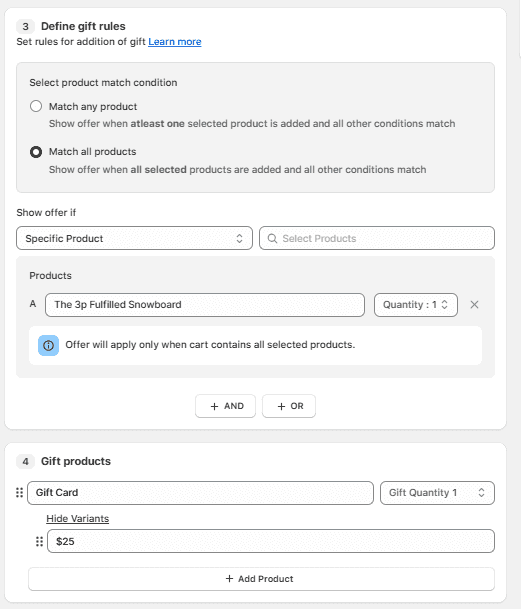
Simply put, if a customer has purchased The 3p Fulfilled Snowboard, and then they’d automatically receive a $25 gift card in their cart.
Get the 'cheapest item in the cart for free': Make the lowest-priced item in the cart free and encourage shoppers to grab that extra accessory or refill they were on the fence about, effectively clearing more inventory per transaction.
This is perfect for 'Buy 2 Get 1' or 'Mix and Match' promotions.
Here’s how the configured rule will look:
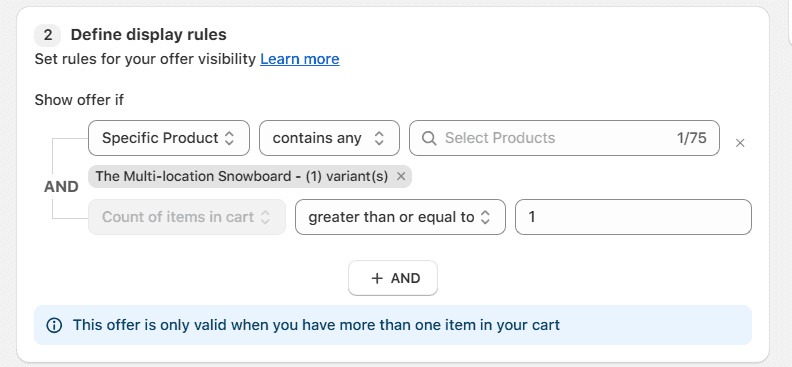
To reiterate, this means that the customer can buy any lower-priced item for free in the cart as long as one of the products is the Multi-location Snowboard.
📈Did You know? Gartner reports that a mass-market approach to promotions actually reduces conversion rates because offers feel irrelevant. Thus, personalizing the gift in the cart is no longer a nice-to-have; it's a requirement for ROI.
Value-Based Milestone Rewards: Gamify the shopping experience by setting spending goals.
When a customer sees they are only $10 away from a free gift, they are motivated and are far more likely to add a small upsell to their cart just to reach that satisfying 'reward unlocked' state.
This is how the configured rule will look:
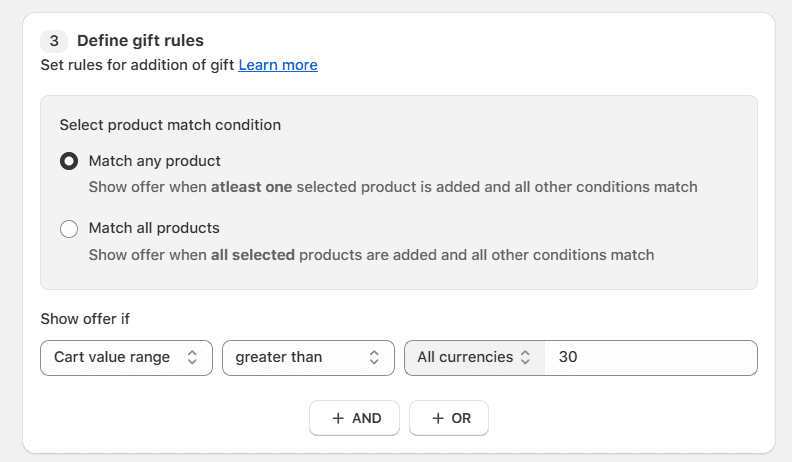
In simpler terms, the customer can get a free gift if their cart value is over $30 (applicable to all currencies).
Buy X Get Y Free Gift Strategies
You can mandate the purchase of one specific item (X) to receive a desirable gift (Y). This bypasses the customer's price sensitivity and encourages immediate conversion, making them feel they are receiving a reward rather than a marginal discount.
This is how the rules work in Monk Commerce for the BOGO strategy:
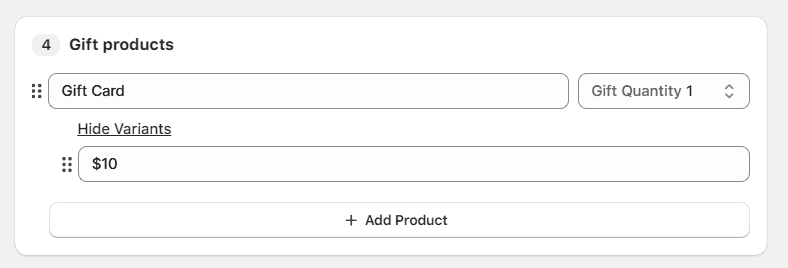
📌If you select a product-based condition, set the trigger to ‘Selling Plans Ski Wax’ with a quantity of 1, and then configure the gift product as a $10 gift card.
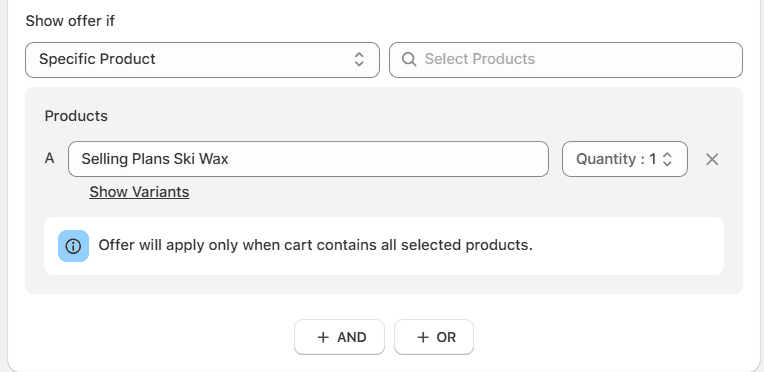
Here’s us selecting the gift card as the gift product:
📌Monk Commerce Tip: You can add gifts automatically to customers' carts at checkout—no manual steps required. This eliminates missed gifts, increases customer satisfaction, and improves conversion rates. 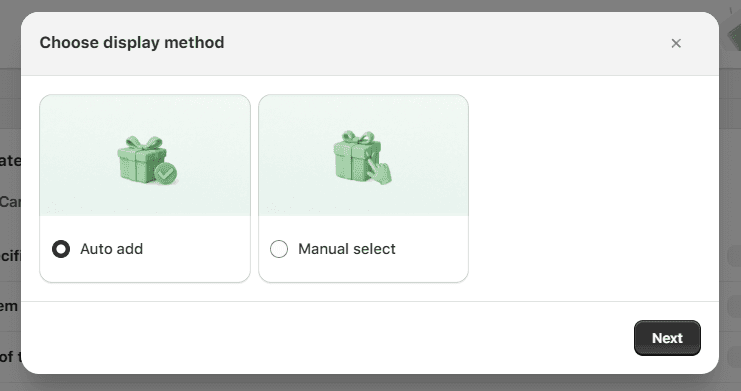 👀 How does this happen? Every time you configure a pre-existing template in Monk Commerce, you can choose between auto-gifting and manual addition. It’s preferable to choose the former so customers don't have to put in effort themselves or have a chance to rethink their purchase. |
How Monk Simplifies Gift Logic
Setting up complex gift offers doesn't require custom code or technical expertise with Monk Commerce. Here's what makes it simple:
Pre-built offer templates: Monk comes with pre-configured templates for common gifting strategies, including Buy One, Get One (BOGO), tiered gifts, and cart-based free gifts. Everything is already set up for you; you just need to activate it.
Three simple steps to follow:
Set up the rules: Define the conditions for your gift offer (product-based, cart value, customer tags, etc.)
Customize: Tailor the offer to match your store's needs
Test and activate: Preview the final product and go live
Unlike Shopify's native checkout, where gifts must be manually added (and are often missed), Monk Commerce automatically adds gifts to the cart.
To summarize, what would normally require custom development or complex manual processes can now be achieved in minutes, making sophisticated gifting strategies accessible to every store owner.
How to Choose the Right Free Gift for Your Shopify Store
Selecting the right free gift is a crucial strategic step that transforms a simple cost center into a powerful marketing asset. It requires careful alignment with your brand values, a deep understanding of customer psychology, and strict adherence to your financial margins.
Here is how to ensure your gift maximizes value and minimizes waste.
Align Gifts with Your Product Category
A free gift should be an extension of the product, serving as a natural complement to the core purchase. If you sell coffee beans, a free branded scoop is relevant because it enhances the brewing ritual. If you sell high-end watches, a free cleaning kit is essential to protect the customer's investment and maintain the item's luxury status.
A mismatch, like giving a skincare sample with a hardware tool, creates an awkward unboxing experience and ultimately cheapens the brand perception.
Global Example: Luxury brand Dior often includes generous samples of its top-tier fragrance or skincare line with apparel or accessory purchases. This ensures the free item aligns with the brand's premium positioning and encourages cross-category adoption.
Understand Your Customer’s Buying Intent
Tailoring your gift to the customer's purchase history and status is key to driving the next transaction.
First-time buyers: Need a wow factor to build immediate trust and reduce buyer's remorse.
Samples are great here because they let customers experience your quality risk-free, making a future full-sized purchase much more likely.
Returning customers: Value exclusivity and recognition more than a generic freebie.
A VIP-only merch item, early access to a new launch, or a birthday-specific reward makes them feel seen and reinforces their status within the brand community.
Cost, Perceived Value, and Scalability
The sweet spot is a gift that costs you very little but has a high perceived value to the user. This could be a comprehensive digital guide, an exclusive video, or a thoughtfully branded accessory.
Always consider the landed cost: the expense of the gift itself plus any impact it has on fulfillment. If the gift makes the shipping box larger or heavier, your margins might suffer more than you anticipated, potentially rendering the campaign unprofitable.
A good rule of thumb is to ensure the gift's Cost of Goods Sold (COGS) remains within 5-10% of the AOV threshold you are trying to reach. At the end, the best gift is one that reinforces the original purchase and sets the stage for a profitable second purchase.
Common Free Gift Mistakes Shopify Stores Should Avoid
Being aware of these common pitfalls will help you run campaigns that consistently drive revenue and positive customer sentiment.
Gifting Dead Stock: Don't use free gifts to dump products no one wanted.
Customers can easily perceive this as the merchant clearing inventory, which signals that the gift has low inherent value and can even reflect poorly on the quality of the main product they purchased.
Hiding the Gift: If you’re offering a gift, shout it from the rooftops.
The psychological power of the Zero Price Effect only works if the customer is aware of the bonus item before they complete the transaction. Use announcement bars in Monk Commerce, bold text on the Product Detail Page (PDP), cart drawers, and email headers to make sure the customer knows exactly what they’re earning and why.
Complex Redemption: If the customer has to enter a code, fill out a form, or jump through hoops to get the gift, they’ll get frustrated and abandon the purchase.
Friction blocks conversion. Automation is key to ensuring the gift simply appears in the cart the moment the qualifying criteria are met.
Avoiding these three mistakes ensures your free gifts function as genuine value-adds rather than inventory problems or customer service headaches.
How to Measure the Success of Free Gift Campaigns
Gifting is an investment, but only if you track the right metrics to prove a positive return on investment (ROI). Before launching any gift campaign, establish a baseline for your key metrics and monitor performance against it. Look at:
Increased AOV: Is the average order value actually increasing to meet the threshold?
This is the most direct indicator of whether your incentive is strong enough to drive customers to add extra items to their cart. You should calculate the percentage lift in AOV among the segment receiving the gift.
Conversion Rate: Are more people completing checkout because of the added value?
A significant boost in conversion can often justify the gift's cost, as increased total transactions lower the overall Customer Acquisition Cost (CAC).
Retention Rate: Do customers who received a gift have a higher ‘Repeat Purchase Rate’ than those who didn't?
This is the most crucial long-term health indicator; measure the 30-day, 60-day, and 90-day repurchase rate for gift recipients versus a control group to quantify the long-term value of the relationship built by the gift.
By rigorously tracking these three metrics, you ensure that every gift you send out is a data-driven decision contributing to profitability.
When Free Gifts Are Better Than Discounts
Free gifts win over discounts when your primary goal is to protect your price point. If you are a luxury or premium brand, offering 20% off can look cheap, teaching customers to wait for the next sale, and eroding brand equity. A free $25 gift, however, adds tangible value without devaluing the core product.
Gifts are also superior when you want to clear specific inventory strategically (like accessories or slow-moving colors) or introduce a new product line to your existing, loyal audience.
📌Discounts teach customers to buy when prices are low; gifts teach them to buy when they are receiving the highest value
Gifting as Strategy: Your Path to Long-Term Profit
The perfect free gift makes the customer feel like they’ve received a secret bonus. Whether it's a digital planner or a physical sample, the goal is to enhance the relationship between your brand and the buyer. To put this strategy into action without the manual headache, book a demo with Monk Commerce and set up automated, margin-friendly gift flows to turn your first-time buyers into loyal advocates.
Frequently Asked Questions (FAQs)
What are the best free gift ideas for Shopify stores?
The best free gift ideas for Shopify stores include high-perceived-value items that complement the main purchase, such as product samples, mini or travel-sized versions of bestsellers, branded merchandise like tote bags, and digital assets like styling guides or exclusive templates.
Do free gifts increase Shopify conversion rates?
Yes, free gifts increase Shopify conversion rates by leveraging the 'Zero Price Effect' to reduce purchase hesitation. It adds a bonus item instead of a discount, increasing the perceived value of the order and making the customer feel they are getting an immediate win, which often leads to faster checkout.
Are free gifts better than discounts for Shopify stores?
Free gifts are often better than discounts for Shopify stores because they protect your brand's price integrity and long-term equity. While discounts can train customers to wait for sales, a free gift provides a reward that feels more personal. It can also be more cost-effective for the merchant if the gift has a low cost of goods sold (COGS) but high value to the shopper.
How much should a free gift cost an ecommerce business?
A free gift should ideally cost an ecommerce business between 5% and 10% of the target Average Order Value (AOV). When calculating this cost, it is important to include the 'landed cost,' which accounts for the price of the item itself plus any additional shipping or fulfillment fees incurred by adding the gift to the box.
What free gifts work best for first-time customers?
The free gifts that work best for first-time customers are samples or travel-sized versions of your most popular products. These allow new shoppers to experience your quality risk-free, which significantly increases the likelihood of them returning to make a full-priced purchase of the full-sized version later.
Can digital products be used as free gifts in Shopify?
Yes, digital products like downloadable guides, exclusive video content, or Notion templates can be used as free gifts in Shopify. These are highly scalable options because they provide immediate value to the customer with zero fulfillment or shipping costs for the store owner.
How to automatically add free gifts in Shopify stores?
Shopify stores automate free gifts by using third-party apps like Monk Free Gift to overcome the limitations of Shopify’s native 'Buy X Get Y' feature, which requires customers to manually add gift items to their cart. Unlike the native setup, Monk automatically adds the free gift to the cart when specific conditions are met and removes it if those conditions are no longer satisfied, ensuring a seamless experience while preventing promotion misuse.
Do free gifts increase average order value (AOV)?
Yes, free gifts can increase the Average Order Value for the Shopify stores by motivating customers to spend a bit extra to get a free gift. When combined with a cart value limit or item quantity limit and a tiered progress bar in the cart, free gifts have shown to be highly effective for raising store AOV.
20+ Best Free Gift Ideas for Shopify Stores That Drive More Sales
Summary
Free gifts are a growth strategy that use the Zero Price Effect to increase perceived value without reducing brand price integrity. Instead of discounts, merchants offer samples, digital downloads, accessories, or VIP perks to raise AOV, improve conversions, clear inventory, and drive product discovery. Effective strategies include tiered rewards based on cart value or quantity and matching gifts to purchase intent and margins. Success depends on relevance, low fulfillment cost, tracking AOV conversion and retention. Mistakes include irrelevant items, hidden offers, or complex redemption. Free gifts outperform discounts by preserving brand value and encouraging higher spend and repeat purchases.
Deep discounts can accidentally make your customers think your products aren't worth the full price. But there’s a better way to win them over: free gifts.
Put simply, instead of lowering your brand's value, giving a gift protects your hard-earned equity while using the ‘power of free’ to make shoppers happy. It turns a standard checkout into a rewarding win for your customers.
In this guide, we explore 20+ of the best free gift ideas for Shopify stores to improve ROI and customer relationships.
Why Free Gifts are a Proven Ecommerce Growth Strategy
The 'Zero Price Effect' is a psychological phenomenon in which the presence of a free offer significantly increases demand for a product, often overriding rational evaluation of the gift's objective value. This shift in perception makes the overall purchase feel less like a cost and more like an immediate win.
From a business perspective, free gifts serve three primary functions:
Increased Average Order Value (AOV): Setting a clearly communicated spending threshold, such as 'Spend $75 to get a free gift,' you create a strong incentive for customers to add one or more items to their cart to qualify, effectively boosting immediate revenue.
Inventory Liquidation: Moving slow-moving stock or seasonal items without resorting to visible price markdowns or the damaging 'clearance' stigma as a strategic and brand-preserving way.
Product Discovery: Sending a high-quality sample of a related or new product line to allow customers to experience it risk-free, often leading directly to a full-priced purchase in their next order and fueling long-term customer value.
In essence, strategic gifting transforms short-term costs into long-term profit drivers and fundamentally strengthens customer relationships.
Best Free Gift Ideas for Shopify Stores (By Category)
The best gift isn't always the most expensive one; it’s the one that makes the most sense for your brand and your customer’s journey. To help you choose, we’ve broken down the best gifting strategies into four distinct categories: physical products, digital assets, branded merchandise, and exclusive experiences.
Product-Based Free Gift Ideas
Physical gifts provide a tangible connection to your brand and allow customers to experience your product range firsthand.
Sample products: Include a sachet or fun-size version of a bestseller to introduce customers to other parts of your catalog, which significantly increases the likelihood of full-size repeat purchases.
Mini or travel-size versions: Offer a TSA-friendly version of a core product, perfect for beauty and skincare brands, and keep your brand present during customers' travels.
Complementary accessories: Provide a microfiber eyewear cloth, a scoop for protein powder, or a dust bag for leather goods to enhance the utility and longevity of the main purchase.
Refill packs or consumables: Give a small refill of a high-frequency item to encourage the customer to return sooner and establish a regular buying habit.
Digital Free Gift Ideas
Digital gifts offer high perceived value with zero fulfillment costs, making them an incredibly scalable option for any niche.
Downloadable guides or PDFs: Create a ‘How to Style’ lookbook for fashion brands or a ‘Meal Prep Guide’ for kitchenware stores to position your brand as a helpful authority in the space.
Exclusive templates or planners: Offer digital assets like budget trackers, workout logs, or Notion templates that align with your niche, providing daily utility that keeps your brand top-of-mind.
Online tools or calculators: Provide access to a proprietary web tool, such as a personalized skincare routine builder or a macro calculator, to create a sticky experience that brings users back to your site.
Bonus digital content: Include a link to an unlisted YouTube masterclass or a curated Spotify playlist that aligns with the brand vibe to deepen the emotional connection.
Branding and Merch Free Gift Ideas
Using merchandise as gifts turns your happy customers into active brand ambassadors in their everyday lives.
Stickers, postcards, or thank-you cards: Add a touch of personality with high-quality stickers or a handwritten note to build emotional loyalty and encourage social media sharing.
Branded packaging inserts: Include a ‘Golden Ticket’ for a future discount or a high-quality brand magazine to bridge the gap between the first purchase and the second.
Limited-edition swag: Give away branded tote bags, enamel pins, or popsockets that turn your customers into walking advertisements and create a sense of belonging.
Experience-Based Free Gifts
Experience-based rewards foster a sense of exclusivity and community, driving long-term customer retention.
Free consultations: Offer a 15-minute Zoom styling session or a virtual ‘consult the expert’ slot for high-ticket items to reduce buyer remorse and build high-level trust.
Early access to sales: Grant ‘Skip the Line’ privileges for upcoming seasonal drops or Black Friday deals to make customers feel like valued VIP insiders.
Loyalty points or store credits: Add extra bits to their account that can only be redeemed on a subsequent visit, providing a direct financial incentive for their next purchase.
Membership or VIP access: Provide a one-month trial to a premium community or a private Facebook group to foster a sense of brand community and peer-to-peer engagement.
High-Converting Free Gift Ideas Based on Order Value
Strategy matters as much as the gift itself. To protect your margins while maximizing revenue, scale your rewards to match the customer’s investment. Using a logic-driven approach ensures that the incentive is always proportional to the commitment.
Free Gifts for Low AOV Orders
When margins are tight, focus on ‘low weight, high value’ items that don't significantly increase shipping costs. Digital downloads, exclusive guides, or lightweight accessories like stickers and enamel pins are ideal. The goal is to make the unboxing experience feel like a win without eating into your basic product margins.
Free Gifts for Medium AOV Thresholds
This is the prime territory for tiered gifting strategies. By setting specific milestones, you give the customer a tangible reason to keep clicking ‘Add to Cart.’ Common tiers include:
Spend $50: Get a branded sticker pack or accessory
Spend $100: Get the sticker pack + a travel-size bestseller
Free Gifts for High AOV or Bundle Purchases
For your biggest spenders, the gift should feel substantial and exclusive. A high-quality tote bag, a full-sized complementary product, or a VIP-only gift box conveys prestige. These rewards act as powerful psychological triggers for upsells, reminding users they are ‘only $20 away’ from a premium set.
Best Free Gift Ideas for Shopify Stores Using Monk Free Gift
Managing free gifts manually is a nightmare. This is where Monk Free Gift steps in, automating the entire logic so you can focus on brand building.
Cart-Based Free Gift Offers
Here are three poular ways you can offer cart-based gifts to your customers using Monk Commerce.
Item-Specific Triggers: Reward customers for choosing specific high-margin or featured products.
This strategy delivers an instant dopamine hit at the point of purchase, validating their choice and increasing the perceived value of the specific item without resorting to a price cut.
This is how the configured rule for this condition will look:
Simply put, if a customer has purchased The 3p Fulfilled Snowboard, and then they’d automatically receive a $25 gift card in their cart.
Get the 'cheapest item in the cart for free': Make the lowest-priced item in the cart free and encourage shoppers to grab that extra accessory or refill they were on the fence about, effectively clearing more inventory per transaction.
This is perfect for 'Buy 2 Get 1' or 'Mix and Match' promotions.
Here’s how the configured rule will look:
To reiterate, this means that the customer can buy any lower-priced item for free in the cart as long as one of the products is the Multi-location Snowboard.
📈Did You know? Gartner reports that a mass-market approach to promotions actually reduces conversion rates because offers feel irrelevant. Thus, personalizing the gift in the cart is no longer a nice-to-have; it's a requirement for ROI.
Value-Based Milestone Rewards: Gamify the shopping experience by setting spending goals.
When a customer sees they are only $10 away from a free gift, they are motivated and are far more likely to add a small upsell to their cart just to reach that satisfying 'reward unlocked' state.
This is how the configured rule will look:
In simpler terms, the customer can get a free gift if their cart value is over $30 (applicable to all currencies).
Buy X Get Y Free Gift Strategies
You can mandate the purchase of one specific item (X) to receive a desirable gift (Y). This bypasses the customer's price sensitivity and encourages immediate conversion, making them feel they are receiving a reward rather than a marginal discount.
This is how the rules work in Monk Commerce for the BOGO strategy:
📌If you select a product-based condition, set the trigger to ‘Selling Plans Ski Wax’ with a quantity of 1, and then configure the gift product as a $10 gift card.
Here’s us selecting the gift card as the gift product:
📌Monk Commerce Tip: You can add gifts automatically to customers' carts at checkout—no manual steps required. This eliminates missed gifts, increases customer satisfaction, and improves conversion rates. 👀 How does this happen? Every time you configure a pre-existing template in Monk Commerce, you can choose between auto-gifting and manual addition. It’s preferable to choose the former so customers don't have to put in effort themselves or have a chance to rethink their purchase. |
How Monk Simplifies Gift Logic
Setting up complex gift offers doesn't require custom code or technical expertise with Monk Commerce. Here's what makes it simple:
Pre-built offer templates: Monk comes with pre-configured templates for common gifting strategies, including Buy One, Get One (BOGO), tiered gifts, and cart-based free gifts. Everything is already set up for you; you just need to activate it.
Three simple steps to follow:
Set up the rules: Define the conditions for your gift offer (product-based, cart value, customer tags, etc.)
Customize: Tailor the offer to match your store's needs
Test and activate: Preview the final product and go live
Unlike Shopify's native checkout, where gifts must be manually added (and are often missed), Monk Commerce automatically adds gifts to the cart.
To summarize, what would normally require custom development or complex manual processes can now be achieved in minutes, making sophisticated gifting strategies accessible to every store owner.
How to Choose the Right Free Gift for Your Shopify Store
Selecting the right free gift is a crucial strategic step that transforms a simple cost center into a powerful marketing asset. It requires careful alignment with your brand values, a deep understanding of customer psychology, and strict adherence to your financial margins.
Here is how to ensure your gift maximizes value and minimizes waste.
Align Gifts with Your Product Category
A free gift should be an extension of the product, serving as a natural complement to the core purchase. If you sell coffee beans, a free branded scoop is relevant because it enhances the brewing ritual. If you sell high-end watches, a free cleaning kit is essential to protect the customer's investment and maintain the item's luxury status.
A mismatch, like giving a skincare sample with a hardware tool, creates an awkward unboxing experience and ultimately cheapens the brand perception.
Global Example: Luxury brand Dior often includes generous samples of its top-tier fragrance or skincare line with apparel or accessory purchases. This ensures the free item aligns with the brand's premium positioning and encourages cross-category adoption.
Understand Your Customer’s Buying Intent
Tailoring your gift to the customer's purchase history and status is key to driving the next transaction.
First-time buyers: Need a wow factor to build immediate trust and reduce buyer's remorse.
Samples are great here because they let customers experience your quality risk-free, making a future full-sized purchase much more likely.
Returning customers: Value exclusivity and recognition more than a generic freebie.
A VIP-only merch item, early access to a new launch, or a birthday-specific reward makes them feel seen and reinforces their status within the brand community.
Cost, Perceived Value, and Scalability
The sweet spot is a gift that costs you very little but has a high perceived value to the user. This could be a comprehensive digital guide, an exclusive video, or a thoughtfully branded accessory.
Always consider the landed cost: the expense of the gift itself plus any impact it has on fulfillment. If the gift makes the shipping box larger or heavier, your margins might suffer more than you anticipated, potentially rendering the campaign unprofitable.
A good rule of thumb is to ensure the gift's Cost of Goods Sold (COGS) remains within 5-10% of the AOV threshold you are trying to reach. At the end, the best gift is one that reinforces the original purchase and sets the stage for a profitable second purchase.
Common Free Gift Mistakes Shopify Stores Should Avoid
Being aware of these common pitfalls will help you run campaigns that consistently drive revenue and positive customer sentiment.
Gifting Dead Stock: Don't use free gifts to dump products no one wanted.
Customers can easily perceive this as the merchant clearing inventory, which signals that the gift has low inherent value and can even reflect poorly on the quality of the main product they purchased.
Hiding the Gift: If you’re offering a gift, shout it from the rooftops.
The psychological power of the Zero Price Effect only works if the customer is aware of the bonus item before they complete the transaction. Use announcement bars in Monk Commerce, bold text on the Product Detail Page (PDP), cart drawers, and email headers to make sure the customer knows exactly what they’re earning and why.
Complex Redemption: If the customer has to enter a code, fill out a form, or jump through hoops to get the gift, they’ll get frustrated and abandon the purchase.
Friction blocks conversion. Automation is key to ensuring the gift simply appears in the cart the moment the qualifying criteria are met.
Avoiding these three mistakes ensures your free gifts function as genuine value-adds rather than inventory problems or customer service headaches.
How to Measure the Success of Free Gift Campaigns
Gifting is an investment, but only if you track the right metrics to prove a positive return on investment (ROI). Before launching any gift campaign, establish a baseline for your key metrics and monitor performance against it. Look at:
Increased AOV: Is the average order value actually increasing to meet the threshold?
This is the most direct indicator of whether your incentive is strong enough to drive customers to add extra items to their cart. You should calculate the percentage lift in AOV among the segment receiving the gift.
Conversion Rate: Are more people completing checkout because of the added value?
A significant boost in conversion can often justify the gift's cost, as increased total transactions lower the overall Customer Acquisition Cost (CAC).
Retention Rate: Do customers who received a gift have a higher ‘Repeat Purchase Rate’ than those who didn't?
This is the most crucial long-term health indicator; measure the 30-day, 60-day, and 90-day repurchase rate for gift recipients versus a control group to quantify the long-term value of the relationship built by the gift.
By rigorously tracking these three metrics, you ensure that every gift you send out is a data-driven decision contributing to profitability.
When Free Gifts Are Better Than Discounts
Free gifts win over discounts when your primary goal is to protect your price point. If you are a luxury or premium brand, offering 20% off can look cheap, teaching customers to wait for the next sale, and eroding brand equity. A free $25 gift, however, adds tangible value without devaluing the core product.
Gifts are also superior when you want to clear specific inventory strategically (like accessories or slow-moving colors) or introduce a new product line to your existing, loyal audience.
📌Discounts teach customers to buy when prices are low; gifts teach them to buy when they are receiving the highest value
Gifting as Strategy: Your Path to Long-Term Profit
The perfect free gift makes the customer feel like they’ve received a secret bonus. Whether it's a digital planner or a physical sample, the goal is to enhance the relationship between your brand and the buyer. To put this strategy into action without the manual headache, book a demo with Monk Commerce and set up automated, margin-friendly gift flows to turn your first-time buyers into loyal advocates.
Frequently Asked Questions (FAQs)
What are the best free gift ideas for Shopify stores?
The best free gift ideas for Shopify stores include high-perceived-value items that complement the main purchase, such as product samples, mini or travel-sized versions of bestsellers, branded merchandise like tote bags, and digital assets like styling guides or exclusive templates.
Do free gifts increase Shopify conversion rates?
Yes, free gifts increase Shopify conversion rates by leveraging the 'Zero Price Effect' to reduce purchase hesitation. It adds a bonus item instead of a discount, increasing the perceived value of the order and making the customer feel they are getting an immediate win, which often leads to faster checkout.
Are free gifts better than discounts for Shopify stores?
Free gifts are often better than discounts for Shopify stores because they protect your brand's price integrity and long-term equity. While discounts can train customers to wait for sales, a free gift provides a reward that feels more personal. It can also be more cost-effective for the merchant if the gift has a low cost of goods sold (COGS) but high value to the shopper.
How much should a free gift cost an ecommerce business?
A free gift should ideally cost an ecommerce business between 5% and 10% of the target Average Order Value (AOV). When calculating this cost, it is important to include the 'landed cost,' which accounts for the price of the item itself plus any additional shipping or fulfillment fees incurred by adding the gift to the box.
What free gifts work best for first-time customers?
The free gifts that work best for first-time customers are samples or travel-sized versions of your most popular products. These allow new shoppers to experience your quality risk-free, which significantly increases the likelihood of them returning to make a full-priced purchase of the full-sized version later.
Can digital products be used as free gifts in Shopify?
Yes, digital products like downloadable guides, exclusive video content, or Notion templates can be used as free gifts in Shopify. These are highly scalable options because they provide immediate value to the customer with zero fulfillment or shipping costs for the store owner.
How to automatically add free gifts in Shopify stores?
Shopify stores automate free gifts by using third-party apps like Monk Free Gift to overcome the limitations of Shopify’s native 'Buy X Get Y' feature, which requires customers to manually add gift items to their cart. Unlike the native setup, Monk automatically adds the free gift to the cart when specific conditions are met and removes it if those conditions are no longer satisfied, ensuring a seamless experience while preventing promotion misuse.
Do free gifts increase average order value (AOV)?
Yes, free gifts can increase the Average Order Value for the Shopify stores by motivating customers to spend a bit extra to get a free gift. When combined with a cart value limit or item quantity limit and a tiered progress bar in the cart, free gifts have shown to be highly effective for raising store AOV.
Contents
Related Articles
Free Gift With Purchase Shopify Setup in 5 Minutes
Steps to Offer Free Gift With Purchase (FGWP): A Complete Guide
How to Add a Free Gift With Purchase on Shopify
Get Monk Free Gift app for just $1/month this Black Friday
First month: $1 after your 7-day free trial. All features included. Offer live!
Claim offer now

Get Monk Free Gift app for just $1/month this Black Friday
First month: $1 after your 7-day free trial. All features included. Offer live!
Claim offer now
Get Monk Free Gift app for just $1/month this Black Friday
First month: $1 after your 7-day free trial. All features included. Offer live!
Claim offer now