Cross-Sell Strategies for Shopify Stores to Increase AOV and Revenue
Summary
Cross-selling in Shopify recommends complementary products to increase average order value without extra acquisition cost. It differs from upselling, which offers higher tier versions of the same product. It improves revenue, inventory turnover, and customer experience when relevant. Key touchpoints include product pages, cart, checkout, post-purchase, email and SMS. Strategies include frequently bought together, bundles, personalized and AI recommendations, low cost add-ons, and discounts. Avoid irrelevant suggestions, too many options, poor timing, and out-of-stock items. Relevance, timing, and testing drive results.

Ravish (RV)
Senior Content Writer
Ravish is an ecommerce and SaaS marketing expert with 6+ years of experience in Shopify and ecommerce and 10+ years of experience in marketing, and growth strategy. He has worked closely with Shopify merchants to solve real ecommerce challenges and shares practical, research-backed insights, industry best practices, and emerging trends.
Key Takeaways
Cross-selling in Shopify recommends complementary products to increase average order value without extra acquisition cost. It differs from upselling, which offers higher tier versions of the same product. It improves revenue, inventory turnover, and customer experience when relevant. Key touchpoints include product pages, cart, checkout, post-purchase, email and SMS. Strategies include frequently bought together, bundles, personalized and AI recommendations, low cost add-ons, and discounts. Avoid irrelevant suggestions, too many options, poor timing, and out-of-stock items. Relevance, timing, and testing drive results.
We bet you're not using cross-selling as much as you should for growing your revenue. Unlike paid ads or campaigns that require significant time and budget, cross-selling works with the customers you already have. This happens when they're already in a buying mindset.
It’s a massive opportunity to increase average order value through cost-efficient strategies, since it removes the headache of acquiring new customers. Yet many stores either don't cross-sell at all or do it so poorly that it actively hurts the shopping experience.
In this guide, let's break down everything you need to know about cross-sell strategies for Shopify stores.
What is Cross-Selling in Shopify?
Cross-selling in Shopify is the practice of recommending complementary or related products to a customer based on what they're already viewing or purchasing. The goal is to increase the total transaction value by helping customers discover products that naturally pair.
In a brick-and-mortar context, it's the salesperson at an electronics store asking, ‘Would you like a screen protector and a case with that phone?’
In e-commerce, it's the same logic, just automated, scalable, and data-driven.
Here are a few straightforward e-commerce cross-selling examples:
A customer adds a camera to their cart. The store suggests a memory card, a camera bag, and a lens cleaning kit.
A customer buys a pair of running shoes. The store recommends moisture-wicking socks and an insole upgrade.
A customer purchases a facial cleanser. The store cross-sells a toner and moisturizer to complete the skincare routine.
In each case, the recommendation adds value to the customer's purchase rather than feeling like a random or pushy sales attempt.
Cross-Sell vs Upsell in Shopify
These two terms are often used interchangeably, but they refer to distinct strategies. Understanding the difference matters when building your Shopify AOV optimization plan.
Cross-selling means recommending a different product that complements the one the customer is buying. If someone buys a laptop, cross-sell a laptop stand or a wireless mouse.
Upselling means encouraging the customer to buy a better or more expensive version of the same product. If someone is looking at a laptop, upselling could suggest a premium model with more features.
Both strategies aim to increase average order value on Shopify, but they do so in different ways.
📌 Cross-selling broadens the cart; upselling increases its price value. The most effective Shopify stores use both, but in the right context, at the right moment, and without overwhelming the customer.
Learn the difference between upsell vs. cross-sell in Shopify in detail
Why It Matters for Shopify Growth
Cross-selling directly impacts your bottom line. Here's why it matters specifically for Shopify merchants:
Revenue without extra ad spend: Every cross-sell conversion is revenue you generate from existing traffic. There's no additional customer acquisition cost.
Better inventory turnover: Cross-selling helps move complementary or slower-moving products by pairing them with bestsellers.
Improved customer experience: When done right, cross-selling helps customers get more out of their purchase. They leave happier, and they're more likely to return.
Scalability: With the right Shopify app, cross-sell rules can be automated across your entire catalog, so you don't have to manually manage every cross-sell product recommendation.
Key Cross-Sell Touchpoints in Shopify
Knowing what to recommend is only half the equation. Where you place cross-sell offers is equally critical. Different touchpoints in the customer journey serve different purposes, and the best Shopify cross-selling strategies use multiple placements working together.
Product Page Cross-Sell
The product page is often the first major cross-sell opportunity. At this stage, the customer is in research mode: they're interested but haven't committed yet.
Effective product page cross-sells typically include a ‘You Might Also Like’ or ‘Frequently Bought Together’ section placed below the fold. The key here is to keep the recommendation relevant without distracting from the primary conversion.
For example, Allbirds, a sustainable footwear and apparel brand, has a ‘You may also like’ section placed right below one of its products:
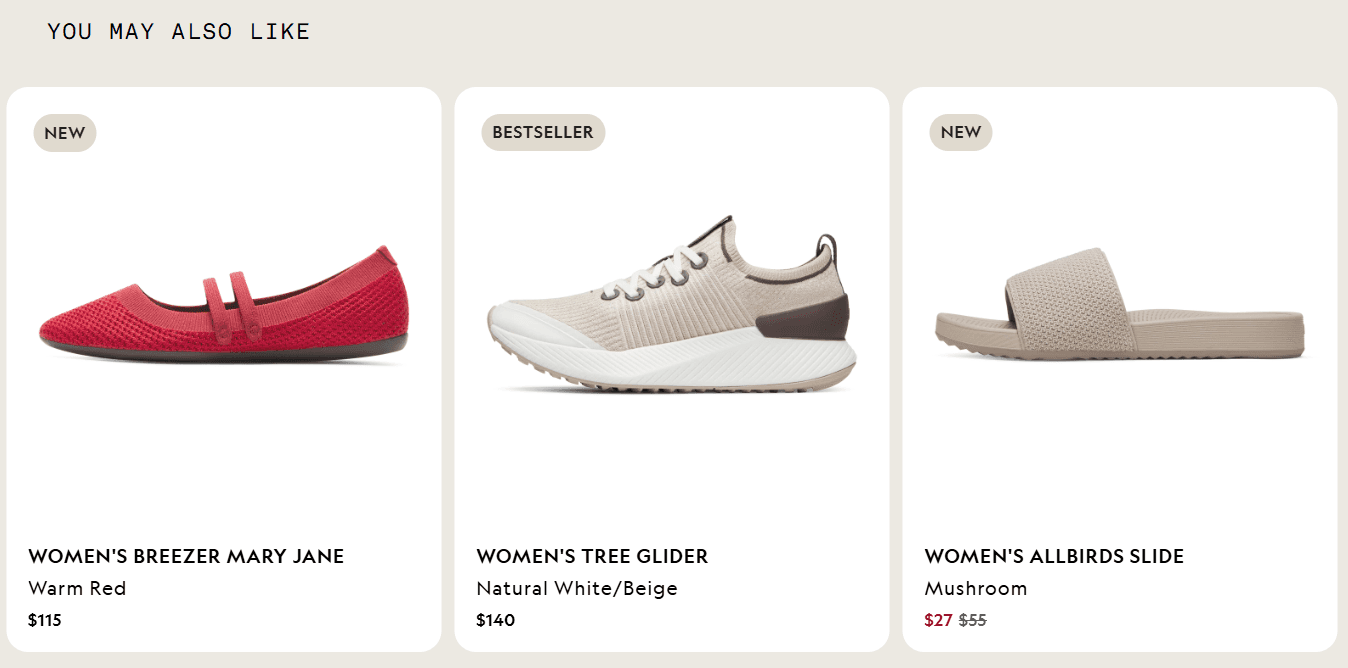
The customer's main goal is to decide on the product they're viewing; your cross-sell should add value to that decision, not compete with it.
👏 Product page cross-sells work best for accessories, consumables, and items that naturally pair together.
Cart Page Cross-Sell
Your customer is committed to buying when they finally reach the cart. Which makes it a high-intent moment and a prime opportunity for cross-selling.
Cart page cross-sells are especially effective because customers are already in a transactional mindset. Showing a low-friction, relevant add-on (particularly at a lower price point than the items already in the cart) often results in strong conversion rates.
For example, Bite Toothpaste Bits, a beauty and wellness brand suggests what more you can add once you add your preferred product to the cart:
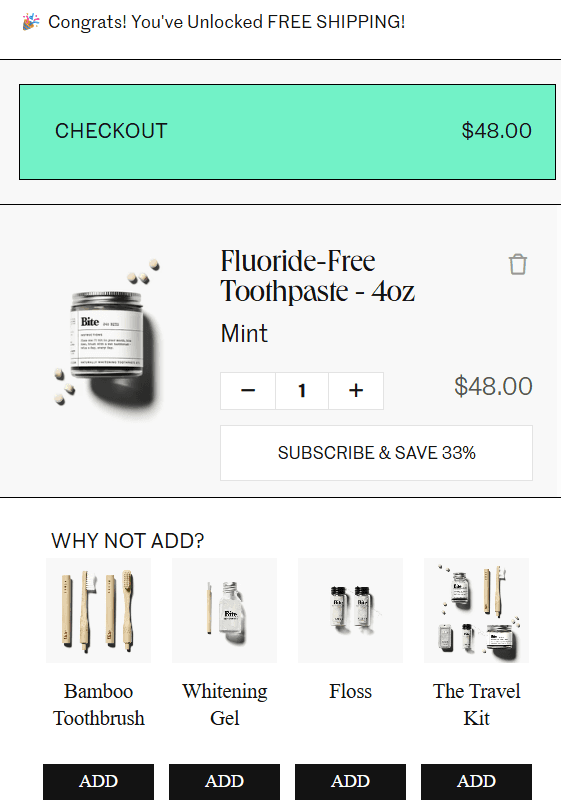
👏 A common tactic here is the ‘You're $X away from free shipping’ bar paired with a cross-sell widget. It gives the customer both a reason and a suggested item to push them over the threshold.
Checkout Cross-Sell
The Shopify checkout cross-sell is more accessible than ever, especially with Shopify's native checkout extensibility features (available on Shopify Plus).
At checkout, the customer is moments away from completing a purchase. A well-placed, low-cost cross-sell offer at this stage requires minimal additional decision-making.
For example, Blume, a nutrition brand, suggests add-ons when the customer has reached the checkout page:
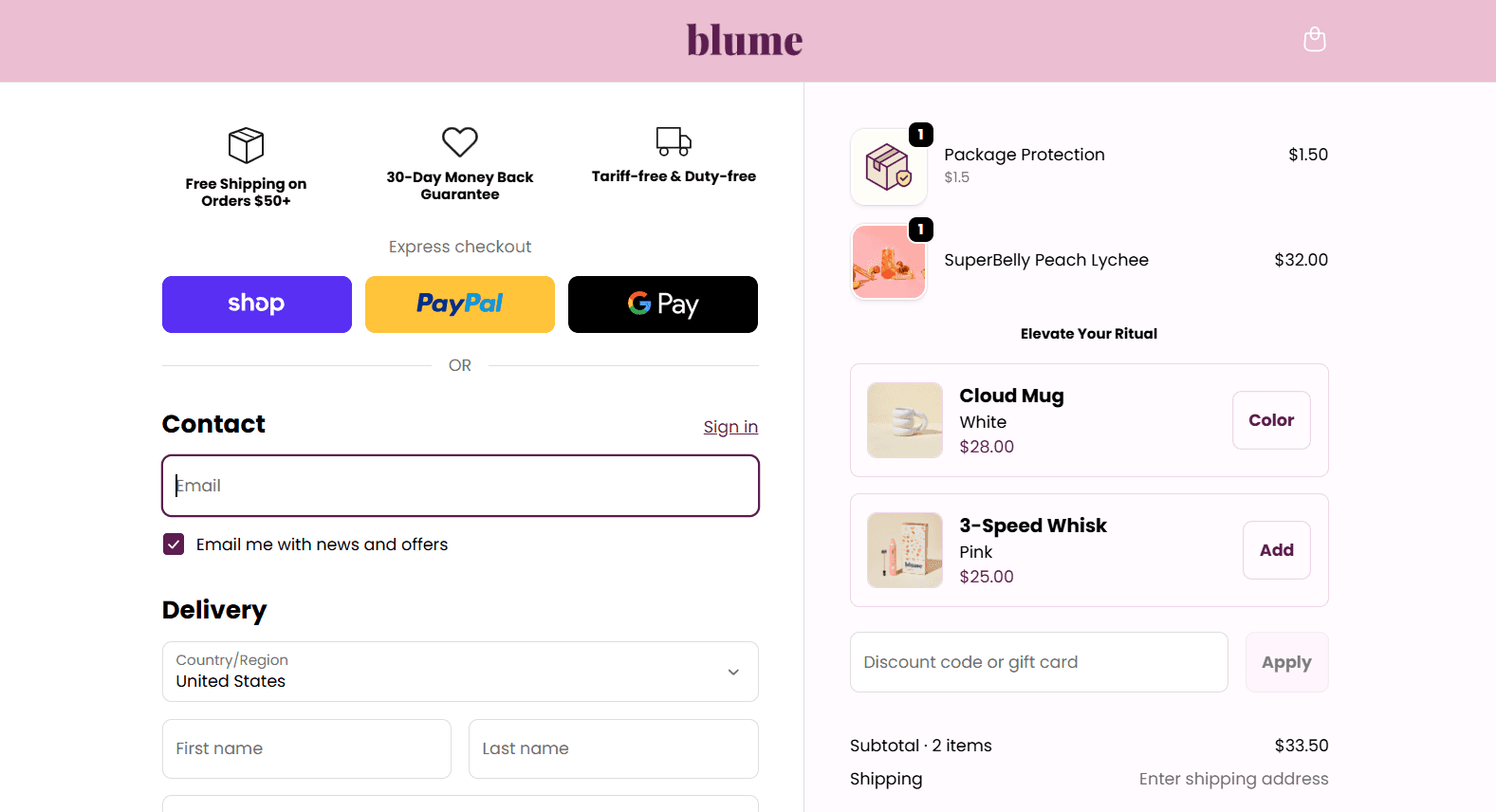
👏 Keep recommendations simple, fast to add, and clearly priced. This is not the place for complex bundles or high-ticket items. It's the place for smart, easy add-ons.
Post-Purchase Cross-Sell
The post-purchase page, that is, the order confirmation screen shown immediately after a transaction, is a gold mine.
Here's why: the customer has just completed a transaction. There's no cart abandonment risk or conversion pressure. They're in a positive emotional state, having just made a decision they're happy with.
A relevant cross-sell offer on this page can be accepted with a single click (especially when the payment method and address details are already saved), making it remarkably low-friction.
You can configure this placement in Monk, and this is how it will look:
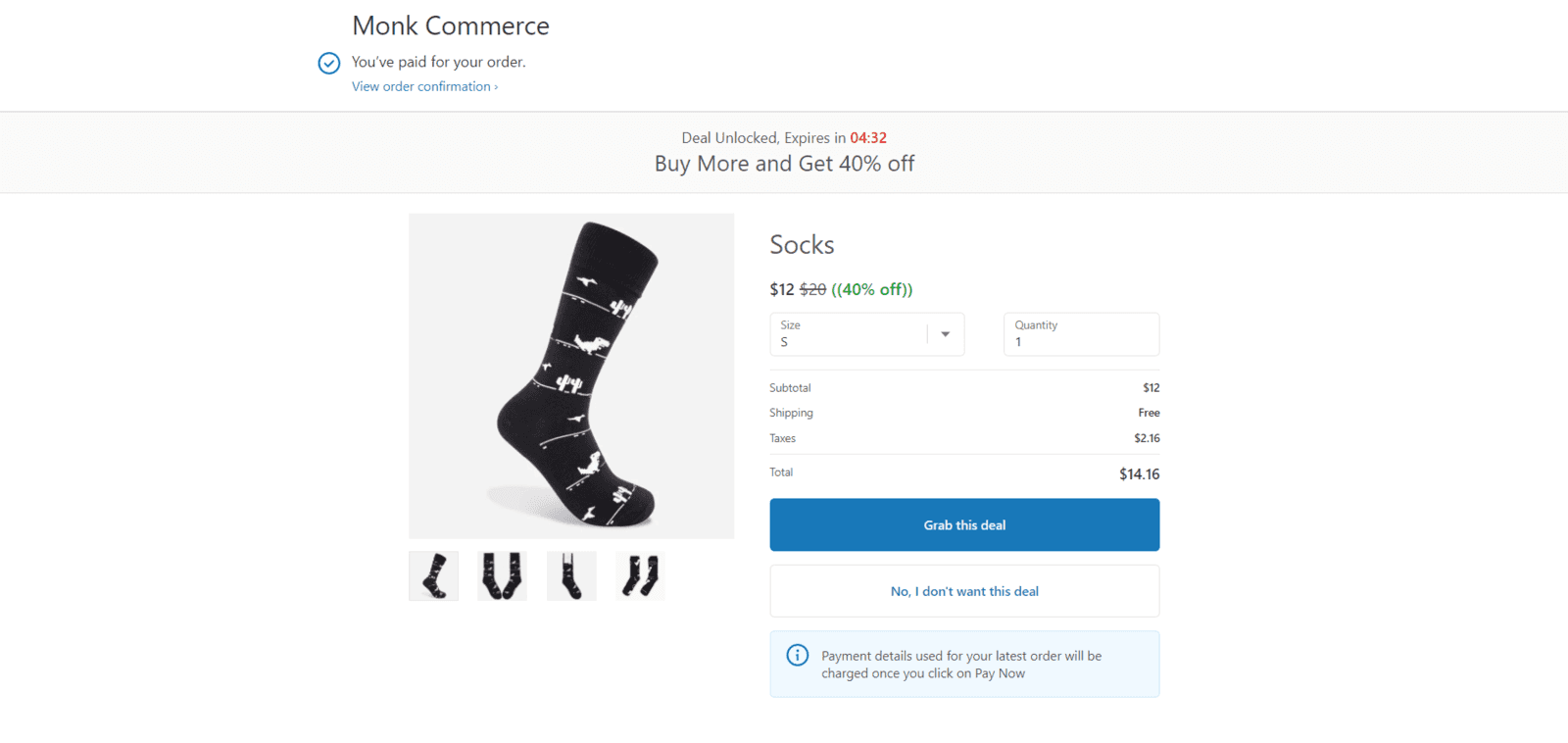
👏 Post-purchase cross-sell on Shopify is particularly effective for consumables, subscription offers, and items that complement the just-purchased item.
Top Cross-Sell Strategies for Shopify Stores
Below are the most effective cross-sell strategies for Shopify stores, each one proven to increase average order value and configurable in Monk.
Pick the ones that fit your catalog and customer journey, and build from there.
1. Frequently Bought Together
Frequently Bought Together (FBT) is grounded in behavioral data: if a large number of customers have historically purchased Product A and Product B together, that's a strong signal that future customers will find the combination valuable too.
FBT widgets typically appear on product pages and let customers add all listed items to the cart with a single click. The social proof element, for example, ‘other customers buy these together,’ adds credibility to the recommendation.
Even for newer stores without extensive purchase history data, FBT sections can be manually curated based on product logic and category expertise until enough data accumulates. |
2. Personalized Product Recommendations
Generic recommendations, like ‘You might also like this,’ applied uniformly to all customers, are ineffective. Personalized product recommendations, on the other hand, use individual customer behavior to tailor suggestions to each shopper.
AI product recommendations on Shopify take this further by dynamically adjusting in real time based on what the customer is doing right now, not just what they did in the past. It significantly improves relevance, thereby boosting conversion rates.
This strategy is especially beneficial for returning customers. If someone bought a coffee grinder from you three months ago, showing them single-origin beans or a new brewing accessory when they return is far more compelling than showing them another grinder. |
3. Low-Cost Add-On Products
One of the most reliable cross-sell strategies for Shopify stores is the low-cost add-on: a small, affordable product placed prominently at the cart or checkout stage. Put simply, once a customer has already committed to spending $80, adding a $9 item feels trivial.
These items typically have high perceived value relative to their price. For example, consider a warranty extension, a travel-size version of a product, or a complimentary accessory. They're easy to say yes to and collectively have a significant impact on AOV.
The key to making this strategy work is placement and price anchoring. The add-on should appear after the customer has added their primary item to the cart, and it should be priced so low as to feel inconsequential compared to what's already in the cart. |
4. Cross-Sell with Discounts and Offers
Pairing cross-sell recommendations with a discount or incentive can significantly increase uptake rates. Common implementations include:
Bundle discounts: ‘Add these two items together and save 15%’
Free shipping thresholds: ‘Add $12 more to get free shipping’, paired with a cross-sell suggestion for an item in that price range
Time-limited offers: ‘Add this to your order in the next 10 minutes for 20% off’
Quantity-based discounts: ‘Buy 2, get 1 free’ applied to cross-sell items
Make the offer feel natural and relevant, not arbitrary. A discount on a cross-sell item works best when the item genuinely complements the purchase. Otherwise, even a generous discount won't overcome the lack of relevance.
These tactics are particularly effective during high-traffic periods like seasonal sales, when customers are already in a deal-seeking mindset. To add extra weight to the offers, always show the original price alongside the discounted price, and make it easy for customers to see what they're getting. |
6. AI-Based Cross-Selling
AI product recommendations on Shopify represent the future of cross-selling. Rather than relying solely on manually curated rules, AI-based systems analyze vast amounts of behavioral data to surface the most likely next purchase for each individual customer.
Machine learning models used in AI cross-selling can factor in:
Purchase history (individual and aggregate)
Real-time browsing behavior
Cart contents and order value
Customer segments and demographics
Seasonal trends and inventory levels
The result is a recommendation engine that gets smarter over time and consistently surfaces more relevant, higher-converting suggestions than static rules alone.
For Shopify merchants scaling past a certain catalog size or traffic volume, AI-based cross-selling becomes necessary. Because manually managing recommendation logic across hundreds of SKUs is neither feasible nor effective.
7. Email and SMS Cross-Selling
Cross-selling doesn't have to happen exclusively on-site. Post-purchase email and SMS sequences are suitable channels for cross-selling to customers after they've completed a transaction.
Effective post-purchase cross-sell sequences can look something like this:
Day 1 of order confirmation: Primarily transactional, but can include a ‘You might also love’ section featuring complementary products
Day 3–5 of product tips email: Content-focused email helping the customer get the most out of their purchase, with a natural segue to related products
Day 10–14 of reorder or cross-sell email: For consumables, a reorder reminder; for non-consumables, a curated recommendation for a complementary product
SMS cross-selling follows similar logic but requires even greater brevity and relevance. A short, personalized message with a direct link to a complementary product, sent at the right time, can drive impressive click-through and conversion rates.
The advantage of email and SMS cross-selling is that it keeps your brand top of mind even after the customer has left your store. Thus, extending the cross-sell window well beyond the original transaction. |
Learn more about product recommendations strategies for cross-selling in Shopify
Common Cross-Selling Mistakes to Avoid
Even with the best intentions, cross-selling can backfire if executed poorly. Here are the most common mistakes Shopify merchants make and how to avoid them:
Recommending irrelevant products: If a customer is buying a yoga mat and you suggest a power drill, you've created a confusing, trust-eroding experience.
✅ Every cross-sell recommendation should pass a simple relevance test: would a knowledgeable salesperson naturally suggest this item alongside the one being purchased?
Overloading customers with too many options: Showing 12 cross-sell items at checkout creates decision fatigue and often leads customers to choose none of them.
✅ Limit your cross-sell widgets to 2–4 highly relevant items at any given touchpoint.
Poor timing: Displaying a cross-sell pop-up before the customer has even made their primary purchase decision is disruptive and often counterproductive.
✅ Match the cross-sell moment to the stage of the customer journey.
Ignoring mobile experience: Cross-sell widgets that look great on desktop but are clunky, slow, or poorly positioned on mobile will fail.
✅ Always test your cross-sell placements on mobile before going live.
Recommending out-of-stock items: Nothing erodes trust faster than clicking on a cross-sell recommendation only to find the product is unavailable.
✅ Ensure your cross-sell logic automatically excludes out-of-stock items.
Not testing or optimizing: Treating cross-selling as a set-it-and-forget-it tactic is not effective.
✅ The best-performing stores continuously A/B test their placements, copy, pricing, and product combinations. Data should drive your decisions, not assumptions.
How Monk Helps with Shopify Cross-Selling
Monk is a Shopify app built specifically to help merchants implement high-converting cross-sell and upsell strategies along with other AOV-increasing strategies, without requiring a developer or complex setup.

Here's how Monk enables smarter cross-selling for Shopify stores:
Flexible cross-sell placements: Monk supports cross-sell widgets across all major touchpoints: product pages, cart pages, checkout, and post-purchase. You can configure different offers for different placements, giving you full control over the cross-sell experience at every stage of the funnel.
Product-level and collection-level rules: You can set cross-sell rules at the product or collection level. This makes it easy to manage recommendations across large product catalogs.
Bundle and quantity discount support: Monk's bundling features let you create compelling ‘buy together’ offers with automatic discounts, free gifts, or tiered pricing, all tied to cross-sell recommendations.
Post-purchase offers: After a customer completes checkout, Monk can display a one-click cross-sell offer on the order confirmation page, allowing customers to add items to their order without re-entering payment information.
Clean, customizable design: Monk's cross-selling widgets blend seamlessly with your store's theme. You can customize colors, fonts, copy, and layout to match your brand without any code.
Analytics and performance tracking: Monk provides clear data on cross-sell impressions, clicks, and conversions, so you can see exactly which offers are performing and optimize accordingly.
For Shopify merchants looking to implement solid cross-selling without a complex technical build, Monk offers a purpose-built solution that covers every major cross-sell touchpoint and strategy discussed in this guide.
Conclusion:
Cross-selling is not about squeezing more money out of customers. Done right, it's about helping customers get more value from their purchases and building a more sustainable, profitable Shopify business in the process.
The strategies covered in this guide share a common foundation: relevance, timing, and value. When your cross-sell recommendations feel genuinely helpful, customers respond.
Implementing even two or three of the strategies in this guide, at the right touchpoints, with the right tools, can drive AOV and revenue without increasing your ad spend or traffic.
Start with the highest-intent touchpoints (cart and checkout), build out from there, and use data to continuously refine your approach. Tools like Monk make it straightforward to implement and manage these strategies across your store without a developer.
Frequently Asked Questions (FAQs)
How is cross-selling different from upselling?
While both upselling and cross-selling serve the same end goal, they work very differently. An upsell nudges a customer toward a better, higher-priced version of what they are already considering. A cross-sell brings in a product that pairs naturally with what is already in their cart.
What are the best cross-sell strategies for Shopify stores?
The most effective cross-sell strategies for Shopify stores include product bundling, frequently bought together widgets, personalized AI-powered recommendations, low-cost add-ons at checkout, and post-purchase offers. The right mix depends on your product catalog, price points, and customer behavior. Generally, starting with cart and checkout placements yields the fastest results since these are the highest-intent moments in the customer journey.
Where should I place cross-sell offers in Shopify?
The four primary cross-sell placements in Shopify are the product page, the cart page, the checkout page, and the post-purchase confirmation page. Each serves a different purpose. Product page cross-sells are discovery-focused; cart page cross-sells target customers already committed to buying; checkout cross-sells are last-minute, low-friction add-ons; and post-purchase cross-sells capitalize on the customer's positive post-transaction mindset. Using multiple placements in combination produces the best results.
What are examples of cross-selling in e-commerce?
Common e-commerce cross-selling examples include suggesting a memory card and camera bag when a customer buys a camera; recommending socks and insoles when a customer buys running shoes; or showing a complete skincare routine when a customer adds a cleanser to their cart. The unifying principle across all examples is relevance, which means the recommended product should naturally complement what the customer is buying.
How do I create product bundles in Shopify?
You can create product bundles in Shopify in several ways. Natively, you can create a bundle as a new product with its own SKU, listing the included items in the description. For more dynamic bundling, where customers see ‘buy together’ recommendations with automatic discounts, you'll need a dedicated Shopify upselling app like Monk. It will create bundle offers directly on product and cart pages, with automatic discount application and full design customization, without needing developer support.
Does cross-selling improve customer experience?
Yes, cross-selling significantly improves customer experience. Relevant recommendations help customers discover products they need but might not have found on their own, save them additional shopping trips, and help them get more value from their purchases. The critical factor is relevance: cross-sell recommendations that are well-matched to the customer's purchase feel like good service. Recommendations that are random or clearly self-serving feel intrusive.
Cross-Sell Strategies for Shopify Stores to Increase AOV and Revenue
Summary
Cross-selling in Shopify recommends complementary products to increase average order value without extra acquisition cost. It differs from upselling, which offers higher tier versions of the same product. It improves revenue, inventory turnover, and customer experience when relevant. Key touchpoints include product pages, cart, checkout, post-purchase, email and SMS. Strategies include frequently bought together, bundles, personalized and AI recommendations, low cost add-ons, and discounts. Avoid irrelevant suggestions, too many options, poor timing, and out-of-stock items. Relevance, timing, and testing drive results.
We bet you're not using cross-selling as much as you should for growing your revenue. Unlike paid ads or campaigns that require significant time and budget, cross-selling works with the customers you already have. This happens when they're already in a buying mindset.
It’s a massive opportunity to increase average order value through cost-efficient strategies, since it removes the headache of acquiring new customers. Yet many stores either don't cross-sell at all or do it so poorly that it actively hurts the shopping experience.
In this guide, let's break down everything you need to know about cross-sell strategies for Shopify stores.
What is Cross-Selling in Shopify?
Cross-selling in Shopify is the practice of recommending complementary or related products to a customer based on what they're already viewing or purchasing. The goal is to increase the total transaction value by helping customers discover products that naturally pair.
In a brick-and-mortar context, it's the salesperson at an electronics store asking, ‘Would you like a screen protector and a case with that phone?’
In e-commerce, it's the same logic, just automated, scalable, and data-driven.
Here are a few straightforward e-commerce cross-selling examples:
A customer adds a camera to their cart. The store suggests a memory card, a camera bag, and a lens cleaning kit.
A customer buys a pair of running shoes. The store recommends moisture-wicking socks and an insole upgrade.
A customer purchases a facial cleanser. The store cross-sells a toner and moisturizer to complete the skincare routine.
In each case, the recommendation adds value to the customer's purchase rather than feeling like a random or pushy sales attempt.
Cross-Sell vs Upsell in Shopify
These two terms are often used interchangeably, but they refer to distinct strategies. Understanding the difference matters when building your Shopify AOV optimization plan.
Cross-selling means recommending a different product that complements the one the customer is buying. If someone buys a laptop, cross-sell a laptop stand or a wireless mouse.
Upselling means encouraging the customer to buy a better or more expensive version of the same product. If someone is looking at a laptop, upselling could suggest a premium model with more features.
Both strategies aim to increase average order value on Shopify, but they do so in different ways.
📌 Cross-selling broadens the cart; upselling increases its price value. The most effective Shopify stores use both, but in the right context, at the right moment, and without overwhelming the customer.
Learn the difference between upsell vs. cross-sell in Shopify in detail
Why It Matters for Shopify Growth
Cross-selling directly impacts your bottom line. Here's why it matters specifically for Shopify merchants:
Revenue without extra ad spend: Every cross-sell conversion is revenue you generate from existing traffic. There's no additional customer acquisition cost.
Better inventory turnover: Cross-selling helps move complementary or slower-moving products by pairing them with bestsellers.
Improved customer experience: When done right, cross-selling helps customers get more out of their purchase. They leave happier, and they're more likely to return.
Scalability: With the right Shopify app, cross-sell rules can be automated across your entire catalog, so you don't have to manually manage every cross-sell product recommendation.
Key Cross-Sell Touchpoints in Shopify
Knowing what to recommend is only half the equation. Where you place cross-sell offers is equally critical. Different touchpoints in the customer journey serve different purposes, and the best Shopify cross-selling strategies use multiple placements working together.
Product Page Cross-Sell
The product page is often the first major cross-sell opportunity. At this stage, the customer is in research mode: they're interested but haven't committed yet.
Effective product page cross-sells typically include a ‘You Might Also Like’ or ‘Frequently Bought Together’ section placed below the fold. The key here is to keep the recommendation relevant without distracting from the primary conversion.
For example, Allbirds, a sustainable footwear and apparel brand, has a ‘You may also like’ section placed right below one of its products:
The customer's main goal is to decide on the product they're viewing; your cross-sell should add value to that decision, not compete with it.
👏 Product page cross-sells work best for accessories, consumables, and items that naturally pair together.
Cart Page Cross-Sell
Your customer is committed to buying when they finally reach the cart. Which makes it a high-intent moment and a prime opportunity for cross-selling.
Cart page cross-sells are especially effective because customers are already in a transactional mindset. Showing a low-friction, relevant add-on (particularly at a lower price point than the items already in the cart) often results in strong conversion rates.
For example, Bite Toothpaste Bits, a beauty and wellness brand suggests what more you can add once you add your preferred product to the cart:
👏 A common tactic here is the ‘You're $X away from free shipping’ bar paired with a cross-sell widget. It gives the customer both a reason and a suggested item to push them over the threshold.
Checkout Cross-Sell
The Shopify checkout cross-sell is more accessible than ever, especially with Shopify's native checkout extensibility features (available on Shopify Plus).
At checkout, the customer is moments away from completing a purchase. A well-placed, low-cost cross-sell offer at this stage requires minimal additional decision-making.
For example, Blume, a nutrition brand, suggests add-ons when the customer has reached the checkout page:
👏 Keep recommendations simple, fast to add, and clearly priced. This is not the place for complex bundles or high-ticket items. It's the place for smart, easy add-ons.
Post-Purchase Cross-Sell
The post-purchase page, that is, the order confirmation screen shown immediately after a transaction, is a gold mine.
Here's why: the customer has just completed a transaction. There's no cart abandonment risk or conversion pressure. They're in a positive emotional state, having just made a decision they're happy with.
A relevant cross-sell offer on this page can be accepted with a single click (especially when the payment method and address details are already saved), making it remarkably low-friction.
You can configure this placement in Monk, and this is how it will look:
👏 Post-purchase cross-sell on Shopify is particularly effective for consumables, subscription offers, and items that complement the just-purchased item.
Top Cross-Sell Strategies for Shopify Stores
Below are the most effective cross-sell strategies for Shopify stores, each one proven to increase average order value and configurable in Monk.
Pick the ones that fit your catalog and customer journey, and build from there.
1. Frequently Bought Together
Frequently Bought Together (FBT) is grounded in behavioral data: if a large number of customers have historically purchased Product A and Product B together, that's a strong signal that future customers will find the combination valuable too.
FBT widgets typically appear on product pages and let customers add all listed items to the cart with a single click. The social proof element, for example, ‘other customers buy these together,’ adds credibility to the recommendation.
Even for newer stores without extensive purchase history data, FBT sections can be manually curated based on product logic and category expertise until enough data accumulates. |
2. Personalized Product Recommendations
Generic recommendations, like ‘You might also like this,’ applied uniformly to all customers, are ineffective. Personalized product recommendations, on the other hand, use individual customer behavior to tailor suggestions to each shopper.
AI product recommendations on Shopify take this further by dynamically adjusting in real time based on what the customer is doing right now, not just what they did in the past. It significantly improves relevance, thereby boosting conversion rates.
This strategy is especially beneficial for returning customers. If someone bought a coffee grinder from you three months ago, showing them single-origin beans or a new brewing accessory when they return is far more compelling than showing them another grinder. |
3. Low-Cost Add-On Products
One of the most reliable cross-sell strategies for Shopify stores is the low-cost add-on: a small, affordable product placed prominently at the cart or checkout stage. Put simply, once a customer has already committed to spending $80, adding a $9 item feels trivial.
These items typically have high perceived value relative to their price. For example, consider a warranty extension, a travel-size version of a product, or a complimentary accessory. They're easy to say yes to and collectively have a significant impact on AOV.
The key to making this strategy work is placement and price anchoring. The add-on should appear after the customer has added their primary item to the cart, and it should be priced so low as to feel inconsequential compared to what's already in the cart. |
4. Cross-Sell with Discounts and Offers
Pairing cross-sell recommendations with a discount or incentive can significantly increase uptake rates. Common implementations include:
Bundle discounts: ‘Add these two items together and save 15%’
Free shipping thresholds: ‘Add $12 more to get free shipping’, paired with a cross-sell suggestion for an item in that price range
Time-limited offers: ‘Add this to your order in the next 10 minutes for 20% off’
Quantity-based discounts: ‘Buy 2, get 1 free’ applied to cross-sell items
Make the offer feel natural and relevant, not arbitrary. A discount on a cross-sell item works best when the item genuinely complements the purchase. Otherwise, even a generous discount won't overcome the lack of relevance.
These tactics are particularly effective during high-traffic periods like seasonal sales, when customers are already in a deal-seeking mindset. To add extra weight to the offers, always show the original price alongside the discounted price, and make it easy for customers to see what they're getting. |
6. AI-Based Cross-Selling
AI product recommendations on Shopify represent the future of cross-selling. Rather than relying solely on manually curated rules, AI-based systems analyze vast amounts of behavioral data to surface the most likely next purchase for each individual customer.
Machine learning models used in AI cross-selling can factor in:
Purchase history (individual and aggregate)
Real-time browsing behavior
Cart contents and order value
Customer segments and demographics
Seasonal trends and inventory levels
The result is a recommendation engine that gets smarter over time and consistently surfaces more relevant, higher-converting suggestions than static rules alone.
For Shopify merchants scaling past a certain catalog size or traffic volume, AI-based cross-selling becomes necessary. Because manually managing recommendation logic across hundreds of SKUs is neither feasible nor effective.
7. Email and SMS Cross-Selling
Cross-selling doesn't have to happen exclusively on-site. Post-purchase email and SMS sequences are suitable channels for cross-selling to customers after they've completed a transaction.
Effective post-purchase cross-sell sequences can look something like this:
Day 1 of order confirmation: Primarily transactional, but can include a ‘You might also love’ section featuring complementary products
Day 3–5 of product tips email: Content-focused email helping the customer get the most out of their purchase, with a natural segue to related products
Day 10–14 of reorder or cross-sell email: For consumables, a reorder reminder; for non-consumables, a curated recommendation for a complementary product
SMS cross-selling follows similar logic but requires even greater brevity and relevance. A short, personalized message with a direct link to a complementary product, sent at the right time, can drive impressive click-through and conversion rates.
The advantage of email and SMS cross-selling is that it keeps your brand top of mind even after the customer has left your store. Thus, extending the cross-sell window well beyond the original transaction. |
Learn more about product recommendations strategies for cross-selling in Shopify
Common Cross-Selling Mistakes to Avoid
Even with the best intentions, cross-selling can backfire if executed poorly. Here are the most common mistakes Shopify merchants make and how to avoid them:
Recommending irrelevant products: If a customer is buying a yoga mat and you suggest a power drill, you've created a confusing, trust-eroding experience.
✅ Every cross-sell recommendation should pass a simple relevance test: would a knowledgeable salesperson naturally suggest this item alongside the one being purchased?
Overloading customers with too many options: Showing 12 cross-sell items at checkout creates decision fatigue and often leads customers to choose none of them.
✅ Limit your cross-sell widgets to 2–4 highly relevant items at any given touchpoint.
Poor timing: Displaying a cross-sell pop-up before the customer has even made their primary purchase decision is disruptive and often counterproductive.
✅ Match the cross-sell moment to the stage of the customer journey.
Ignoring mobile experience: Cross-sell widgets that look great on desktop but are clunky, slow, or poorly positioned on mobile will fail.
✅ Always test your cross-sell placements on mobile before going live.
Recommending out-of-stock items: Nothing erodes trust faster than clicking on a cross-sell recommendation only to find the product is unavailable.
✅ Ensure your cross-sell logic automatically excludes out-of-stock items.
Not testing or optimizing: Treating cross-selling as a set-it-and-forget-it tactic is not effective.
✅ The best-performing stores continuously A/B test their placements, copy, pricing, and product combinations. Data should drive your decisions, not assumptions.
How Monk Helps with Shopify Cross-Selling
Monk is a Shopify app built specifically to help merchants implement high-converting cross-sell and upsell strategies along with other AOV-increasing strategies, without requiring a developer or complex setup.
Here's how Monk enables smarter cross-selling for Shopify stores:
Flexible cross-sell placements: Monk supports cross-sell widgets across all major touchpoints: product pages, cart pages, checkout, and post-purchase. You can configure different offers for different placements, giving you full control over the cross-sell experience at every stage of the funnel.
Product-level and collection-level rules: You can set cross-sell rules at the product or collection level. This makes it easy to manage recommendations across large product catalogs.
Bundle and quantity discount support: Monk's bundling features let you create compelling ‘buy together’ offers with automatic discounts, free gifts, or tiered pricing, all tied to cross-sell recommendations.
Post-purchase offers: After a customer completes checkout, Monk can display a one-click cross-sell offer on the order confirmation page, allowing customers to add items to their order without re-entering payment information.
Clean, customizable design: Monk's cross-selling widgets blend seamlessly with your store's theme. You can customize colors, fonts, copy, and layout to match your brand without any code.
Analytics and performance tracking: Monk provides clear data on cross-sell impressions, clicks, and conversions, so you can see exactly which offers are performing and optimize accordingly.
For Shopify merchants looking to implement solid cross-selling without a complex technical build, Monk offers a purpose-built solution that covers every major cross-sell touchpoint and strategy discussed in this guide.
Conclusion:
Cross-selling is not about squeezing more money out of customers. Done right, it's about helping customers get more value from their purchases and building a more sustainable, profitable Shopify business in the process.
The strategies covered in this guide share a common foundation: relevance, timing, and value. When your cross-sell recommendations feel genuinely helpful, customers respond.
Implementing even two or three of the strategies in this guide, at the right touchpoints, with the right tools, can drive AOV and revenue without increasing your ad spend or traffic.
Start with the highest-intent touchpoints (cart and checkout), build out from there, and use data to continuously refine your approach. Tools like Monk make it straightforward to implement and manage these strategies across your store without a developer.
Frequently Asked Questions (FAQs)
How is cross-selling different from upselling?
While both upselling and cross-selling serve the same end goal, they work very differently. An upsell nudges a customer toward a better, higher-priced version of what they are already considering. A cross-sell brings in a product that pairs naturally with what is already in their cart.
What are the best cross-sell strategies for Shopify stores?
The most effective cross-sell strategies for Shopify stores include product bundling, frequently bought together widgets, personalized AI-powered recommendations, low-cost add-ons at checkout, and post-purchase offers. The right mix depends on your product catalog, price points, and customer behavior. Generally, starting with cart and checkout placements yields the fastest results since these are the highest-intent moments in the customer journey.
Where should I place cross-sell offers in Shopify?
The four primary cross-sell placements in Shopify are the product page, the cart page, the checkout page, and the post-purchase confirmation page. Each serves a different purpose. Product page cross-sells are discovery-focused; cart page cross-sells target customers already committed to buying; checkout cross-sells are last-minute, low-friction add-ons; and post-purchase cross-sells capitalize on the customer's positive post-transaction mindset. Using multiple placements in combination produces the best results.
What are examples of cross-selling in e-commerce?
Common e-commerce cross-selling examples include suggesting a memory card and camera bag when a customer buys a camera; recommending socks and insoles when a customer buys running shoes; or showing a complete skincare routine when a customer adds a cleanser to their cart. The unifying principle across all examples is relevance, which means the recommended product should naturally complement what the customer is buying.
How do I create product bundles in Shopify?
You can create product bundles in Shopify in several ways. Natively, you can create a bundle as a new product with its own SKU, listing the included items in the description. For more dynamic bundling, where customers see ‘buy together’ recommendations with automatic discounts, you'll need a dedicated Shopify upselling app like Monk. It will create bundle offers directly on product and cart pages, with automatic discount application and full design customization, without needing developer support.
Does cross-selling improve customer experience?
Yes, cross-selling significantly improves customer experience. Relevant recommendations help customers discover products they need but might not have found on their own, save them additional shopping trips, and help them get more value from their purchases. The critical factor is relevance: cross-sell recommendations that are well-matched to the customer's purchase feel like good service. Recommendations that are random or clearly self-serving feel intrusive.
Ravish (RV)
Co-Founder, Monk Commerce
Ravish is an ecommerce and SaaS marketing expert with 6+ years of experience in Shopify and ecommerce and 10+ years of experience in marketing, and growth strategy. He has worked closely with Shopify merchants to solve real ecommerce challenges and shares practical, research-backed insights, industry best practices, and emerging trends.
Contents
Related Articles
Cross-Selling Examples That Drive More Revenue in Ecommerce
How to Add Upsell Offers on Shopify to Increase AOV (Step-by-Step Guide)
Upsell vs Cross-Sell in Shopify: Key Differences, Examples & Strategies
Get Monk Free Gift app for just $1/month this Black Friday
First month: $1 after your 7-day free trial. All features included. Offer live!
Claim offer now

Get Monk Free Gift app for just $1/month this Black Friday
First month: $1 after your 7-day free trial. All features included. Offer live!
Claim offer now
Get Monk Free Gift app for just $1/month this Black Friday
First month: $1 after your 7-day free trial. All features included. Offer live!
Claim offer now