Cross-Selling Examples That Drive More Revenue in Ecommerce
Summary
Cross-selling in Shopify increases revenue by recommending complementary products during the shopping journey without increasing ad spend. It raises average order value and improves customer experience when suggestions are relevant and well timed. Effective placements include product pages, “frequently bought together” bundles, cart and checkout add-ons, post-purchase offers, popups, personalized AI recommendations, subscriptions, and email campaigns. Its success depends on timing, relevance, and simplicity, usually showing one to three items.
Different industries apply it differently, such as complete outfits in fashion, essential add-ons in electronics, routine-based products in beauty, and matching items in home goods. Proper execution improves conversions, retention, and long-term customer value.

Key Takeaways
Cross-selling in Shopify increases revenue by recommending complementary products during the shopping journey without increasing ad spend. It raises average order value and improves customer experience when suggestions are relevant and well timed. Effective placements include product pages, “frequently bought together” bundles, cart and checkout add-ons, post-purchase offers, popups, personalized AI recommendations, subscriptions, and email campaigns. Its success depends on timing, relevance, and simplicity, usually showing one to three items.
Different industries apply it differently, such as complete outfits in fashion, essential add-ons in electronics, routine-based products in beauty, and matching items in home goods. Proper execution improves conversions, retention, and long-term customer value.
A customer lands on your Shopify store for a phone case. But they check out with the case, a screen protector, and a charging dock. It's a win, that too without any extra ad spend. That’s the magic of cross-selling.
This win is much more than just a feel-good moment. It directly boosts your revenue and increases your average order value with every transaction. Not just this, when you offer your customer something more, something that genuinely complements what's already in their cart, you get added to their good books.
Shopify brands are already cashing in on this. In fact, companies practicing effective cross-selling see 20% higher revenue.
Ready to make that happen for your store? We'll break down why cross-selling works so well in ecommerce, along with real Shopify examples for you to draw inspiration from.
What Is Cross-Selling and Why Does It Work So Well?
Cross-selling is the practice of recommending related or complementary products to a customer based on what they're already buying. On a Shopify store, this looks like suggesting a lens cleaning kit when someone buys a camera, or offering a matching phone case when a customer adds earbuds to their cart. The goal is to increase the value of every order without increasing your acquisition costs.
Here's why it works so well:
The customer is already in buying mode: The hardest part is convincing someone to open their wallet. But here, it's already done. A well-placed cross-sell simply rides that momentum.
Relevant recommendations feel like good service: When the suggested product makes sense with what's in the cart, customers don't see it as an upsell. They see it as helpful.
Builds a stronger shopping experience: Customers who find everything they need in one place are more likely to return and trust your store.
Increase AOV of your Shopify store: Cross-sells work effectively with other proven strategies like free gifts with purchase because cross-sells help customers reach the spending threshold needed to unlock the gift. When done well, this increases AOV while guiding customers toward higher-value purchases without adding friction.
10 High-Converting Cross-Selling Examples
Cross-selling only works when it's done right. By that, we mean the right product, the right placement, and the right moment. Here are ten examples that Shopify stores are using to make it happen.
1. "Frequently Bought Together" Bundles
This is one of the most straightforward and effective cross-selling placements. When a customer lands on a product page, they're already interested. They're reading descriptions, looking at images, and mentally making the purchase. Showing them a "Frequently Bought Together" bundle at that exact moment catches them while their intent is at its peak.
The placement works because it doesn't feel like a sales tactic. It feels like information. You're simply telling the customer what other shoppers picked up alongside this product. That social proof, combined with the convenience of adding everything in a single click, removes friction and makes the decision easier.
2. Product Page Recommendations
If "Frequently Bought Together" bundles are about grouping products, product page recommendations are about expanding the customer's options while they're still in discovery mode. The placement typically lives below the main product details with the header "You Might Also Like" or "Complete the Look".
Its job is to keep the customer engaged and spending, without pulling them away from what they originally came for. The key is relevance. A recommendation that makes logical sense with the product on the page feels like a helpful nudge. One that doesn't, feels like clutter.
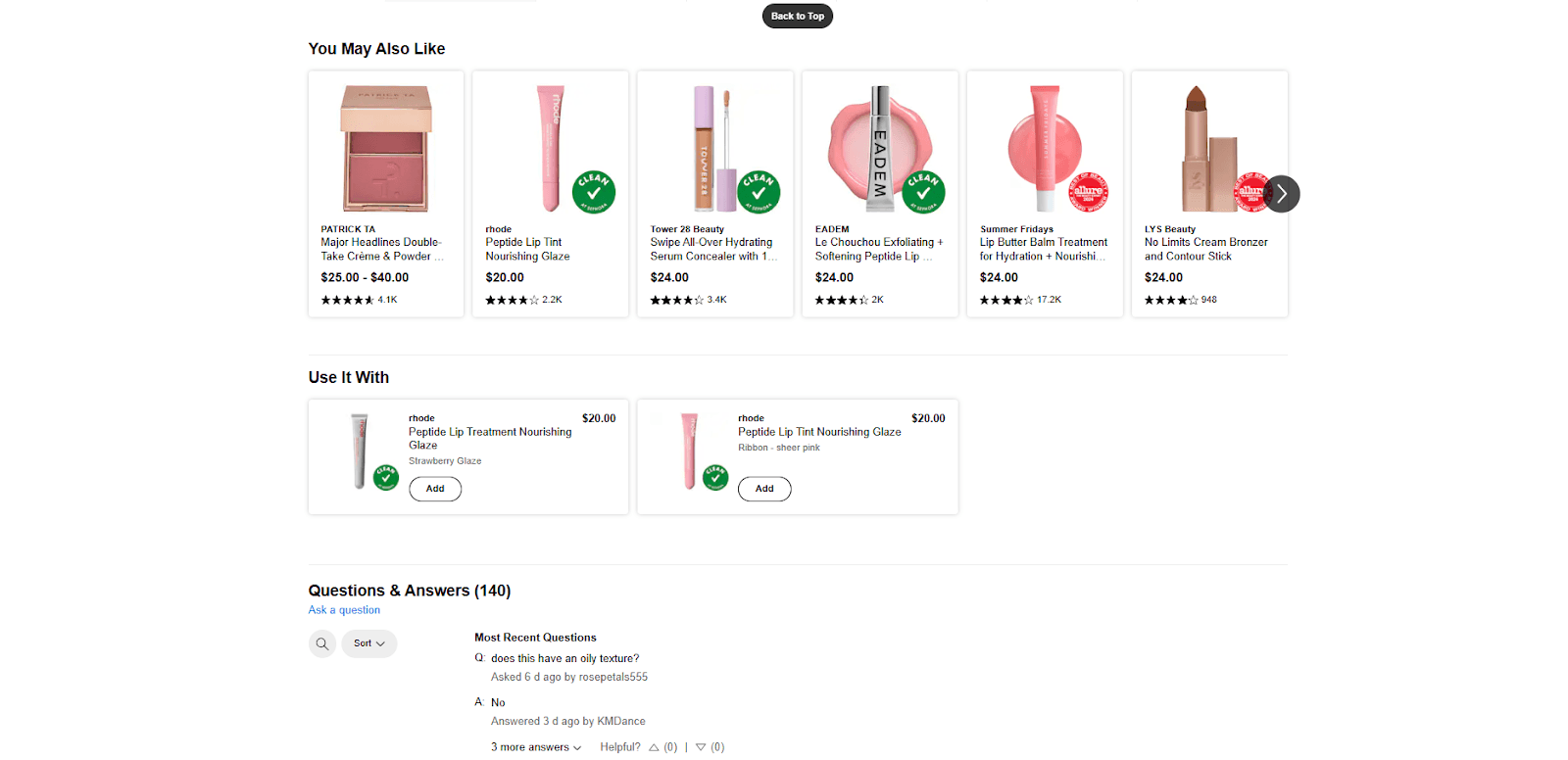
For example, Sephora features “You May Also Like” and “Use It With” sections on the product page to guide customers and increase the likelihood of cross-sell.
3. Accessories Cross-Sell (Core + Add-ons)
Some products are simply incomplete without their accessories, and that's exactly where this cross-sell strategy earns its place. The core product is what the customer came for. The add-ons are what make it work better, last longer, or deliver the full experience the customer actually wants. Positioning accessories as natural extensions renders them as customer service.
When your Shopify store surfaces those accessories at the right moment on the product page, in the cart, or at checkout, you're not introducing a new need. You're solving one that already exists.
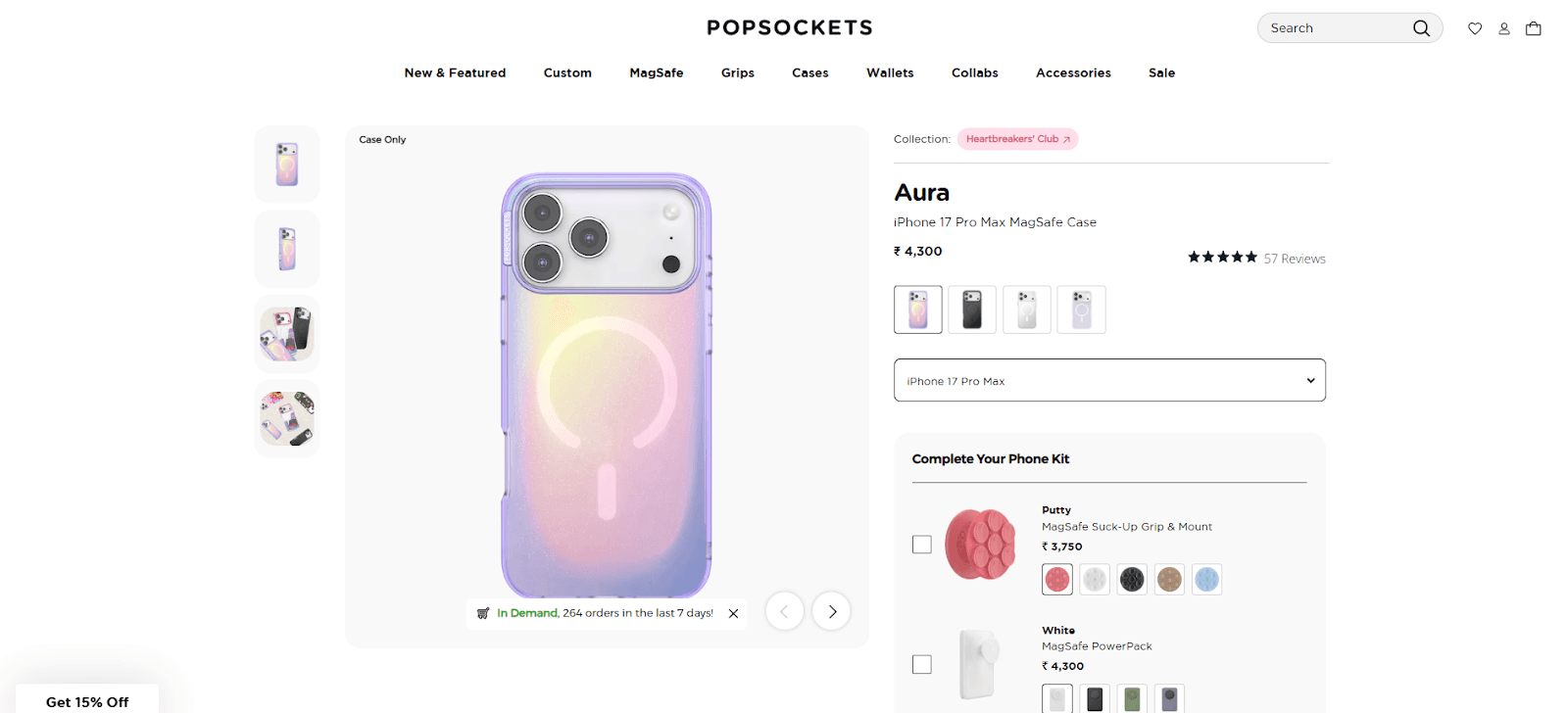
For example, Popsockets has a section that features products that help “Complete Your Phone Kit.” Along with a phone case, it offers a MagSafe Power Pack or a mount, making the purchase complete.
4. Cart Page Cross-Selling
By the time a customer reaches the cart page, they've already made their decision. The hard part is done. This makes the cart page one of the cross-selling placements on any Shopify store.
The reason this placement converts so well is intent. Unlike a homepage visitor who's still browsing, a cart page visitor is ready to spend. A cross-sell at this stage doesn't need to build desire from scratch; it just needs to present something relevant enough to make the customer think, "that actually makes sense, I'll add it."
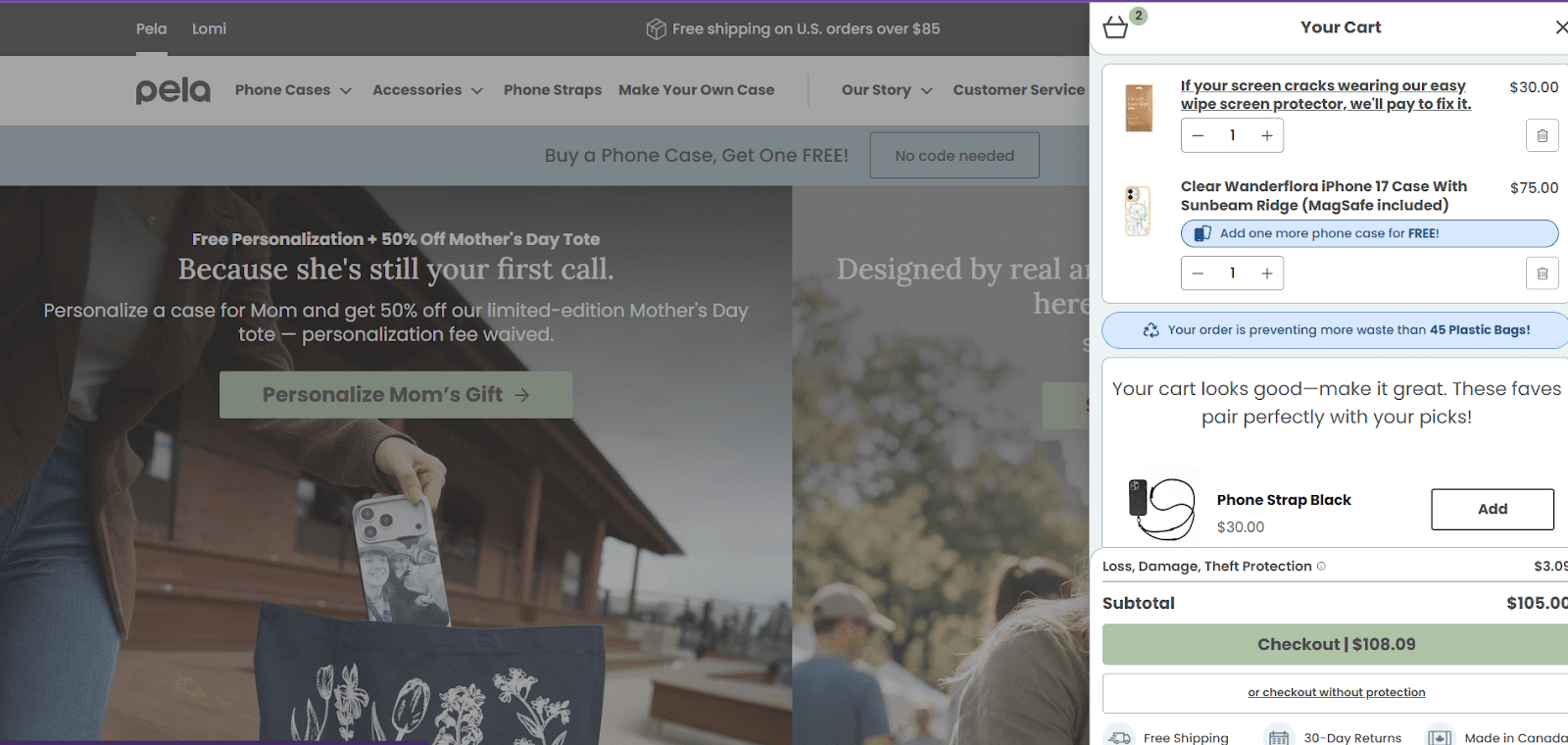
For example, Pela, a phone case Shopify store, adds a phone strap option in just one click on the cart page when the customer buys a phone case. It is the last moment, yet it is utterly convincing.
5. Checkout Add-ons (Last-Minute Cross-Sell)
If the cart page is high-intent, the checkout page is the highest-intent. A customer who has entered their shipping details and is one click away from placing an order is as committed as a customer can get. This makes the checkout page a surprisingly powerful spot for one final, well-timed cross-sell.
The reason this works is psychology. Adding a smaller, complementary product at this stage feels like a minor decision compared to the one they've already made. This is why checkout add-ons tend to work best with low-cost, high-relevance products. A ten-dollar add-on feels like nothing to someone already spending a hundred.
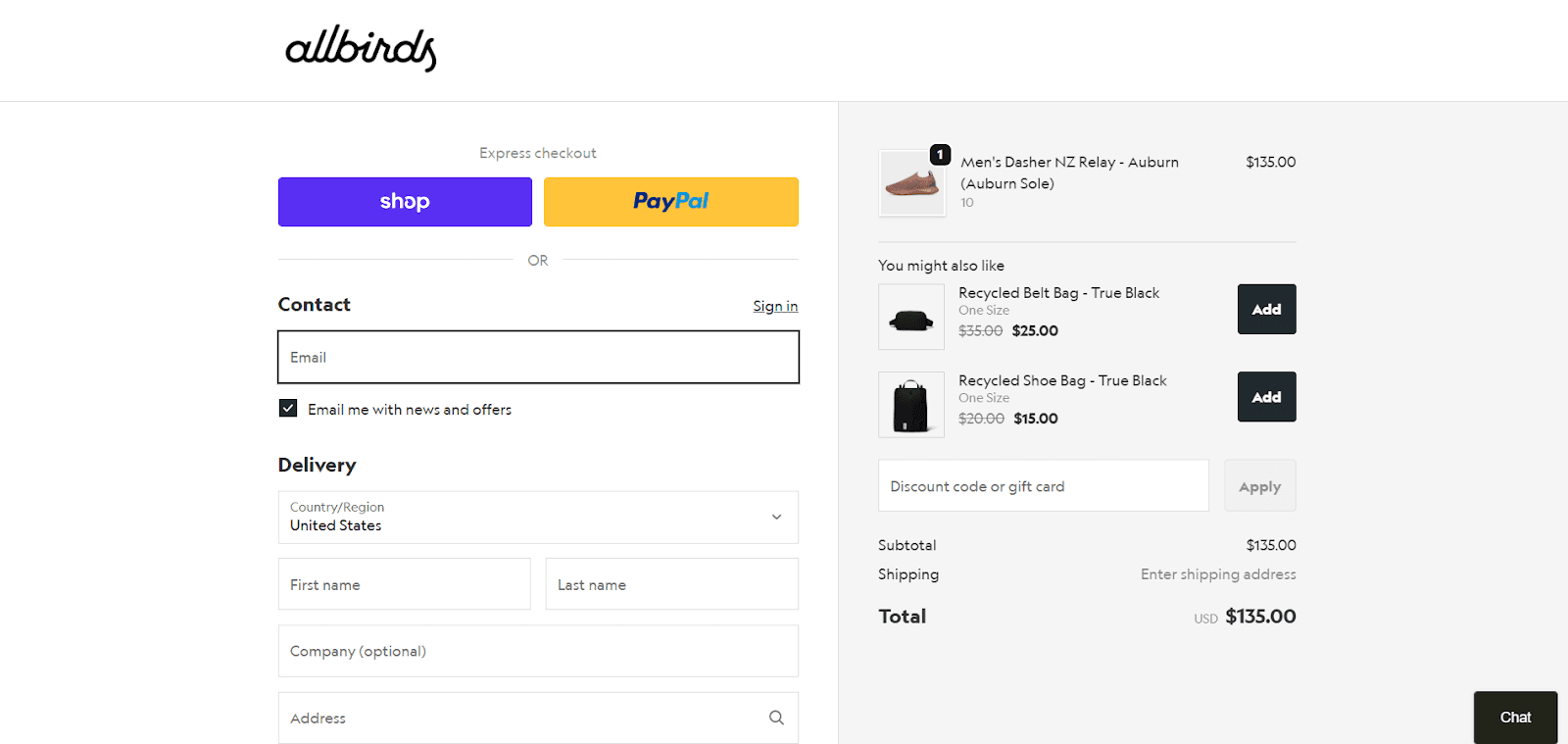
For example, Allbirds offers cross-sells such as a shoe bag when a customer is buying a pair of shoes. A shoe bag doesn’t require much consideration, but it is also necessary, which makes it the perfect spot.
6. Post-Purchase Cross-Selling (Thank You Page)
Most Shopify stores treat the thank you page as a formality, a polite confirmation that the order went through, and nothing more. That's a missed opportunity. The thank-you page is one of the few moments in the customer journey when there is zero purchase anxiety. The order is placed, the decision is made, and the customer is in a genuinely positive headspace. That's a remarkably receptive audience.
What makes post-purchase cross-selling different from every other placement is that there's no risk of cart abandonment. Any additional purchase made on the thank-you page is pure incremental revenue.
7. Cross-Sell Popups (Smart Triggers)
A poorly timed pop-up that interrupts a customer mid-browse. But a pop-up that appears at the right moment, with the right product, triggered by the right customer behaviour? That's an entirely different story.
Smart cross-sell popups respond to specific customer actions, such as adding a product to the cart, spending a set amount of time on a product page, or reaching a certain cart value. That context is what separates a cross-sell that converts from one that gets closed in under a second.
8. Personalized Recommendations (AI-Based)
Every customer who lands on your Shopify store leaves a trail of what they clicked, what they browsed, what they added and removed from their cart, and what they've purchased before. AI-based personalization takes all that behavioural data and turns it into cross-sell recommendations specific to each individual shopper, rather than a generic suggestion served to everyone who visits the same page.
Every other method relies on product logic of what generally pairs well with what. AI-based recommendations rely on customer logic of what this specific person is most likely to want based on everything they've shown you through their behaviour. The result is a cross-sell that feels less like a store recommendation and more like a genuinely personalised suggestion.
9. Subscription-Based Cross-Selling
Subscription-based cross-selling works on a dynamic of an ongoing relationship. A subscription customer isn't a one-time buyer. They've committed to your store on a recurring basis, which means they've already demonstrated a level of trust that most customers take multiple purchases to build. That trust is the foundation that makes cross-selling to subscribers so effective.
The key is that the cross-sell is anchored to something they're already loyal to, which makes the leap to a second product significantly smaller than it would be for a first-time visitor browsing your store cold.
10. Email Cross-Selling Campaigns
Email is the one cross-selling channel that reaches your customers outside your store. It lands in the customer's inbox hours, days, or even weeks after their purchase, at a time when they've had a chance to use what they bought and form an opinion about it.
A customer who has been using your product for a week and is happy with it is far more receptive to a complementary recommendation than they were at checkout. An email that arrives at this moment feels like a thoughtful follow-up from a brand that understands them.
Best Cross-Selling Examples by Industry
Cross-selling looks different depending on what you sell: the products, the customer mindset, and the right moment to recommend all vary by industry. Here's how the best Shopify stores are doing it across the most competitive categories:
Fashion and Apparel
Nobody buys an outfit in isolation. A customer purchasing a dress is already thinking about shoes. A customer adding a jacket to their cart is mentally pairing it with accessories. Fashion cross-selling simply makes that natural thought process visible and actionable within your Shopify store.
The most effective cross-sells in fashion revolve around two core ideas: completing the look and matching within a collection. "Complete the Look" recommendations take a single product and build an outfit around it, showing the customer exactly how other pieces work together with what they're already buying.
Collection-based cross-sells surface items from the same range, colour palette, or aesthetic, making it easy for the customer to stay within a style they've already responded to without having to hunt for it themselves.
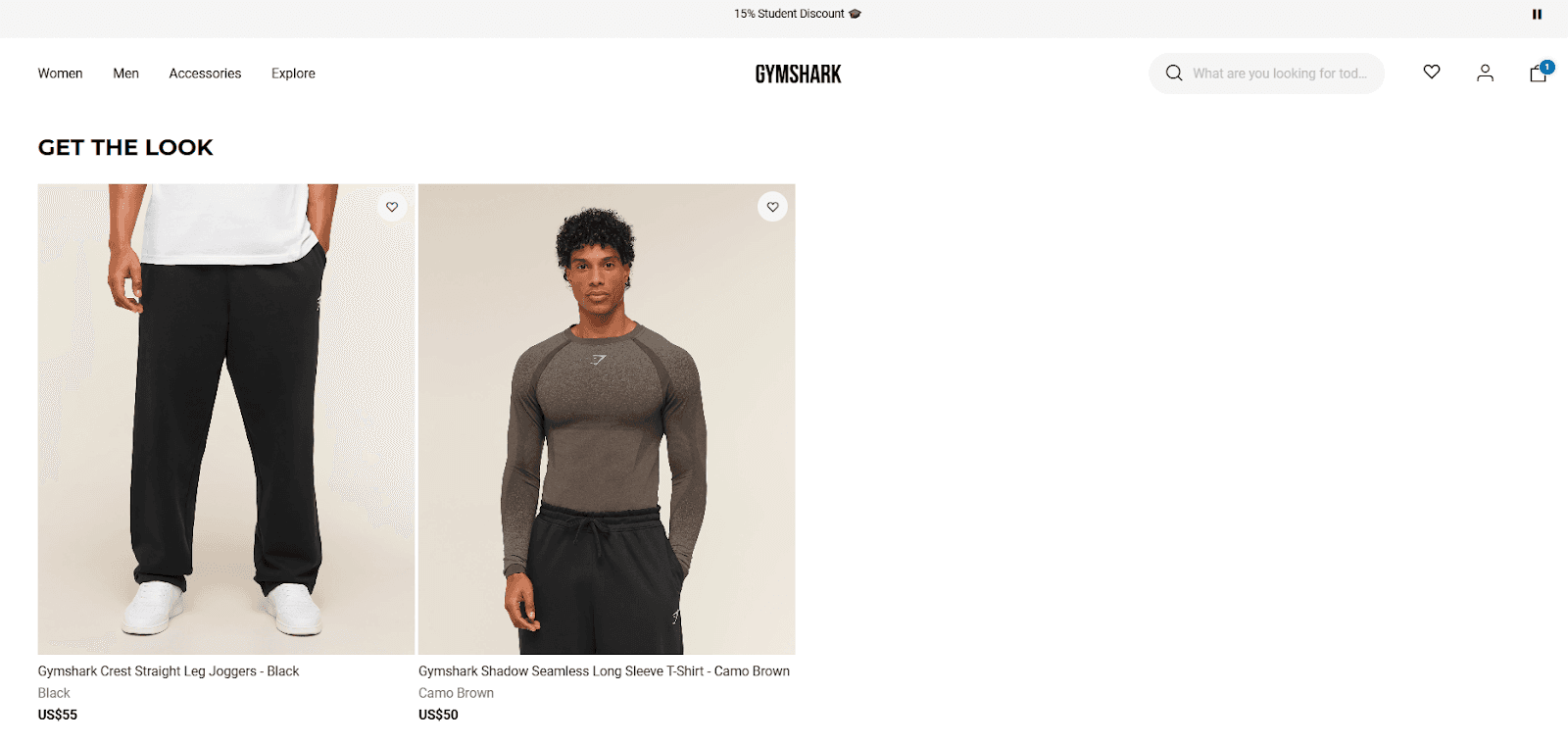
For example, Gymshark, an apparel brand, features a “Get The Look” section when a customer purchases a t-shirt. It provides a matching set of joggers to pitch a complete look to the customer.
Electronics
Electronics almost always come with a list of things you need alongside them. A camera needs a memory card, a laptop needs a sleeve, and a wireless speaker needs a carrying case.
For electronics brands, a cross-sell is often about necessity; the customer genuinely needs the add-on to get the full value out of their main purchase. That shift from want to need makes the recommendation significantly easier to say yes to, especially when it's presented clearly and at the right moment.
The most effective electronics cross-sells on Shopify tend to focus on three categories of add-ons: protection products like cases and screen protectors, performance enhancers like extended batteries and memory upgrades, and compatibility accessories like cables, adapters, and mounts. Each of these solves a real and immediate problem the customer is already anticipating, which is why they convert well when surfaced at the product page or cart stage.
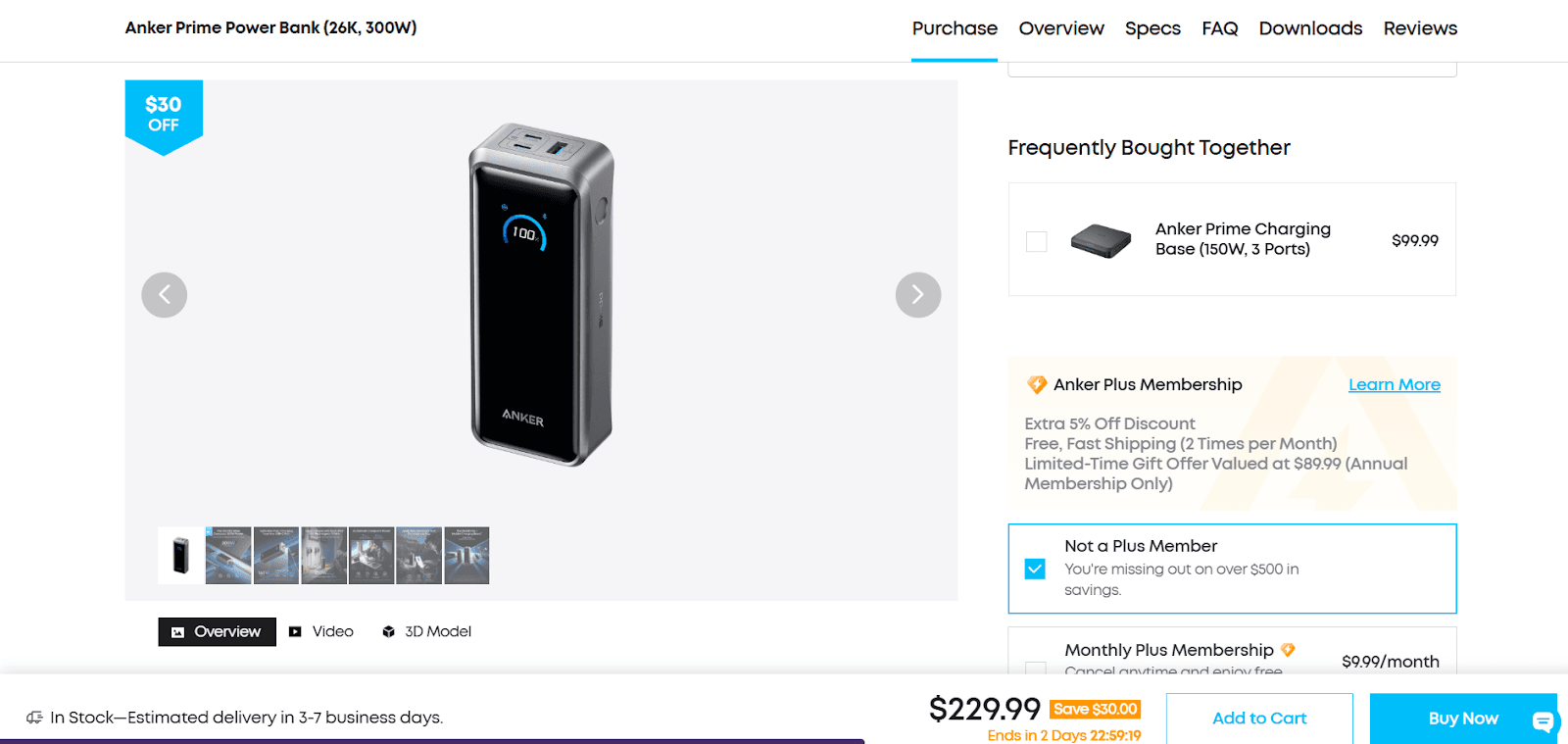
For example, Anker features a “Frequently Bought Together” section where, when a customer is purchasing a power bank, they show an option to add a charging base.
Beauty and Skincare
Beauty and skincare are among the highest-performing verticals for cross-selling on Shopify, and the reason is how skincare actually works. A single product rarely delivers the full result a customer is looking for. A cleanser works better with a toner. A serum performs better when followed by an SPF. A foundation sits better on prepped skin.
The most effective cross-sells in this vertical tend to follow the routine logic. Customers shopping for skincare are already thinking in steps: cleanse, treat, moisturize, protect. The customer isn't being pushed toward something arbitrary. They're being guided toward something that improves the product they've already chosen.
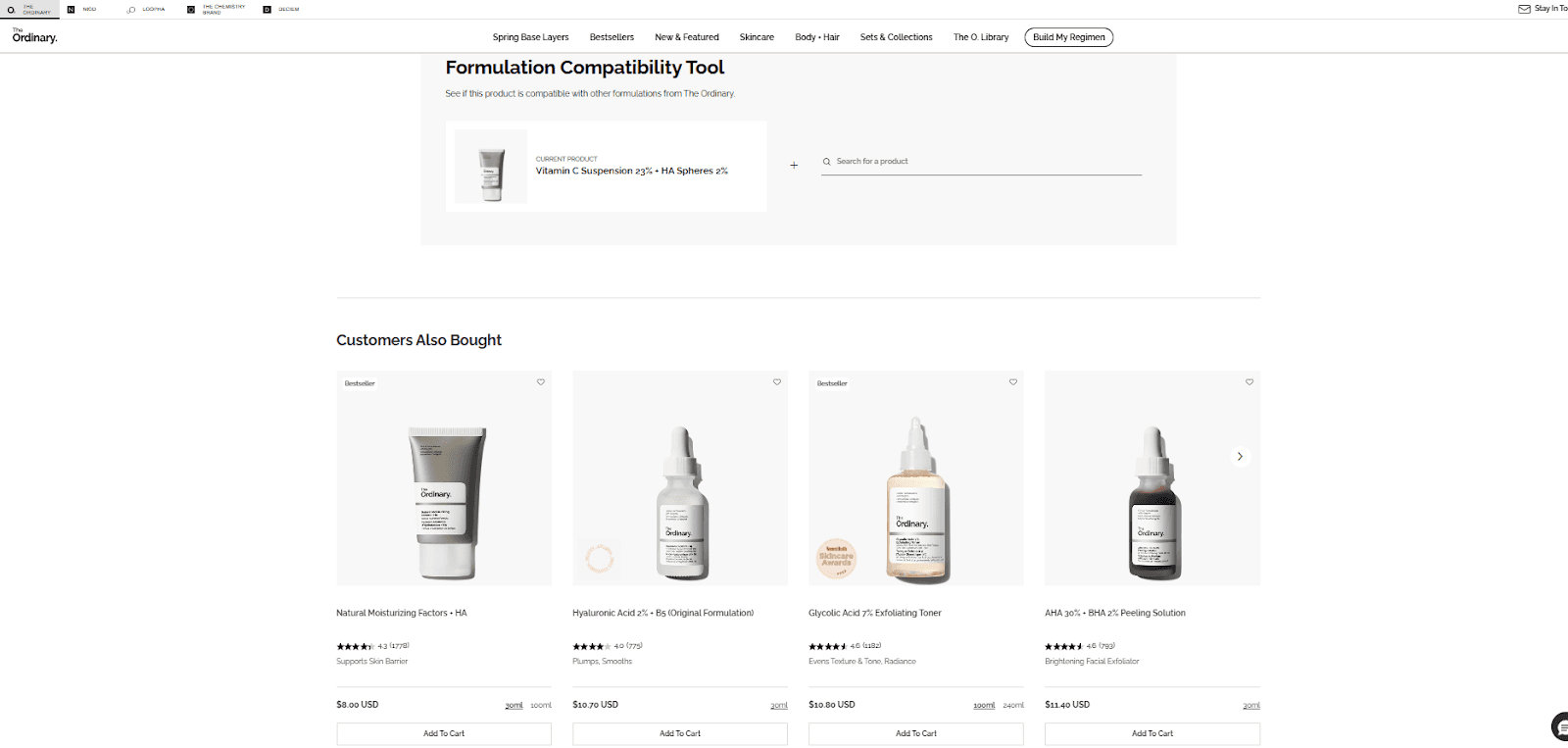
For example, when a customer searches for a serum on The Ordinary, it features a “Customers Also Bought” section that includes a toner, a moisturizer, a peeling solution, and hyaluronic acid as other steps in the skincare routine.
Home & Furniture
Unlike beauty or electronics, where the complementary product is often obvious and functional, home and furniture cross-selling requires a stronger emphasis on vision. A customer who has just chosen a sofa has made a significant aesthetic decision; they've committed to a colour, a material, a style. Everything else in the room now needs to work around that decision.
A Shopify store that steps in at this moment and shows them a rug that complements the sofa, a set of cushions that match the palette, and a coffee table that fits the proportions feels like an interior designer's assistance. The visual does the selling. The cross-sell just needs to be in the right place at the right time.
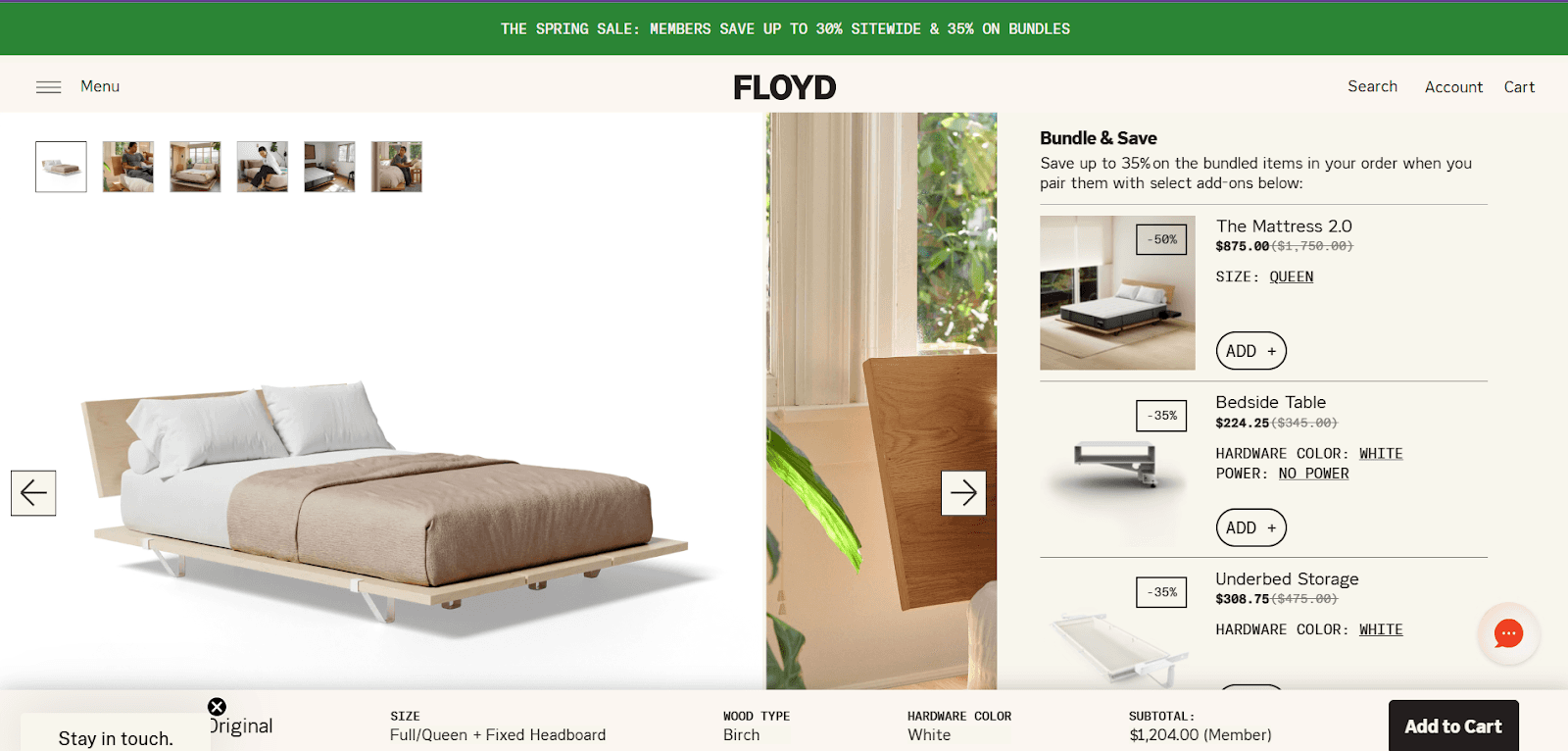
For example, Floyd provides its viewers with relevant furniture that complements the main product they are buying. In this case, when a customer is looking up a bed, they see bundling options of a mattress, beside table, and under storage.
How Monk Free Gift + BOGO Helps You Implement Cross-Selling
Knowing what cross-selling looks like is one thing. Having the right tool to actually set it up on your Shopify store is another. That's where Monk Free Gift + BOGO comes in.
Monk Free Gift is a Shopify app built specifically to help stores create and manage upsell and cross-sell offers across every key touchpoint in the customer journey: product pages, cart, checkout, and post-purchase.
It seamlessly integrates with all Shopify themes and gives you full control over when, where, and how your cross-sell offers appear, all from a clean, straightforward dashboard. Here's what Monk Free Gift + BOGO brings to your cross-selling setup:
Product page cross-sell offers: Monk Free Gift lets you configure cross-sell widgets directly on your product pages. You can choose from a range of pre-built templates or build a custom offer structure that matches your store's specific needs, all without any developer involvement.
Flexible eligibility and scheduling rules: Every cross-sell offer in Monk Free Gift can be configured with specific eligibility criteria to trigger only for certain products, collections, or customer segments. You can also schedule offers for a defined date range, making it easy to run cross-sell campaigns around launches, sales, or seasonal events.
AI-powered auto recommendations: For stores that don't want to manually curate every cross-sell pairing, Monk Free Gift + BOGO offers an auto-recommendation setting that uses Shopify's AI algorithm to suggest products based on your store's bestsellers and past purchase behaviour. It's particularly effective for stores processing high order volumes where the data set is large enough to generate accurate suggestions.
Multiple layout options for every theme: The widget isn't one-size-fits-all. Monk Free Gift + BOGO offers multiple display layouts, including carousel and list formats, with separate layout options for desktop and mobile. Every element of the widget, from fonts and colours to spacing and button styles, can be customised to match your store's branding through a global design editor.
Cart and checkout cross-sell placements: Beyond the product page, Monk Free Gift extends cross-sell functionality to the cart page and, for Shopify Plus stores, the checkout page as well, covering every high-intent moment in the purchase journey within a single app.
No interference with your theme's code: Monk Free Gift + BOGO works entirely through Shopify's app block system. It doesn't add, remove, or alter any of your theme's existing code, which means your store's performance and design stay intact regardless of how many offers you set up.
Conclusion
Cross-selling runs across your entire store experience. Whether you're in fashion, electronics, beauty, or home and furniture, there's an opportunity to recommend something relevant and valuable at every stage of the customer journey.
And as we emphasized, where you place that recommendation matters just as much as what you recommend. A suggestion on the product page hits differently than one at checkout, and a post-purchase email lands in a completely different headspace than a cart popup. Getting the placement right is what separates cross-selling that converts from cross-selling that gets ignored.
If you're looking to put this into practice on your Shopify store without the technical heavy lifting, Monk Free Gift + BOGO gives you the infrastructure to set it up cleanly and efficiently across every placement, every touchpoint, and every industry.
Frequently Asked Questions
What is cross-selling in e-commerce?
Cross-selling is the practice of recommending products that complement what a customer is already purchasing. In e-commerce, this typically appears as product suggestions on the product page, in the cart, at checkout, or in post-purchase communications.
What are the best cross-selling examples?
Some of the most effective cross-selling examples include "Frequently Bought Together" bundles on product pages, accessory recommendations at the cart stage, post-purchase thank you page offers, and personalised email campaigns triggered by what a customer has already bought.
How is cross-selling different from upselling?
Cross-selling suggests a different, complementary product alongside what the customer is buying. Upselling encourages the customer to upgrade to a higher-value version of the same product. Both increase order value but work through different types of recommendations.
Does cross-selling increase conversion rate?
Cross-selling primarily increases average order value rather than the initial conversion rate. However, when recommendations are relevant and well-timed, they can also improve the overall shopping experience, contributing to repeat purchases and higher lifetime conversion rates.
What is the best cross-selling strategy for Shopify?
The most effective strategy depends on your product catalogue and customer behaviour. A combination of product page recommendations, cart page add-ons, and post-purchase email campaigns tends to cover the full customer journey and deliver the most consistent revenue lift.
How many cross-sell products should I show?
As a general rule, showing between one and three products works best. Too many recommendations create decision fatigue and can distract the customer from completing their original purchase.
Can cross-selling improve customer experience?
Yes, when done correctly, cross-selling feels like helpful guidance rather than a sales tactic. A customer who finds everything they need in one place, with recommendations that genuinely make sense for their purchase, has a smoother and more satisfying shopping experience.
What tools help with cross-selling on Shopify?
Several Shopify apps support cross-selling across different placements, including product pages, cart, and post-purchase. Tools like Monk Free Gift + BOGO, Rebuy, and LimeSpot are commonly used by Shopify merchants to configure and manage cross-sell offers without custom development.
When is the best time to show cross-sell offers?
The highest-converting moments tend to be when purchase intent is at its peak: on the product page when a customer is actively considering a product, and on the cart page when they're close to checking out. Post-purchase placements also perform well because customers are satisfied and there's no risk of disrupting the original sale.
Cross-Selling Examples That Drive More Revenue in Ecommerce
Summary
Cross-selling in Shopify increases revenue by recommending complementary products during the shopping journey without increasing ad spend. It raises average order value and improves customer experience when suggestions are relevant and well timed. Effective placements include product pages, “frequently bought together” bundles, cart and checkout add-ons, post-purchase offers, popups, personalized AI recommendations, subscriptions, and email campaigns. Its success depends on timing, relevance, and simplicity, usually showing one to three items.
Different industries apply it differently, such as complete outfits in fashion, essential add-ons in electronics, routine-based products in beauty, and matching items in home goods. Proper execution improves conversions, retention, and long-term customer value.
A customer lands on your Shopify store for a phone case. But they check out with the case, a screen protector, and a charging dock. It's a win, that too without any extra ad spend. That’s the magic of cross-selling.
This win is much more than just a feel-good moment. It directly boosts your revenue and increases your average order value with every transaction. Not just this, when you offer your customer something more, something that genuinely complements what's already in their cart, you get added to their good books.
Shopify brands are already cashing in on this. In fact, companies practicing effective cross-selling see 20% higher revenue.
Ready to make that happen for your store? We'll break down why cross-selling works so well in ecommerce, along with real Shopify examples for you to draw inspiration from.
What Is Cross-Selling and Why Does It Work So Well?
Cross-selling is the practice of recommending related or complementary products to a customer based on what they're already buying. On a Shopify store, this looks like suggesting a lens cleaning kit when someone buys a camera, or offering a matching phone case when a customer adds earbuds to their cart. The goal is to increase the value of every order without increasing your acquisition costs.
Here's why it works so well:
The customer is already in buying mode: The hardest part is convincing someone to open their wallet. But here, it's already done. A well-placed cross-sell simply rides that momentum.
Relevant recommendations feel like good service: When the suggested product makes sense with what's in the cart, customers don't see it as an upsell. They see it as helpful.
Builds a stronger shopping experience: Customers who find everything they need in one place are more likely to return and trust your store.
Increase AOV of your Shopify store: Cross-sells work effectively with other proven strategies like free gifts with purchase because cross-sells help customers reach the spending threshold needed to unlock the gift. When done well, this increases AOV while guiding customers toward higher-value purchases without adding friction.
10 High-Converting Cross-Selling Examples
Cross-selling only works when it's done right. By that, we mean the right product, the right placement, and the right moment. Here are ten examples that Shopify stores are using to make it happen.
1. "Frequently Bought Together" Bundles
This is one of the most straightforward and effective cross-selling placements. When a customer lands on a product page, they're already interested. They're reading descriptions, looking at images, and mentally making the purchase. Showing them a "Frequently Bought Together" bundle at that exact moment catches them while their intent is at its peak.
The placement works because it doesn't feel like a sales tactic. It feels like information. You're simply telling the customer what other shoppers picked up alongside this product. That social proof, combined with the convenience of adding everything in a single click, removes friction and makes the decision easier.
2. Product Page Recommendations
If "Frequently Bought Together" bundles are about grouping products, product page recommendations are about expanding the customer's options while they're still in discovery mode. The placement typically lives below the main product details with the header "You Might Also Like" or "Complete the Look".
Its job is to keep the customer engaged and spending, without pulling them away from what they originally came for. The key is relevance. A recommendation that makes logical sense with the product on the page feels like a helpful nudge. One that doesn't, feels like clutter.
For example, Sephora features “You May Also Like” and “Use It With” sections on the product page to guide customers and increase the likelihood of cross-sell.
3. Accessories Cross-Sell (Core + Add-ons)
Some products are simply incomplete without their accessories, and that's exactly where this cross-sell strategy earns its place. The core product is what the customer came for. The add-ons are what make it work better, last longer, or deliver the full experience the customer actually wants. Positioning accessories as natural extensions renders them as customer service.
When your Shopify store surfaces those accessories at the right moment on the product page, in the cart, or at checkout, you're not introducing a new need. You're solving one that already exists.
For example, Popsockets has a section that features products that help “Complete Your Phone Kit.” Along with a phone case, it offers a MagSafe Power Pack or a mount, making the purchase complete.
4. Cart Page Cross-Selling
By the time a customer reaches the cart page, they've already made their decision. The hard part is done. This makes the cart page one of the cross-selling placements on any Shopify store.
The reason this placement converts so well is intent. Unlike a homepage visitor who's still browsing, a cart page visitor is ready to spend. A cross-sell at this stage doesn't need to build desire from scratch; it just needs to present something relevant enough to make the customer think, "that actually makes sense, I'll add it."
For example, Pela, a phone case Shopify store, adds a phone strap option in just one click on the cart page when the customer buys a phone case. It is the last moment, yet it is utterly convincing.
5. Checkout Add-ons (Last-Minute Cross-Sell)
If the cart page is high-intent, the checkout page is the highest-intent. A customer who has entered their shipping details and is one click away from placing an order is as committed as a customer can get. This makes the checkout page a surprisingly powerful spot for one final, well-timed cross-sell.
The reason this works is psychology. Adding a smaller, complementary product at this stage feels like a minor decision compared to the one they've already made. This is why checkout add-ons tend to work best with low-cost, high-relevance products. A ten-dollar add-on feels like nothing to someone already spending a hundred.
For example, Allbirds offers cross-sells such as a shoe bag when a customer is buying a pair of shoes. A shoe bag doesn’t require much consideration, but it is also necessary, which makes it the perfect spot.
6. Post-Purchase Cross-Selling (Thank You Page)
Most Shopify stores treat the thank you page as a formality, a polite confirmation that the order went through, and nothing more. That's a missed opportunity. The thank-you page is one of the few moments in the customer journey when there is zero purchase anxiety. The order is placed, the decision is made, and the customer is in a genuinely positive headspace. That's a remarkably receptive audience.
What makes post-purchase cross-selling different from every other placement is that there's no risk of cart abandonment. Any additional purchase made on the thank-you page is pure incremental revenue.
7. Cross-Sell Popups (Smart Triggers)
A poorly timed pop-up that interrupts a customer mid-browse. But a pop-up that appears at the right moment, with the right product, triggered by the right customer behaviour? That's an entirely different story.
Smart cross-sell popups respond to specific customer actions, such as adding a product to the cart, spending a set amount of time on a product page, or reaching a certain cart value. That context is what separates a cross-sell that converts from one that gets closed in under a second.
8. Personalized Recommendations (AI-Based)
Every customer who lands on your Shopify store leaves a trail of what they clicked, what they browsed, what they added and removed from their cart, and what they've purchased before. AI-based personalization takes all that behavioural data and turns it into cross-sell recommendations specific to each individual shopper, rather than a generic suggestion served to everyone who visits the same page.
Every other method relies on product logic of what generally pairs well with what. AI-based recommendations rely on customer logic of what this specific person is most likely to want based on everything they've shown you through their behaviour. The result is a cross-sell that feels less like a store recommendation and more like a genuinely personalised suggestion.
9. Subscription-Based Cross-Selling
Subscription-based cross-selling works on a dynamic of an ongoing relationship. A subscription customer isn't a one-time buyer. They've committed to your store on a recurring basis, which means they've already demonstrated a level of trust that most customers take multiple purchases to build. That trust is the foundation that makes cross-selling to subscribers so effective.
The key is that the cross-sell is anchored to something they're already loyal to, which makes the leap to a second product significantly smaller than it would be for a first-time visitor browsing your store cold.
10. Email Cross-Selling Campaigns
Email is the one cross-selling channel that reaches your customers outside your store. It lands in the customer's inbox hours, days, or even weeks after their purchase, at a time when they've had a chance to use what they bought and form an opinion about it.
A customer who has been using your product for a week and is happy with it is far more receptive to a complementary recommendation than they were at checkout. An email that arrives at this moment feels like a thoughtful follow-up from a brand that understands them.
Best Cross-Selling Examples by Industry
Cross-selling looks different depending on what you sell: the products, the customer mindset, and the right moment to recommend all vary by industry. Here's how the best Shopify stores are doing it across the most competitive categories:
Fashion and Apparel
Nobody buys an outfit in isolation. A customer purchasing a dress is already thinking about shoes. A customer adding a jacket to their cart is mentally pairing it with accessories. Fashion cross-selling simply makes that natural thought process visible and actionable within your Shopify store.
The most effective cross-sells in fashion revolve around two core ideas: completing the look and matching within a collection. "Complete the Look" recommendations take a single product and build an outfit around it, showing the customer exactly how other pieces work together with what they're already buying.
Collection-based cross-sells surface items from the same range, colour palette, or aesthetic, making it easy for the customer to stay within a style they've already responded to without having to hunt for it themselves.
For example, Gymshark, an apparel brand, features a “Get The Look” section when a customer purchases a t-shirt. It provides a matching set of joggers to pitch a complete look to the customer.
Electronics
Electronics almost always come with a list of things you need alongside them. A camera needs a memory card, a laptop needs a sleeve, and a wireless speaker needs a carrying case.
For electronics brands, a cross-sell is often about necessity; the customer genuinely needs the add-on to get the full value out of their main purchase. That shift from want to need makes the recommendation significantly easier to say yes to, especially when it's presented clearly and at the right moment.
The most effective electronics cross-sells on Shopify tend to focus on three categories of add-ons: protection products like cases and screen protectors, performance enhancers like extended batteries and memory upgrades, and compatibility accessories like cables, adapters, and mounts. Each of these solves a real and immediate problem the customer is already anticipating, which is why they convert well when surfaced at the product page or cart stage.
For example, Anker features a “Frequently Bought Together” section where, when a customer is purchasing a power bank, they show an option to add a charging base.
Beauty and Skincare
Beauty and skincare are among the highest-performing verticals for cross-selling on Shopify, and the reason is how skincare actually works. A single product rarely delivers the full result a customer is looking for. A cleanser works better with a toner. A serum performs better when followed by an SPF. A foundation sits better on prepped skin.
The most effective cross-sells in this vertical tend to follow the routine logic. Customers shopping for skincare are already thinking in steps: cleanse, treat, moisturize, protect. The customer isn't being pushed toward something arbitrary. They're being guided toward something that improves the product they've already chosen.
For example, when a customer searches for a serum on The Ordinary, it features a “Customers Also Bought” section that includes a toner, a moisturizer, a peeling solution, and hyaluronic acid as other steps in the skincare routine.
Home & Furniture
Unlike beauty or electronics, where the complementary product is often obvious and functional, home and furniture cross-selling requires a stronger emphasis on vision. A customer who has just chosen a sofa has made a significant aesthetic decision; they've committed to a colour, a material, a style. Everything else in the room now needs to work around that decision.
A Shopify store that steps in at this moment and shows them a rug that complements the sofa, a set of cushions that match the palette, and a coffee table that fits the proportions feels like an interior designer's assistance. The visual does the selling. The cross-sell just needs to be in the right place at the right time.
For example, Floyd provides its viewers with relevant furniture that complements the main product they are buying. In this case, when a customer is looking up a bed, they see bundling options of a mattress, beside table, and under storage.
How Monk Free Gift + BOGO Helps You Implement Cross-Selling
Knowing what cross-selling looks like is one thing. Having the right tool to actually set it up on your Shopify store is another. That's where Monk Free Gift + BOGO comes in.
Monk Free Gift is a Shopify app built specifically to help stores create and manage upsell and cross-sell offers across every key touchpoint in the customer journey: product pages, cart, checkout, and post-purchase.
It seamlessly integrates with all Shopify themes and gives you full control over when, where, and how your cross-sell offers appear, all from a clean, straightforward dashboard. Here's what Monk Free Gift + BOGO brings to your cross-selling setup:
Product page cross-sell offers: Monk Free Gift lets you configure cross-sell widgets directly on your product pages. You can choose from a range of pre-built templates or build a custom offer structure that matches your store's specific needs, all without any developer involvement.
Flexible eligibility and scheduling rules: Every cross-sell offer in Monk Free Gift can be configured with specific eligibility criteria to trigger only for certain products, collections, or customer segments. You can also schedule offers for a defined date range, making it easy to run cross-sell campaigns around launches, sales, or seasonal events.
AI-powered auto recommendations: For stores that don't want to manually curate every cross-sell pairing, Monk Free Gift + BOGO offers an auto-recommendation setting that uses Shopify's AI algorithm to suggest products based on your store's bestsellers and past purchase behaviour. It's particularly effective for stores processing high order volumes where the data set is large enough to generate accurate suggestions.
Multiple layout options for every theme: The widget isn't one-size-fits-all. Monk Free Gift + BOGO offers multiple display layouts, including carousel and list formats, with separate layout options for desktop and mobile. Every element of the widget, from fonts and colours to spacing and button styles, can be customised to match your store's branding through a global design editor.
Cart and checkout cross-sell placements: Beyond the product page, Monk Free Gift extends cross-sell functionality to the cart page and, for Shopify Plus stores, the checkout page as well, covering every high-intent moment in the purchase journey within a single app.
No interference with your theme's code: Monk Free Gift + BOGO works entirely through Shopify's app block system. It doesn't add, remove, or alter any of your theme's existing code, which means your store's performance and design stay intact regardless of how many offers you set up.
Conclusion
Cross-selling runs across your entire store experience. Whether you're in fashion, electronics, beauty, or home and furniture, there's an opportunity to recommend something relevant and valuable at every stage of the customer journey.
And as we emphasized, where you place that recommendation matters just as much as what you recommend. A suggestion on the product page hits differently than one at checkout, and a post-purchase email lands in a completely different headspace than a cart popup. Getting the placement right is what separates cross-selling that converts from cross-selling that gets ignored.
If you're looking to put this into practice on your Shopify store without the technical heavy lifting, Monk Free Gift + BOGO gives you the infrastructure to set it up cleanly and efficiently across every placement, every touchpoint, and every industry.
Frequently Asked Questions
What is cross-selling in e-commerce?
Cross-selling is the practice of recommending products that complement what a customer is already purchasing. In e-commerce, this typically appears as product suggestions on the product page, in the cart, at checkout, or in post-purchase communications.
What are the best cross-selling examples?
Some of the most effective cross-selling examples include "Frequently Bought Together" bundles on product pages, accessory recommendations at the cart stage, post-purchase thank you page offers, and personalised email campaigns triggered by what a customer has already bought.
How is cross-selling different from upselling?
Cross-selling suggests a different, complementary product alongside what the customer is buying. Upselling encourages the customer to upgrade to a higher-value version of the same product. Both increase order value but work through different types of recommendations.
Does cross-selling increase conversion rate?
Cross-selling primarily increases average order value rather than the initial conversion rate. However, when recommendations are relevant and well-timed, they can also improve the overall shopping experience, contributing to repeat purchases and higher lifetime conversion rates.
What is the best cross-selling strategy for Shopify?
The most effective strategy depends on your product catalogue and customer behaviour. A combination of product page recommendations, cart page add-ons, and post-purchase email campaigns tends to cover the full customer journey and deliver the most consistent revenue lift.
How many cross-sell products should I show?
As a general rule, showing between one and three products works best. Too many recommendations create decision fatigue and can distract the customer from completing their original purchase.
Can cross-selling improve customer experience?
Yes, when done correctly, cross-selling feels like helpful guidance rather than a sales tactic. A customer who finds everything they need in one place, with recommendations that genuinely make sense for their purchase, has a smoother and more satisfying shopping experience.
What tools help with cross-selling on Shopify?
Several Shopify apps support cross-selling across different placements, including product pages, cart, and post-purchase. Tools like Monk Free Gift + BOGO, Rebuy, and LimeSpot are commonly used by Shopify merchants to configure and manage cross-sell offers without custom development.
When is the best time to show cross-sell offers?
The highest-converting moments tend to be when purchase intent is at its peak: on the product page when a customer is actively considering a product, and on the cart page when they're close to checking out. Post-purchase placements also perform well because customers are satisfied and there's no risk of disrupting the original sale.
Contents
Related Articles
20+ Best Free Gift Ideas for Shopify Stores That Drive More Sales
Upsell vs Cross-Sell in Shopify: Key Differences, Examples & Strategies
10 Best Upsell Apps for Shopify to Boost Sales & AOV in 2026
Get Monk Free Gift app for just $1/month this Black Friday
First month: $1 after your 7-day free trial. All features included. Offer live!
Claim offer now

Get Monk Free Gift app for just $1/month this Black Friday
First month: $1 after your 7-day free trial. All features included. Offer live!
Claim offer now
Get Monk Free Gift app for just $1/month this Black Friday
First month: $1 after your 7-day free trial. All features included. Offer live!
Claim offer now