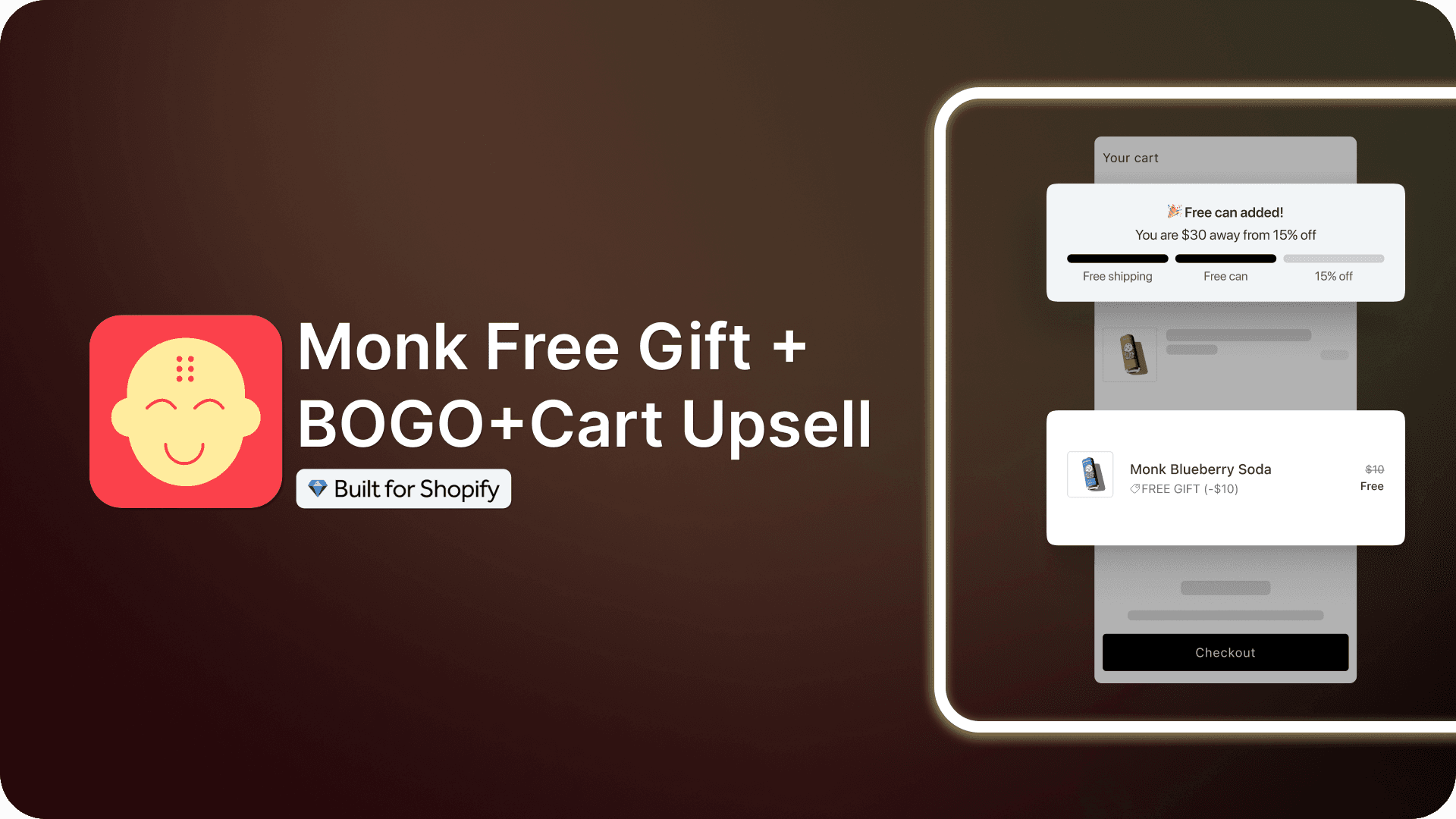
How to Set a Free Gift Threshold on Shopify (With Examples)
Summary
A free gift threshold is one of the simplest ways to increase average order value on Shopify. This guide explains how to set the right threshold (30–50% above your AOV), choose a free gift with high perceived value and low cost to you, and track your threshold reach rate. It compares five campaign types with examples: spend X get a free gift, tiered free gift offers, Buy X Get Y (BOGO), free gift plus free shipping, and limited-time offers. You’ll also learn why free gifts often beat discounts on margin, how a cart progress bar keeps customers moving toward the threshold, and how to set up free gift with purchase offers in Monk Free Gift + BOGO to raise cart value and AOV on your store.

Ravish (RV)
Senior Content Writer
Ravish is an ecommerce and SaaS marketing expert with 6+ years of experience in Shopify and ecommerce and 10+ years of experience in marketing, and growth strategy. He has worked closely with Shopify merchants to solve real ecommerce challenges and shares practical, research-backed insights, industry best practices, and emerging trends.
Key Takeaways
A free gift threshold is one of the simplest ways to increase average order value on Shopify. This guide explains how to set the right threshold (30–50% above your AOV), choose a free gift with high perceived value and low cost to you, and track your threshold reach rate. It compares five campaign types with examples: spend X get a free gift, tiered free gift offers, Buy X Get Y (BOGO), free gift plus free shipping, and limited-time offers. You’ll also learn why free gifts often beat discounts on margin, how a cart progress bar keeps customers moving toward the threshold, and how to set up free gift with purchase offers in Monk Free Gift + BOGO to raise cart value and AOV on your store.
A free gift gives shoppers a concrete reason to add one more item. A customer who sees they’re $15 away from something free behaves very differently from one who sees nothing at all, and that gap is where a free gift threshold earns its keep.
Thresholds are the most common way to run a free gift with purchase on Shopify, because the reward only unlocks once the cart reaches a set value. This guide covers how to set the right threshold, pick a gift that costs little but feels valuable, choose a campaign type, and measure whether it’s lifting your AOV.
What Are Free Gift Thresholds in Ecommerce?
A free gift threshold is the minimum spend a customer must meet before they can claim a free item. The most common version is based on cart value: “Spend $80, get a free gift.” Less common but equally effective is the item-count version: “Add 3 products, unlock a bonus item.”
The threshold creates a target. Without it, customers check out whenever they feel done shopping. With it, they have a reason to add one more thing. A cart at $62 behaves very differently when the customer sees they’re $13 away from something free.
The idea is simple, but the execution depends on choosing the right threshold, picking the right gift, and presenting it correctly.

Why Free Gift Thresholds Increase Average Order Value (AOV)
Customers overvalue free things. A candle that retails for $18 and costs you $3 to produce becomes a much stronger motivator when it’s framed as a gift rather than a line item. Customers aren’t thinking about your cost; they’re thinking about the $18 value they’re getting for free.
Here’s an example: a skincare store with a $55 AOV sets a gift threshold at $75. A customer who would’ve checked out at $58 sees they’re $17 away. They add a $20 travel moisturizer. Now the order is $78, the customer gets a sample set worth $14 retail, and the store gains $20 in incremental revenue for a $3 gift.
The mechanism also works differently from discounts. When you offer 15% off, you reduce revenue on orders that would’ve happened anyway. With a free gift threshold, you mostly pay when a customer spends more, though customers who would have crossed the threshold anyway still receive the gift. And you pay at product cost, not on their full basket margin.
Best Types of Free Gift Threshold Campaigns
Here are five campaign types, with examples:
Spend X, Get a Free Gift
This is the most basic form of free gift threshold. Set a cart-value threshold, display a progress bar in the cart, and offer one gift when the customer crosses it: “You’re $12 away from a free travel pouch,” then “You’ve unlocked your free gift! Choose below.” This baseline offer is clean, intuitive, and effective for almost every store type.
Beauty brands like Sephora have run versions of this for years, tying cart-value milestones to curated sample sets.
Tiered Free Gift Offers
Instead of one threshold, you build a ladder. Spend $50, get a small gift. Spend $100, get a better one. Spend $150, unlock the premium reward. Each tier gives the customer a new target to chase. Tiered structures work especially well for repeat customers who’ve already seen your entry-level gift.
A fitness supplement brand might structure it like this: $60 → branded shaker bottle, $100 → sample pack of 3 flavors, $150 → full-size product of their choice. The customer who came in for $65 worth of protein often ends up at $100 because the mid-tier reward is just interesting enough to justify it.
Buy X Get Y (BXGY) Campaigns
BXGY shifts the logic from spending to purchasing. Buy 2 full-price items, get 1 free. Buy a specific product, get a complementary item free. This campaign type is especially useful for clearing slow-moving inventory or introducing new products. If someone buys your best-selling face wash and gets your new vitamin C serum free, they try the serum, like it, and come back for it next time.
Monk Free Gift + BOGO handles BXGY natively, and the free item can be auto-added or offered as a selection. Auto-add gives you control; selection lets customers choose.
Free Gift + Free Shipping Combination
Pairing two incentives in the same cart creates a compounding effect. Set your free shipping threshold at roughly AOV + 30%. Then place the gift threshold another 30–40% above that. A store with a $50 AOV might structure it as free shipping at $65 and a free gift at $90.
The customer at $50 sees two goals. They hit $65 and unlock free shipping, and now they’re already partway to the gift. The second goal feels achievable because they’re already in motion. Completing one target builds momentum toward the next.
Limited-Time Gift Threshold Campaigns
Time pressure and free gifts are a strong combination: “This weekend only: spend $60 and get a free limited-edition candle.” The gift itself is interesting; the deadline makes it urgent. Customers who were going to buy next week buy today.
These work particularly well during holidays, brand anniversaries, or product launches. The gift doesn’t have to be expensive; it has to feel exclusive. A small run of a special colorway, a bundle that doesn’t exist in your regular catalog, or a seasonal product that won’t be back creates the right kind of urgency.
How to Choose the Right Free Gift for Your Store
Choose your gift using three criteria:
High perceived value relative to cost: Choose a gift that feels worth noticeably more to the customer than it costs you, and make sure that cost fits within the extra profit your threshold brings in.
Brand relevance: The gift should feel like it belongs. A haircare brand offering a satin scrunchie makes sense. The same brand offering a phone grip doesn’t. Relevance signals thoughtfulness; randomness signals clearance.
Not a product customers would otherwise buy: If it’s already in your top 10 bestsellers, it doesn’t belong in the gift pool. You want something customers would enjoy but wouldn’t have added to their cart on their own. That’s what makes it feel like a bonus rather than a forced upsell.
Where possible, let customers choose from 3–5 options. Someone who picked their gift is more likely to keep it in the cart.
How to Set the Right Free Gift Threshold
Start with your current AOV and set the threshold 30–50% above it.
If your AOV is $55, a $75–$80 threshold is a reasonable starting point. This range applies to a single threshold.
If you’re building a tiered ladder, set the first tier closer, at 15–25% above AOV, so the first goal feels reachable.
Then watch your threshold reach rate: the percentage of carts that cross the line.
A reach rate below 15% means the threshold is too high, and most customers never engage with it.
Above 60% means it’s too low, and you’re giving away gifts without meaningful lift. The productive range is 20–40%.
Also factor in your gift cost.
If the gift costs you $6, the incremental spend needs to generate at least $6 in gross profit. At a 50% margin, that’s $12 in added spend. At a $75 threshold from a $55 AOV baseline, the average incremental spend is $20. At a 50% margin, that yields $10 in profit, covering a $6 gift with $4 left over.
As your product mix and AOV shift, adjust your thresholds to match.
Best Practices for Running High-Converting Free Gift Campaigns
Show the progress, not just the offer. “Spend $80 to get a free gift” is weak. “You’re $14 away from a free travel bag” is what actually moves people. Dynamic messaging that updates as items are added, tied to a progress bar, keeps the goal in front of the customer throughout the cart session.
Keep the gift selection simple. If you're opting for a Free Gift- Selection offer, three to five options is the range that converts. Fewer feels like you didn’t think about it; more creates decision fatigue. Each option should have a clear name and image.
Promote the offer before the cart. Homepage banners, product page banners, and email subject lines (“Free gift with your next order”) prime the customer before they start adding to cart. By the time they see the cart progress bar, they’re already motivated.
Rotate gifts every 4–6 weeks. Returning customers won’t respond to a gift they’ve already seen or received. Seasonal rotations tied to your marketing calendar, like summer, back-to-school, Black Friday, and the holidays, keep the offer fresh.
Common Mistakes to Avoid With Free Gift Thresholds
Auto-adding gifts with variants: If a gift comes in sizes or shades, an auto-added default may not suit the customer. Use gift selection for variant gifts, and auto-add for single-variant items.
Setting thresholds too high: If your AOV is $50 and you set a threshold at $150, almost no one will reach it, and the campaign goes unnoticed.
Running no analytics: A gift campaign without tracking is guesswork. You need to know your threshold reach rate, which gift options get selected, and whether AOV is lifting for orders that include a gift.
Forgetting mobile: Most Shopify traffic comes from mobile devices. Your gift selection UI, progress bar, and call to action all need to work cleanly on a 375px screen.
How Monk Helps Increase Cart Value With Free Gift Thresholds
Monk Free Gift + BOGO is built for running free gift campaigns on Shopify without custom code or workarounds. You can set up spend-based thresholds, tiered gift ladders, and BXGY campaigns from a single offer builder. The free gift can be auto-added or presented as a selection, so customers can choose from a curated pool of gifts.

In the offer setup, you define your eligibility rules (cart value range, specific collections, specific discount codes), select the gift product or pool, and choose your display method. For Shopify Plus merchants, Monk Free Gift also extends into the native checkout. The gift selection widget sits right at checkout, so the offer doesn’t disappear when customers leave the cart.
The analytics dashboard tracks gift views, gifts claimed, and which options customers choose most often, giving you the data to rotate underperformers and double down on what’s working.
For stores that want to combine free gifts with free shipping incentives, Monk Free Gift + BOGO supports both in a single progress-based display in the cart.
Free Gift Thresholds vs Traditional Discounting
Free gifts and discounts both cost money, but they cost it on different orders.
With a traditional discount, 15% off applies to every order that qualifies, including ones that would’ve happened at full price. You’re paying for conversions you would’ve gotten anyway.
A free gift threshold mostly costs you when a customer spends more than they planned, though customers who would have crossed the threshold anyway still receive the gift. There’s no revenue reduction on the existing basket, just a product cost. The margin math usually favors gifts over discounts.
There’s also brand perception. Discounts train customers to wait for sales. Free gifts create a sense of value and reward without telling customers your prices are negotiable. For brands that care about price positioning, that difference compounds over time.
That said, discounts have their place: clearance events, customer win-backs, and price-sensitive segments. For AOV growth on a healthy catalog, gift thresholds consistently outperform.
How to Measure the Success of Free Gift Campaigns
Track these metrics:
Threshold reach rate: The percentage of carts that cross the threshold. Aim for 20–40%, and adjust the threshold if you fall outside that range.
Gift claim rate: Of the customers who see the offer, how many add a gift? A low claim rate means the gift selection isn’t compelling.
AOV lift: Compare average order value for gift orders vs. non-gift orders. This is your bottom-line ROI number.
Revenue per gift campaign: Total incremental revenue (gift orders minus expected non-gift revenue) minus total gift cost. It tells you whether the campaign is profitable, not just popular.
Final Thoughts
Free gift thresholds work because they align what the customer wants (something free) with what you need (a higher order value). The gap between your cost and their perceived value is where the profit lives.
The mechanics aren’t complicated. Set a threshold 30–50% above your AOV and pick a gift that costs you little and feels worth a lot. Show customers how close they are in real time and let them choose. Measure the reach rate and adjust.
Most campaigns fail on one of three things: the wrong gift, a threshold no one reaches, or an offer customers don’t notice.
To make adding free gifts easy, use an app like Monk Free Gift + BOGO. It handles the setup, the display, and the analytics, so you can focus on strategy rather than implementation.
FAQs
Do free gifts increase average order value?
Yes. Free gift thresholds are one of the most effective AOV levers for ecommerce stores, because customers qualify by spending more. Customers add items to reach the threshold, and the gift cost is more than offset by the additional cart value.
What is the best free gift threshold percentage?
For a single threshold, setting it 30–50% above your current average order value gives the best balance of reachability and lift. For the first tier of a tiered ladder, aim closer, at 15–25% above AOV. The clearest signal that you’ve calibrated correctly is your threshold reach rate. Aim for 20–40% of carts crossing the line. Below 15% means the bar is too high; above 60% means customers qualify too easily, leaving AOV lift on the table.
How do I automatically add free gifts in Shopify?
Shopify can’t auto-add free gifts natively on any plan, so you need a third-party app. Monk Free Gift + BOGO lets you configure automatic gift additions based on cart value, item count, or specific product combinations without writing any code. For Shopify Plus merchants, it also extends the gift experience into the native checkout.
What products work best as free gifts?
Products that cost $3–8 to produce but carry $12–20 in perceived retail value work best, like travel-size versions of hero products, branded accessories, seasonal bundles, or novelty items customers wouldn’t buy on their own. Avoid using your bestsellers as gifts; those will sell anyway, so you’re giving away margin rather than driving incremental revenue.
Can free gift campaigns improve conversion rates?
Free gift thresholds mainly target AOV rather than initial conversion. They’re designed to move customers from “check out now” to “add one more thing.” That said, a well-promoted gift threshold (visible on the product page, in the cart, and in email campaigns) can also push customers to make their first purchase if the gift is compelling enough. Conversion lift tends to be a secondary benefit, with AOV improvement as the primary ROI driver.
What is better: discounts or free gifts?
For AOV growth, free gifts usually win because they mostly cost you when a customer spends more, while discounts reduce revenue on orders that would’ve happened anyway. Discounts also carry a brand-positioning risk, because customers learn to wait for sales rather than buying at full price. Free gifts reward spending without signaling that your prices are negotiable.
Can I create tiered free gift rewards in Shopify?
Yes, using third-party apps like Monk Free Gift + BOGO. Tiered systems are particularly effective for repeat customers who’ve already claimed your entry-level gift and need a new milestone to reach. Shopify’s native admin doesn’t support multi-tier gift logic, so you need an app.
How often should I run free gift campaigns?
Running various gift threshold campaigns with different strategies year-round tends to produce the best results, because it consistently pulls AOV up. Rotate your gifts every 4–6 weeks to keep returning customers interested.
Do free gift thresholds work for small Shopify stores?
Yes. Small stores benefit because a threshold lifts AOV without a large marketing team, and a smaller catalog makes it easier to pick a relevant gift. Start with one threshold and one or two gift options.
How to Set a Free Gift Threshold on Shopify (With Examples)
Summary
A free gift threshold is one of the simplest ways to increase average order value on Shopify. This guide explains how to set the right threshold (30–50% above your AOV), choose a free gift with high perceived value and low cost to you, and track your threshold reach rate. It compares five campaign types with examples: spend X get a free gift, tiered free gift offers, Buy X Get Y (BOGO), free gift plus free shipping, and limited-time offers. You’ll also learn why free gifts often beat discounts on margin, how a cart progress bar keeps customers moving toward the threshold, and how to set up free gift with purchase offers in Monk Free Gift + BOGO to raise cart value and AOV on your store.
A free gift gives shoppers a concrete reason to add one more item. A customer who sees they’re $15 away from something free behaves very differently from one who sees nothing at all, and that gap is where a free gift threshold earns its keep.
Thresholds are the most common way to run a free gift with purchase on Shopify, because the reward only unlocks once the cart reaches a set value. This guide covers how to set the right threshold, pick a gift that costs little but feels valuable, choose a campaign type, and measure whether it’s lifting your AOV.
What Are Free Gift Thresholds in Ecommerce?
A free gift threshold is the minimum spend a customer must meet before they can claim a free item. The most common version is based on cart value: “Spend $80, get a free gift.” Less common but equally effective is the item-count version: “Add 3 products, unlock a bonus item.”
The threshold creates a target. Without it, customers check out whenever they feel done shopping. With it, they have a reason to add one more thing. A cart at $62 behaves very differently when the customer sees they’re $13 away from something free.
The idea is simple, but the execution depends on choosing the right threshold, picking the right gift, and presenting it correctly.
Why Free Gift Thresholds Increase Average Order Value (AOV)
Customers overvalue free things. A candle that retails for $18 and costs you $3 to produce becomes a much stronger motivator when it’s framed as a gift rather than a line item. Customers aren’t thinking about your cost; they’re thinking about the $18 value they’re getting for free.
Here’s an example: a skincare store with a $55 AOV sets a gift threshold at $75. A customer who would’ve checked out at $58 sees they’re $17 away. They add a $20 travel moisturizer. Now the order is $78, the customer gets a sample set worth $14 retail, and the store gains $20 in incremental revenue for a $3 gift.
The mechanism also works differently from discounts. When you offer 15% off, you reduce revenue on orders that would’ve happened anyway. With a free gift threshold, you mostly pay when a customer spends more, though customers who would have crossed the threshold anyway still receive the gift. And you pay at product cost, not on their full basket margin.
Best Types of Free Gift Threshold Campaigns
Here are five campaign types, with examples:
Spend X, Get a Free Gift
This is the most basic form of free gift threshold. Set a cart-value threshold, display a progress bar in the cart, and offer one gift when the customer crosses it: “You’re $12 away from a free travel pouch,” then “You’ve unlocked your free gift! Choose below.” This baseline offer is clean, intuitive, and effective for almost every store type.
Beauty brands like Sephora have run versions of this for years, tying cart-value milestones to curated sample sets.
Tiered Free Gift Offers
Instead of one threshold, you build a ladder. Spend $50, get a small gift. Spend $100, get a better one. Spend $150, unlock the premium reward. Each tier gives the customer a new target to chase. Tiered structures work especially well for repeat customers who’ve already seen your entry-level gift.
A fitness supplement brand might structure it like this: $60 → branded shaker bottle, $100 → sample pack of 3 flavors, $150 → full-size product of their choice. The customer who came in for $65 worth of protein often ends up at $100 because the mid-tier reward is just interesting enough to justify it.
Buy X Get Y (BXGY) Campaigns
BXGY shifts the logic from spending to purchasing. Buy 2 full-price items, get 1 free. Buy a specific product, get a complementary item free. This campaign type is especially useful for clearing slow-moving inventory or introducing new products. If someone buys your best-selling face wash and gets your new vitamin C serum free, they try the serum, like it, and come back for it next time.
Monk Free Gift + BOGO handles BXGY natively, and the free item can be auto-added or offered as a selection. Auto-add gives you control; selection lets customers choose.
Free Gift + Free Shipping Combination
Pairing two incentives in the same cart creates a compounding effect. Set your free shipping threshold at roughly AOV + 30%. Then place the gift threshold another 30–40% above that. A store with a $50 AOV might structure it as free shipping at $65 and a free gift at $90.
The customer at $50 sees two goals. They hit $65 and unlock free shipping, and now they’re already partway to the gift. The second goal feels achievable because they’re already in motion. Completing one target builds momentum toward the next.
Limited-Time Gift Threshold Campaigns
Time pressure and free gifts are a strong combination: “This weekend only: spend $60 and get a free limited-edition candle.” The gift itself is interesting; the deadline makes it urgent. Customers who were going to buy next week buy today.
These work particularly well during holidays, brand anniversaries, or product launches. The gift doesn’t have to be expensive; it has to feel exclusive. A small run of a special colorway, a bundle that doesn’t exist in your regular catalog, or a seasonal product that won’t be back creates the right kind of urgency.
How to Choose the Right Free Gift for Your Store
Choose your gift using three criteria:
High perceived value relative to cost: Choose a gift that feels worth noticeably more to the customer than it costs you, and make sure that cost fits within the extra profit your threshold brings in.
Brand relevance: The gift should feel like it belongs. A haircare brand offering a satin scrunchie makes sense. The same brand offering a phone grip doesn’t. Relevance signals thoughtfulness; randomness signals clearance.
Not a product customers would otherwise buy: If it’s already in your top 10 bestsellers, it doesn’t belong in the gift pool. You want something customers would enjoy but wouldn’t have added to their cart on their own. That’s what makes it feel like a bonus rather than a forced upsell.
Where possible, let customers choose from 3–5 options. Someone who picked their gift is more likely to keep it in the cart.
How to Set the Right Free Gift Threshold
Start with your current AOV and set the threshold 30–50% above it.
If your AOV is $55, a $75–$80 threshold is a reasonable starting point. This range applies to a single threshold.
If you’re building a tiered ladder, set the first tier closer, at 15–25% above AOV, so the first goal feels reachable.
Then watch your threshold reach rate: the percentage of carts that cross the line.
A reach rate below 15% means the threshold is too high, and most customers never engage with it.
Above 60% means it’s too low, and you’re giving away gifts without meaningful lift. The productive range is 20–40%.
Also factor in your gift cost.
If the gift costs you $6, the incremental spend needs to generate at least $6 in gross profit. At a 50% margin, that’s $12 in added spend. At a $75 threshold from a $55 AOV baseline, the average incremental spend is $20. At a 50% margin, that yields $10 in profit, covering a $6 gift with $4 left over.
As your product mix and AOV shift, adjust your thresholds to match.
Best Practices for Running High-Converting Free Gift Campaigns
Show the progress, not just the offer. “Spend $80 to get a free gift” is weak. “You’re $14 away from a free travel bag” is what actually moves people. Dynamic messaging that updates as items are added, tied to a progress bar, keeps the goal in front of the customer throughout the cart session.
Keep the gift selection simple. If you're opting for a Free Gift- Selection offer, three to five options is the range that converts. Fewer feels like you didn’t think about it; more creates decision fatigue. Each option should have a clear name and image.
Promote the offer before the cart. Homepage banners, product page banners, and email subject lines (“Free gift with your next order”) prime the customer before they start adding to cart. By the time they see the cart progress bar, they’re already motivated.
Rotate gifts every 4–6 weeks. Returning customers won’t respond to a gift they’ve already seen or received. Seasonal rotations tied to your marketing calendar, like summer, back-to-school, Black Friday, and the holidays, keep the offer fresh.
Common Mistakes to Avoid With Free Gift Thresholds
Auto-adding gifts with variants: If a gift comes in sizes or shades, an auto-added default may not suit the customer. Use gift selection for variant gifts, and auto-add for single-variant items.
Setting thresholds too high: If your AOV is $50 and you set a threshold at $150, almost no one will reach it, and the campaign goes unnoticed.
Running no analytics: A gift campaign without tracking is guesswork. You need to know your threshold reach rate, which gift options get selected, and whether AOV is lifting for orders that include a gift.
Forgetting mobile: Most Shopify traffic comes from mobile devices. Your gift selection UI, progress bar, and call to action all need to work cleanly on a 375px screen.
How Monk Helps Increase Cart Value With Free Gift Thresholds
Monk Free Gift + BOGO is built for running free gift campaigns on Shopify without custom code or workarounds. You can set up spend-based thresholds, tiered gift ladders, and BXGY campaigns from a single offer builder. The free gift can be auto-added or presented as a selection, so customers can choose from a curated pool of gifts.
In the offer setup, you define your eligibility rules (cart value range, specific collections, specific discount codes), select the gift product or pool, and choose your display method. For Shopify Plus merchants, Monk Free Gift also extends into the native checkout. The gift selection widget sits right at checkout, so the offer doesn’t disappear when customers leave the cart.
The analytics dashboard tracks gift views, gifts claimed, and which options customers choose most often, giving you the data to rotate underperformers and double down on what’s working.
For stores that want to combine free gifts with free shipping incentives, Monk Free Gift + BOGO supports both in a single progress-based display in the cart.
Free Gift Thresholds vs Traditional Discounting
Free gifts and discounts both cost money, but they cost it on different orders.
With a traditional discount, 15% off applies to every order that qualifies, including ones that would’ve happened at full price. You’re paying for conversions you would’ve gotten anyway.
A free gift threshold mostly costs you when a customer spends more than they planned, though customers who would have crossed the threshold anyway still receive the gift. There’s no revenue reduction on the existing basket, just a product cost. The margin math usually favors gifts over discounts.
There’s also brand perception. Discounts train customers to wait for sales. Free gifts create a sense of value and reward without telling customers your prices are negotiable. For brands that care about price positioning, that difference compounds over time.
That said, discounts have their place: clearance events, customer win-backs, and price-sensitive segments. For AOV growth on a healthy catalog, gift thresholds consistently outperform.
How to Measure the Success of Free Gift Campaigns
Track these metrics:
Threshold reach rate: The percentage of carts that cross the threshold. Aim for 20–40%, and adjust the threshold if you fall outside that range.
Gift claim rate: Of the customers who see the offer, how many add a gift? A low claim rate means the gift selection isn’t compelling.
AOV lift: Compare average order value for gift orders vs. non-gift orders. This is your bottom-line ROI number.
Revenue per gift campaign: Total incremental revenue (gift orders minus expected non-gift revenue) minus total gift cost. It tells you whether the campaign is profitable, not just popular.
Final Thoughts
Free gift thresholds work because they align what the customer wants (something free) with what you need (a higher order value). The gap between your cost and their perceived value is where the profit lives.
The mechanics aren’t complicated. Set a threshold 30–50% above your AOV and pick a gift that costs you little and feels worth a lot. Show customers how close they are in real time and let them choose. Measure the reach rate and adjust.
Most campaigns fail on one of three things: the wrong gift, a threshold no one reaches, or an offer customers don’t notice.
To make adding free gifts easy, use an app like Monk Free Gift + BOGO. It handles the setup, the display, and the analytics, so you can focus on strategy rather than implementation.
FAQs
Do free gifts increase average order value?
Yes. Free gift thresholds are one of the most effective AOV levers for ecommerce stores, because customers qualify by spending more. Customers add items to reach the threshold, and the gift cost is more than offset by the additional cart value.
What is the best free gift threshold percentage?
For a single threshold, setting it 30–50% above your current average order value gives the best balance of reachability and lift. For the first tier of a tiered ladder, aim closer, at 15–25% above AOV. The clearest signal that you’ve calibrated correctly is your threshold reach rate. Aim for 20–40% of carts crossing the line. Below 15% means the bar is too high; above 60% means customers qualify too easily, leaving AOV lift on the table.
How do I automatically add free gifts in Shopify?
Shopify can’t auto-add free gifts natively on any plan, so you need a third-party app. Monk Free Gift + BOGO lets you configure automatic gift additions based on cart value, item count, or specific product combinations without writing any code. For Shopify Plus merchants, it also extends the gift experience into the native checkout.
What products work best as free gifts?
Products that cost $3–8 to produce but carry $12–20 in perceived retail value work best, like travel-size versions of hero products, branded accessories, seasonal bundles, or novelty items customers wouldn’t buy on their own. Avoid using your bestsellers as gifts; those will sell anyway, so you’re giving away margin rather than driving incremental revenue.
Can free gift campaigns improve conversion rates?
Free gift thresholds mainly target AOV rather than initial conversion. They’re designed to move customers from “check out now” to “add one more thing.” That said, a well-promoted gift threshold (visible on the product page, in the cart, and in email campaigns) can also push customers to make their first purchase if the gift is compelling enough. Conversion lift tends to be a secondary benefit, with AOV improvement as the primary ROI driver.
What is better: discounts or free gifts?
For AOV growth, free gifts usually win because they mostly cost you when a customer spends more, while discounts reduce revenue on orders that would’ve happened anyway. Discounts also carry a brand-positioning risk, because customers learn to wait for sales rather than buying at full price. Free gifts reward spending without signaling that your prices are negotiable.
Can I create tiered free gift rewards in Shopify?
Yes, using third-party apps like Monk Free Gift + BOGO. Tiered systems are particularly effective for repeat customers who’ve already claimed your entry-level gift and need a new milestone to reach. Shopify’s native admin doesn’t support multi-tier gift logic, so you need an app.
How often should I run free gift campaigns?
Running various gift threshold campaigns with different strategies year-round tends to produce the best results, because it consistently pulls AOV up. Rotate your gifts every 4–6 weeks to keep returning customers interested.
Do free gift thresholds work for small Shopify stores?
Yes. Small stores benefit because a threshold lifts AOV without a large marketing team, and a smaller catalog makes it easier to pick a relevant gift. Start with one threshold and one or two gift options.
Ravish (RV)
Co-Founder, Monk Commerce
Ravish is an ecommerce and SaaS marketing expert with 6+ years of experience in Shopify and ecommerce and 10+ years of experience in marketing, and growth strategy. He has worked closely with Shopify merchants to solve real ecommerce challenges and shares practical, research-backed insights, industry best practices, and emerging trends.
Contents
Related Articles
How to Trigger a Free Gift Based on a Specific Product or Collection on Shopify
How to Automatically Add a Free Gift to Cart When a Spending Threshold Is Met
How to Enable Free Gift Selection on Shopify
Get Monk Free Gift app for just $1/month this Black Friday
First month: $1 after your 7-day free trial. All features included. Offer live!
Claim offer now

Get Monk Free Gift app for just $1/month this Black Friday
First month: $1 after your 7-day free trial. All features included. Offer live!
Claim offer now
Get Monk Free Gift app for just $1/month this Black Friday
First month: $1 after your 7-day free trial. All features included. Offer live!
Claim offer now