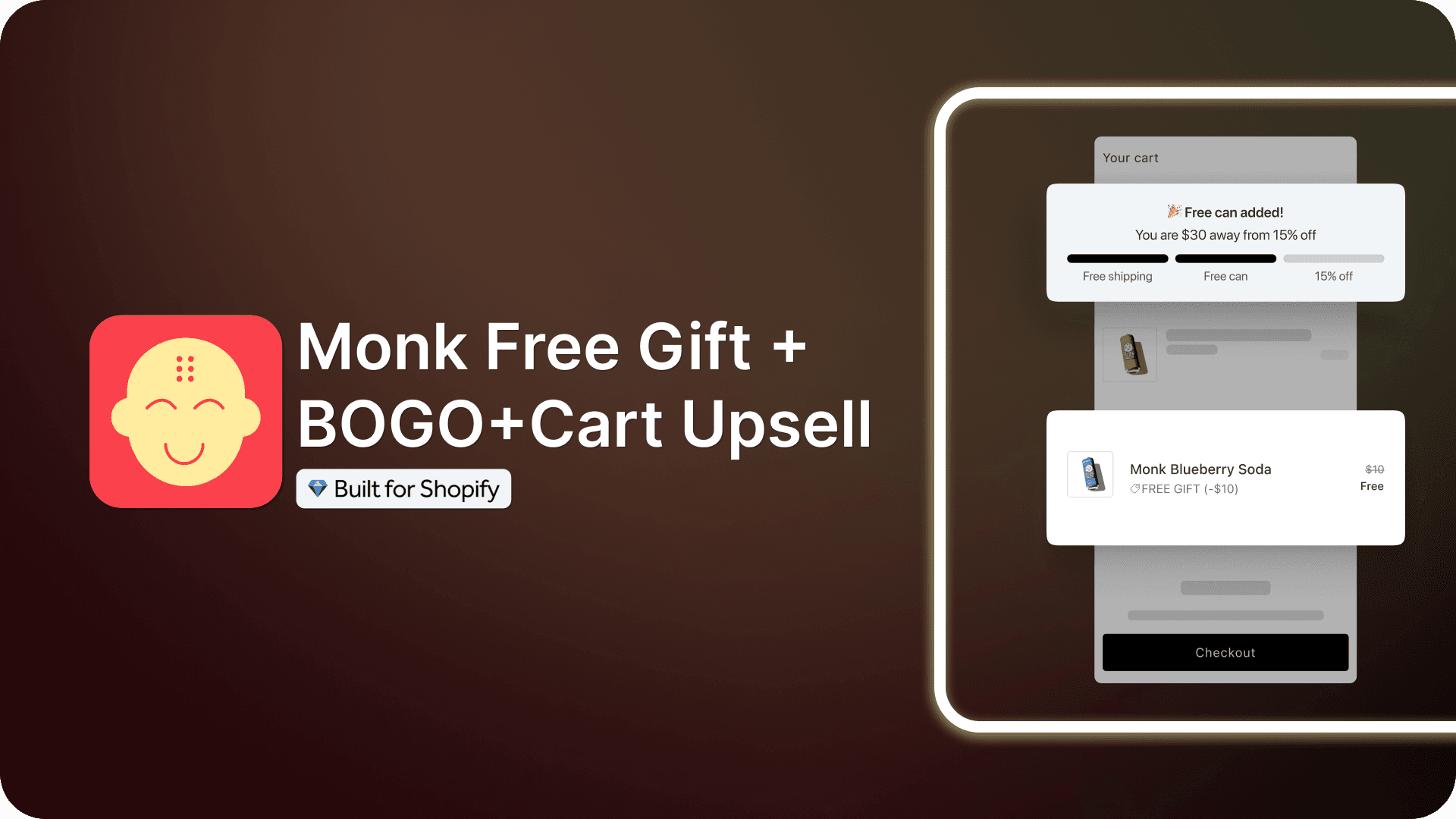
How Free Gifts Reduce Cart Abandonment
Summary
Free gifts are one of the most effective tools Shopify merchants have to reduce cart abandonment without cutting prices or training customers to wait for discounts. When tied to a cart value threshold and promoted visibly on product and cart pages, a well-chosen gift shifts the shopper's mindset from hesitation to action. The strategy works because of the zero-price effect: the human brain stops weighing risk the moment something is free.
Unlike a blanket discount, a free gift protects your margins, raises average order value by up to 30%, and creates a memorable checkout experience that drives repeat purchases. The key is matching your gift cost to the right spending threshold, choosing items with high perceived value and low production cost, and measuring contribution margin rather than just revenue to confirm the campaign is actually profitable.

Ravish (RV)
Senior Content Writer
Ravish is an ecommerce and SaaS marketing expert with 6+ years of experience in Shopify and ecommerce and 10+ years of experience in marketing, and growth strategy. He has worked closely with Shopify merchants to solve real ecommerce challenges and shares practical, research-backed insights, industry best practices, and emerging trends.
Key Takeaways
Free gifts are one of the most effective tools Shopify merchants have to reduce cart abandonment without cutting prices or training customers to wait for discounts. When tied to a cart value threshold and promoted visibly on product and cart pages, a well-chosen gift shifts the shopper's mindset from hesitation to action. The strategy works because of the zero-price effect: the human brain stops weighing risk the moment something is free.
Unlike a blanket discount, a free gift protects your margins, raises average order value by up to 30%, and creates a memorable checkout experience that drives repeat purchases. The key is matching your gift cost to the right spending threshold, choosing items with high perceived value and low production cost, and measuring contribution margin rather than just revenue to confirm the campaign is actually profitable.
Seven out of ten people who add an item to their online cart leave without buying it. In fact, the Baymard Institute shows the average cart abandonment rate is over 70%. For your Shopify store making $50,000 a month, this is a massive issue. It means more than half of your potential sales disappear right before the checkout page.
You might try to answer that problem with a discount. But discounts can hurt your business in two ways.
Shrink your profit margins on the current sale
Train your customers to wait for a sale before buying anything else
Implementing free gifts with purchase in Shopify solves the same problem better. It adds extra value to the order without lowering your prices. It also gives shoppers a clear reason to finish buying right now instead of waiting.
This guide explains how free gifts reduce cart abandonment. You will learn which gift types work best and how to run these campaigns on Shopify to increase e-commerce conversions.
What Is Cart Abandonment in Ecommerce?
Cart abandonment in e-commerce is when your customer adds one or more products to their cart. But they leave before completing the buying process. You measure it as the share of initiated carts that never turn into orders.
The number runs high because some shoppers never intend to buy right away. When looking for cart abandonment solutions, it helps to understand why people drop off:
Adding items to compare prices
Measuring a shipping total
Bookmarking something they are still thinking about
In fact, research shows that about 43% of these shoppers are just browsing. The carts you want to focus on belong to the other 57%. These are people who want your product but drop off at checkout due to a minor issue. Offering a free gift in Shopify is the perfect tool to push these shoppers to finish their purchase.
Cart Abandonment Statistics You Should Know in 2026
A few benchmarks worth keeping on hand when you build the business case for a gift campaign:
70.19% average abandonment rate: Ecommerce stores lose about seven out of ten carts.
80% mobile abandonment rate: Mobile shoppers leave their carts much more often than desktop shoppers (66%). This is critical since most web traffic comes from phones.
Extra checkout costs: Hidden fees for shipping, taxes, and service charges drive people away.
Forced account creation: Requiring to create a profile before buying is not liked by 25% of potential customers.
$145 average order value (AOV): Standard Shopify store data gives you a solid benchmark for setting your own gift thresholds.
30% lift in AOV:Adding a free gift with purchase offer can increase your average order value by a third.
Read those together, and a pattern shows up. Shoppers walk away because of unexpected costs and checkout friction. Using the right checkout incentives ecommerce brands rely on alters the math in their head, making the checkout feel worth the price.
Why Free Gifts Work in Shopify?
Let's understand this using a famous experiment shared in the book Predictably Irrational. Shoppers had to choose between a premium Lindt truffle for 15 cents and a basic Hershey's Kiss for 1 cent. Most people (73%) picked the high-quality truffle.
Then, researchers dropped the price of both chocolates by one penny. The truffle became 14 cents, and the Kiss became free. Technically, the price difference stayed exactly the same. Still, 69% of people switched to the free Kiss.
Psychologists call this the zero-price effect. When a product costs money, buyers feel a small fear of making a bad choice. A free item carries zero risk. The human brain stops weighing the pros and cons and accepts the offer.
During a Shopify checkout, that hesitation is what causes cart abandonment. A shopper stares at the total price and shipping costs. Then starts to second-guess the purchase. A targeted purchase incentive ideas campaign stops this mental debate right when the shopper is about to leave.
Shopify makes it simple to use this strategy. The platform automatically tracks your store's cart values and customer tags. This allows you to deploy a highly effective Shopify free gift strategy based on specific shopper behavior. Meaning you no longer need to send the same generic offer to everyone.
How Free Gifts Reduce Cart Abandonment
Knowing that the word 'free' changes customer decisions is helpful. But you also need to know where it helps in your sales funnel. A free gift focuses on checkout conversion optimization by fixing six specific friction points between the cart and the checkout page.
Creates a Stronger Motivation to Buy
A gift tied to a specific spend amount turns a simple cart into a gamified cart experience. Say a shopper has $58 worth of items in their cart and needs $65 to get a free travel kit. They will ideally look for one more item to add instead of closing the tab. This shifts their mindset from 'Should I spend this money?' to 'What else do I want to get?'
Reduces Checkout Hesitation
Unexpected checkout costs cause nearly half of all abandoned carts. A free gift helps reframe that expense to improve the checkout experience. Instead of thinking the order got too expensive, the shopper feels like they are getting a great deal. The shipping fee hurts less when there is an extra item coming in the box.
Increases Perceived Order Value
A $60 order with a $15 gift feels like $75 worth of value, even though you never changed your prices. Discounts do the exact opposite. A 10% coupon lowers the value of your product because it implies your original price was too high. A gift raises the value while keeping your prices intact.
Encourages Faster Purchasing
A gift with a clear deadline or a limited supply forces shoppers to act immediately. The phrase 'I will buy this later' is how most cart abandonment starts. A time-limited gift gives people a reason to finish checking out now.
Makes Customers Feel Rewarded
Receiving a gift triggers a psychological need to give back. Because the shopper did not have to hunt for a coupon code, the gift feels like a genuine reward. This positive feeling acts as an excellent e-commerce retention strategy, leading to higher customer satisfaction and more repeat orders later on.
Builds Brand Trust
A free gift shows confidence to a first-time buyer who might be unsure about your quality. A brand that gives away extra items signals that its main products are excellent. It turns a boring checkout process into an exciting moment that customers remember.
Best Types of Free Gifts for Shopify Stores
Not every free gift will drive your profit. The most effective gifts have a high perceived value but a low cost to produce. Your free gifts should complement the shopper's existing cart. While also helping you clear out inventory.
Here are six free gift marketing examples you can rely on:
Free Samples
Offering a trial-size version of a related product serves two purposes. It serves as an exciting reward today while you set up your next sale. When a customer enjoys a sample, they are likely to buy the full-size version later. This strategy works well for beauty, supplement, and food brands. Basically, brands where trying the product is the biggest hurdle to buying.
Buy One Get One Offers
BOGO deals work well for everyday items, consumables, and fashion basics. Here, having a second unit is useful. This tactic keeps your main product prices high because you don't discount individual items. At the same time, it helps you move twice as much stock.
Free Travel-Size Products
Travel-sized items offer excellent perceived value. They also keep your shipping and product costs low. Shoppers view a travel item as a premium, standalone product rather than a cheap giveaway. And the best part? It costs you a fraction of what a full-size unit costs.
Free Accessories or Add-Ons
Think of a phone case with a smartphone, extra laces with shoes, or an application brush with a skincare set. These add-ons make the main purchase feel complete. They also stop your customers from shopping at a competitor for necessary accessories.
Mystery Gifts
Promising a surprise gift in every order uses curiosity to drive sales. It also gives you a clever way to clear out slow-moving stock. Simultaneously, the shopper gets the excitement of a surprise. Meaning, the gift does not have to be your top-selling product to be effective.
Limited-Time Free Gifts
Connecting a gift to a specific season, product launch, or a tight deadline builds a sense of urgency. This makes the promotion feel like a special event instead of a permanent discount. So, your customers do not expect the same offers on every visit.
Gift Types Comparison Matrix
Here’s your quick decision guide for choosing which type of free gift you should offer:
Gift type | Best for | Profit margin impact | Inventory benefits |
Free samples | Cosmetics, food, supplements | Low cost per unit | Introduces new product lines |
BOGO offers | Apparel basics, consumables | Moderate cost impact | Clears large volumes of stock |
Travel sizes | Premium personal care, travel gear | Low fulfillment cost | Introduces portable options |
Accessories | Electronics, footwear, tools | Predictable low cost | Increases total utility per order |
Mystery gifts | Multi-SKU stores, apparel | Highly flexible cost | Rotates slow-moving inventory |
Limited-time | Holiday campaigns, product launches | Controlled overall cost | Drives short-term sales spikes |
Free Gifts vs Discounts: Which Works Better?
Neither free gifts nor discounts win in the abstract. They solve different problems and carry different costs. The table below lays out the trade-offs, and the notes after it cover when each is the right call.
Dimension | Percentage discount | Free gift |
Margin impact | Cuts revenue on every unit sold, scaling with order size | Fixed cost you control by choosing a low-cost, high-perceived-value item |
Perceived value | Signals that the original price was inflated | Adds value while products stay at full price |
Brand positioning | Frequent discounting can cheapen the brand over time | Reads as generous and premium |
Effect on AOV | Can lower AOV as shoppers buy only what is discounted | Pushes AOV up 15% to 30% when tied to a threshold |
Shopper psychology | Expected, and easy to compare against competitors | A pleasant surprise that is hard to compare-shop |
Long-term behavior | Trains shoppers to wait for the next sale | Leaves no lower price anchor behind |
When Discounts Work Better
Use a discount code when you need to accomplish these specific goals:
Clear out dead stock quickly to free up warehouse space
Sell in a highly price-sensitive market where buyers compare costs item by item
Win back old customers who have not bought from your store in months
Match a competitor’s pricing to secure a sale you would otherwise lose
When Free Gifts Work Better
Choose a free gift campaign when your strategy focuses on these outcomes:
Protect your profit margins and keep your core prices high
Increase average order value instead of just increasing your total number of sales
Build a premium brand image that does not rely on constant sales
Earn repeat purchases by creating a memorable checkout experience
When designing your checkout page, you will also face the classic debate of free shipping vs free gifts. Stores often pit them against each other. Free shipping addresses the number-one stated reason for abandonment head-on. It removes the surprise cost that pushes nearly half of shoppers away.
The downside is that it is pure cost with no product story attached. A free gift carries a story and a perceived value. But it does not directly resolve a shipping objection. The strongest threshold offers often combine them. Meaning, spend a set amount and unlock free shipping plus a gift. This way, your customer can neutralize the cost objection and add value in one move.
How to Offer Free Gifts Without Hurting Your Profits
You must start with the math, because this is where most free gift campaigns lose money. Giving a $6 gift on a $40 order cuts your profit margins by 15%. However, giving that same $6 gift on a $120 order only impacts your margins by 5%.
The cost of your gift stays the same, but its impact on your profit changes depending on the order size. The goal is to match the cost of your gift to the right spending threshold.
Set Minimum Cart Value Thresholds
Set your free gift to unlock at a price point roughly 15% to 25% higher than your current average order value. This gap is large enough to encourage shoppers to spend more money. But small enough that the goal feels reachable. If you set the threshold too low, you give away products on orders that would have happened anyway. If you set it too high, almost no one will qualify.
Use Slow-Moving Inventory as Gifts
Stock that sits in your warehouse costs you money in storage fees every day. Turning slow-moving items into free gifts feels like an exciting bonus. Your customers value the item at its full retail price, even though you have already spent the actual cost. This is an excellent way to make dead stock work for your business.
Offer Gifts on High-Margin Products
When a customer buys an item with a high profit margin, your overall profit stays healthy. This happens despite adding a free gift. Connect your gift campaigns to your highest-margin product categories first. This allows you to offer a more impressive gift without losing money on the sale.
Run Seasonal Campaigns
Limiting your gift offers to specific seasons or product launches keeps expectations away. Your customers won't expect gifts on every visit. A permanent gift behaves like a permanent discount on your balance sheet. A seasonal gift feels like a special event. It creates buying urgency and allows you to reset your strategy between campaigns.
Use Personalized Free Gifts Ecommerce Rules
A relevant gift gets used and appreciated. While an irrelevant one gets ignored and still costs you money to ship. Matching the free item to what the shopper already has in their cart increases checkout rates. It also eliminates the waste of shipping unwanted items.
How Monk Stops Cart Abandonment with Free Gifts
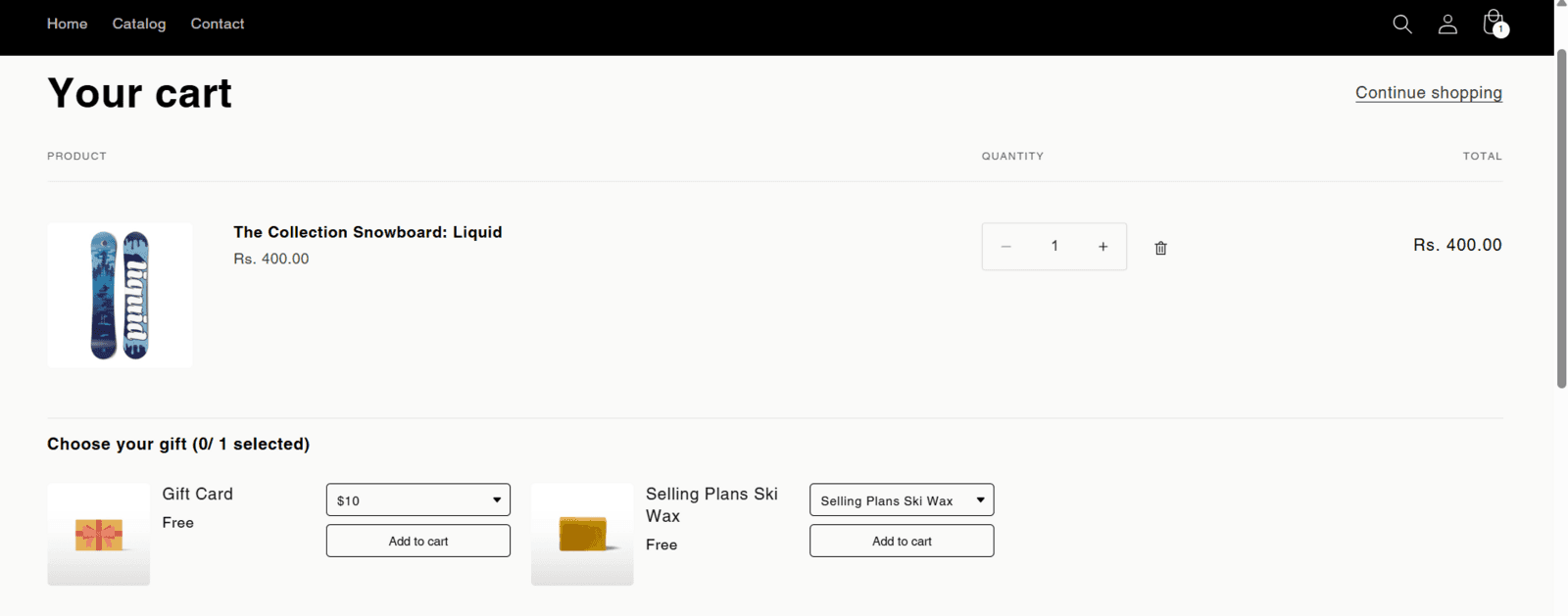
Monk is a Shopify-first tool designed to increase average order value. It manages upsells, cross-sells, and free gift offers inside your cart and checkout pages.
Monk does not replace your email tool or marketing software. Instead, it focuses entirely on the spot where shoppers stall: the checkout line. It handles all the profit margin math automatically, without requiring any custom coding.
Free Gifts That Scale With Cart Value
Many Shopify store owners want a system where a free gift unlocks at one price tier. And then more gifts unlock as the customer spends more. Generally, you need to make the customer re-select their choices every time.
The Monk free gift app uses progress bars and cart-value rules instead. It automatically increases gift quantities as the cart total grows. The app remembers the customer's size or color choice the first time, so they never have to re-enter it. The progress bar also acts as a visual nudge. It shows shoppers exactly how close they are to unlocking the next reward.
Let Customers Choose Their Gift, With Variants
Monk uses a pop-up window that lets shoppers select their own free gift when they click 'add to cart' or 'checkout.' It includes a variant picker so they can choose their preferred size or color. Giving customers a gift they want removes friction and gives them a real reason to finish buying.
Auto-Add and Auto-Remove Guardrails
You can set Monk to drop a qualifying free gift straight into the shopping cart. This makes the reward visible to the shopper within seconds.
The app also protects your profit margins with an auto-remove feature. If a customer removes items from their cart and drops below your spending threshold, Monk pulls the free gift out of the order. This stops shoppers from gaming the system.
Targeted Eligibility Rules
You can target your gifts based on customer location, language, or specific customer tags. This allows you to offer different gifts to different customer types. Targeting your budget toward the customers most likely to leave ensures you get the highest return on investment.
Triggers Across Every Cart Type
Monk integrates seamlessly with slide-out cart drawers, cart pop-ups, and standard cart pages. You can trigger the gift offer right when a user clicks the 'add to cart' or 'checkout' button. Placing the offer the second a shopper hesitates prevents abandonment.
Display Control and Scheduling
Monk gives you full control over how your offers look. You can display a clear 'FREE' label or add a countdown timer to build urgency. You can also schedule campaigns to start and stop on specific dates. It turns seasonal promotions into a hands-off, automated process.
No-Code Setup Built for Conversion
There is a visual builder with pre-made templates that work across any Shopify theme. You do not need a developer to launch a campaign. This allows your team to set up, test, and change gift offers in an afternoon. No more waiting weeks for custom code.
Monk Features at a Glance
Multi-tier progress bars: Visualizes how much more a shopper needs to spend to unlock the next gift
Smart variant selection: Allows customers to pick their own size or color inside the cart pop-up
Automatic margin protection: Removes free items if the total cart value falls below the threshold
Customer segment targeting: Delivers specific gift campaigns to VIPs, new users, or local regions
Step-by-Step: Launch Your First Free Gift Campaign on Shopify
Follow these steps to launch your first free gift campaign without hurting your profits:
Find your baseline: Pull your store's average order value (AOV) from the last 90 days. Use your actual store data for this step, not general industry benchmarks.
Set your spending threshold: Calculate a gift unlock tier that sits 15% to 25% higher than your baseline AOV. This keeps the goal realistic for shoppers while driving up order sizes.
Select your gift product: Choose an item with high perceived value and low production cost. The real cost of the item should be between 5% and 8% of your spending threshold. Travel sizes, samples, or high-margin accessories work best.
Verify your Shopify settings: Go to your Shopify admin page and check your gift inventory. Confirm the item is in stock, set to active, and published to your Online Store channel so the app can display it.
Choose your campaign trigger: Set your campaign to fire when a user clicks the checkout button. This ensures the app can read the total cart value and item count right before the shopper buys.
Configure the customer experience: Decide whether to drop the gift into the cart or let the shopper select it themselves. If the item comes in different sizes or colors, turn on the variant picker.
Enable margin guardrails: Turn on the auto-remove feature. This stops customers from buying your limited gift items at full price. It also pulls the gift out of the cart if the shopper drops below the required spending tier.
Add a time limit: Set a countdown timer or schedule specific start and end dates for your campaign. This builds buying urgency and stops customers from expecting a permanent discount.
Run a clean test: Launch your campaign against a control group. Test the free gift offer against a standard checkout page to accurately measure your sales lift.
Post-Launch Checklist
Monitor AOV: Watch for a lift in your average cart size over the first 14 days
Track attach rate: Ensure qualified shoppers are actually accepting the gift
Check contribution margin: Review your net profit per order to confirm the campaign is making money
Generate a 14-day campaign analytics spreadsheet template
Draft a Shopify theme announcement script for tier goals
Create an A/B testing framework for Shopify gift campaigns
Mistakes and Best Practices for Free Gift Campaigns
Most failed free gift campaigns fail because of poor execution. For example, a gift priced too high for the cart value, a launch with no way to track results, or an offer the shopper never saw.
Here are a few common errors like these that you can avoid:
Mistake | Consequence | How to fix it |
Giving high-cost gifts on low-value orders | Your profit margin shrinks and you lose money on every sale | Keep the real cost of your gift under 5% to 8% of the spending threshold |
Running campaigns without a control group | You cannot prove if the gift caused your sales lift or if it was just a seasonal swing | A/B test the gift offer against a standard checkout page before scaling up |
Using a gift to hide a weak main product | The gift temporarily hides a pricing or product quality problem instead of fixing it | Fix your core offer first, then use a gift to boost a product that already sells well |
Ignoring extra fulfillment costs | Every gift requires extra picking and packing, which eats into your final profits | Build packing fees into your margin math and choose gifts that are easy to ship |
Letting buyers keep gifts when their cart changes | Free items leak out to orders that no longer qualify for the promotion | Use an auto-remove rule to pull the gift if the cart value drops below the threshold |
Hiding the free gift until the checkout page | A surprise gift is a nice gesture, but it does not motivate people to spend more money | Promote the gift and the required threshold on product and cart pages |
Best Practices for Higher Conversions
The table above shows you what to stop doing. These best practices represent the core habits that separate profitable, scalable campaigns from those that stall out:
Promote the gift early: Display your offer clearly on product pages and in cart drawers, rather than waiting until checkout.
Base thresholds on real data: Calculate your spending tiers using your own average order value, and update them every quarter.
Keep the gift relevant: Choose items that complement what the customer is already buying to build genuine goodwill.
Use short campaign windows: Keep your gift offers time-boxed so they feel like special events rather than permanent price cuts.
Maintain a clean checkout: Pair your gift with clear shipping fees and guest checkout options so customers do not get frustrated.
Test everything against a control: Only scale up gift campaigns that you can prove are highly profitable.
Metrics to Track After Launching Free Gift Campaigns
A free gift campaign can look successful on the surface while losing money underneath. The data points you choose to monitor will determine whether you catch profit leaks early or accidentally scale them up.
Always track these six metrics against a control group rather than against last month's data. Since seasonal trends can easily distort your numbers.
Metric | What it tells you | Why it matters |
Average Order Value (AOV) | Proves whether the gift is successfully pulling cart sizes up | This is the main goal of your campaign, but it is only accurate when compared directly to a control group |
Incremental Conversion Lift | Shows the difference in completed checkouts between shoppers who saw the gift and those who did not | This isolates the actual impact of the gift from other simultaneous marketing changes |
Gift Attach Rate | Measures whether shoppers are accepting the offer or scrolling past it | A low rate means your choice of gift, spending tier, or banner placement needs adjustment |
Near-Threshold Abandonment Rate | Tracks changes in cart drop-offs, specifically among shoppers who are close to qualifying | General store data hides this effect; this specific group is where the gift should drastically lower abandonment |
Contribution Margin Per Order | Confirms whether revenue gains are hurting your actual profit margins | This is your most important metric. A campaign that raises sales volume but lowers net profit per order must be stopped early |
Repeat Purchase Rate | Tracks whether gift recipients return to buy from your store again | The true, long-term financial return of a free gift campaign often shows up in the second purchase |
How to Analyze Your Campaign Data
Review performance weekly: Do not make major changes based on less than 14 days of consistent tracking.
Compare against a control: Never compare campaign weeks directly to non-campaign weeks, as traffic quality varies.
Watch the margin bottom line: Prioritize contribution margin over high average order values every time.
When Free Gifts Are Not Enough
A free gift helps overcome customer hesitation. It cannot fix structural problems in your business, and pretending it can will only hurt your profit margins. If your store's cart abandonment rate sits well above the 70% industry benchmark, the main issue is further up your sales funnel.
High abandonment rates are often caused by:
Unexpected shipping costs at checkout
Product pages that fail to explain value clearly
Checkout forms with too many input fields
Weak brand trust signals
Low-quality bot traffic inflating your cart numbers
Use this simple test to diagnose your funnel:
If shoppers add items to the cart but never start checkout, look at your cost transparency and trust signals.
If shoppers start checkout but leave before paying, look at form length, available payment options, and forced account creation.
Fix these fundamental leaks first to optimize your ecommerce upsell strategy. Once your sales funnel works correctly, a free gift becomes a powerful sales multiplier rather than a temporary band-aid.
Final Takeaway: Protect Margins and Lift Conversions
Cart abandonment rates have stayed near 70% for more than ten years. Most of this loss stems from late-stage hesitation rather than a lack of interest.
While discounts fight this hesitation by lowering your prices and training customers to wait for sales, free gifts protect your brand value. They increase average order value, maintain your core pricing, and give stalling buyers a clear reason to finish their purchase immediately.
Reviewing abandoned cart reduction tips shows that the most profitable Shopify stores treat free gifts as a strategic, margin-aware tool. To see real success with this strategy, implement these core steps:
Match your gift cost strictly to your spending thresholds
Promote the offer early, where it can actively persuade buyers
Measure your sales lift against a clean control group
When built on a smooth checkout experience and targeted to the right shoppers, a free gift campaign becomes one of the few ecommerce conversion tactics that successfully protects both your profit margins and your conversion rates.
FAQs
Do free gifts really reduce cart abandonment?
Free gifts really reduce cart abandonment when they are tied to a clear spending threshold and promoted before the checkout page. A free gift directly fixes the late-stage hesitation that causes most lost sales by adding extra value right when a shopper is deciding whether to buy. It works best on shoppers who are already close to your threshold or first-time buyers who need an extra push to complete their order.
Are free gifts better than discount coupons in ecommerce?
Free gifts are better than discount coupons when your goal is to protect profit margins and maintain a premium brand image. Discount coupons are better suited for clearing out old stock quickly or matching a competitor's lower price. While a discount lowers your revenue on the current sale and trains shoppers to wait for future promos, a free gift adds value without forcing you to permanently lower your product prices.
What is the best free gift strategy for Shopify stores?
The best free gift strategy for Shopify stores is to set an unlock threshold 15% to 25% above your current average order value and pair it with a low-cost, high-value gift, such as a travel-sized product or a high-margin accessory. To make this strategy work as a conversion tool rather than a quiet business expense, you must promote both the gift and the spending threshold early on your product and cart pages.
How do free gifts increase average order value?
Free gifts increase average order value by giving shoppers a clear spending goal to reach inside the cart drawer. When a free gift unlocks at a specific tier, a customer who is just below that threshold will typically add one more item to their cart to qualify for the reward. This threshold-chasing behavior can raise average order value by up to 30% because the additional spend easily covers the cost of the gift.
What type of free gifts work best for fashion brands?
The free gifts that work best for fashion brands are relevant accessories and seasonal add-ons like tote bags, scarves, or socks that naturally complement the main apparel purchase. These items feel like thoughtful extras rather than cheap promotional gimmicks. Using limited-edition or seasonal gifts also helps create immediate buying urgency among fashion shoppers without requiring you to mark down your core collection.
Can free gift campaigns hurt profit margins?
Free gift campaigns can hurt profit margins if the gift's actual cost is poorly matched to the cart value, or if you run the promotion without tracking your net data. Giving a pricey gift on a small order quickly erodes your returns, whereas the same gift on a much larger order has a much lower impact. You can protect your margins by using high-margin or slow-moving stock and tracking your contribution margin per order.
How can small ecommerce stores offer free gifts affordably?
Small ecommerce stores can offer free gifts affordably by using slow-moving inventory, trial samples, or low-cost accessories that carry a high perceived value against a tiny real production cost. Setting a strict minimum spending threshold ensures you give away items only on orders large enough to cover the expense, while starting with a single targeted customer segment keeps your initial budget fully contained.
What cart value should trigger a free gift offer?
The cart value that should trigger a free gift offer should sit roughly 15% to 25% higher than your store's trailing average order value. This specific range is high enough to successfully encourage shoppers to add another item to their cart, yet low enough that your baseline customers can realistically achieve it. You should recalculate this spending trigger every quarter as your overall store sales patterns change.
Should free gifts be automatically added to the cart?
Free gifts should be automatically added to the cart when the item is straightforward and you want the reward instantly visible to the shopper without them taking action. Letting customers manually choose their gift through a variant picker tends to perform better when the product comes in different sizes or colors, as a useful gift carries much more weight. In both scenarios, an auto-remove rule should be enabled to pull the item if the cart value drops below your spending threshold.
How do you measure the success of a free gift campaign?
You measure the success of a free gift campaign by comparing the data from shoppers who saw the offer to a clean control group, rather than comparing it to last month's numbers. You must specifically track your incremental conversion lift, gift attach rate, average order value changes, and contribution margin per order. Because rising revenue can easily mask a profit margin leak, tracking net profit per order is the only way to confirm whether the campaign is worth scaling.
How Free Gifts Reduce Cart Abandonment
Summary
Free gifts are one of the most effective tools Shopify merchants have to reduce cart abandonment without cutting prices or training customers to wait for discounts. When tied to a cart value threshold and promoted visibly on product and cart pages, a well-chosen gift shifts the shopper's mindset from hesitation to action. The strategy works because of the zero-price effect: the human brain stops weighing risk the moment something is free.
Unlike a blanket discount, a free gift protects your margins, raises average order value by up to 30%, and creates a memorable checkout experience that drives repeat purchases. The key is matching your gift cost to the right spending threshold, choosing items with high perceived value and low production cost, and measuring contribution margin rather than just revenue to confirm the campaign is actually profitable.
Seven out of ten people who add an item to their online cart leave without buying it. In fact, the Baymard Institute shows the average cart abandonment rate is over 70%. For your Shopify store making $50,000 a month, this is a massive issue. It means more than half of your potential sales disappear right before the checkout page.
You might try to answer that problem with a discount. But discounts can hurt your business in two ways.
Shrink your profit margins on the current sale
Train your customers to wait for a sale before buying anything else
Implementing free gifts with purchase in Shopify solves the same problem better. It adds extra value to the order without lowering your prices. It also gives shoppers a clear reason to finish buying right now instead of waiting.
This guide explains how free gifts reduce cart abandonment. You will learn which gift types work best and how to run these campaigns on Shopify to increase e-commerce conversions.
What Is Cart Abandonment in Ecommerce?
Cart abandonment in e-commerce is when your customer adds one or more products to their cart. But they leave before completing the buying process. You measure it as the share of initiated carts that never turn into orders.
The number runs high because some shoppers never intend to buy right away. When looking for cart abandonment solutions, it helps to understand why people drop off:
Adding items to compare prices
Measuring a shipping total
Bookmarking something they are still thinking about
In fact, research shows that about 43% of these shoppers are just browsing. The carts you want to focus on belong to the other 57%. These are people who want your product but drop off at checkout due to a minor issue. Offering a free gift in Shopify is the perfect tool to push these shoppers to finish their purchase.
Cart Abandonment Statistics You Should Know in 2026
A few benchmarks worth keeping on hand when you build the business case for a gift campaign:
70.19% average abandonment rate: Ecommerce stores lose about seven out of ten carts.
80% mobile abandonment rate: Mobile shoppers leave their carts much more often than desktop shoppers (66%). This is critical since most web traffic comes from phones.
Extra checkout costs: Hidden fees for shipping, taxes, and service charges drive people away.
Forced account creation: Requiring to create a profile before buying is not liked by 25% of potential customers.
$145 average order value (AOV): Standard Shopify store data gives you a solid benchmark for setting your own gift thresholds.
30% lift in AOV:Adding a free gift with purchase offer can increase your average order value by a third.
Read those together, and a pattern shows up. Shoppers walk away because of unexpected costs and checkout friction. Using the right checkout incentives ecommerce brands rely on alters the math in their head, making the checkout feel worth the price.
Why Free Gifts Work in Shopify?
Let's understand this using a famous experiment shared in the book Predictably Irrational. Shoppers had to choose between a premium Lindt truffle for 15 cents and a basic Hershey's Kiss for 1 cent. Most people (73%) picked the high-quality truffle.
Then, researchers dropped the price of both chocolates by one penny. The truffle became 14 cents, and the Kiss became free. Technically, the price difference stayed exactly the same. Still, 69% of people switched to the free Kiss.
Psychologists call this the zero-price effect. When a product costs money, buyers feel a small fear of making a bad choice. A free item carries zero risk. The human brain stops weighing the pros and cons and accepts the offer.
During a Shopify checkout, that hesitation is what causes cart abandonment. A shopper stares at the total price and shipping costs. Then starts to second-guess the purchase. A targeted purchase incentive ideas campaign stops this mental debate right when the shopper is about to leave.
Shopify makes it simple to use this strategy. The platform automatically tracks your store's cart values and customer tags. This allows you to deploy a highly effective Shopify free gift strategy based on specific shopper behavior. Meaning you no longer need to send the same generic offer to everyone.
How Free Gifts Reduce Cart Abandonment
Knowing that the word 'free' changes customer decisions is helpful. But you also need to know where it helps in your sales funnel. A free gift focuses on checkout conversion optimization by fixing six specific friction points between the cart and the checkout page.
Creates a Stronger Motivation to Buy
A gift tied to a specific spend amount turns a simple cart into a gamified cart experience. Say a shopper has $58 worth of items in their cart and needs $65 to get a free travel kit. They will ideally look for one more item to add instead of closing the tab. This shifts their mindset from 'Should I spend this money?' to 'What else do I want to get?'
Reduces Checkout Hesitation
Unexpected checkout costs cause nearly half of all abandoned carts. A free gift helps reframe that expense to improve the checkout experience. Instead of thinking the order got too expensive, the shopper feels like they are getting a great deal. The shipping fee hurts less when there is an extra item coming in the box.
Increases Perceived Order Value
A $60 order with a $15 gift feels like $75 worth of value, even though you never changed your prices. Discounts do the exact opposite. A 10% coupon lowers the value of your product because it implies your original price was too high. A gift raises the value while keeping your prices intact.
Encourages Faster Purchasing
A gift with a clear deadline or a limited supply forces shoppers to act immediately. The phrase 'I will buy this later' is how most cart abandonment starts. A time-limited gift gives people a reason to finish checking out now.
Makes Customers Feel Rewarded
Receiving a gift triggers a psychological need to give back. Because the shopper did not have to hunt for a coupon code, the gift feels like a genuine reward. This positive feeling acts as an excellent e-commerce retention strategy, leading to higher customer satisfaction and more repeat orders later on.
Builds Brand Trust
A free gift shows confidence to a first-time buyer who might be unsure about your quality. A brand that gives away extra items signals that its main products are excellent. It turns a boring checkout process into an exciting moment that customers remember.
Best Types of Free Gifts for Shopify Stores
Not every free gift will drive your profit. The most effective gifts have a high perceived value but a low cost to produce. Your free gifts should complement the shopper's existing cart. While also helping you clear out inventory.
Here are six free gift marketing examples you can rely on:
Free Samples
Offering a trial-size version of a related product serves two purposes. It serves as an exciting reward today while you set up your next sale. When a customer enjoys a sample, they are likely to buy the full-size version later. This strategy works well for beauty, supplement, and food brands. Basically, brands where trying the product is the biggest hurdle to buying.
Buy One Get One Offers
BOGO deals work well for everyday items, consumables, and fashion basics. Here, having a second unit is useful. This tactic keeps your main product prices high because you don't discount individual items. At the same time, it helps you move twice as much stock.
Free Travel-Size Products
Travel-sized items offer excellent perceived value. They also keep your shipping and product costs low. Shoppers view a travel item as a premium, standalone product rather than a cheap giveaway. And the best part? It costs you a fraction of what a full-size unit costs.
Free Accessories or Add-Ons
Think of a phone case with a smartphone, extra laces with shoes, or an application brush with a skincare set. These add-ons make the main purchase feel complete. They also stop your customers from shopping at a competitor for necessary accessories.
Mystery Gifts
Promising a surprise gift in every order uses curiosity to drive sales. It also gives you a clever way to clear out slow-moving stock. Simultaneously, the shopper gets the excitement of a surprise. Meaning, the gift does not have to be your top-selling product to be effective.
Limited-Time Free Gifts
Connecting a gift to a specific season, product launch, or a tight deadline builds a sense of urgency. This makes the promotion feel like a special event instead of a permanent discount. So, your customers do not expect the same offers on every visit.
Gift Types Comparison Matrix
Here’s your quick decision guide for choosing which type of free gift you should offer:
Gift type | Best for | Profit margin impact | Inventory benefits |
Free samples | Cosmetics, food, supplements | Low cost per unit | Introduces new product lines |
BOGO offers | Apparel basics, consumables | Moderate cost impact | Clears large volumes of stock |
Travel sizes | Premium personal care, travel gear | Low fulfillment cost | Introduces portable options |
Accessories | Electronics, footwear, tools | Predictable low cost | Increases total utility per order |
Mystery gifts | Multi-SKU stores, apparel | Highly flexible cost | Rotates slow-moving inventory |
Limited-time | Holiday campaigns, product launches | Controlled overall cost | Drives short-term sales spikes |
Free Gifts vs Discounts: Which Works Better?
Neither free gifts nor discounts win in the abstract. They solve different problems and carry different costs. The table below lays out the trade-offs, and the notes after it cover when each is the right call.
Dimension | Percentage discount | Free gift |
Margin impact | Cuts revenue on every unit sold, scaling with order size | Fixed cost you control by choosing a low-cost, high-perceived-value item |
Perceived value | Signals that the original price was inflated | Adds value while products stay at full price |
Brand positioning | Frequent discounting can cheapen the brand over time | Reads as generous and premium |
Effect on AOV | Can lower AOV as shoppers buy only what is discounted | Pushes AOV up 15% to 30% when tied to a threshold |
Shopper psychology | Expected, and easy to compare against competitors | A pleasant surprise that is hard to compare-shop |
Long-term behavior | Trains shoppers to wait for the next sale | Leaves no lower price anchor behind |
When Discounts Work Better
Use a discount code when you need to accomplish these specific goals:
Clear out dead stock quickly to free up warehouse space
Sell in a highly price-sensitive market where buyers compare costs item by item
Win back old customers who have not bought from your store in months
Match a competitor’s pricing to secure a sale you would otherwise lose
When Free Gifts Work Better
Choose a free gift campaign when your strategy focuses on these outcomes:
Protect your profit margins and keep your core prices high
Increase average order value instead of just increasing your total number of sales
Build a premium brand image that does not rely on constant sales
Earn repeat purchases by creating a memorable checkout experience
When designing your checkout page, you will also face the classic debate of free shipping vs free gifts. Stores often pit them against each other. Free shipping addresses the number-one stated reason for abandonment head-on. It removes the surprise cost that pushes nearly half of shoppers away.
The downside is that it is pure cost with no product story attached. A free gift carries a story and a perceived value. But it does not directly resolve a shipping objection. The strongest threshold offers often combine them. Meaning, spend a set amount and unlock free shipping plus a gift. This way, your customer can neutralize the cost objection and add value in one move.
How to Offer Free Gifts Without Hurting Your Profits
You must start with the math, because this is where most free gift campaigns lose money. Giving a $6 gift on a $40 order cuts your profit margins by 15%. However, giving that same $6 gift on a $120 order only impacts your margins by 5%.
The cost of your gift stays the same, but its impact on your profit changes depending on the order size. The goal is to match the cost of your gift to the right spending threshold.
Set Minimum Cart Value Thresholds
Set your free gift to unlock at a price point roughly 15% to 25% higher than your current average order value. This gap is large enough to encourage shoppers to spend more money. But small enough that the goal feels reachable. If you set the threshold too low, you give away products on orders that would have happened anyway. If you set it too high, almost no one will qualify.
Use Slow-Moving Inventory as Gifts
Stock that sits in your warehouse costs you money in storage fees every day. Turning slow-moving items into free gifts feels like an exciting bonus. Your customers value the item at its full retail price, even though you have already spent the actual cost. This is an excellent way to make dead stock work for your business.
Offer Gifts on High-Margin Products
When a customer buys an item with a high profit margin, your overall profit stays healthy. This happens despite adding a free gift. Connect your gift campaigns to your highest-margin product categories first. This allows you to offer a more impressive gift without losing money on the sale.
Run Seasonal Campaigns
Limiting your gift offers to specific seasons or product launches keeps expectations away. Your customers won't expect gifts on every visit. A permanent gift behaves like a permanent discount on your balance sheet. A seasonal gift feels like a special event. It creates buying urgency and allows you to reset your strategy between campaigns.
Use Personalized Free Gifts Ecommerce Rules
A relevant gift gets used and appreciated. While an irrelevant one gets ignored and still costs you money to ship. Matching the free item to what the shopper already has in their cart increases checkout rates. It also eliminates the waste of shipping unwanted items.
How Monk Stops Cart Abandonment with Free Gifts
Monk is a Shopify-first tool designed to increase average order value. It manages upsells, cross-sells, and free gift offers inside your cart and checkout pages.
Monk does not replace your email tool or marketing software. Instead, it focuses entirely on the spot where shoppers stall: the checkout line. It handles all the profit margin math automatically, without requiring any custom coding.
Free Gifts That Scale With Cart Value
Many Shopify store owners want a system where a free gift unlocks at one price tier. And then more gifts unlock as the customer spends more. Generally, you need to make the customer re-select their choices every time.
The Monk free gift app uses progress bars and cart-value rules instead. It automatically increases gift quantities as the cart total grows. The app remembers the customer's size or color choice the first time, so they never have to re-enter it. The progress bar also acts as a visual nudge. It shows shoppers exactly how close they are to unlocking the next reward.
Let Customers Choose Their Gift, With Variants
Monk uses a pop-up window that lets shoppers select their own free gift when they click 'add to cart' or 'checkout.' It includes a variant picker so they can choose their preferred size or color. Giving customers a gift they want removes friction and gives them a real reason to finish buying.
Auto-Add and Auto-Remove Guardrails
You can set Monk to drop a qualifying free gift straight into the shopping cart. This makes the reward visible to the shopper within seconds.
The app also protects your profit margins with an auto-remove feature. If a customer removes items from their cart and drops below your spending threshold, Monk pulls the free gift out of the order. This stops shoppers from gaming the system.
Targeted Eligibility Rules
You can target your gifts based on customer location, language, or specific customer tags. This allows you to offer different gifts to different customer types. Targeting your budget toward the customers most likely to leave ensures you get the highest return on investment.
Triggers Across Every Cart Type
Monk integrates seamlessly with slide-out cart drawers, cart pop-ups, and standard cart pages. You can trigger the gift offer right when a user clicks the 'add to cart' or 'checkout' button. Placing the offer the second a shopper hesitates prevents abandonment.
Display Control and Scheduling
Monk gives you full control over how your offers look. You can display a clear 'FREE' label or add a countdown timer to build urgency. You can also schedule campaigns to start and stop on specific dates. It turns seasonal promotions into a hands-off, automated process.
No-Code Setup Built for Conversion
There is a visual builder with pre-made templates that work across any Shopify theme. You do not need a developer to launch a campaign. This allows your team to set up, test, and change gift offers in an afternoon. No more waiting weeks for custom code.
Monk Features at a Glance
Multi-tier progress bars: Visualizes how much more a shopper needs to spend to unlock the next gift
Smart variant selection: Allows customers to pick their own size or color inside the cart pop-up
Automatic margin protection: Removes free items if the total cart value falls below the threshold
Customer segment targeting: Delivers specific gift campaigns to VIPs, new users, or local regions
Step-by-Step: Launch Your First Free Gift Campaign on Shopify
Follow these steps to launch your first free gift campaign without hurting your profits:
Find your baseline: Pull your store's average order value (AOV) from the last 90 days. Use your actual store data for this step, not general industry benchmarks.
Set your spending threshold: Calculate a gift unlock tier that sits 15% to 25% higher than your baseline AOV. This keeps the goal realistic for shoppers while driving up order sizes.
Select your gift product: Choose an item with high perceived value and low production cost. The real cost of the item should be between 5% and 8% of your spending threshold. Travel sizes, samples, or high-margin accessories work best.
Verify your Shopify settings: Go to your Shopify admin page and check your gift inventory. Confirm the item is in stock, set to active, and published to your Online Store channel so the app can display it.
Choose your campaign trigger: Set your campaign to fire when a user clicks the checkout button. This ensures the app can read the total cart value and item count right before the shopper buys.
Configure the customer experience: Decide whether to drop the gift into the cart or let the shopper select it themselves. If the item comes in different sizes or colors, turn on the variant picker.
Enable margin guardrails: Turn on the auto-remove feature. This stops customers from buying your limited gift items at full price. It also pulls the gift out of the cart if the shopper drops below the required spending tier.
Add a time limit: Set a countdown timer or schedule specific start and end dates for your campaign. This builds buying urgency and stops customers from expecting a permanent discount.
Run a clean test: Launch your campaign against a control group. Test the free gift offer against a standard checkout page to accurately measure your sales lift.
Post-Launch Checklist
Monitor AOV: Watch for a lift in your average cart size over the first 14 days
Track attach rate: Ensure qualified shoppers are actually accepting the gift
Check contribution margin: Review your net profit per order to confirm the campaign is making money
Generate a 14-day campaign analytics spreadsheet template
Draft a Shopify theme announcement script for tier goals
Create an A/B testing framework for Shopify gift campaigns
Mistakes and Best Practices for Free Gift Campaigns
Most failed free gift campaigns fail because of poor execution. For example, a gift priced too high for the cart value, a launch with no way to track results, or an offer the shopper never saw.
Here are a few common errors like these that you can avoid:
Mistake | Consequence | How to fix it |
Giving high-cost gifts on low-value orders | Your profit margin shrinks and you lose money on every sale | Keep the real cost of your gift under 5% to 8% of the spending threshold |
Running campaigns without a control group | You cannot prove if the gift caused your sales lift or if it was just a seasonal swing | A/B test the gift offer against a standard checkout page before scaling up |
Using a gift to hide a weak main product | The gift temporarily hides a pricing or product quality problem instead of fixing it | Fix your core offer first, then use a gift to boost a product that already sells well |
Ignoring extra fulfillment costs | Every gift requires extra picking and packing, which eats into your final profits | Build packing fees into your margin math and choose gifts that are easy to ship |
Letting buyers keep gifts when their cart changes | Free items leak out to orders that no longer qualify for the promotion | Use an auto-remove rule to pull the gift if the cart value drops below the threshold |
Hiding the free gift until the checkout page | A surprise gift is a nice gesture, but it does not motivate people to spend more money | Promote the gift and the required threshold on product and cart pages |
Best Practices for Higher Conversions
The table above shows you what to stop doing. These best practices represent the core habits that separate profitable, scalable campaigns from those that stall out:
Promote the gift early: Display your offer clearly on product pages and in cart drawers, rather than waiting until checkout.
Base thresholds on real data: Calculate your spending tiers using your own average order value, and update them every quarter.
Keep the gift relevant: Choose items that complement what the customer is already buying to build genuine goodwill.
Use short campaign windows: Keep your gift offers time-boxed so they feel like special events rather than permanent price cuts.
Maintain a clean checkout: Pair your gift with clear shipping fees and guest checkout options so customers do not get frustrated.
Test everything against a control: Only scale up gift campaigns that you can prove are highly profitable.
Metrics to Track After Launching Free Gift Campaigns
A free gift campaign can look successful on the surface while losing money underneath. The data points you choose to monitor will determine whether you catch profit leaks early or accidentally scale them up.
Always track these six metrics against a control group rather than against last month's data. Since seasonal trends can easily distort your numbers.
Metric | What it tells you | Why it matters |
Average Order Value (AOV) | Proves whether the gift is successfully pulling cart sizes up | This is the main goal of your campaign, but it is only accurate when compared directly to a control group |
Incremental Conversion Lift | Shows the difference in completed checkouts between shoppers who saw the gift and those who did not | This isolates the actual impact of the gift from other simultaneous marketing changes |
Gift Attach Rate | Measures whether shoppers are accepting the offer or scrolling past it | A low rate means your choice of gift, spending tier, or banner placement needs adjustment |
Near-Threshold Abandonment Rate | Tracks changes in cart drop-offs, specifically among shoppers who are close to qualifying | General store data hides this effect; this specific group is where the gift should drastically lower abandonment |
Contribution Margin Per Order | Confirms whether revenue gains are hurting your actual profit margins | This is your most important metric. A campaign that raises sales volume but lowers net profit per order must be stopped early |
Repeat Purchase Rate | Tracks whether gift recipients return to buy from your store again | The true, long-term financial return of a free gift campaign often shows up in the second purchase |
How to Analyze Your Campaign Data
Review performance weekly: Do not make major changes based on less than 14 days of consistent tracking.
Compare against a control: Never compare campaign weeks directly to non-campaign weeks, as traffic quality varies.
Watch the margin bottom line: Prioritize contribution margin over high average order values every time.
When Free Gifts Are Not Enough
A free gift helps overcome customer hesitation. It cannot fix structural problems in your business, and pretending it can will only hurt your profit margins. If your store's cart abandonment rate sits well above the 70% industry benchmark, the main issue is further up your sales funnel.
High abandonment rates are often caused by:
Unexpected shipping costs at checkout
Product pages that fail to explain value clearly
Checkout forms with too many input fields
Weak brand trust signals
Low-quality bot traffic inflating your cart numbers
Use this simple test to diagnose your funnel:
If shoppers add items to the cart but never start checkout, look at your cost transparency and trust signals.
If shoppers start checkout but leave before paying, look at form length, available payment options, and forced account creation.
Fix these fundamental leaks first to optimize your ecommerce upsell strategy. Once your sales funnel works correctly, a free gift becomes a powerful sales multiplier rather than a temporary band-aid.
Final Takeaway: Protect Margins and Lift Conversions
Cart abandonment rates have stayed near 70% for more than ten years. Most of this loss stems from late-stage hesitation rather than a lack of interest.
While discounts fight this hesitation by lowering your prices and training customers to wait for sales, free gifts protect your brand value. They increase average order value, maintain your core pricing, and give stalling buyers a clear reason to finish their purchase immediately.
Reviewing abandoned cart reduction tips shows that the most profitable Shopify stores treat free gifts as a strategic, margin-aware tool. To see real success with this strategy, implement these core steps:
Match your gift cost strictly to your spending thresholds
Promote the offer early, where it can actively persuade buyers
Measure your sales lift against a clean control group
When built on a smooth checkout experience and targeted to the right shoppers, a free gift campaign becomes one of the few ecommerce conversion tactics that successfully protects both your profit margins and your conversion rates.
FAQs
Do free gifts really reduce cart abandonment?
Free gifts really reduce cart abandonment when they are tied to a clear spending threshold and promoted before the checkout page. A free gift directly fixes the late-stage hesitation that causes most lost sales by adding extra value right when a shopper is deciding whether to buy. It works best on shoppers who are already close to your threshold or first-time buyers who need an extra push to complete their order.
Are free gifts better than discount coupons in ecommerce?
Free gifts are better than discount coupons when your goal is to protect profit margins and maintain a premium brand image. Discount coupons are better suited for clearing out old stock quickly or matching a competitor's lower price. While a discount lowers your revenue on the current sale and trains shoppers to wait for future promos, a free gift adds value without forcing you to permanently lower your product prices.
What is the best free gift strategy for Shopify stores?
The best free gift strategy for Shopify stores is to set an unlock threshold 15% to 25% above your current average order value and pair it with a low-cost, high-value gift, such as a travel-sized product or a high-margin accessory. To make this strategy work as a conversion tool rather than a quiet business expense, you must promote both the gift and the spending threshold early on your product and cart pages.
How do free gifts increase average order value?
Free gifts increase average order value by giving shoppers a clear spending goal to reach inside the cart drawer. When a free gift unlocks at a specific tier, a customer who is just below that threshold will typically add one more item to their cart to qualify for the reward. This threshold-chasing behavior can raise average order value by up to 30% because the additional spend easily covers the cost of the gift.
What type of free gifts work best for fashion brands?
The free gifts that work best for fashion brands are relevant accessories and seasonal add-ons like tote bags, scarves, or socks that naturally complement the main apparel purchase. These items feel like thoughtful extras rather than cheap promotional gimmicks. Using limited-edition or seasonal gifts also helps create immediate buying urgency among fashion shoppers without requiring you to mark down your core collection.
Can free gift campaigns hurt profit margins?
Free gift campaigns can hurt profit margins if the gift's actual cost is poorly matched to the cart value, or if you run the promotion without tracking your net data. Giving a pricey gift on a small order quickly erodes your returns, whereas the same gift on a much larger order has a much lower impact. You can protect your margins by using high-margin or slow-moving stock and tracking your contribution margin per order.
How can small ecommerce stores offer free gifts affordably?
Small ecommerce stores can offer free gifts affordably by using slow-moving inventory, trial samples, or low-cost accessories that carry a high perceived value against a tiny real production cost. Setting a strict minimum spending threshold ensures you give away items only on orders large enough to cover the expense, while starting with a single targeted customer segment keeps your initial budget fully contained.
What cart value should trigger a free gift offer?
The cart value that should trigger a free gift offer should sit roughly 15% to 25% higher than your store's trailing average order value. This specific range is high enough to successfully encourage shoppers to add another item to their cart, yet low enough that your baseline customers can realistically achieve it. You should recalculate this spending trigger every quarter as your overall store sales patterns change.
Should free gifts be automatically added to the cart?
Free gifts should be automatically added to the cart when the item is straightforward and you want the reward instantly visible to the shopper without them taking action. Letting customers manually choose their gift through a variant picker tends to perform better when the product comes in different sizes or colors, as a useful gift carries much more weight. In both scenarios, an auto-remove rule should be enabled to pull the item if the cart value drops below your spending threshold.
How do you measure the success of a free gift campaign?
You measure the success of a free gift campaign by comparing the data from shoppers who saw the offer to a clean control group, rather than comparing it to last month's numbers. You must specifically track your incremental conversion lift, gift attach rate, average order value changes, and contribution margin per order. Because rising revenue can easily mask a profit margin leak, tracking net profit per order is the only way to confirm whether the campaign is worth scaling.
Ravish (RV)
Co-Founder, Monk Commerce
Ravish is an ecommerce and SaaS marketing expert with 6+ years of experience in Shopify and ecommerce and 10+ years of experience in marketing, and growth strategy. He has worked closely with Shopify merchants to solve real ecommerce challenges and shares practical, research-backed insights, industry best practices, and emerging trends.
Contents
Related Articles
20+ Best Free Gift Ideas for Shopify Stores That Drive More Sales
Free Gift Promotion Strategy [8 Proven Ways to Boost Conversions, AOV & Customer Loyalty]
How to Enable Free Gift Selection on Shopify
Get Monk Free Gift app for just $1/month this Black Friday
First month: $1 after your 7-day free trial. All features included. Offer live!
Claim offer now

Get Monk Free Gift app for just $1/month this Black Friday
First month: $1 after your 7-day free trial. All features included. Offer live!
Claim offer now
Get Monk Free Gift app for just $1/month this Black Friday
First month: $1 after your 7-day free trial. All features included. Offer live!
Claim offer now