How to Increase AOV at Checkout on Shopify
Summary
Average Order Value (AOV) is the average revenue per order, calculated as total revenue divided by number of orders, and is a key driver of ecommerce growth. Checkout is the most critical stage to increase AOV since customers are already ready to buy and small, relevant offers can raise spend without extra acquisition cost. Effective strategies include contextual upsells based on cart behavior, complementary product bundles, simple one-click add-ons, and incentive thresholds like free shipping or gifts that encourage customers to add more items. Post-purchase upsells further increase revenue after payment without risking conversion. Success depends on relevance, limited friction, clear value, and avoiding overwhelming offers. Continuous testing and tracking AOV, conversion rate, and revenue per visitor ensures sustained improvement.

Key Takeaways
Average Order Value (AOV) is the average revenue per order, calculated as total revenue divided by number of orders, and is a key driver of ecommerce growth. Checkout is the most critical stage to increase AOV since customers are already ready to buy and small, relevant offers can raise spend without extra acquisition cost. Effective strategies include contextual upsells based on cart behavior, complementary product bundles, simple one-click add-ons, and incentive thresholds like free shipping or gifts that encourage customers to add more items. Post-purchase upsells further increase revenue after payment without risking conversion. Success depends on relevance, limited friction, clear value, and avoiding overwhelming offers. Continuous testing and tracking AOV, conversion rate, and revenue per visitor ensures sustained improvement.
Let’s be honest, a $100 sale feels a lot more exciting than a $10 one.
Your customer is at the very last stage of their purchase journey: the checkout page. They’re ready to buy, and as a store owner, you can’t help but quietly hope they’ll add just a little more to their cart.
You’re not alone; thousands of Shopify store owners think the same way. After putting in all the effort to bring a customer this far, it’s only natural to want to make the most of that purchase moment.
That urge to increase each purchase isn’t just instinct; it’s linked to one of ecommerce’s most important metrics: Average Order Value (AOV). It shows how much customers spend per order and reveals how effectively your store turns traffic into revenue.
But how do you increase that order value without interrupting the checkout experience? It all comes down to smart strategy. In this blog, we’ll show you exactly how to increase AOV at checkout so every completed purchase feels like a big fish in the sea.
What Is Average Order Value and Why Does Checkout Matter Most?
Average Order Value (AOV) is a key ecommerce metric that tells you how much customers spend per transaction on average. To put it simply, we are counting how heavy the bags are instead of the total number of bags.
AOV is calculated using a simple formula:
AOV = Total Revenue ÷ Number of Orders |
For example, if your store generates $5,000 in revenue from 100 total orders, your Average Order Value (AOV) would be $50.This means, on average, each customer makes a purchase of $50 from your store.
Quick Tip: While this formula is one way to calculate AOV, you can also find it directly in your Shopify dashboard under Reports → Customers, where Shopify automatically calculates it for you. |
Research from Accenture shows that well-executed upselling strategies can increase revenue by roughly 10% to 30% on average, which is why optimizing AOV is often one of the fastest ways to grow ecommerce revenue without increasing traffic.
Now that we understand what AOV is and why its impoprtant, let's look at why it is so critical to manage it at the checkout stage:
Easier upsell moment: You’re not persuading customers to purchase anymore; you’re simply encouraging them to slightly increase their order value using strategies like Free gifts with purchase, buy one get one free, upsell and cross-sell on Shopify.
No extra ad spend needed: Boosting order value at checkout increases revenue without requiring additional marketing or acquisition costs.
Lower risk of drop-off (if friction-free): When checkout stays smooth and fast, relevant offers can increase value without hurting conversions.
Active decision stage: Customers are reviewing their cart at this point, making them more open to last-minute suggestions that enhance their purchase.
That’s why optimizing this final step can have a huge impact on your Average Order Value and overall store performance. Now, let's look at practical strategies on how to increase AOV at checkout.
Proven Strategies to Increase AOV at Checkout
Here are some proven strategies that can be helpful in giving the push your AOV needs, worked especially for the checkout stage.
However, it’s important to note that full checkout page customization is only available to merchants on the Shopify Plus plan. If you’re using a standard Shopify subscription, your ability to modify the checkout experience will be limited to the platform’s default settings and approved configurations.
Use Contextual Checkout Upsells
You can hit the right spot with an upsell only when it's contextual, which means no generic recommendations. When we say 'contextual,' we mean three things: relevance, timing, and personalization.
In fact, nearly 49% of customers have made an impulse purchase after being shown a personalized product suggestion.
The reason is simple: the customer should feel like you are helping them, like a friendly shopkeeper would, rather than being pushy. Here’s how you can make the most of contextual checkout upsells:
Trigger offers based on cart value or behavior: The value of the upsell product should match the items in the customer’s cart. If the customer is buying high-end, luxury products, you can push a premium upgrade. However, if they are being economical, then so should be their upsell offers.
Personalize using customer data: When you are providing upsell options to repeat customers, it is a good opportunity to go through their purchase history and then make a relevant suggestion. To put this simply, returning customers should see different offers than first-time buyers.
Bundle Complementary Products
One way to make upsells truly meaningful is to provide complementary products as upsell product options. Think of adding a conditioner to someone who is already getting a shampoo, a screen protector for a new phone, or a MacBook sleeve to someone purchasing a MacBook.
When you provide recommendations like these, you are selling a complete solution to your customer, not just a single product. When shoppers see items grouped together in a logical package, it simplifies decision-making and makes the purchase feel more valuable.
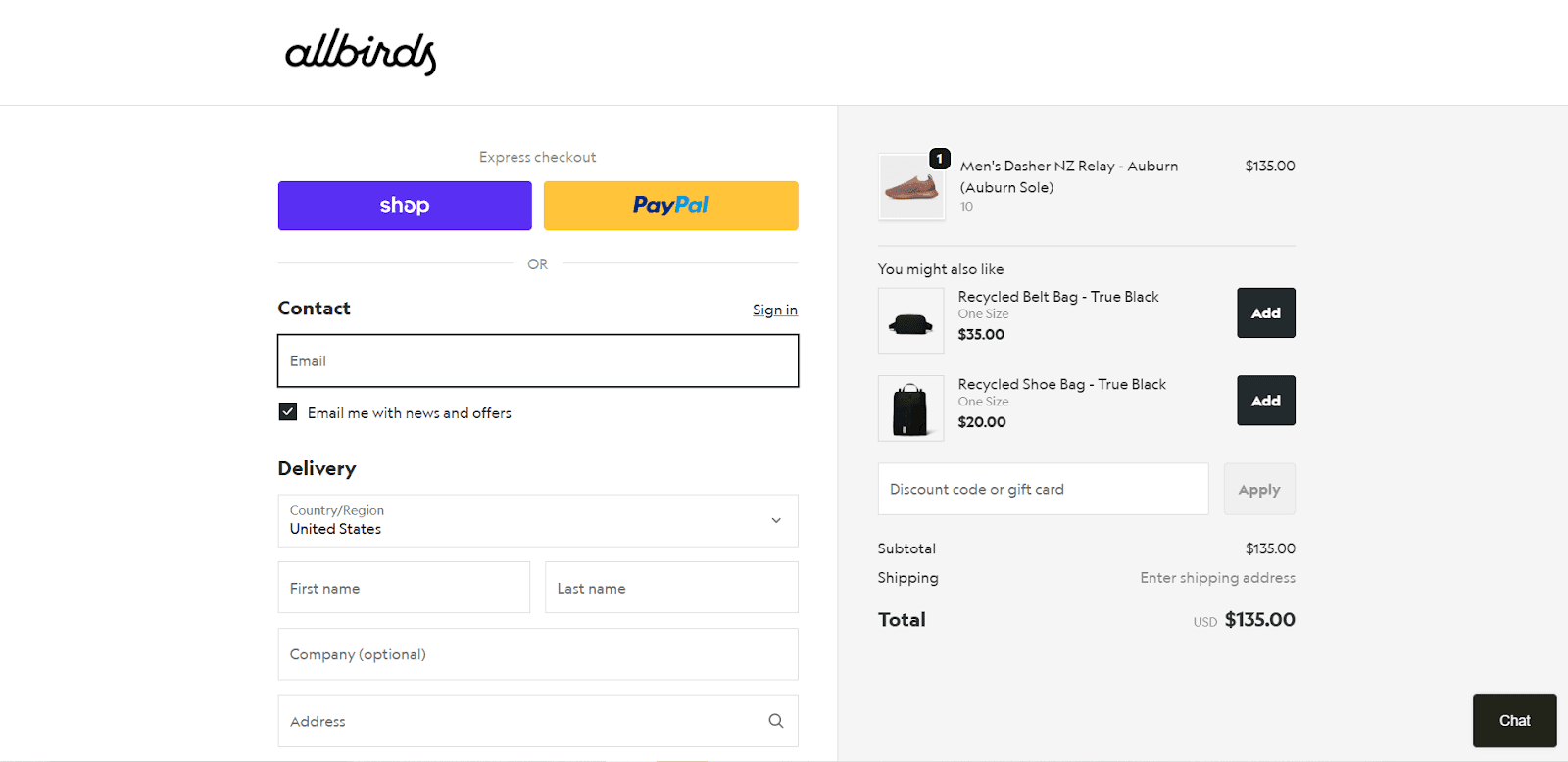
For example, Allbirds, a footwear and apparel brand, provides customers with an option to add a shoe or a belt bag to their cart at checkout when they are buying shoes. It is an effortless, relevant add-on that increases order value without interrupting the purchase flow.
Here’s how you can make the most of this upsell opportunity:
Position bundles as value deals: Even a small perceived discount or bonus item can make the bundle feel like a smarter purchase than buying individually. Also, highlight these savings upfront so the customer sees them instantly.
Use bundles for different buyer types: Offer basic, standard, and premium bundles to capture shoppers with different budgets.
Offer One-Click Add-Ons
The checkout is the last stage of the customer journey, and hence, the last thing a customer wants is a delay. Not even when adding upsell products to their cart. This is why one-click add-ons are one of the simplest yet most powerful ways to increase AOV at checkout.
They let customers include an extra item in their order with a single tap, no redirects, no extra forms, no friction. Because the action is effortless, shoppers are far more likely to accept the offer.
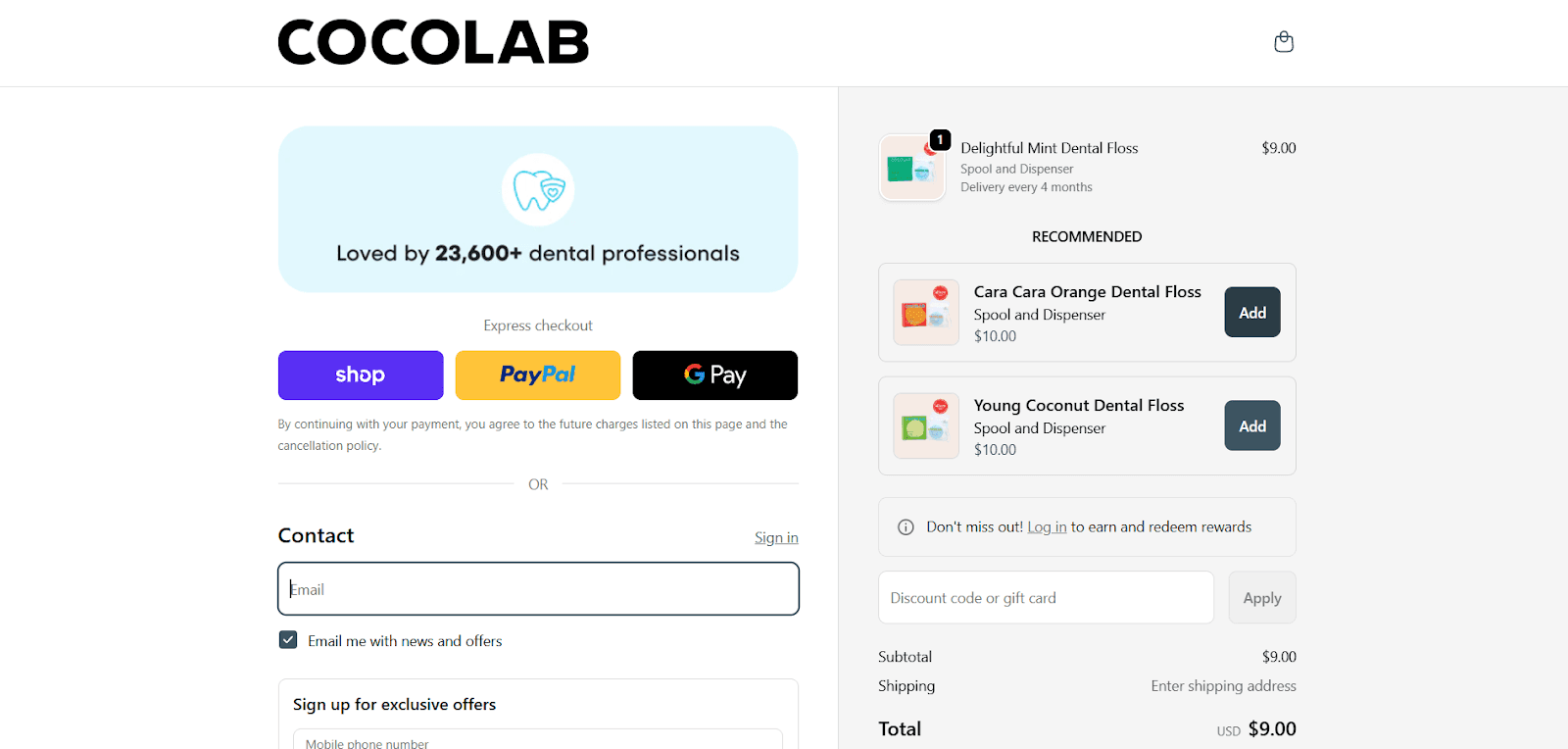
For example, Cocolab, a health and overall well-being brand, lets customers add recommended products to their order with just one tap. When someone selects a mint dental floss, they can instantly include suggested items like coconut or orange dental floss simply by clicking “Add to cart.”
Not just Shopify stores, but even retail giants such as Amazon also capitalise on the one-tap add-on upsell and drive higher cart values.
Here is how you can make the most of one-click upsell offers:
Make the value obvious: Short copy like “Add for $5” or “Upgrade for just $9 more” helps customers decide instantly.
Limit to one to two strong offers: Presenting a single or two clear add-ons performs better than stacking multiple choices that slow decision-making.
Incentivize Higher Spend With Smart Thresholds
This strategy runs on a simple customer mindset, “I’m already this close… I might as well add one more thing.” So, instead of offering product options as upsells, you give them an incentive to browse the store again and add something else they need to either get a discount or reach the free delivery threshold.
Here are the three incentive options:
Free shipping thresholds: This is one of the most effective incentives you can offer. When customers see they’re just a small amount away from free shipping, many will add another item or even increase their order quantity rather than pay for delivery.
Quick Tip: Set your free delivery threshold slightly above your current AOV to see a quick and noticeable lift in order value. When the gap isn’t too large, customers feel it’s achievable, so they’re far more likely to add an extra item to qualify. |
Gift with purchase: This is when you offer your customers a free gift as soon as they reach a specific order value. The customer is more inclined to get something “for free” than to consider the value they add to the cart for it. On the company’s end, the perceived value of a free gift often outweighs its actual cost to you.
Progress bars and visual cues: Visual indicators like “You’re $8 away from free shipping” make the goal tangible and motivating. Tiered progress bars on Shopify create momentum by showing customers how close they are to unlocking a reward.
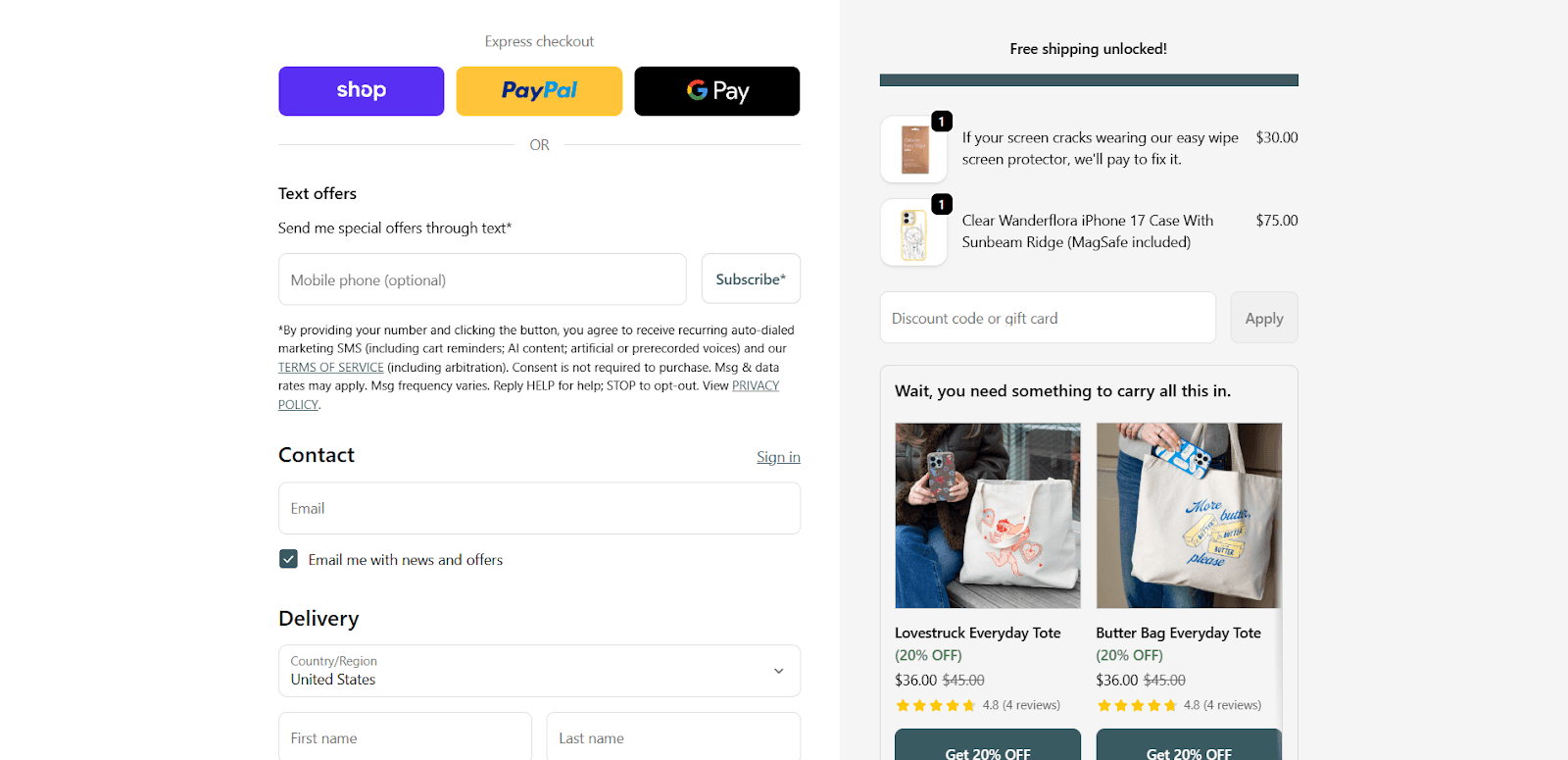
Pela, a phone case brand, is a great example of smart ecommerce checkout optimization. On the checkout page, at the very top of the cart, a visual progress bar clearly shows how close customers are to unlocking free shipping. As shoppers add items and increase their order value, the bar fills up.
Use Post-Purchase Upsells Without Hurting Conversion
Finally, once you have worked through these strategies, give your customers one final push post-purchase. Post-purchase upsell is the safest way to upsell to your customer, since their original transaction is already confirmed.
Let's first understand what the difference is between pre-purchase and post-purchase upsell through this table:
Aspect | Checkout Offers | Post-Purchase Offers |
When they appear | Before payment is completed | After payment is confirmed |
Placement | During checkout flow | Thank you or confirmation page |
Goal | Encourage customers to add more before buying | Enhance the order after it’s placed |
Conversion sensitivity | Must be friction-free to avoid drop-offs | No risk to the original conversion |
Customer mindset | Still deciding | Already committed |
At this point, any additional purchase is purely incremental revenue because your original sale is safe.
Here are some examples of post-purchase upsell offers:
A discounted upgradeis shown immediately after checkout (“Add premium version for 20% off, today only”)
A limited-time add-on related to the order (“Add extended warranty for $9”)
A replenishment or refill item for consumable products
A VIP or membership offer with perks for future purchases
Read More: How to Increase Average Order Value in E-commerce
How Monk Free Gift + BOGO Helps Increase AOV at Checkout
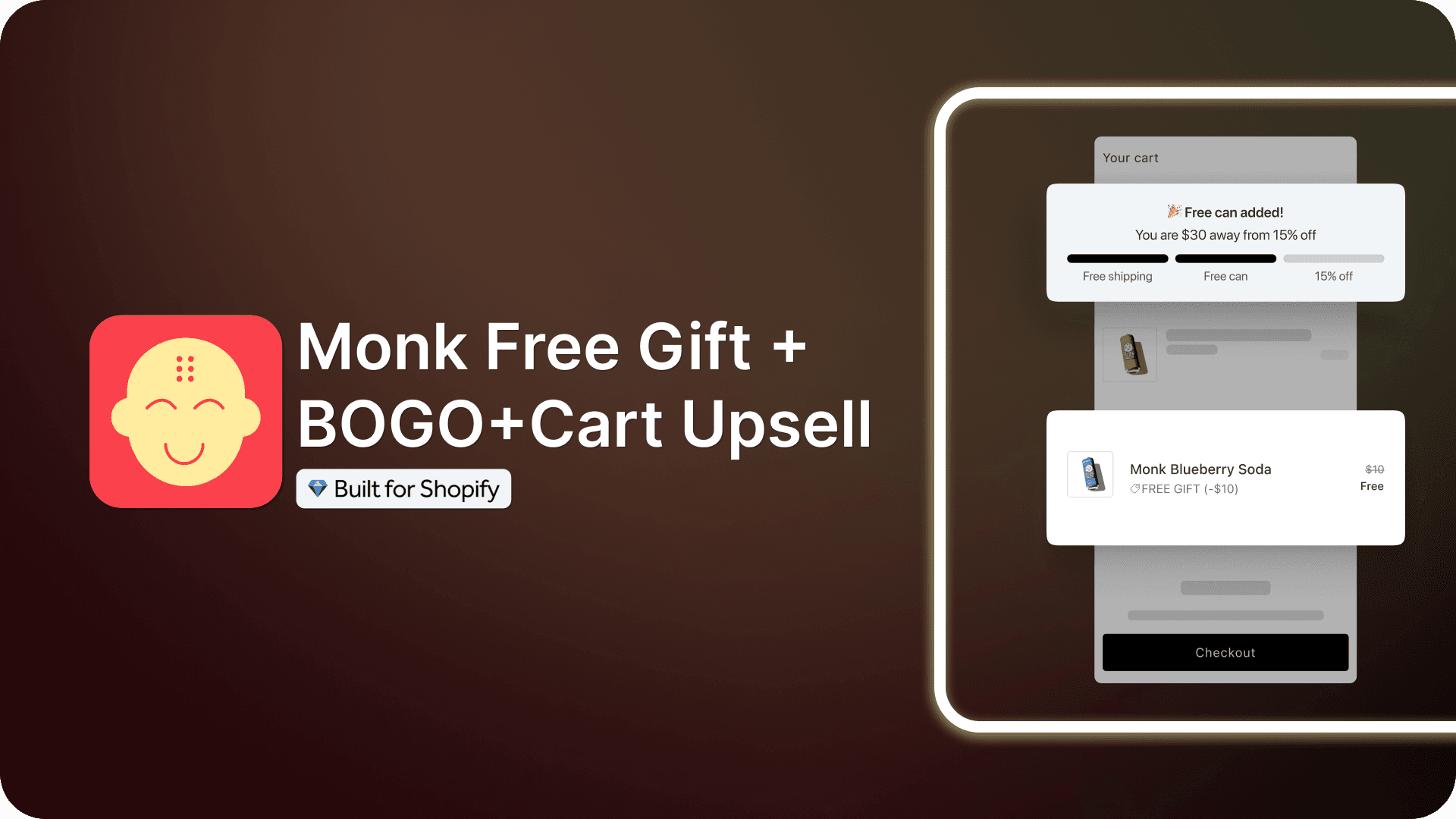
Ready with the strategies you want to pick, but don’t know how to get started? That’s exactly where Monk Free Gift + BOGO comes up. It is designed specifically to help Shopify brands turn checkout into a revenue growth engine rather than just a transaction step.
The platform combines upsells, cross-sells, rewards, and post-purchase offers into one unified system so merchants can optimize order value without adding friction. Monk Free Gift is the trusted partner of 3000+ brands on Shopify and Shopify Plus and boasts a rating of 4.9/5 with 400+ reviews on the Shopify App Store.
Here are the top Monk Free Gift + BOGO features to simplify checkout upsells for your store:
Checkout Upsells: Displays targeted upsell and cross-sell offers on product and cart pages to encourage customers to add more items before completing their order.
Cross-Sell at Checkout Logic: Offers can be triggered based on cart value, eligibility, or product selection, ensuring recommendations are relevant rather than random.
One-Click Post-Purchase Offers: Shows additional offers immediately after checkout and before the thank-you page, allowing customers to accept with a single click for higher conversions.
Personalization Capabilities: Supports targeted incentives like auto-added gifts or selectable rewards based on customer criteria.

Beyond features, the real advantage is how easy it is to deploy. Merchants can launch offers quickly, operate on predictable monthly pricing, and run optimization experiments without technical complexity.
Here’s what our customers have to say about their experience using Monk Free Gift: “We've increased our conversion by 25% in just one day. I had a little trouble getting the app set up correctly, but customer support was very helpful in getting it straight and working exactly as we intended. Highly recommend.” - David Dundas, COO, You Go Natural “Monk has been vital for allowing us to grow our monthly sales, we have tried several apps but none perform as well as this. I would highly recommend it to anyone looking to increase their AOV and ultimately their sales” - Marc Byrne, MD & Founder, JSML Global |
This positions Monk Free Gift not just as an app, but also as a checkout revenue-optimization partner.
Best Practices for Checkout Upsells That Build Trust (and Mistakes to Avoid)
Checkout upsells can significantly boost your overall revenue, but only when they are presented to customers the right way and at the right moment. At the heart of a successful upsell strategy is to make upsells feel like helpful suggestions instead of sales traps.
Here are some common mistakes to avoid, along with the best practices to help you get started on maximizing AOV:
Mistake: Showing too many offers → Fix: Keep offers optional and focused
You do not have to flood the checkout page with upsell options. Far from convincing the customer, it will only overwhelm them. Instead, show one or two clear, relevant offers and make it optional. Additionally, avoid pre-checked boxes or forced add-ons so customers feel they are in control.
Mistake: Irrelevant recommendations → Fix: Maintain brand and purchase context
Upsells that don’t match the cart feel random and, therefore, are only a sales tactic. Make sure suggestions align with what the customer is buying so you come across as offering them a complete solution. Also, match your brand’s tone, design, and messaging so the experience feels seamless.
Mistake: Disruptive checkout experiences → Fix: Prioritize smooth, user-first design
Pop-ups, redirects, or extra steps during checkout can directly impact conversions. Upsells should sit naturally within the flow and never interrupt payment. At the checkout stage, the smoother the experience, the more likely customers are to accept the offer.
Mistake: Relying on guesswork → Fix: Test and optimize using real data
You cannot set up the same upsell options indefinitely. It is crucial to monitor performance, assess customer behaviour, and adjust your upsell strategy to achieve the best results. You must also run A/B tests on timing, pricing, copy, and placement to see what actually increases AOV without hurting conversion rates.
Mistake: Short-term tactics that hurt trust → Fix: Follow transparency-first principles
Manual discount tricks, hidden conditions, or misleading wording might increase immediate revenue but damage credibility. As a result, focus on clear pricing, honest messaging, and transparent offers that build long-term trust and align with user-first standards, such as Google’s EEAT principles.
Only when you approach upsells as a way to help customers can you avoid the common pitfalls and create a trustworthy experience.
Measuring the Impact of Checkout AOV Optimization
While these are effective Shopify checkout AOV strategies, you cannot rely on guesswork or stagnant approaches to drive revenue. It is crucial to monitor your progress and refine your strategy based on the results.
Here are the key performance indicators that help you evaluate the true impact of checkout:
Average Order Value (AOV)
This shows the average amount customers spend per purchase. If your checkout upsells are working, this number should rise without affecting conversions. A steady increase here usually means your offers are relevant and well-timed.
Formula:
AOV = Total Revenue ÷ Number of Orders |
Example:
If you generate $8,000 from 200 orders, your AOV is $40.
Conversion Rate
This metric acts as your safety check. If AOV rises while conversion rate drops, your upsells may be too aggressive or distracting. The goal is to increase the average order value in ecommerce without lowering conversions.
Formula:
Conversion Rate = (Orders ÷ Visitors) × 100 |
Example:
If 1,000 people visit your store and 50 buy, your conversion rate is 5%.
Upsell Take Rate
This shows how appealing your upsell actually is. A low take rate usually means your offer isn’t relevant, priced right, or positioned well. A high take rate signals strong product fit and good timing.
Formula:
Take Rate = (Number of Accepted Upsells ÷ Number of Upsell Offers Shown) × 100 |
Example:
If 300 customers see an upsell and 60 accept it, your take rate is 20%.
Revenue per Visitor (RPV)
RPV combines conversion rate and order value into one powerful metric. It answers a simple question: How much is each visitor worth? Even a small increase here can boost overall revenue because it reflects improvements across your entire funnel.
Formula:
RPV = Total Revenue ÷ Total Visitors |
Example:
If you make $5,000 from 2,000 visitors, your RPV is $2.50.
Along with these metrics, A/B testing is crucial. You won’t know which upsell strategy works best unless you test variations. Try different product bundles, price points, messaging, or placement.
For example, test a “Add this for 20% off” offer against a “Customers also bought this” suggestion. The data will quickly show which version customers respond to more.
Another thing to keep in mind is that customer preferences change. Customer behavior changes, product trends shift, and seasonal demand fluctuates. The brands that consistently grow AOV treat optimization as an ongoing process.
Turning Checkout Into a Revenue Growth Engine
The core of how to increase AOV at checkout is helping customers discover more value in what they’re already buying. All you have to do is be present for your customer as a friend, helping them through checkout with everything they need and a few extras that can help.
However, keep in mind that brands that consistently grow AOV treat checkout as an evolving system, not a fixed step. They track performance metrics, test new ideas, and refine what works.
Monk Free Gift + BOGO supports this process by making it easier to implement targeted upsells, personalized incentives, and post-purchase offers without compromising user experience.
Ready to make the most of your checkout? Install Monk Now!
Frequently Asked Questions (FAQs)
1. What is the best way to increase AOV at checkout?
The best way to increase AOV at checkout is to provide relevant and personalized upsell recommendations so it feels like you are helping them instead of pushing a sale.
2. How many upsell offers should appear at checkout?
One to two upsell offers should appear at the checkout page. If you put too many offers, you risk overwhelming the customer.
3. How can Shopify stores increase average order value at checkout?
Shopify stores can use free gift incentives, one-click add-ons, complimentary product bundles, and even post-purchase upsells to increase average order value at checkout.
4. What is a good AOV increase percentage for e-commerce?
Even a 5–10% increase is considered strong because AOV gains compound across all orders. High-performing stores sometimes achieve 15–30% improvements when optimization is done strategically.
5. Can checkout upsell hurt user experience?
Checkout upsell can hurt user experience if not done well. Aggressive pop-ups, irrelevant offers, or too many choices can frustrate shoppers and cause cart abandonment.
6. Which tools help increase AOV at checkout?
Monk Free Gift + BOGO helps you increase AOV at checkout with features like tiered reward bars, gifts with purchase, and post-purchase upsells.
How to Increase AOV at Checkout on Shopify
Summary
Average Order Value (AOV) is the average revenue per order, calculated as total revenue divided by number of orders, and is a key driver of ecommerce growth. Checkout is the most critical stage to increase AOV since customers are already ready to buy and small, relevant offers can raise spend without extra acquisition cost. Effective strategies include contextual upsells based on cart behavior, complementary product bundles, simple one-click add-ons, and incentive thresholds like free shipping or gifts that encourage customers to add more items. Post-purchase upsells further increase revenue after payment without risking conversion. Success depends on relevance, limited friction, clear value, and avoiding overwhelming offers. Continuous testing and tracking AOV, conversion rate, and revenue per visitor ensures sustained improvement.
Let’s be honest, a $100 sale feels a lot more exciting than a $10 one.
Your customer is at the very last stage of their purchase journey: the checkout page. They’re ready to buy, and as a store owner, you can’t help but quietly hope they’ll add just a little more to their cart.
You’re not alone; thousands of Shopify store owners think the same way. After putting in all the effort to bring a customer this far, it’s only natural to want to make the most of that purchase moment.
That urge to increase each purchase isn’t just instinct; it’s linked to one of ecommerce’s most important metrics: Average Order Value (AOV). It shows how much customers spend per order and reveals how effectively your store turns traffic into revenue.
But how do you increase that order value without interrupting the checkout experience? It all comes down to smart strategy. In this blog, we’ll show you exactly how to increase AOV at checkout so every completed purchase feels like a big fish in the sea.
What Is Average Order Value and Why Does Checkout Matter Most?
Average Order Value (AOV) is a key ecommerce metric that tells you how much customers spend per transaction on average. To put it simply, we are counting how heavy the bags are instead of the total number of bags.
AOV is calculated using a simple formula:
AOV = Total Revenue ÷ Number of Orders |
For example, if your store generates $5,000 in revenue from 100 total orders, your Average Order Value (AOV) would be $50.This means, on average, each customer makes a purchase of $50 from your store.
Quick Tip: While this formula is one way to calculate AOV, you can also find it directly in your Shopify dashboard under Reports → Customers, where Shopify automatically calculates it for you. |
Research from Accenture shows that well-executed upselling strategies can increase revenue by roughly 10% to 30% on average, which is why optimizing AOV is often one of the fastest ways to grow ecommerce revenue without increasing traffic.
Now that we understand what AOV is and why its impoprtant, let's look at why it is so critical to manage it at the checkout stage:
Easier upsell moment: You’re not persuading customers to purchase anymore; you’re simply encouraging them to slightly increase their order value using strategies like Free gifts with purchase, buy one get one free, upsell and cross-sell on Shopify.
No extra ad spend needed: Boosting order value at checkout increases revenue without requiring additional marketing or acquisition costs.
Lower risk of drop-off (if friction-free): When checkout stays smooth and fast, relevant offers can increase value without hurting conversions.
Active decision stage: Customers are reviewing their cart at this point, making them more open to last-minute suggestions that enhance their purchase.
That’s why optimizing this final step can have a huge impact on your Average Order Value and overall store performance. Now, let's look at practical strategies on how to increase AOV at checkout.
Proven Strategies to Increase AOV at Checkout
Here are some proven strategies that can be helpful in giving the push your AOV needs, worked especially for the checkout stage.
However, it’s important to note that full checkout page customization is only available to merchants on the Shopify Plus plan. If you’re using a standard Shopify subscription, your ability to modify the checkout experience will be limited to the platform’s default settings and approved configurations.
Use Contextual Checkout Upsells
You can hit the right spot with an upsell only when it's contextual, which means no generic recommendations. When we say 'contextual,' we mean three things: relevance, timing, and personalization.
In fact, nearly 49% of customers have made an impulse purchase after being shown a personalized product suggestion.
The reason is simple: the customer should feel like you are helping them, like a friendly shopkeeper would, rather than being pushy. Here’s how you can make the most of contextual checkout upsells:
Trigger offers based on cart value or behavior: The value of the upsell product should match the items in the customer’s cart. If the customer is buying high-end, luxury products, you can push a premium upgrade. However, if they are being economical, then so should be their upsell offers.
Personalize using customer data: When you are providing upsell options to repeat customers, it is a good opportunity to go through their purchase history and then make a relevant suggestion. To put this simply, returning customers should see different offers than first-time buyers.
Bundle Complementary Products
One way to make upsells truly meaningful is to provide complementary products as upsell product options. Think of adding a conditioner to someone who is already getting a shampoo, a screen protector for a new phone, or a MacBook sleeve to someone purchasing a MacBook.
When you provide recommendations like these, you are selling a complete solution to your customer, not just a single product. When shoppers see items grouped together in a logical package, it simplifies decision-making and makes the purchase feel more valuable.
For example, Allbirds, a footwear and apparel brand, provides customers with an option to add a shoe or a belt bag to their cart at checkout when they are buying shoes. It is an effortless, relevant add-on that increases order value without interrupting the purchase flow.
Here’s how you can make the most of this upsell opportunity:
Position bundles as value deals: Even a small perceived discount or bonus item can make the bundle feel like a smarter purchase than buying individually. Also, highlight these savings upfront so the customer sees them instantly.
Use bundles for different buyer types: Offer basic, standard, and premium bundles to capture shoppers with different budgets.
Offer One-Click Add-Ons
The checkout is the last stage of the customer journey, and hence, the last thing a customer wants is a delay. Not even when adding upsell products to their cart. This is why one-click add-ons are one of the simplest yet most powerful ways to increase AOV at checkout.
They let customers include an extra item in their order with a single tap, no redirects, no extra forms, no friction. Because the action is effortless, shoppers are far more likely to accept the offer.
For example, Cocolab, a health and overall well-being brand, lets customers add recommended products to their order with just one tap. When someone selects a mint dental floss, they can instantly include suggested items like coconut or orange dental floss simply by clicking “Add to cart.”
Not just Shopify stores, but even retail giants such as Amazon also capitalise on the one-tap add-on upsell and drive higher cart values.
Here is how you can make the most of one-click upsell offers:
Make the value obvious: Short copy like “Add for $5” or “Upgrade for just $9 more” helps customers decide instantly.
Limit to one to two strong offers: Presenting a single or two clear add-ons performs better than stacking multiple choices that slow decision-making.
Incentivize Higher Spend With Smart Thresholds
This strategy runs on a simple customer mindset, “I’m already this close… I might as well add one more thing.” So, instead of offering product options as upsells, you give them an incentive to browse the store again and add something else they need to either get a discount or reach the free delivery threshold.
Here are the three incentive options:
Free shipping thresholds: This is one of the most effective incentives you can offer. When customers see they’re just a small amount away from free shipping, many will add another item or even increase their order quantity rather than pay for delivery.
Quick Tip: Set your free delivery threshold slightly above your current AOV to see a quick and noticeable lift in order value. When the gap isn’t too large, customers feel it’s achievable, so they’re far more likely to add an extra item to qualify. |
Gift with purchase: This is when you offer your customers a free gift as soon as they reach a specific order value. The customer is more inclined to get something “for free” than to consider the value they add to the cart for it. On the company’s end, the perceived value of a free gift often outweighs its actual cost to you.
Progress bars and visual cues: Visual indicators like “You’re $8 away from free shipping” make the goal tangible and motivating. Tiered progress bars on Shopify create momentum by showing customers how close they are to unlocking a reward.
Pela, a phone case brand, is a great example of smart ecommerce checkout optimization. On the checkout page, at the very top of the cart, a visual progress bar clearly shows how close customers are to unlocking free shipping. As shoppers add items and increase their order value, the bar fills up.
Use Post-Purchase Upsells Without Hurting Conversion
Finally, once you have worked through these strategies, give your customers one final push post-purchase. Post-purchase upsell is the safest way to upsell to your customer, since their original transaction is already confirmed.
Let's first understand what the difference is between pre-purchase and post-purchase upsell through this table:
Aspect | Checkout Offers | Post-Purchase Offers |
When they appear | Before payment is completed | After payment is confirmed |
Placement | During checkout flow | Thank you or confirmation page |
Goal | Encourage customers to add more before buying | Enhance the order after it’s placed |
Conversion sensitivity | Must be friction-free to avoid drop-offs | No risk to the original conversion |
Customer mindset | Still deciding | Already committed |
At this point, any additional purchase is purely incremental revenue because your original sale is safe.
Here are some examples of post-purchase upsell offers:
A discounted upgradeis shown immediately after checkout (“Add premium version for 20% off, today only”)
A limited-time add-on related to the order (“Add extended warranty for $9”)
A replenishment or refill item for consumable products
A VIP or membership offer with perks for future purchases
Read More: How to Increase Average Order Value in E-commerce
How Monk Free Gift + BOGO Helps Increase AOV at Checkout
Ready with the strategies you want to pick, but don’t know how to get started? That’s exactly where Monk Free Gift + BOGO comes up. It is designed specifically to help Shopify brands turn checkout into a revenue growth engine rather than just a transaction step.
The platform combines upsells, cross-sells, rewards, and post-purchase offers into one unified system so merchants can optimize order value without adding friction. Monk Free Gift is the trusted partner of 3000+ brands on Shopify and Shopify Plus and boasts a rating of 4.9/5 with 400+ reviews on the Shopify App Store.
Here are the top Monk Free Gift + BOGO features to simplify checkout upsells for your store:
Checkout Upsells: Displays targeted upsell and cross-sell offers on product and cart pages to encourage customers to add more items before completing their order.
Cross-Sell at Checkout Logic: Offers can be triggered based on cart value, eligibility, or product selection, ensuring recommendations are relevant rather than random.
One-Click Post-Purchase Offers: Shows additional offers immediately after checkout and before the thank-you page, allowing customers to accept with a single click for higher conversions.
Personalization Capabilities: Supports targeted incentives like auto-added gifts or selectable rewards based on customer criteria.
Beyond features, the real advantage is how easy it is to deploy. Merchants can launch offers quickly, operate on predictable monthly pricing, and run optimization experiments without technical complexity.
Here’s what our customers have to say about their experience using Monk Free Gift: “We've increased our conversion by 25% in just one day. I had a little trouble getting the app set up correctly, but customer support was very helpful in getting it straight and working exactly as we intended. Highly recommend.” - David Dundas, COO, You Go Natural “Monk has been vital for allowing us to grow our monthly sales, we have tried several apps but none perform as well as this. I would highly recommend it to anyone looking to increase their AOV and ultimately their sales” - Marc Byrne, MD & Founder, JSML Global |
This positions Monk Free Gift not just as an app, but also as a checkout revenue-optimization partner.
Best Practices for Checkout Upsells That Build Trust (and Mistakes to Avoid)
Checkout upsells can significantly boost your overall revenue, but only when they are presented to customers the right way and at the right moment. At the heart of a successful upsell strategy is to make upsells feel like helpful suggestions instead of sales traps.
Here are some common mistakes to avoid, along with the best practices to help you get started on maximizing AOV:
Mistake: Showing too many offers → Fix: Keep offers optional and focused
You do not have to flood the checkout page with upsell options. Far from convincing the customer, it will only overwhelm them. Instead, show one or two clear, relevant offers and make it optional. Additionally, avoid pre-checked boxes or forced add-ons so customers feel they are in control.
Mistake: Irrelevant recommendations → Fix: Maintain brand and purchase context
Upsells that don’t match the cart feel random and, therefore, are only a sales tactic. Make sure suggestions align with what the customer is buying so you come across as offering them a complete solution. Also, match your brand’s tone, design, and messaging so the experience feels seamless.
Mistake: Disruptive checkout experiences → Fix: Prioritize smooth, user-first design
Pop-ups, redirects, or extra steps during checkout can directly impact conversions. Upsells should sit naturally within the flow and never interrupt payment. At the checkout stage, the smoother the experience, the more likely customers are to accept the offer.
Mistake: Relying on guesswork → Fix: Test and optimize using real data
You cannot set up the same upsell options indefinitely. It is crucial to monitor performance, assess customer behaviour, and adjust your upsell strategy to achieve the best results. You must also run A/B tests on timing, pricing, copy, and placement to see what actually increases AOV without hurting conversion rates.
Mistake: Short-term tactics that hurt trust → Fix: Follow transparency-first principles
Manual discount tricks, hidden conditions, or misleading wording might increase immediate revenue but damage credibility. As a result, focus on clear pricing, honest messaging, and transparent offers that build long-term trust and align with user-first standards, such as Google’s EEAT principles.
Only when you approach upsells as a way to help customers can you avoid the common pitfalls and create a trustworthy experience.
Measuring the Impact of Checkout AOV Optimization
While these are effective Shopify checkout AOV strategies, you cannot rely on guesswork or stagnant approaches to drive revenue. It is crucial to monitor your progress and refine your strategy based on the results.
Here are the key performance indicators that help you evaluate the true impact of checkout:
Average Order Value (AOV)
This shows the average amount customers spend per purchase. If your checkout upsells are working, this number should rise without affecting conversions. A steady increase here usually means your offers are relevant and well-timed.
Formula:
AOV = Total Revenue ÷ Number of Orders |
Example:
If you generate $8,000 from 200 orders, your AOV is $40.
Conversion Rate
This metric acts as your safety check. If AOV rises while conversion rate drops, your upsells may be too aggressive or distracting. The goal is to increase the average order value in ecommerce without lowering conversions.
Formula:
Conversion Rate = (Orders ÷ Visitors) × 100 |
Example:
If 1,000 people visit your store and 50 buy, your conversion rate is 5%.
Upsell Take Rate
This shows how appealing your upsell actually is. A low take rate usually means your offer isn’t relevant, priced right, or positioned well. A high take rate signals strong product fit and good timing.
Formula:
Take Rate = (Number of Accepted Upsells ÷ Number of Upsell Offers Shown) × 100 |
Example:
If 300 customers see an upsell and 60 accept it, your take rate is 20%.
Revenue per Visitor (RPV)
RPV combines conversion rate and order value into one powerful metric. It answers a simple question: How much is each visitor worth? Even a small increase here can boost overall revenue because it reflects improvements across your entire funnel.
Formula:
RPV = Total Revenue ÷ Total Visitors |
Example:
If you make $5,000 from 2,000 visitors, your RPV is $2.50.
Along with these metrics, A/B testing is crucial. You won’t know which upsell strategy works best unless you test variations. Try different product bundles, price points, messaging, or placement.
For example, test a “Add this for 20% off” offer against a “Customers also bought this” suggestion. The data will quickly show which version customers respond to more.
Another thing to keep in mind is that customer preferences change. Customer behavior changes, product trends shift, and seasonal demand fluctuates. The brands that consistently grow AOV treat optimization as an ongoing process.
Turning Checkout Into a Revenue Growth Engine
The core of how to increase AOV at checkout is helping customers discover more value in what they’re already buying. All you have to do is be present for your customer as a friend, helping them through checkout with everything they need and a few extras that can help.
However, keep in mind that brands that consistently grow AOV treat checkout as an evolving system, not a fixed step. They track performance metrics, test new ideas, and refine what works.
Monk Free Gift + BOGO supports this process by making it easier to implement targeted upsells, personalized incentives, and post-purchase offers without compromising user experience.
Ready to make the most of your checkout? Install Monk Now!
Frequently Asked Questions (FAQs)
1. What is the best way to increase AOV at checkout?
The best way to increase AOV at checkout is to provide relevant and personalized upsell recommendations so it feels like you are helping them instead of pushing a sale.
2. How many upsell offers should appear at checkout?
One to two upsell offers should appear at the checkout page. If you put too many offers, you risk overwhelming the customer.
3. How can Shopify stores increase average order value at checkout?
Shopify stores can use free gift incentives, one-click add-ons, complimentary product bundles, and even post-purchase upsells to increase average order value at checkout.
4. What is a good AOV increase percentage for e-commerce?
Even a 5–10% increase is considered strong because AOV gains compound across all orders. High-performing stores sometimes achieve 15–30% improvements when optimization is done strategically.
5. Can checkout upsell hurt user experience?
Checkout upsell can hurt user experience if not done well. Aggressive pop-ups, irrelevant offers, or too many choices can frustrate shoppers and cause cart abandonment.
6. Which tools help increase AOV at checkout?
Monk Free Gift + BOGO helps you increase AOV at checkout with features like tiered reward bars, gifts with purchase, and post-purchase upsells.
Contents
Related Articles
10 Best Shopify Apps for Increasing Revenue
How to Increase Average Order Value in E-commerce
Top 10 Shopify Apps to Raise Average Order Value
Get Monk Free Gift app for just $1/month this Black Friday
First month: $1 after your 7-day free trial. All features included. Offer live!
Claim offer now

Get Monk Free Gift app for just $1/month this Black Friday
First month: $1 after your 7-day free trial. All features included. Offer live!
Claim offer now
Get Monk Free Gift app for just $1/month this Black Friday
First month: $1 after your 7-day free trial. All features included. Offer live!
Claim offer now