Free Gift Promotion Strategy [8 Proven Ways to Boost Conversions, AOV & Customer Loyalty]
Summary
Free gift promotions are ecommerce strategies where customers receive an extra product or reward with purchase, used to increase average order value, improve conversions, and build loyalty. Common formats include spend-based gifts, BOGO-style offers, free shipping thresholds, tiered reward ladders, product bundles, limited-time campaigns, subscription sign-up gifts, and free samples for product discovery. These incentives work because customers perceive higher value and feel rewarded, often driving higher spending to reach thresholds. They are especially effective for new product launches, seasonal campaigns, inventory clearance, and customer acquisition. Success depends on choosing relevant gifts, setting smart spending thresholds above average order value, and avoiding overuse that reduces perceived value. Tools like Shopify apps can automate gift qualification, add gifts to carts, and manage tiered or personalized offers across the shopping journey.

Ravish (RV)
Senior Content Writer
Ravish is an ecommerce and SaaS marketing expert with 6+ years of experience in Shopify and ecommerce and 10+ years of experience in marketing, and growth strategy. He has worked closely with Shopify merchants to solve real ecommerce challenges and shares practical, research-backed insights, industry best practices, and emerging trends.
Key Takeaways
Free gift promotions are ecommerce strategies where customers receive an extra product or reward with purchase, used to increase average order value, improve conversions, and build loyalty. Common formats include spend-based gifts, BOGO-style offers, free shipping thresholds, tiered reward ladders, product bundles, limited-time campaigns, subscription sign-up gifts, and free samples for product discovery. These incentives work because customers perceive higher value and feel rewarded, often driving higher spending to reach thresholds. They are especially effective for new product launches, seasonal campaigns, inventory clearance, and customer acquisition. Success depends on choosing relevant gifts, setting smart spending thresholds above average order value, and avoiding overuse that reduces perceived value. Tools like Shopify apps can automate gift qualification, add gifts to carts, and manage tiered or personalized offers across the shopping journey.
Customers love anything that comes for free, whether it's a candy or a tester pack. Because the customer isn’t paying, it feels less like a transaction and more like a gesture.
Ecommerce brands have long recognized the power of this small moment. Adding a free gift to an order can make customers feel valued and pleasantly surprised. In fact, studies suggest that nearly 70% shoppers are willing to switch from their preferred brand if another brand offers a free gift.
But over time, these gestures can do more than just delight shoppers. They can encourage higher-average order values, improve conversion rates, and strengthen long-term customer loyalty.
If you’re considering this approach, this guide will walk you through the free gift promotion benefits and share 8 practical strategies to implement them in your ecommerce store.
What Is a Free Gift Promotion Strategy?
Free gift promotion strategy, as the name suggests, is giving away products for free when a customer makes a purchase. There can be different types of free gift promotions depending on the conditions set by the store, such as:
Complimentary item for reaching a minimum order value
Bonus product with the purchase of a specific item or category
Limited-time giveaways during seasonal or campaign promotions
Sample-size product added to help customers try something new
For example,
A skincare brand offers a travel-size cleanser with orders above $200
A clothing store adds a free tote bag when customers buy two or more items
The idea behind this strategy is simple: customers receive ‘something extra’ without paying for it. This small incentive can make the purchase feel more rewarding and encourage shoppers to complete their order.
Why Free Gift Promotions Increase Sales?
We know what you’re thinking. “But what about the cost of those gifts?”
The interesting part is that customers often perceive promotional gifts to be about 2.4 times more valuable than the cost to the seller. A well-executed free gift marketing strategy does more than just delight shoppers. Here are the top benefits of incorporating the FGWP (Free Gift With Purchase):
Increases Average Order Value (AOV): Increasing AOV is among the top goals of most e-commerce businesses to boost revenue. FGWP makes it easier with a free-gift threshold. For example, if the free gift unlocks at $200, a shopper with a $180 cart may add another product toreach the threshold and get the gift. Statistically, a free gift can increase the average order value by up to 30%.
Boosts purchase confidence: A small extra reward can make the deal feel more worthwhile and increase the perceived value of the order. As a result, it reduces last-minute hesitation at checkout.
Strengthens brand experience and customer loyalty: Receiving an unexpected bonus in a package often leaves a strong impression and makes customers feel appreciated. These positive experiences can build loyalty, so when deciding between you and your competitor who doesn’t offer free gifts, the customer will have a clear answer.
Introduces customers to new products: Free gifts are a simple way to let customers try products they might not have purchased otherwise. If they like the sample or product, it can lead to future purchases and increased sales.
Now that we know why e-commerce businesses need promotion strategies like free gifts with purchase, let's look at how they can add free gifts through different strategies.
Before You Start: Two Ways to Run Free Gift Promotions on Shopify

For stores looking for high-converting gift campaigns, the flexibility an app offers is the best match. |
Strategy 1: Free Gift With Every Purchase
Its the simplest form of free gift promotion. Every customer who places an order gets a bonus item, no conditions attached. No minimum spend, no specific product to buy, just a guaranteed extra with every purchase.
Because the reward is guaranteed, customers skip the mental math entirely and feel like they're getting a better deal from the start. This reduces checkout hesitation and cart abandonment. It also builds positive brand sentiment before the package even arrives.
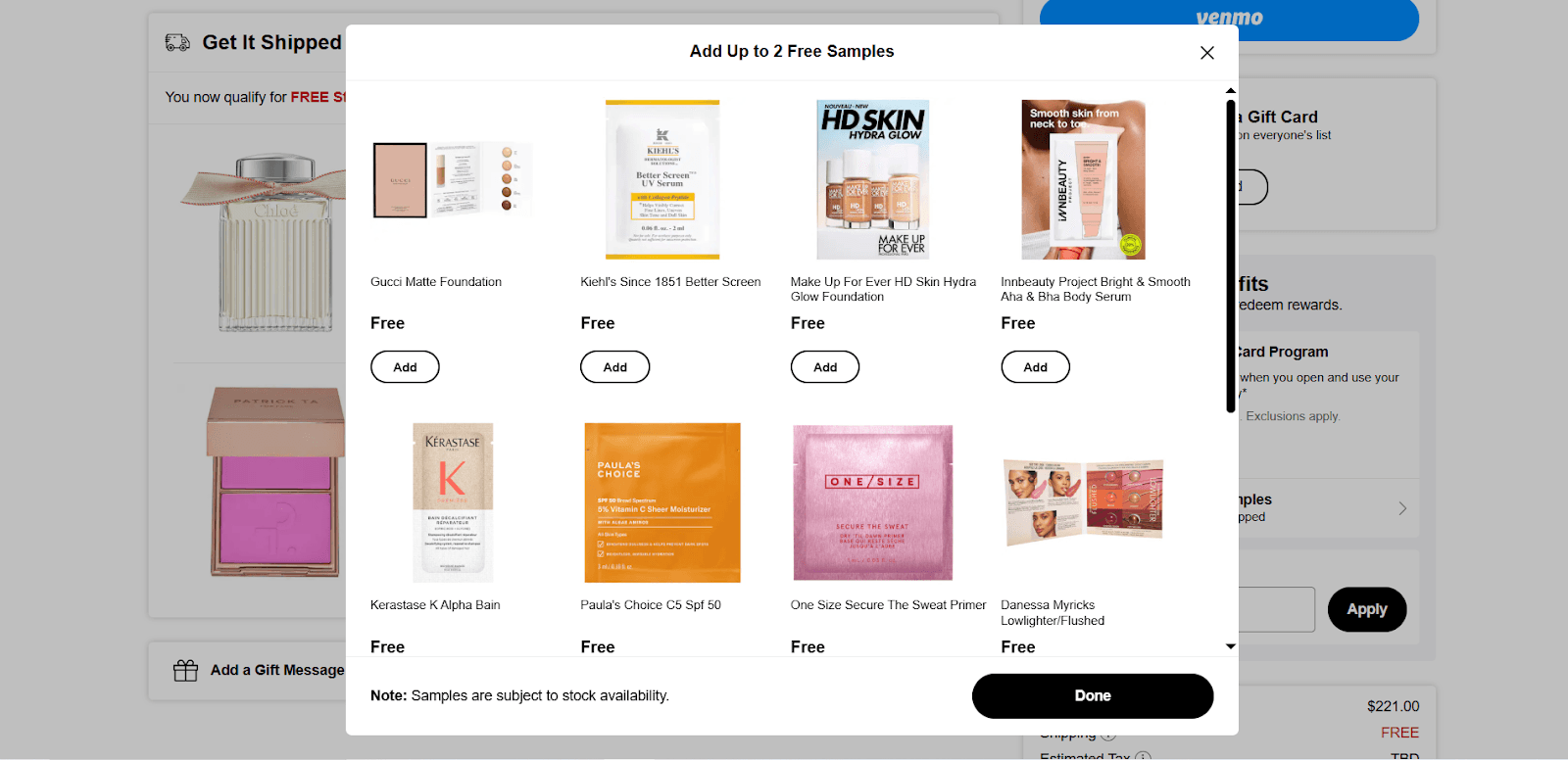
For example, Sephora regularly runs "free gift with every purchase" campaigns. Every customer who places an order, regardless of order size, receives a curated sample set or a full-sized product from a featured brand.
Best practices
Choose a gift that complements your core products so it feels intentional
Display the free gift prominently on your homepage, product pages, and at checkout to ensure customers know about it before they leave
Rotate gifts periodically so returning customers always have something new to look forward to
Strategy 2: Free Shipping as a Gift (Spend $X, Get Free Shipping)
One thing customers hate paying for is the product to reach them, the shipping. So, an extraordinary way to delight your customer is to give them free delivery as a gift.
In this gift type, customers unlock free shipping once their cart reaches a set amount, turning a cost-saving incentive into a compelling reason to spend more.
Shipping costs are among the top reasons shoppers abandon their carts. Removing that fee at the right moment reduces drop-offs, while the spend threshold quietly encourages customers to add more items to qualify, increasing AOV.
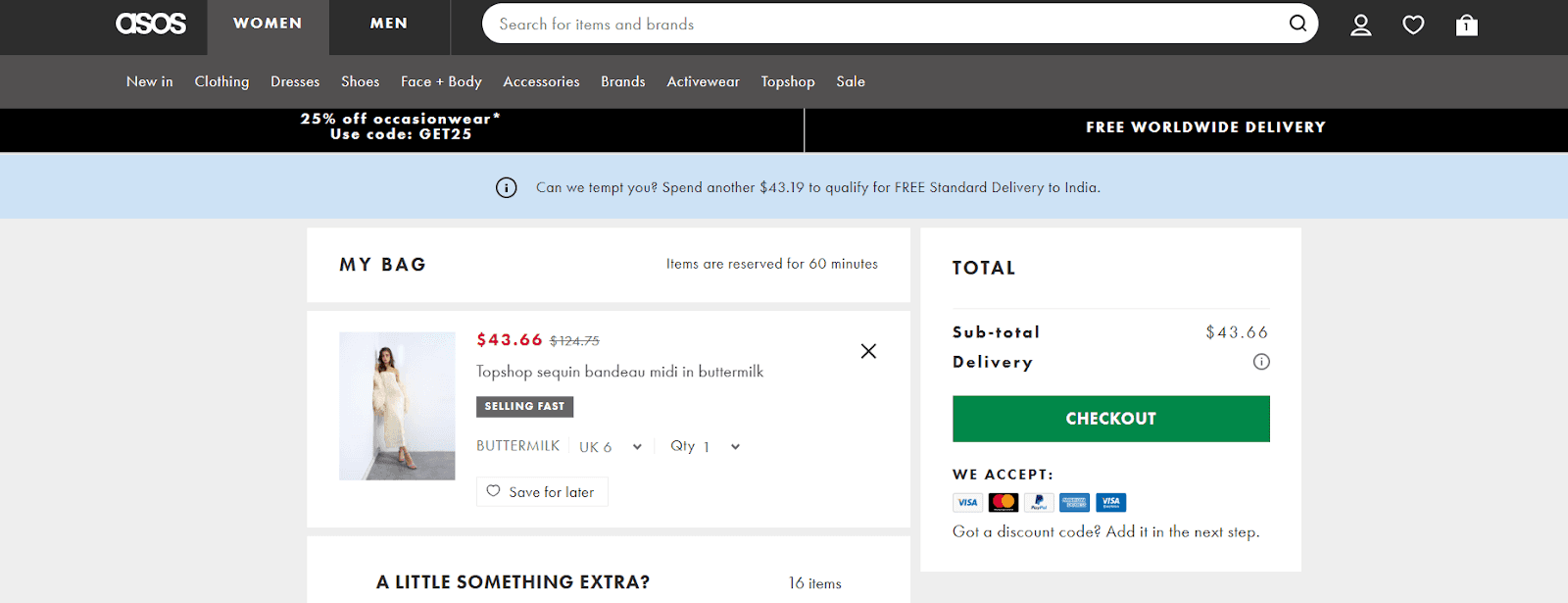
For example, ASOS, an apparel brand, displays a banner on its cart page informing shoppers that orders above $86 qualify for free standard delivery. The message is dynamic; it clearly tells customers how much more they need to spend, such as “You’re only $43.19 away from free delivery.”
Best practices
Set your threshold slightly above your current AOV to encourage incremental spending
Display a progress bar at checkout showing how close customers are to unlocking free shipping
Make the offer visible sitewide, not just on the checkout page
Strategy 3: Buy X, Get Y (BOGO)
Buy X Get Y promotions give customers a free or discounted product when they purchase a specific item or quantity. This could be a classic "buy one get one free," or a variation like "buy two, get one 50% off," or "buy a cleanser, get a free toner."
Unlike a free gift, this strategy ties the reward directly to a purchasing decision. As a result, you can use it to move specific products, clear inventory, or cross-sell complementary items. It's one of the most versatile freebie marketing tactics available to ecommerce stores because it can be tailored to almost any product category.
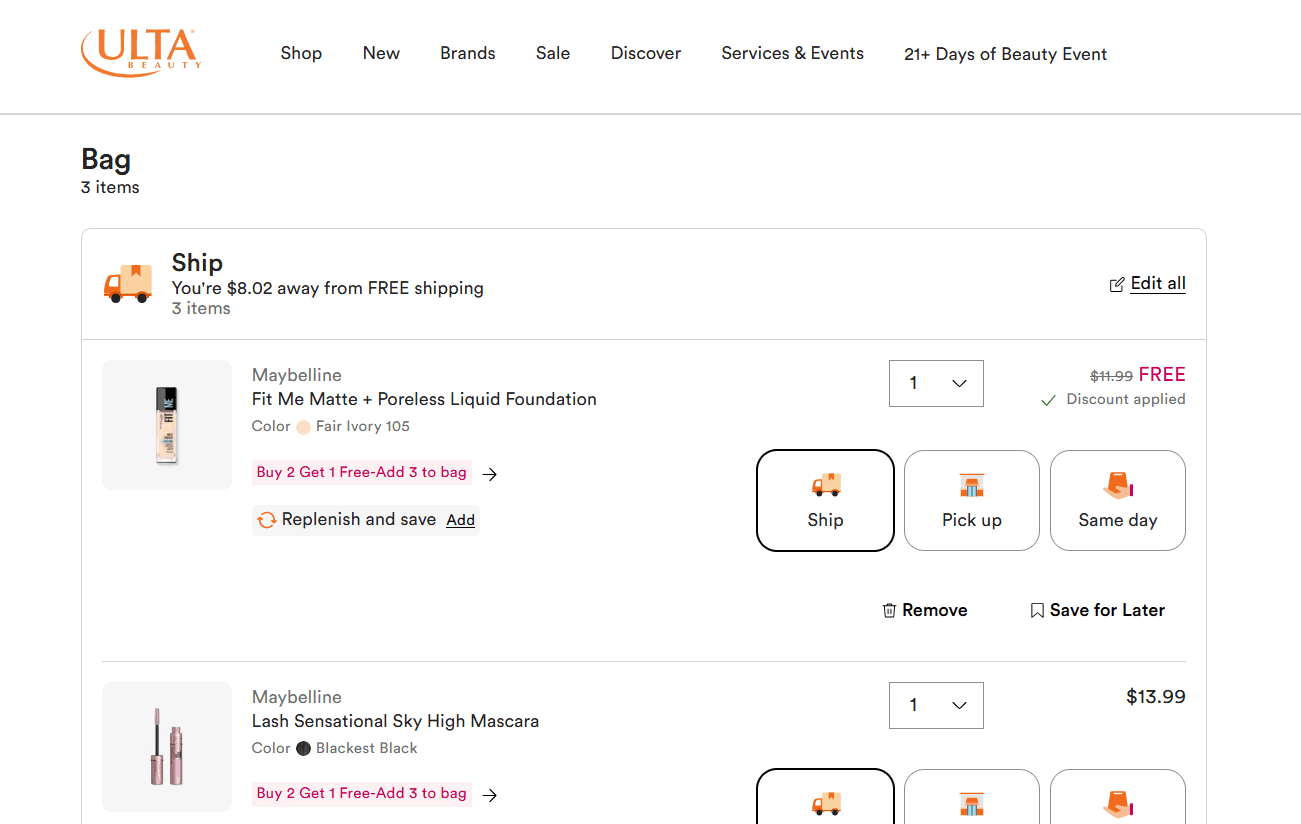
For example, Ulta Beauty runs a "buy 2, get 1 free" promotion on Maybelline makeup products. A customer planning to buy one hand soap might be convinced to purchase two instead to claim one free makeup product. This increases both order value and product exposure simultaneously.
Best practices
Pair complementary products so the free item feels like a natural addition
Make the qualifying condition simple and easy to understand
Use it strategically to cross-sell slower-moving products alongside bestsellers
Strategy 4: Spend $X and Choose a Free Gift
If you don’t want to reward every customer and spend on every purchase, setting a threshold for the free gift is an excellent choice. This strategy unlocks a free gift once a customer's cart reaches a set spending threshold.
The spend threshold naturally pushes customers to add more items to qualify, increasing AOV. But the element of choice makes it significantly more compelling. Customers feel in control of their reward, which increases the perceived value of the gift and makes the overall purchase feel more personal.
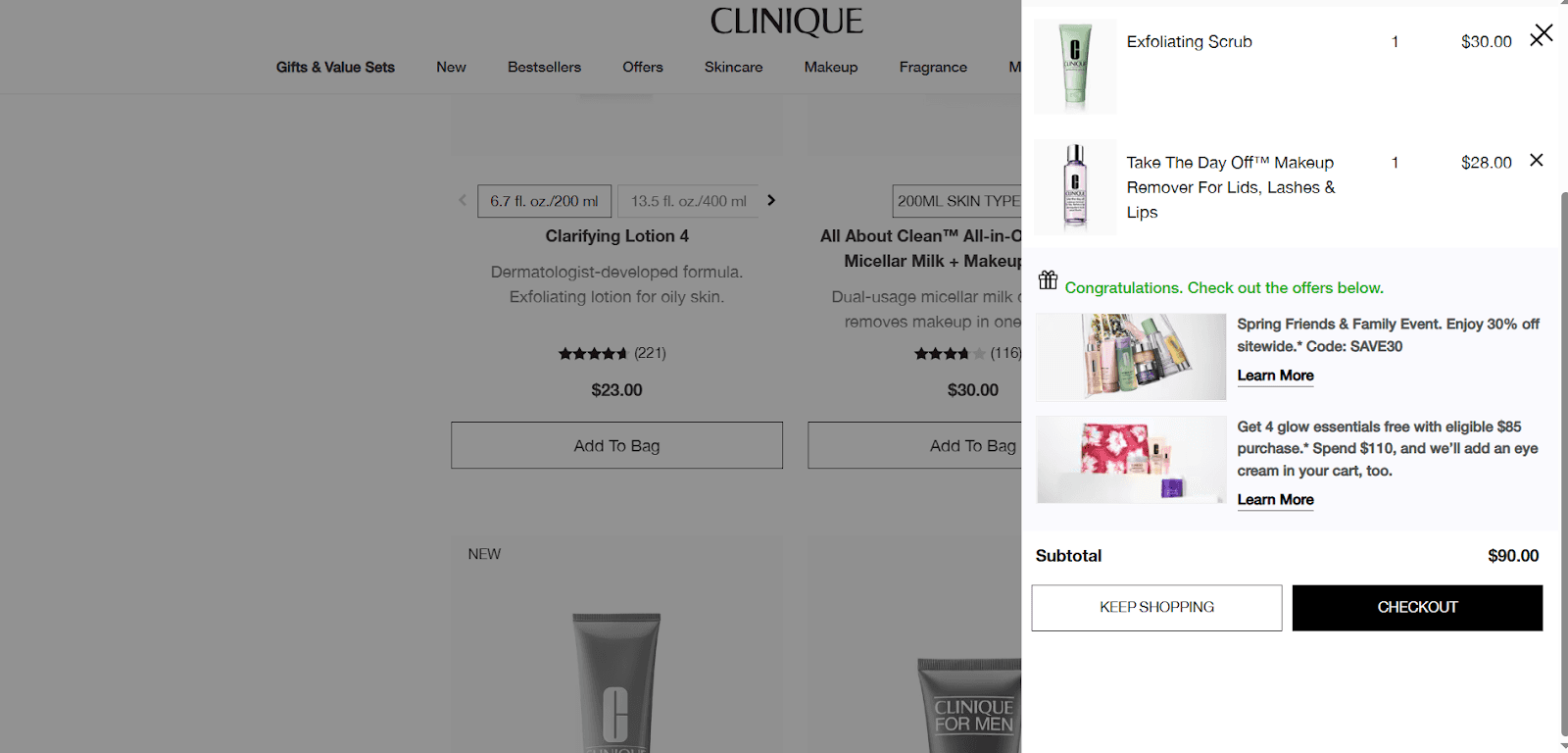
For example, Clinique, one of the most effective free gift offer examples in the beauty industry, offers customers a free gift when they spend over a set amount, letting them pick from a selection of skincare samples and travel-size products. A customer spending $45 who needs $5 more to unlock the gift will almost always find something to add.
Best practices
Offer 3 to 5 gift options so the choice feels meaningful without becoming overwhelming
Set the threshold slightly above your current AOV to drive incremental spending
Display the gift selector early, on product pages and in the cart, not just at checkout
Strategy 5: Multi-Tier Free Gift Ladder
If you really want to make your gifting structure more engaging for customers, this strategy is just the right fit.
A multi-tier free gift ladder combines multiple incentives into a structured reward system. Instead of a single threshold, customers unlock progressively better rewards as they spend more, encouraging them to keep adding to their cart at every stage.
A typical tiered structure looks like this:
Tier 1 ($50+): A small free gift automatically added to the cart
Tier 2 ($100+): Free shipping unlocked on top of the existing gift
Tier 3 ($150+): Customer gets to choose their gift from a curated selection
Each tier does a specific job. The first tier hooks the customer early, the second removes a common checkout barrier, and the third rewards higher spenders with a personalized experience that feels premium.
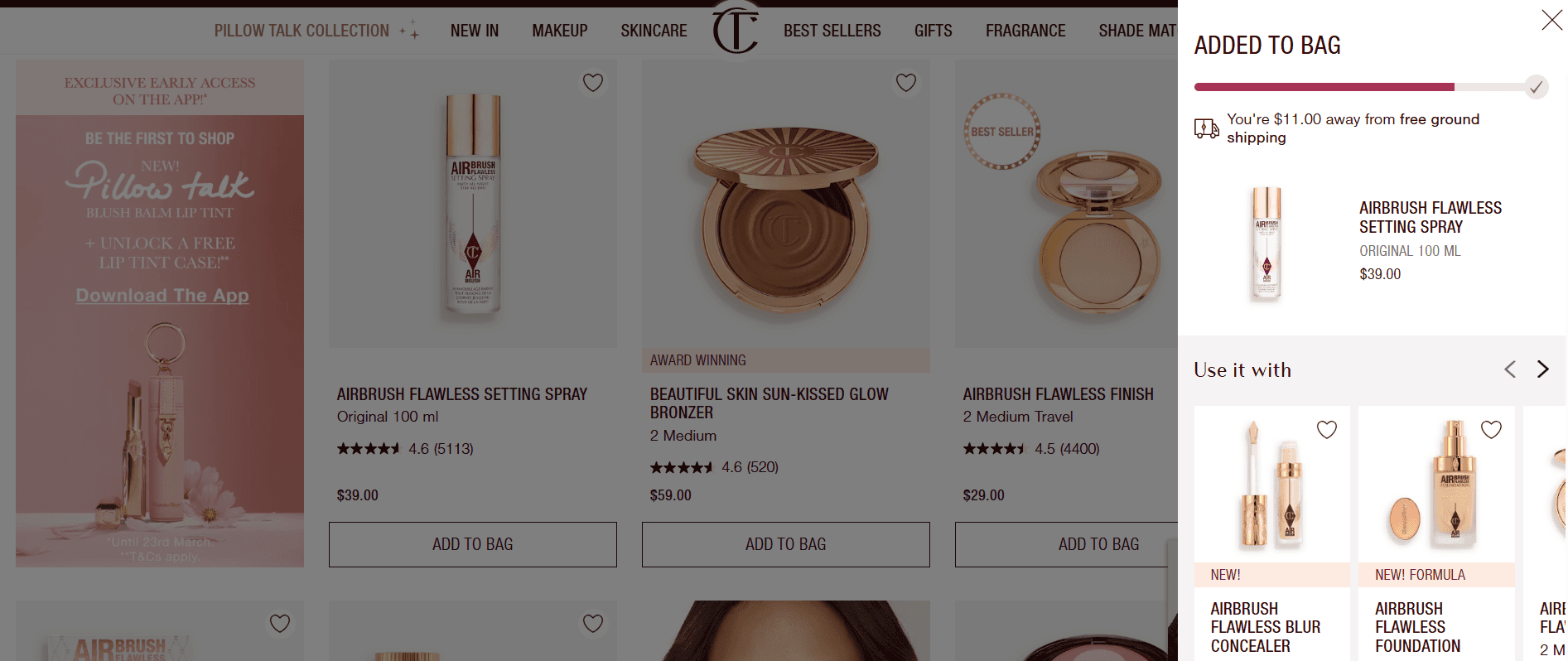
For example, Charlotte Tilbury uses a tiered gifting structure where customers unlock free samples at a lower threshold, free shipping at a mid-range spend, and a choice of a full-sized gift at higher order values. This keeps customers engaged throughout their entire shopping journey rather than stopping once they hit a single threshold.
Best Practices
Set Tier 1slightly above your current AOV to increase AOV, Tier 2 at 1.5-1.8x AOV, and Tier 3 around 2x AOV.
Tier gaps should reflect your average product price. If your average product price is $X, tier increments should match that so the milestones don't feel unattainable.
Learn how to add a tiered progress bar to your Shopify store using Monk
Strategy 6: Free Sample Gift Packs to Promote New Products
Gifting free samples along with purchases is a great way to increase product discovery. This way, the customer feels rewarded, and you get an opportunity to share a sample pack, which can be later turned into a full-size pack order. Simply think of it as a product launch tool.
This strategy solves a common problem in ecommerce: customers' hesitancy to spend money on something unfamiliar.
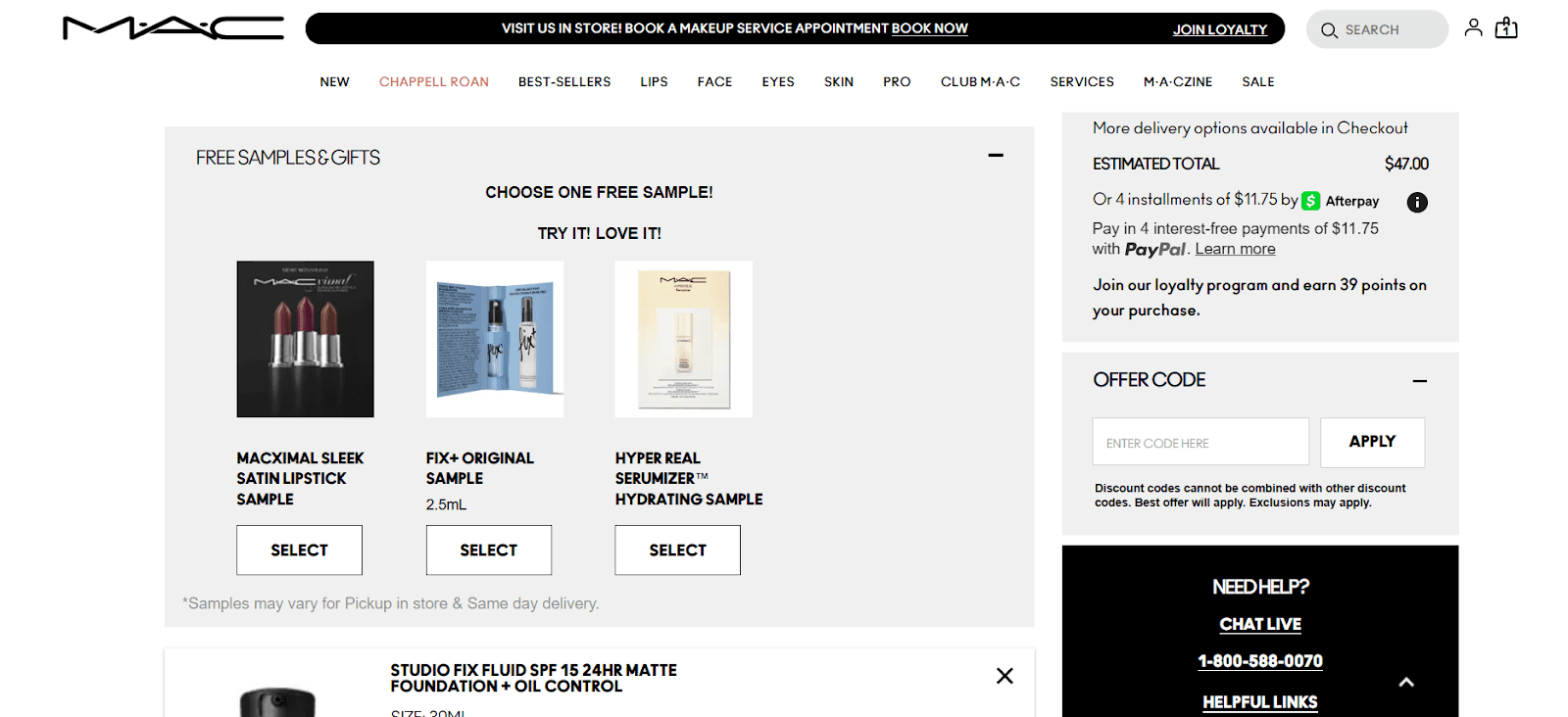
For example, Mac Cosmetics includes sample-size versions of newly launched lipsticks or foundations with outgoing orders. A customer who ordered a foundation receives a mini of a newly launched lipstick shade or makeup fixer they wouldn't have picked off the shelf themselves.
This approach also generates organic word-of-mouth. Customers who discover a product they love through a sample are far more likely to recommend it.
Best practices
Time sample distribution around your product launch window for maximum impact
Include a small card with the sample explaining the product and its benefits
Track whether sample recipients return to purchase the full-sized version to measure effectiveness
Strategy 7: Limited-Time Free Gift Campaigns
A limited-time free gift campaign attaches a free gift to purchases made within a specific window, such as a weekend, holiday period, or flash promotion. Once the window closes, the gift is gone.
The key here is that the sense of urgency drives the customer to action. When they know a free gift is only available for a short time, the fear of missing out pushes them to act faster than they otherwise would. It gives customers a reason to come back to the store and complete the purchase.
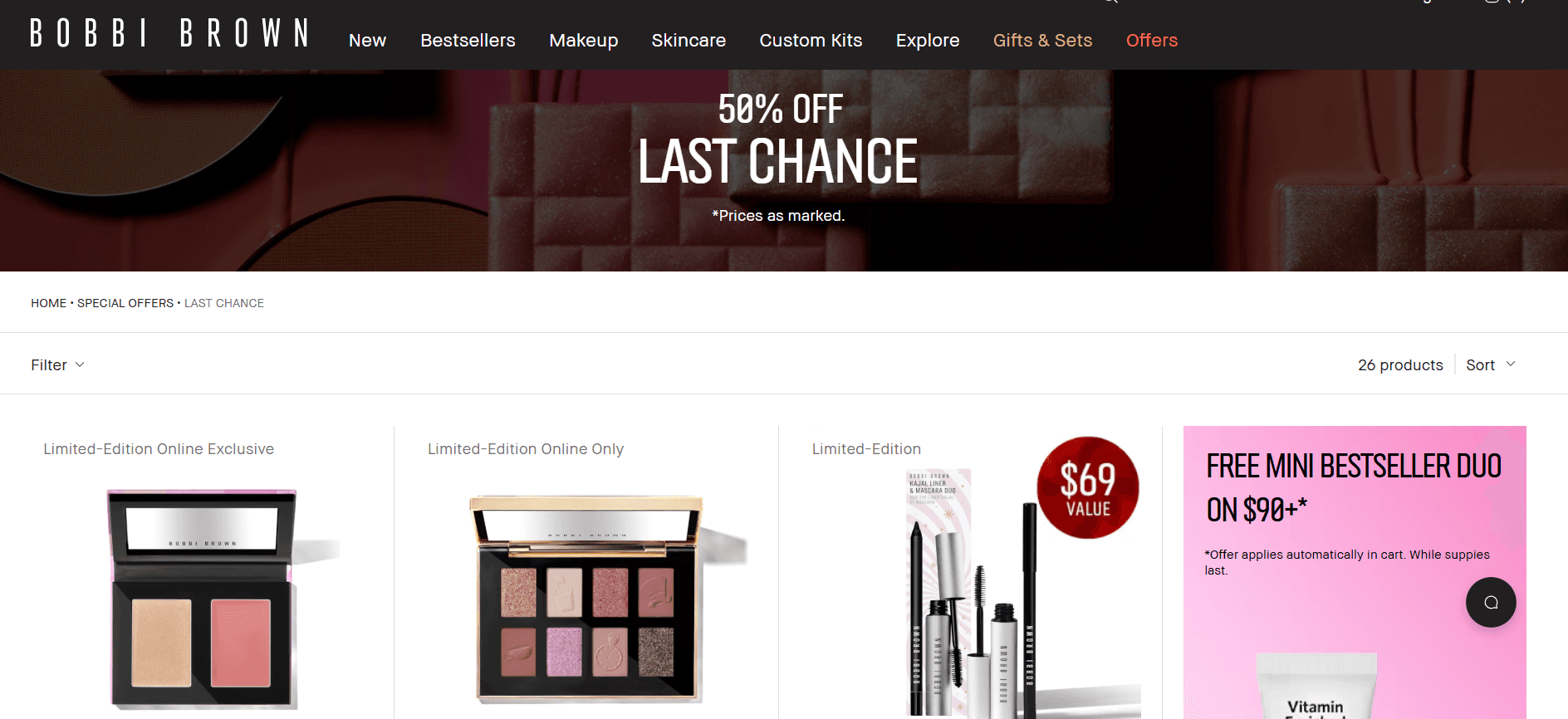
For example, Bobbi Brown runs limited-time gift campaigns around key retail moments like Mother's Day or Black Friday, offering a free makeup bag with a set of samples for purchases made within a specific promotional window. Customers who had been considering a purchase for weeks finally completed their order, not because the product changed, but because the deadline did.
Best practices
Set a clear start and end date and communicate it prominently across all channels
Use countdown timers on your site to reinforce urgency
Promote the campaign via email and social media before it launches to build anticipation
Strategy 8: Free Gift on Subscription or Membership Signup
Many customers simply come to your store, purchase, and leave. How do you loop them in so you can send them a message about future discounts and marketing campaigns? It's possible through a free gift on subscription.
This way, the customer who might not otherwise sign up and provide their details does so because there is an immediate reward. And it's a win-win for the brand too, because this approach is one of the most effective customer incentives strategies for targeting long-term customer value.
The free gift serves as the first impression of the membership experience, setting the tone for what the customer can expect going forward.
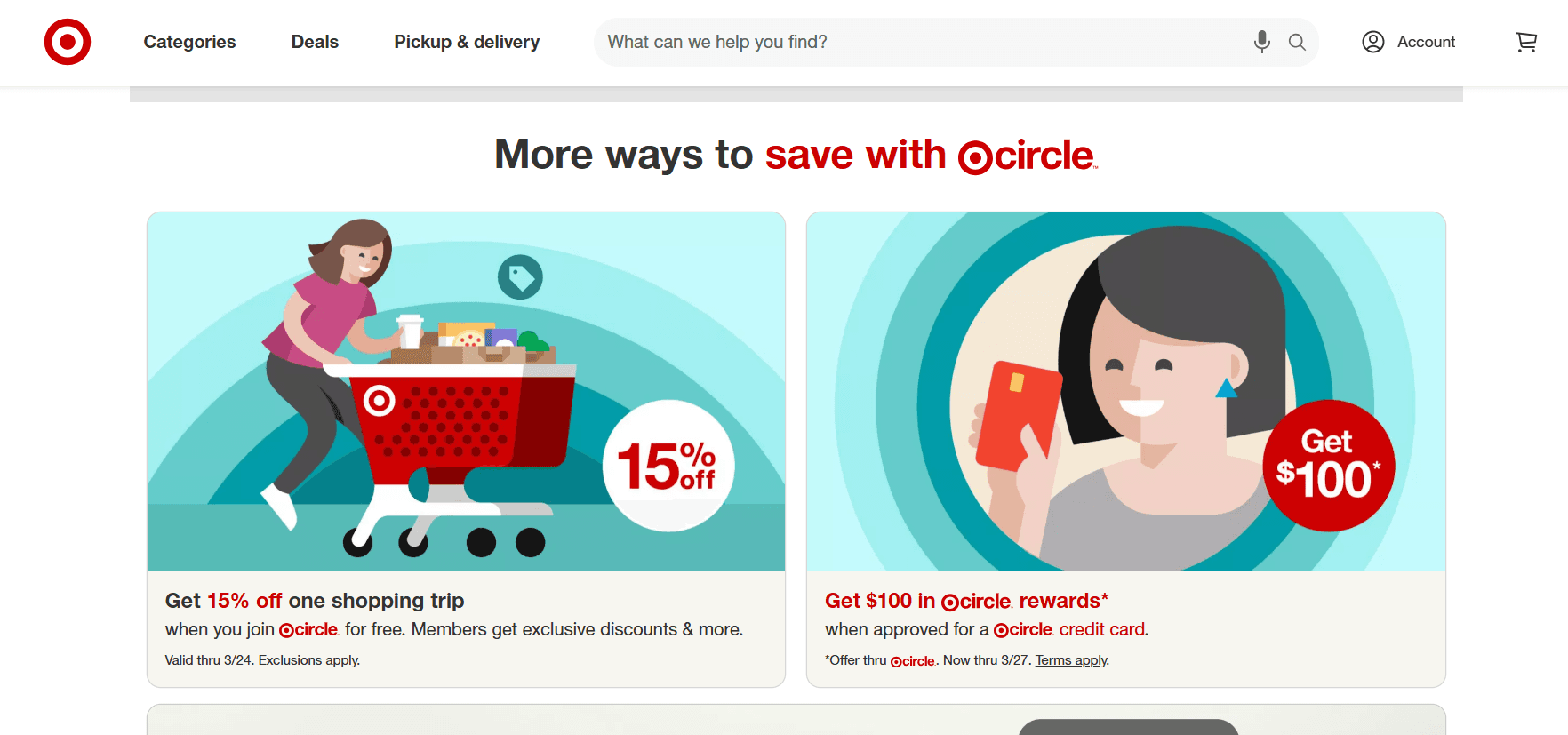
For example, retail giant Target offers new Target Circle members a free gift, discount, or bonus perks when they sign up for their membership program. A customer who was considering joining but is unsure about the value is far more likely to commit when there's an immediate, physical reward waiting for them.
Best practices
Make the gift visible on the signup page so it actively drives conversions
Consider tiered welcome gifts based on the subscription plan chosen to encourage higher-tier signups
Quick Tip:
"Free" has been plastered across so many ads for so long that shoppers barely register it anymore. Some even find it suspicious. Try swapping it for "$0" instead. "Get this tote bag for $0" hits differently than "free tote bag" because it feels like an actual price being waived, not just a marketing line. It's a one-word change that takes 10 seconds to implement and has consistently outperformed in A/B tests.
Running free gift campaigns too frequently can backfire. When customers come to expect a gift with every purchase, they stop buying at full price and simply wait for the next promotion to roll around. Use free gift offers strategically and space them out so they feel like a genuine reward rather than a permanent fixture. |
When to Launch Gift With Purchase Campaigns
After working out which strategy to use, the next question is how to run free gift campaigns at the right moment. Timing is as crucial as the type of strategy to push your customer to act. Here are the moments worth building around:
High-intent shopping periods: Seasonal events like Black Friday, Christmas, and Valentine's Day bring in shoppers who are already ready to buy. A free gift during these windows provides the final push to convert browsers into buyers.
New product launches: Pairing a free sample with a launch is one of the most effective ways to drive trial without relying entirely on paid marketing. Customers get to experience the product firsthand before committing to a full-sized purchase.
Slow sales periods: A well-timed GWP campaign during a slow month can re-engage dormant customers and create a spike in orders without resorting to blanket discounts that erode your margins.
Cart abandonment recovery: Triggering a free gift offer through an abandoned cart email, something as simple as "Complete your order, and we'll add a free gift," can recover purchases that would otherwise be lost.
Loyalty milestones: Rewarding customers on their birthday, after a set number of orders, or when they hit a new loyalty tier makes the gift feel personal rather than promotional, which strengthens long-term retention far more than a generic campaign would.
Clearance and inventory management: Free gifts can also serve an operational purpose. Bundling slow-moving or excess stock as a gift with purchase helps brands clear warehouse inventory while still creating a positive experience for the customer, turning a logistical challenge into a brand-building moment.
How Monk helps Shopify Brands run a Free Gift with Purchase promotion
Monk enables Shopify brands to execute all the Free Gift with Purchase (FGWP) campaign strategies mentioned above, with ease and limited setup.
Flexible trigger conditions: Set rules based on cart value, specific products, or collections
Automatic gift addition: Add the free gift to the cart instantly when conditions are met
Smart placement across the funnel: Show offers on product pages, cart, and post-purchase
Customizable offers: Run tiered gifts (e.g., spend more, unlock better rewards)
No-code setup: Easily create and launch campaigns without developer support
Performance optimization: Test and refine offers to maximize AOV and conversions
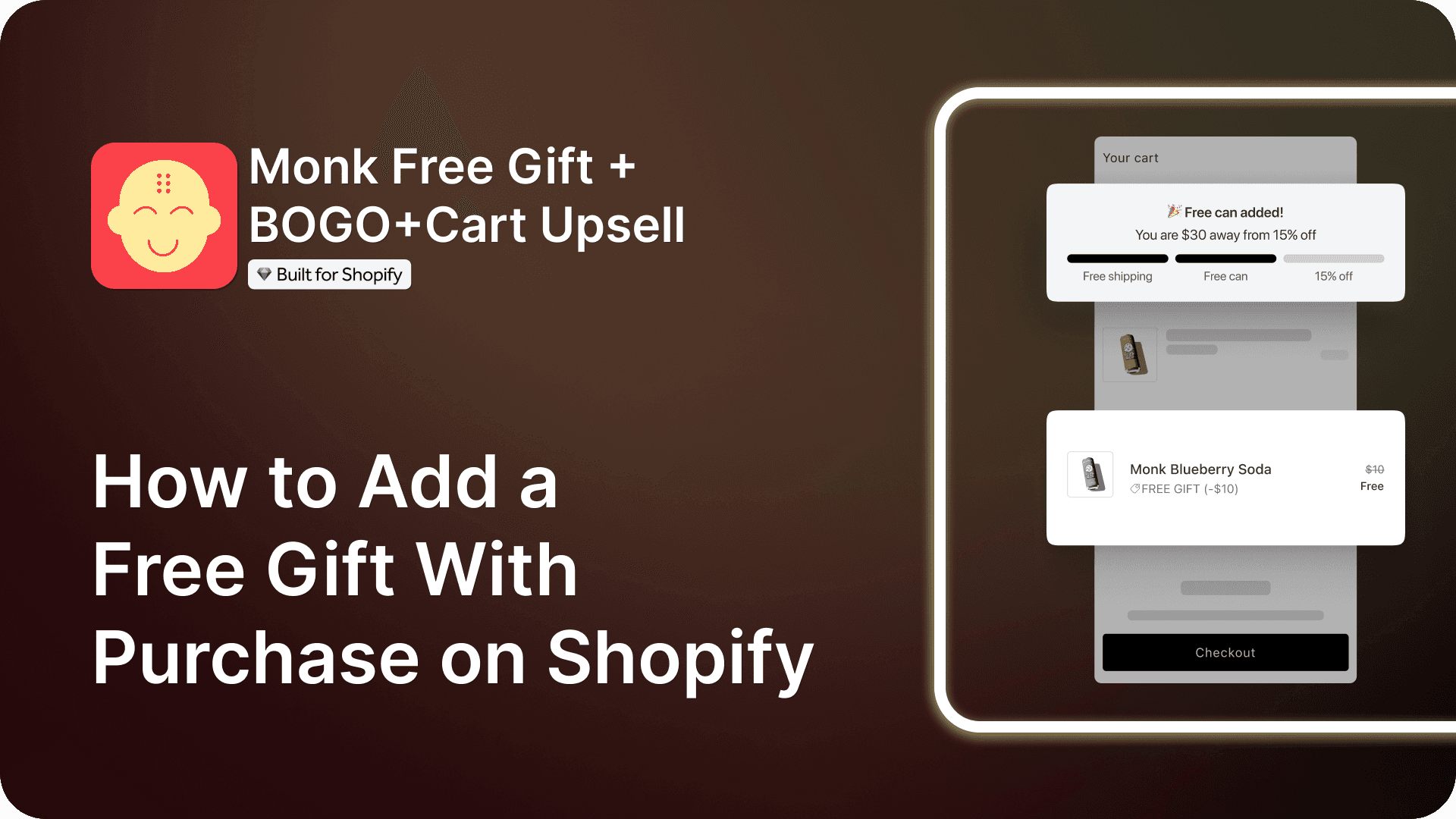
Ready to begin? Here’s a complete guide on How to Add a Free Gift With Purchase on Shopify to get you started.
Making Every Free Gift Count
A Free Gift With Purchase is an extremely effective campaign because it taps into something genuinely human: the feeling of getting more than you paid for.
All you have to do is pick a strategy and start slowly with it by targeting your goal, whether it's abandoned cart recovery, boosting loyalty, or increasing AOV. Once you are in the game, track your progress and pick it up from there.
Monk Free Gift + BOGO makes it straightforward to set up everything covered in this guide, from spend-based free gifts and BOGO offers to multi-tier reward ladders and limited-time campaigns, all without touching a line of code.
Start for free and see how a well-placed gift can change the way customers experience your store.
Frequently Asked Questions (FAQs)
Does a tiered free gift system work better than a single free gift?
A tiered free gift works better than a single free gift. A simple free gift is easier to execute, but a tiered free gift, when constructed strategically, performs way better.
Should I offer free gifts during non-sale seasons?
Yes, offering free gifts during non-sale seasons makes them stand out the most, and these are called evergreen offers. But the decision also depends on the products you are selling on your Shopify store and the industry.
For example, skincare and nutritional brands prefer to run evergreen offers, as giving samples and free products all year round increases their product discovery and impacts their business positively.
Can free gift promotions help clear inventory?
Yes. Using slow-moving products as free gifts moves inventory without publicly marking them down, keeping your pricing and brand positioning intact.
How do I decide the spend threshold for a free gift?
Take your current average order value and set the threshold 10 to 20% above it, reachable enough to motivate customers without being too easy to hit.
How often should I run limited-time free gift campaigns?
Often enough to build anticipation, not so often that customers start waiting for the next one before buying. Once a month for flash campaigns is a reasonable starting point. Also, the duration of a limited-time free gift campaign should be 3-7 days for urgency. Ensure to showcase clear messaging across your store.
Are free gifts more effective than discount coupons?
Yes, free gifts are more effective than discount coupons, as free gifts retain the product value while discounts reduce perceived value for the customer. A free gift improves customer loyalty while preserving brand position. Not just this, the free gift can automatically be added to the customer's cart using a third-party app and has a better UX.
Free Gift Promotion Strategy [8 Proven Ways to Boost Conversions, AOV & Customer Loyalty]
Summary
Free gift promotions are ecommerce strategies where customers receive an extra product or reward with purchase, used to increase average order value, improve conversions, and build loyalty. Common formats include spend-based gifts, BOGO-style offers, free shipping thresholds, tiered reward ladders, product bundles, limited-time campaigns, subscription sign-up gifts, and free samples for product discovery. These incentives work because customers perceive higher value and feel rewarded, often driving higher spending to reach thresholds. They are especially effective for new product launches, seasonal campaigns, inventory clearance, and customer acquisition. Success depends on choosing relevant gifts, setting smart spending thresholds above average order value, and avoiding overuse that reduces perceived value. Tools like Shopify apps can automate gift qualification, add gifts to carts, and manage tiered or personalized offers across the shopping journey.
Customers love anything that comes for free, whether it's a candy or a tester pack. Because the customer isn’t paying, it feels less like a transaction and more like a gesture.
Ecommerce brands have long recognized the power of this small moment. Adding a free gift to an order can make customers feel valued and pleasantly surprised. In fact, studies suggest that nearly 70% shoppers are willing to switch from their preferred brand if another brand offers a free gift.
But over time, these gestures can do more than just delight shoppers. They can encourage higher-average order values, improve conversion rates, and strengthen long-term customer loyalty.
If you’re considering this approach, this guide will walk you through the free gift promotion benefits and share 8 practical strategies to implement them in your ecommerce store.
What Is a Free Gift Promotion Strategy?
Free gift promotion strategy, as the name suggests, is giving away products for free when a customer makes a purchase. There can be different types of free gift promotions depending on the conditions set by the store, such as:
Complimentary item for reaching a minimum order value
Bonus product with the purchase of a specific item or category
Limited-time giveaways during seasonal or campaign promotions
Sample-size product added to help customers try something new
For example,
A skincare brand offers a travel-size cleanser with orders above $200
A clothing store adds a free tote bag when customers buy two or more items
The idea behind this strategy is simple: customers receive ‘something extra’ without paying for it. This small incentive can make the purchase feel more rewarding and encourage shoppers to complete their order.
Why Free Gift Promotions Increase Sales?
We know what you’re thinking. “But what about the cost of those gifts?”
The interesting part is that customers often perceive promotional gifts to be about 2.4 times more valuable than the cost to the seller. A well-executed free gift marketing strategy does more than just delight shoppers. Here are the top benefits of incorporating the FGWP (Free Gift With Purchase):
Increases Average Order Value (AOV): Increasing AOV is among the top goals of most e-commerce businesses to boost revenue. FGWP makes it easier with a free-gift threshold. For example, if the free gift unlocks at $200, a shopper with a $180 cart may add another product toreach the threshold and get the gift. Statistically, a free gift can increase the average order value by up to 30%.
Boosts purchase confidence: A small extra reward can make the deal feel more worthwhile and increase the perceived value of the order. As a result, it reduces last-minute hesitation at checkout.
Strengthens brand experience and customer loyalty: Receiving an unexpected bonus in a package often leaves a strong impression and makes customers feel appreciated. These positive experiences can build loyalty, so when deciding between you and your competitor who doesn’t offer free gifts, the customer will have a clear answer.
Introduces customers to new products: Free gifts are a simple way to let customers try products they might not have purchased otherwise. If they like the sample or product, it can lead to future purchases and increased sales.
Now that we know why e-commerce businesses need promotion strategies like free gifts with purchase, let's look at how they can add free gifts through different strategies.
Before You Start: Two Ways to Run Free Gift Promotions on Shopify
For stores looking for high-converting gift campaigns, the flexibility an app offers is the best match. |
Strategy 1: Free Gift With Every Purchase
Its the simplest form of free gift promotion. Every customer who places an order gets a bonus item, no conditions attached. No minimum spend, no specific product to buy, just a guaranteed extra with every purchase.
Because the reward is guaranteed, customers skip the mental math entirely and feel like they're getting a better deal from the start. This reduces checkout hesitation and cart abandonment. It also builds positive brand sentiment before the package even arrives.
For example, Sephora regularly runs "free gift with every purchase" campaigns. Every customer who places an order, regardless of order size, receives a curated sample set or a full-sized product from a featured brand.
Best practices
Choose a gift that complements your core products so it feels intentional
Display the free gift prominently on your homepage, product pages, and at checkout to ensure customers know about it before they leave
Rotate gifts periodically so returning customers always have something new to look forward to
Strategy 2: Free Shipping as a Gift (Spend $X, Get Free Shipping)
One thing customers hate paying for is the product to reach them, the shipping. So, an extraordinary way to delight your customer is to give them free delivery as a gift.
In this gift type, customers unlock free shipping once their cart reaches a set amount, turning a cost-saving incentive into a compelling reason to spend more.
Shipping costs are among the top reasons shoppers abandon their carts. Removing that fee at the right moment reduces drop-offs, while the spend threshold quietly encourages customers to add more items to qualify, increasing AOV.
For example, ASOS, an apparel brand, displays a banner on its cart page informing shoppers that orders above $86 qualify for free standard delivery. The message is dynamic; it clearly tells customers how much more they need to spend, such as “You’re only $43.19 away from free delivery.”
Best practices
Set your threshold slightly above your current AOV to encourage incremental spending
Display a progress bar at checkout showing how close customers are to unlocking free shipping
Make the offer visible sitewide, not just on the checkout page
Strategy 3: Buy X, Get Y (BOGO)
Buy X Get Y promotions give customers a free or discounted product when they purchase a specific item or quantity. This could be a classic "buy one get one free," or a variation like "buy two, get one 50% off," or "buy a cleanser, get a free toner."
Unlike a free gift, this strategy ties the reward directly to a purchasing decision. As a result, you can use it to move specific products, clear inventory, or cross-sell complementary items. It's one of the most versatile freebie marketing tactics available to ecommerce stores because it can be tailored to almost any product category.
For example, Ulta Beauty runs a "buy 2, get 1 free" promotion on Maybelline makeup products. A customer planning to buy one hand soap might be convinced to purchase two instead to claim one free makeup product. This increases both order value and product exposure simultaneously.
Best practices
Pair complementary products so the free item feels like a natural addition
Make the qualifying condition simple and easy to understand
Use it strategically to cross-sell slower-moving products alongside bestsellers
Strategy 4: Spend $X and Choose a Free Gift
If you don’t want to reward every customer and spend on every purchase, setting a threshold for the free gift is an excellent choice. This strategy unlocks a free gift once a customer's cart reaches a set spending threshold.
The spend threshold naturally pushes customers to add more items to qualify, increasing AOV. But the element of choice makes it significantly more compelling. Customers feel in control of their reward, which increases the perceived value of the gift and makes the overall purchase feel more personal.
For example, Clinique, one of the most effective free gift offer examples in the beauty industry, offers customers a free gift when they spend over a set amount, letting them pick from a selection of skincare samples and travel-size products. A customer spending $45 who needs $5 more to unlock the gift will almost always find something to add.
Best practices
Offer 3 to 5 gift options so the choice feels meaningful without becoming overwhelming
Set the threshold slightly above your current AOV to drive incremental spending
Display the gift selector early, on product pages and in the cart, not just at checkout
Strategy 5: Multi-Tier Free Gift Ladder
If you really want to make your gifting structure more engaging for customers, this strategy is just the right fit.
A multi-tier free gift ladder combines multiple incentives into a structured reward system. Instead of a single threshold, customers unlock progressively better rewards as they spend more, encouraging them to keep adding to their cart at every stage.
A typical tiered structure looks like this:
Tier 1 ($50+): A small free gift automatically added to the cart
Tier 2 ($100+): Free shipping unlocked on top of the existing gift
Tier 3 ($150+): Customer gets to choose their gift from a curated selection
Each tier does a specific job. The first tier hooks the customer early, the second removes a common checkout barrier, and the third rewards higher spenders with a personalized experience that feels premium.
For example, Charlotte Tilbury uses a tiered gifting structure where customers unlock free samples at a lower threshold, free shipping at a mid-range spend, and a choice of a full-sized gift at higher order values. This keeps customers engaged throughout their entire shopping journey rather than stopping once they hit a single threshold.
Best Practices
Set Tier 1slightly above your current AOV to increase AOV, Tier 2 at 1.5-1.8x AOV, and Tier 3 around 2x AOV.
Tier gaps should reflect your average product price. If your average product price is $X, tier increments should match that so the milestones don't feel unattainable.
Learn how to add a tiered progress bar to your Shopify store using Monk
Strategy 6: Free Sample Gift Packs to Promote New Products
Gifting free samples along with purchases is a great way to increase product discovery. This way, the customer feels rewarded, and you get an opportunity to share a sample pack, which can be later turned into a full-size pack order. Simply think of it as a product launch tool.
This strategy solves a common problem in ecommerce: customers' hesitancy to spend money on something unfamiliar.
For example, Mac Cosmetics includes sample-size versions of newly launched lipsticks or foundations with outgoing orders. A customer who ordered a foundation receives a mini of a newly launched lipstick shade or makeup fixer they wouldn't have picked off the shelf themselves.
This approach also generates organic word-of-mouth. Customers who discover a product they love through a sample are far more likely to recommend it.
Best practices
Time sample distribution around your product launch window for maximum impact
Include a small card with the sample explaining the product and its benefits
Track whether sample recipients return to purchase the full-sized version to measure effectiveness
Strategy 7: Limited-Time Free Gift Campaigns
A limited-time free gift campaign attaches a free gift to purchases made within a specific window, such as a weekend, holiday period, or flash promotion. Once the window closes, the gift is gone.
The key here is that the sense of urgency drives the customer to action. When they know a free gift is only available for a short time, the fear of missing out pushes them to act faster than they otherwise would. It gives customers a reason to come back to the store and complete the purchase.
For example, Bobbi Brown runs limited-time gift campaigns around key retail moments like Mother's Day or Black Friday, offering a free makeup bag with a set of samples for purchases made within a specific promotional window. Customers who had been considering a purchase for weeks finally completed their order, not because the product changed, but because the deadline did.
Best practices
Set a clear start and end date and communicate it prominently across all channels
Use countdown timers on your site to reinforce urgency
Promote the campaign via email and social media before it launches to build anticipation
Strategy 8: Free Gift on Subscription or Membership Signup
Many customers simply come to your store, purchase, and leave. How do you loop them in so you can send them a message about future discounts and marketing campaigns? It's possible through a free gift on subscription.
This way, the customer who might not otherwise sign up and provide their details does so because there is an immediate reward. And it's a win-win for the brand too, because this approach is one of the most effective customer incentives strategies for targeting long-term customer value.
The free gift serves as the first impression of the membership experience, setting the tone for what the customer can expect going forward.
For example, retail giant Target offers new Target Circle members a free gift, discount, or bonus perks when they sign up for their membership program. A customer who was considering joining but is unsure about the value is far more likely to commit when there's an immediate, physical reward waiting for them.
Best practices
Make the gift visible on the signup page so it actively drives conversions
Consider tiered welcome gifts based on the subscription plan chosen to encourage higher-tier signups
Quick Tip:
"Free" has been plastered across so many ads for so long that shoppers barely register it anymore. Some even find it suspicious. Try swapping it for "$0" instead. "Get this tote bag for $0" hits differently than "free tote bag" because it feels like an actual price being waived, not just a marketing line. It's a one-word change that takes 10 seconds to implement and has consistently outperformed in A/B tests.
Running free gift campaigns too frequently can backfire. When customers come to expect a gift with every purchase, they stop buying at full price and simply wait for the next promotion to roll around. Use free gift offers strategically and space them out so they feel like a genuine reward rather than a permanent fixture. |
When to Launch Gift With Purchase Campaigns
After working out which strategy to use, the next question is how to run free gift campaigns at the right moment. Timing is as crucial as the type of strategy to push your customer to act. Here are the moments worth building around:
High-intent shopping periods: Seasonal events like Black Friday, Christmas, and Valentine's Day bring in shoppers who are already ready to buy. A free gift during these windows provides the final push to convert browsers into buyers.
New product launches: Pairing a free sample with a launch is one of the most effective ways to drive trial without relying entirely on paid marketing. Customers get to experience the product firsthand before committing to a full-sized purchase.
Slow sales periods: A well-timed GWP campaign during a slow month can re-engage dormant customers and create a spike in orders without resorting to blanket discounts that erode your margins.
Cart abandonment recovery: Triggering a free gift offer through an abandoned cart email, something as simple as "Complete your order, and we'll add a free gift," can recover purchases that would otherwise be lost.
Loyalty milestones: Rewarding customers on their birthday, after a set number of orders, or when they hit a new loyalty tier makes the gift feel personal rather than promotional, which strengthens long-term retention far more than a generic campaign would.
Clearance and inventory management: Free gifts can also serve an operational purpose. Bundling slow-moving or excess stock as a gift with purchase helps brands clear warehouse inventory while still creating a positive experience for the customer, turning a logistical challenge into a brand-building moment.
How Monk helps Shopify Brands run a Free Gift with Purchase promotion
Monk enables Shopify brands to execute all the Free Gift with Purchase (FGWP) campaign strategies mentioned above, with ease and limited setup.
Flexible trigger conditions: Set rules based on cart value, specific products, or collections
Automatic gift addition: Add the free gift to the cart instantly when conditions are met
Smart placement across the funnel: Show offers on product pages, cart, and post-purchase
Customizable offers: Run tiered gifts (e.g., spend more, unlock better rewards)
No-code setup: Easily create and launch campaigns without developer support
Performance optimization: Test and refine offers to maximize AOV and conversions
Ready to begin? Here’s a complete guide on How to Add a Free Gift With Purchase on Shopify to get you started.
Making Every Free Gift Count
A Free Gift With Purchase is an extremely effective campaign because it taps into something genuinely human: the feeling of getting more than you paid for.
All you have to do is pick a strategy and start slowly with it by targeting your goal, whether it's abandoned cart recovery, boosting loyalty, or increasing AOV. Once you are in the game, track your progress and pick it up from there.
Monk Free Gift + BOGO makes it straightforward to set up everything covered in this guide, from spend-based free gifts and BOGO offers to multi-tier reward ladders and limited-time campaigns, all without touching a line of code.
Start for free and see how a well-placed gift can change the way customers experience your store.
Frequently Asked Questions (FAQs)
Does a tiered free gift system work better than a single free gift?
A tiered free gift works better than a single free gift. A simple free gift is easier to execute, but a tiered free gift, when constructed strategically, performs way better.
Should I offer free gifts during non-sale seasons?
Yes, offering free gifts during non-sale seasons makes them stand out the most, and these are called evergreen offers. But the decision also depends on the products you are selling on your Shopify store and the industry.
For example, skincare and nutritional brands prefer to run evergreen offers, as giving samples and free products all year round increases their product discovery and impacts their business positively.
Can free gift promotions help clear inventory?
Yes. Using slow-moving products as free gifts moves inventory without publicly marking them down, keeping your pricing and brand positioning intact.
How do I decide the spend threshold for a free gift?
Take your current average order value and set the threshold 10 to 20% above it, reachable enough to motivate customers without being too easy to hit.
How often should I run limited-time free gift campaigns?
Often enough to build anticipation, not so often that customers start waiting for the next one before buying. Once a month for flash campaigns is a reasonable starting point. Also, the duration of a limited-time free gift campaign should be 3-7 days for urgency. Ensure to showcase clear messaging across your store.
Are free gifts more effective than discount coupons?
Yes, free gifts are more effective than discount coupons, as free gifts retain the product value while discounts reduce perceived value for the customer. A free gift improves customer loyalty while preserving brand position. Not just this, the free gift can automatically be added to the customer's cart using a third-party app and has a better UX.
Ravish (RV)
Co-Founder, Monk Commerce
Ravish is an ecommerce and SaaS marketing expert with 6+ years of experience in Shopify and ecommerce and 10+ years of experience in marketing, and growth strategy. He has worked closely with Shopify merchants to solve real ecommerce challenges and shares practical, research-backed insights, industry best practices, and emerging trends.
Contents
Related Articles
How to Add a Free Gift With Purchase on Shopify
20+ Best Free Gift Ideas for Shopify Stores That Drive More Sales
Free Gift With Purchase Shopify Setup in 5 Minutes
Get Monk Free Gift app for just $1/month this Black Friday
First month: $1 after your 7-day free trial. All features included. Offer live!
Claim offer now

Get Monk Free Gift app for just $1/month this Black Friday
First month: $1 after your 7-day free trial. All features included. Offer live!
Claim offer now
Get Monk Free Gift app for just $1/month this Black Friday
First month: $1 after your 7-day free trial. All features included. Offer live!
Claim offer now