BOGO Strategy for Shopify Stores to Boost Revenue
Summary
BOGO (Buy One Get One) is a discount strategy where customers get a second product free or at a reduced price after buying one. It is widely used in ecommerce to increase average order value, boost conversions, clear inventory, and attract new customers. Its strength lies in the psychological impact of “free,” which creates higher perceived value than standard percentage discounts. Common formats include BOGO free, BOGO 50% off, product-specific pairings, collection-based offers, and curated choice lists. It works best for inventory clearance, product launches, and seasonal campaigns but can reduce margins if overused or poorly planned. Profitability depends on ensuring selling price covers the combined cost of both units including fulfillment. BOGO is effective across DTC brands, subscription models, and marketplaces when used strategically. Compared to flat discounts, bundles, and free shipping, it generally drives stronger engagement and higher perceived value.

Ravish (RV)
Senior Content Writer
Ravish is an ecommerce and SaaS marketing expert with 6+ years of experience in Shopify and ecommerce and 10+ years of experience in marketing, and growth strategy. He has worked closely with Shopify merchants to solve real ecommerce challenges and shares practical, research-backed insights, industry best practices, and emerging trends.
Key Takeaways
BOGO (Buy One Get One) is a discount strategy where customers get a second product free or at a reduced price after buying one. It is widely used in ecommerce to increase average order value, boost conversions, clear inventory, and attract new customers. Its strength lies in the psychological impact of “free,” which creates higher perceived value than standard percentage discounts. Common formats include BOGO free, BOGO 50% off, product-specific pairings, collection-based offers, and curated choice lists. It works best for inventory clearance, product launches, and seasonal campaigns but can reduce margins if overused or poorly planned. Profitability depends on ensuring selling price covers the combined cost of both units including fulfillment. BOGO is effective across DTC brands, subscription models, and marketplaces when used strategically. Compared to flat discounts, bundles, and free shipping, it generally drives stronger engagement and higher perceived value.
Today's online shoppers have one thing in common: they almost always expect a deal. Without some form of discount, even the most interested buyer will pause, second-guess, and scroll away.
But not all discounts are created equal. While a 10% off coupon barely raises an eyebrow, a Buy One Get One Free offer? That grabs attention and sends customers rushing to checkout. For Shopify stores, it's an excellent strategy to increase AOV, clear overstocked items, and build a good customer base.
In this guide, we will look at the different types of BOGO offers, how they work across different ecommerce models, and their benefits compared with other discount strategies.
What Is a BOGO Strategy in Ecommerce?
As the name suggests, the Buy One Get One strategy is when a customer buys one product and gets another one free or at a discounted price. It is among the best discounts you can offer your customers.
In fact, when it comes to discounts that actually get people buying, BOGO leads the pack, with close to 93% of American shoppers having redeemed one at least once.
While BOGO is a bonus for the customers, it serves the businesses equally well. It helps move slow inventory, increases average order value, and brings in new customers who might never have bought at full price. And lastly, it also gives your brand a reason to show up in inboxes and social feeds with something genuinely exciting to say.
Here’s why BOGO works so well:
The Word "Free" Does Magic: A 50% discount and a BOGO offer can deliver the exact same financial value on paper, but BOGO wins because "free" bypasses logic and triggers action instantly. It's only a different way to frame the offer, but it leads to better ad clicks, better email opens, and more conversions.
Increases Average Order Value: Unlike aggressive upsells and pop-ups that customers have learned to ignore, BOGO gets shoppers to spend more by giving them a genuine reward for doing so.
Clears Inventory Without Hurting Your Brand: Most Shopify stores have some products collecting dust. When you pair a slow-mover with a bestseller as the free item, customers perceive the value, and stock begins clearing.
Lowers the Barrier for First-Time Buyers: First-time customers are the hardest to convert. A BOGO offer makes trying your brand for the first time feel like an easy, low-risk decision.
Triggers Urgency Naturally: Time-limited BOGO campaigns give passive shoppers a real reason to act immediately. That deadline alone is enough to cut abandoned carts at checkout.
Types of BOGO Strategies Shopify Stores Use
When it comes to Shopify, there are several BOGO variants that businesses can use. Here’s a look at each one:
Buy One Get One Free
This is the most standard offer and also the most in the customer’s interest. There's no math to do, no conditions to decode, no "wait, how much am I actually saving?" moment. The deal is exactly what it says: buy one product, get another one completely free. For your brand, it's one of the highest-converting offer formats you can run.
For example, you run a skincare brand on Shopify selling a $30 Vitamin C serum. A customer buys one and instantly gets a second one dropped in their cart for free, walking away with $60 worth of product for half the price. |
Buy One Get One at 50% Off
Not every brand can afford to give a second unit away for free. BOGO 50% off keeps the deal compelling for customers while protecting your margins. They're still getting more for less, which is enough to drive action.
Your $30 Vitamin C serum is on a BOGO 50% off. The customer pays $30 for the first and $15 for the second, for a total of $45 instead of $60. You've moved two units and kept a healthier margin than a fully free offer would allow. |
Buy One Get One on Selected Products
This format gives a little more flexibility. You can handpick exactly which products are part of the deal. It's ideal for pairing a bestseller with a slow-moving product to clear inventory, or bundling a new launch with an existing favorite to get it in more hands.
A customer buys your $30 Vitamin C serum and gets your slow-moving $25 eye cream free. You've cleared shelf space without discounting your entire store. |
Buy One Get One from the Same Collection
A customer buys one product and gets another from the same collection for free or discounted. The focus here is different; it gets shoppers exploring your catalogue far beyond what they originally came for.
A customer buys your $30 Vitamin C serum and is prompted to pick any second product from your skincare collection for free. Suddenly, they're browsing your moisturizers, toners, and face masks they hadn't even noticed before. |
Buy One Get One Selected from a List
This BOGO discount gives the reins in your hands completely. Instead of automatically assigning the free item, you give customers a curated list to choose from. It feels personal to the customer while keeping your margins intact.
A customer buys your $30 Vitamin C serum and can choose a free item from a list you've built (a travel-size cleanser, a sample moisturizer, or lip balm). They feel catered to, and you've strategically decided every option on that list in advance. |
When BOGO Works and When It Can Hurt You
BOGO is an excellent strategy; however, it might not always be the best deal for your store. Used at the right moment, it can do wonders. Used carelessly, it can quietly drain your margins and train your customers to never buy at full price again. Here's how to tell the difference:
BOGO is the right call when:
You have excess inventory to move. If certain products are sitting unsold, BOGO is a far smarter exit than a clearance sale. You recover cost, move stock, and still deliver a premium experience to the customer.
You're launching a new product. Pairing a new product as the free item alongside a bestseller gets it into customers' hands without requiring them to take a chance on something unfamiliar.
You want to acquire new customers. High perceived value makes BOGO one of the most effective top-of-funnel offers for cold audiences who don't know your brand yet.
You're running a seasonal campaign. Holidays, flash sales, and peak shopping seasons are natural windows for BOGO because customers are already in buying mode, and the offer adds just enough push to close the deal.
But BOGO can hurt you when:
Your margins are too thin. If your profit on a single unit barely covers costs, giving a second one away, even partially, can turn a busy sales week into a losing one. Always run the numbers before going live.
You run it too often. If your store runs BOGO every other week, full price starts to feel like the wrong price. Over time, this erodes perceived value and makes it harder to sell without a promotion attached.
The wrong products are paired together. A poorly thought-out BOGO pairing can move products you didn't need to discount while doing nothing for the products that actually need a push.
You haven't accounted for fulfillment costs. Two units mean double the packaging, double the shipping weight, and potentially higher return rates. If those costs aren't considered in your pricing, your margins take a hit.
Always keep in mind that BOGO rewards brands that plan it with intention. If you don’t plan it right and analyse your performance, it can become a problem before you know it.
How to Calculate Profitable BOGO Pricing Before launching any BOGO offer, the math needs to make sense. Here's a quick way to know if your offer is profitable before it goes live: BOGO Formula: Revenue from BOGO Sale = Single Unit Selling Price Total Cost = Cost of Unit 1 + Cost of Unit 2 For your BOGO to be profitable, your single unit selling price must exceed the combined cost of both units. Single Unit Selling Price > Total Cost
Selling price of Vitamin C serum: $30 Cost per unit: $10 Combined cost of two units: $20 Profit per BOGO transaction: $10 |
BOGO Strategy for Different Ecommerce Models
At this point, you know what BOGO can do for your business and where to draw the line. But before you set up your first offer, there's something worth pausing on: not every ecommerce model gets the same results from BOGO.
How you sell, who you sell to, and how your revenue is structured all change the equation. Here's how BOGO plays out across three different ecommerce models:
DTC Brands
For direct-to-consumer brands, BOGO is one of the most effective tools in the arsenal simply because DTC brands live and die by customer acquisition costs. Paid ads are expensive, competition is fierce, and getting a first-time buyer to trust a brand they've never heard of is hard.
A BOGO offer cuts through all of that. It gives a cold audience a compelling enough reason to take the leap, try the product, and enter your ecosystem.
Beyond acquisition, BOGO works brilliantly for DTC brands as a retention play too. A well-timed BOGO email to customers who haven't purchased in 60 or 90 days can bring them back far more effectively than a standard discount ever would.
Subscription-Based Stores
For subscription stores, BOGO needs to be approached a little more thoughtfully, but when it's done right, the results are significant. The most effective way to use BOGO here is as an entry point.
Offer a free product alongside the first subscription box, or give a free month when a customer commits to a three-month plan. It immediately makes the subscription feel like a better deal without permanently reducing the price.
The key thing subscription brands need to watch out for is running BOGO too aggressively on standalone purchases. If customers can get two products for the price of one without subscribing, the incentive to commit to a subscription weakens. Use it to pull people into the subscription, not away from it.
Multi-Vendor Marketplaces
Running BOGO on a multi-vendor marketplace is a different game entirely because you're not just thinking about your own margins; you're thinking about how the offer works across multiple sellers.
The smartest approach here is to run BOGO at a vendor level rather than a platform-wide level, giving individual sellers the flexibility to opt in based on their own margins and inventory goals.
When done this way, BOGO becomes a competitive tool within the marketplace itself. Vendors who run it get more visibility, better placement, and higher conversion rates, which in turn drives more traffic to the platform overall.
BOGO vs. Other Ecommerce Discount Strategies
If you are still confused between the different discount options compared with BOGO, here we will compare all of them side by side so you can truly see the value of BOGO offers:
BOGO vs. Flat Discounts
Flat discounts are simple: take 10%, 20%, or 30% off and call it a day. While flat discounts reduce the price of what a customer already wants to buy, BOGO adds value on top of it. One makes your product cheaper, the other makes the deal bigger.
There's a meaningful difference in how customers respond to each, and BOGO almost always wins on perceived value.
BOGO vs. Bundling
Bundling groups multiple products together at a combined price, which works well for increasing order value. The difference is that bundling tells the customer what they're getting, while BOGO gives them a reward for buying.
Bundling can feel transactional, but BOGO feels like a bonus, and that emotional difference matters.
BOGO vs. Free Shipping
Free shipping has become almost expected in ecommerce at this point so much so that it barely moves the needle as a standalone incentive anymore. BOGO, on the other hand, still feels like a genuine win every time.
That said, free shipping has its place as a low-friction add-on that removes a purchase barrier, while BOGO actively creates a purchase motivation.
At the end of the day, flat discounts, bundling, and free shipping all have their place, but none of them combine customer excitement, inventory movement, and order value growth quite like BOGO does.
Running smarter BOGO campaigns using Monk
Setting up a BOGO offer sounds straightforward until you're actually in it. It can be a challenge to juggle conditions, manage cart logic, and make sure the right products show up for the right customers.
That's exactly where Monk Free Gift BOGO comes in.
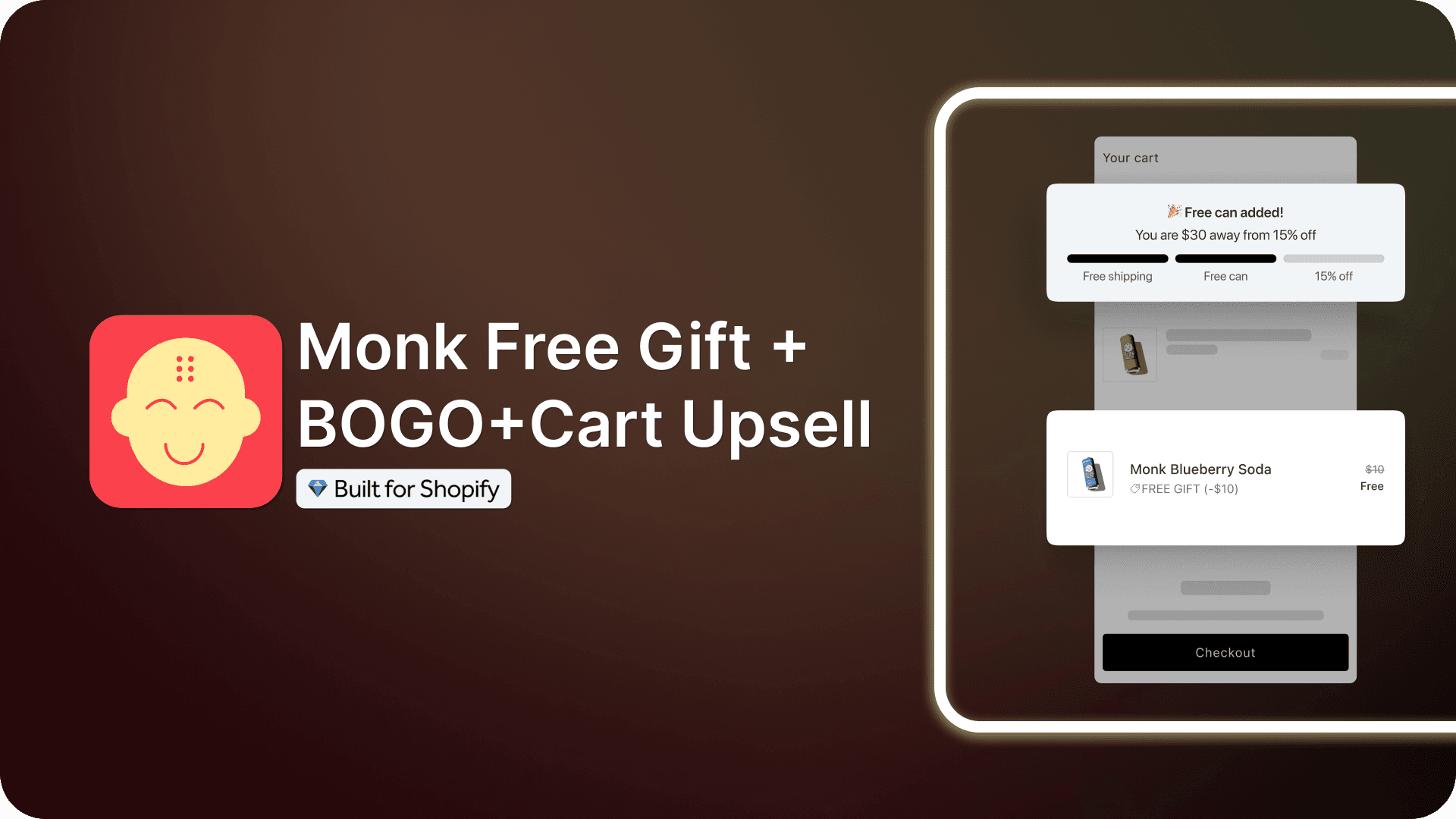
Built specifically for Shopify, Monk Free Gift + BOGO takes the complexity out of running BOGO campaigns and gives brands the flexibility to set up offers as simple or as sophisticated as their business needs require.

Here's what makes Monk Free Gift BOGO stand out:
Automatic Gift Addition to Cart: No redirects, no coupon codes, no friction. When a customer meets the BOGO condition, Monk automatically adds the free gift product to the customers' cart. The experience is seamless, and a smoother checkout experience almost always means better conversion rates.
Auto-Removal on Cart Changes: If a customer removes the qualifying product from their cart, Monk Free Gift automatically removes the free item too. It sounds like a small detail, but it keeps your offer logic clean, prevents misuse of discounts, and saves your team from having to manually sort through order discrepancies later.
Advanced Condition Layering: Beyond basic BOGO setups, Monk Free Gift, BOGO and Upsell lets you stack multiple conditions on a single offer (cart value, product count, specific products, specific collections, customer tags, and more). Want to run a BOGO offer only for returning customers with more than $50 in their cart who are buying from a specific collection? It’s done.
Highly Customizable Banners: A great offer that no one notices is wasted. This app lets you place promotional banners directly on product pages and in the cart, so customers see the BOGO deal exactly where it's most likely to influence their decision. These banners are fully customizable to match your brand's colors, fonts, and guidelines so they feel native to your store rather than bolted on.
24/5 Priority Support with Custom Fixes: Beyond the features, it backs every brand with priority support five days a week and offers custom fixes tailored to your specific store setup. If something isn't working exactly the way you need it to, their team gets it sorted.
For Shopify brands looking to run smart, flexible, and conversion-focused BOGO campaigns, Monk Free Gift + BOGO makes it genuinely easy to execute.
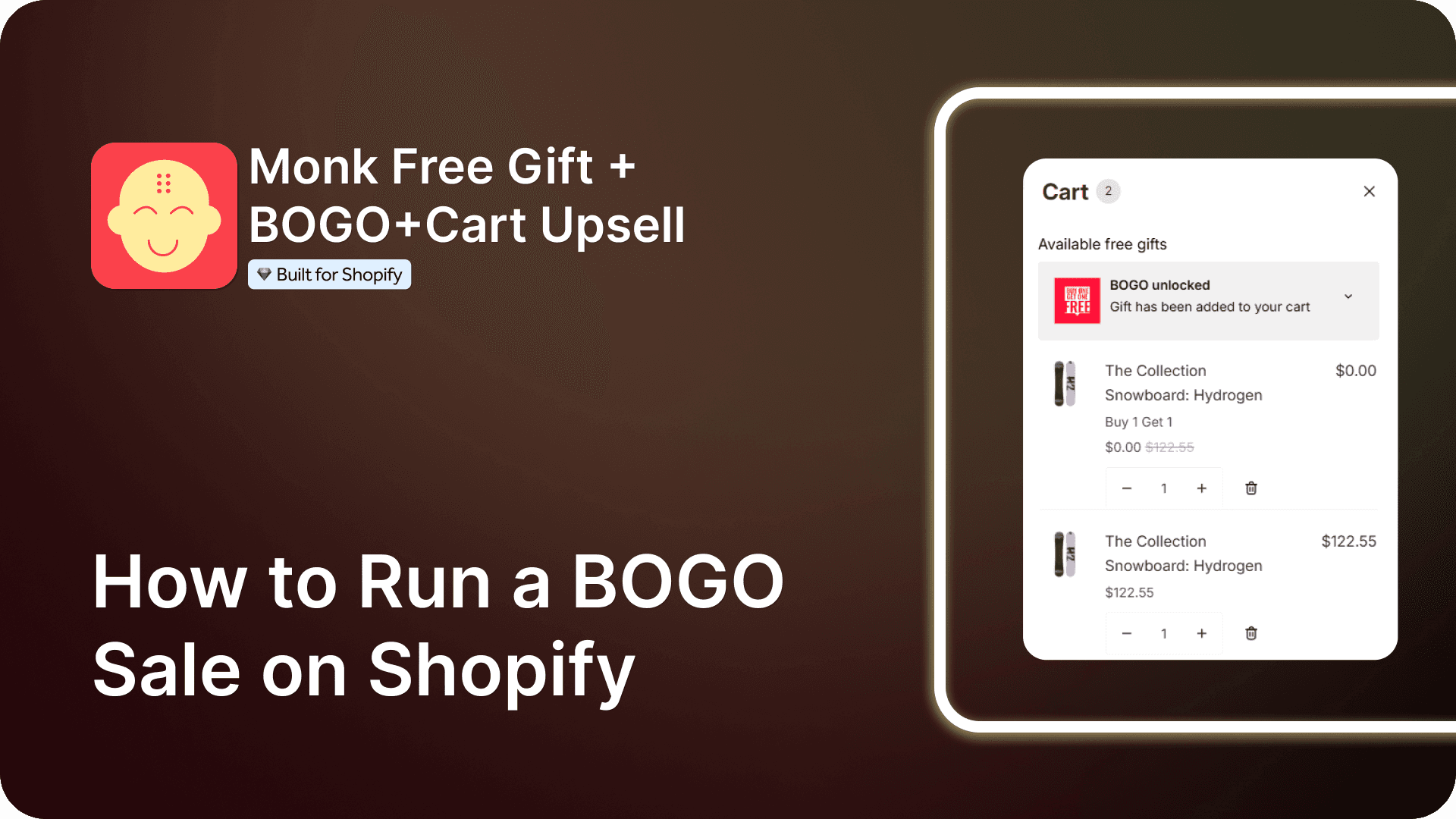
Ready to get started? Here is a detailed guide on How to Run a BOGO Sale on Shopify with Monk Free Gift + BOGO.
Turn BOGO Into Your Brand's Biggest Revenue Driver
BOGO is one of the most battle-tested strategies in ecommerce for a reason. It attracts new customers, moves inventory, increases average order value, and creates the kind of shopping experience people actually remember and come back for.
The brands that win with BOGO are the ones that plan it with intention, price it with precision, and set it up with the right tools.
Whether you're running your first BOGO campaign or looking to make your existing offers smarter and more flexible, Monk Free Gift + BOGO gives you everything you need to do it right, from automatic cart logic and advanced condition layering to on-brand banners.
Frequently Asked Questions (FAQs)
What is a BOGO strategy in ecommerce?
BOGO stands for Buy One Get One, a promotional strategy where a customer buys one product and receives another one free or at a discounted price. It is used to drive sales, move inventory, and increase average order value.
Does BOGO increase Shopify sales?
Yes. BOGO consistently drives higher conversion rates, bigger cart sizes, and more first-time purchases by giving customers a high perceived value offer that feels too good to pass up.
Is Buy One Get One profitable for online stores?
It can be, as long as your margins on the paying unit cover the cost of both units. The key is running the numbers before launch and factoring in fulfillment costs alongside product costs.
What types of BOGO offers work best in Shopify?
Buy One Get One Free drives the highest excitement, while Buy One Get One 50% Off is better for protecting margins. The right format depends on your product margins and campaign goals.
When should Shopify stores avoid BOGO promotions?
Avoid BOGO when your margins are too thin to absorb the cost of a second unit, when you run it so frequently that customers stop buying at full price, or when fulfillment costs haven't been accounted for.
How do you calculate margins for a BOGO deal?
Add the cost of both units together and subtract that from your single unit selling price. If the number is positive, your BOGO is profitable. If it isn't, consider switching to a BOGO 50% off format instead.
Can BOGO be used for subscription Shopify stores?
Yes, but strategically. The most effective use is offering a free product with a first subscription order or a free month with a longer commitment, using BOGO as an entry point rather than a recurring promotion.
How does BOGO compare to bundle pricing?
Bundling groups of products at a set price, which increases order value but feels transactional. BOGO rewards the customer for buying, which feels more like a bonus, and that emotional difference tends to drive stronger conversions.
BOGO Strategy for Shopify Stores to Boost Revenue
Summary
BOGO (Buy One Get One) is a discount strategy where customers get a second product free or at a reduced price after buying one. It is widely used in ecommerce to increase average order value, boost conversions, clear inventory, and attract new customers. Its strength lies in the psychological impact of “free,” which creates higher perceived value than standard percentage discounts. Common formats include BOGO free, BOGO 50% off, product-specific pairings, collection-based offers, and curated choice lists. It works best for inventory clearance, product launches, and seasonal campaigns but can reduce margins if overused or poorly planned. Profitability depends on ensuring selling price covers the combined cost of both units including fulfillment. BOGO is effective across DTC brands, subscription models, and marketplaces when used strategically. Compared to flat discounts, bundles, and free shipping, it generally drives stronger engagement and higher perceived value.
Today's online shoppers have one thing in common: they almost always expect a deal. Without some form of discount, even the most interested buyer will pause, second-guess, and scroll away.
But not all discounts are created equal. While a 10% off coupon barely raises an eyebrow, a Buy One Get One Free offer? That grabs attention and sends customers rushing to checkout. For Shopify stores, it's an excellent strategy to increase AOV, clear overstocked items, and build a good customer base.
In this guide, we will look at the different types of BOGO offers, how they work across different ecommerce models, and their benefits compared with other discount strategies.
What Is a BOGO Strategy in Ecommerce?
As the name suggests, the Buy One Get One strategy is when a customer buys one product and gets another one free or at a discounted price. It is among the best discounts you can offer your customers.
In fact, when it comes to discounts that actually get people buying, BOGO leads the pack, with close to 93% of American shoppers having redeemed one at least once.
While BOGO is a bonus for the customers, it serves the businesses equally well. It helps move slow inventory, increases average order value, and brings in new customers who might never have bought at full price. And lastly, it also gives your brand a reason to show up in inboxes and social feeds with something genuinely exciting to say.
Here’s why BOGO works so well:
The Word "Free" Does Magic: A 50% discount and a BOGO offer can deliver the exact same financial value on paper, but BOGO wins because "free" bypasses logic and triggers action instantly. It's only a different way to frame the offer, but it leads to better ad clicks, better email opens, and more conversions.
Increases Average Order Value: Unlike aggressive upsells and pop-ups that customers have learned to ignore, BOGO gets shoppers to spend more by giving them a genuine reward for doing so.
Clears Inventory Without Hurting Your Brand: Most Shopify stores have some products collecting dust. When you pair a slow-mover with a bestseller as the free item, customers perceive the value, and stock begins clearing.
Lowers the Barrier for First-Time Buyers: First-time customers are the hardest to convert. A BOGO offer makes trying your brand for the first time feel like an easy, low-risk decision.
Triggers Urgency Naturally: Time-limited BOGO campaigns give passive shoppers a real reason to act immediately. That deadline alone is enough to cut abandoned carts at checkout.
Types of BOGO Strategies Shopify Stores Use
When it comes to Shopify, there are several BOGO variants that businesses can use. Here’s a look at each one:
Buy One Get One Free
This is the most standard offer and also the most in the customer’s interest. There's no math to do, no conditions to decode, no "wait, how much am I actually saving?" moment. The deal is exactly what it says: buy one product, get another one completely free. For your brand, it's one of the highest-converting offer formats you can run.
For example, you run a skincare brand on Shopify selling a $30 Vitamin C serum. A customer buys one and instantly gets a second one dropped in their cart for free, walking away with $60 worth of product for half the price. |
Buy One Get One at 50% Off
Not every brand can afford to give a second unit away for free. BOGO 50% off keeps the deal compelling for customers while protecting your margins. They're still getting more for less, which is enough to drive action.
Your $30 Vitamin C serum is on a BOGO 50% off. The customer pays $30 for the first and $15 for the second, for a total of $45 instead of $60. You've moved two units and kept a healthier margin than a fully free offer would allow. |
Buy One Get One on Selected Products
This format gives a little more flexibility. You can handpick exactly which products are part of the deal. It's ideal for pairing a bestseller with a slow-moving product to clear inventory, or bundling a new launch with an existing favorite to get it in more hands.
A customer buys your $30 Vitamin C serum and gets your slow-moving $25 eye cream free. You've cleared shelf space without discounting your entire store. |
Buy One Get One from the Same Collection
A customer buys one product and gets another from the same collection for free or discounted. The focus here is different; it gets shoppers exploring your catalogue far beyond what they originally came for.
A customer buys your $30 Vitamin C serum and is prompted to pick any second product from your skincare collection for free. Suddenly, they're browsing your moisturizers, toners, and face masks they hadn't even noticed before. |
Buy One Get One Selected from a List
This BOGO discount gives the reins in your hands completely. Instead of automatically assigning the free item, you give customers a curated list to choose from. It feels personal to the customer while keeping your margins intact.
A customer buys your $30 Vitamin C serum and can choose a free item from a list you've built (a travel-size cleanser, a sample moisturizer, or lip balm). They feel catered to, and you've strategically decided every option on that list in advance. |
When BOGO Works and When It Can Hurt You
BOGO is an excellent strategy; however, it might not always be the best deal for your store. Used at the right moment, it can do wonders. Used carelessly, it can quietly drain your margins and train your customers to never buy at full price again. Here's how to tell the difference:
BOGO is the right call when:
You have excess inventory to move. If certain products are sitting unsold, BOGO is a far smarter exit than a clearance sale. You recover cost, move stock, and still deliver a premium experience to the customer.
You're launching a new product. Pairing a new product as the free item alongside a bestseller gets it into customers' hands without requiring them to take a chance on something unfamiliar.
You want to acquire new customers. High perceived value makes BOGO one of the most effective top-of-funnel offers for cold audiences who don't know your brand yet.
You're running a seasonal campaign. Holidays, flash sales, and peak shopping seasons are natural windows for BOGO because customers are already in buying mode, and the offer adds just enough push to close the deal.
But BOGO can hurt you when:
Your margins are too thin. If your profit on a single unit barely covers costs, giving a second one away, even partially, can turn a busy sales week into a losing one. Always run the numbers before going live.
You run it too often. If your store runs BOGO every other week, full price starts to feel like the wrong price. Over time, this erodes perceived value and makes it harder to sell without a promotion attached.
The wrong products are paired together. A poorly thought-out BOGO pairing can move products you didn't need to discount while doing nothing for the products that actually need a push.
You haven't accounted for fulfillment costs. Two units mean double the packaging, double the shipping weight, and potentially higher return rates. If those costs aren't considered in your pricing, your margins take a hit.
Always keep in mind that BOGO rewards brands that plan it with intention. If you don’t plan it right and analyse your performance, it can become a problem before you know it.
How to Calculate Profitable BOGO Pricing Before launching any BOGO offer, the math needs to make sense. Here's a quick way to know if your offer is profitable before it goes live: BOGO Formula: Revenue from BOGO Sale = Single Unit Selling Price Total Cost = Cost of Unit 1 + Cost of Unit 2 For your BOGO to be profitable, your single unit selling price must exceed the combined cost of both units. Single Unit Selling Price > Total Cost
Selling price of Vitamin C serum: $30 Cost per unit: $10 Combined cost of two units: $20 Profit per BOGO transaction: $10 |
BOGO Strategy for Different Ecommerce Models
At this point, you know what BOGO can do for your business and where to draw the line. But before you set up your first offer, there's something worth pausing on: not every ecommerce model gets the same results from BOGO.
How you sell, who you sell to, and how your revenue is structured all change the equation. Here's how BOGO plays out across three different ecommerce models:
DTC Brands
For direct-to-consumer brands, BOGO is one of the most effective tools in the arsenal simply because DTC brands live and die by customer acquisition costs. Paid ads are expensive, competition is fierce, and getting a first-time buyer to trust a brand they've never heard of is hard.
A BOGO offer cuts through all of that. It gives a cold audience a compelling enough reason to take the leap, try the product, and enter your ecosystem.
Beyond acquisition, BOGO works brilliantly for DTC brands as a retention play too. A well-timed BOGO email to customers who haven't purchased in 60 or 90 days can bring them back far more effectively than a standard discount ever would.
Subscription-Based Stores
For subscription stores, BOGO needs to be approached a little more thoughtfully, but when it's done right, the results are significant. The most effective way to use BOGO here is as an entry point.
Offer a free product alongside the first subscription box, or give a free month when a customer commits to a three-month plan. It immediately makes the subscription feel like a better deal without permanently reducing the price.
The key thing subscription brands need to watch out for is running BOGO too aggressively on standalone purchases. If customers can get two products for the price of one without subscribing, the incentive to commit to a subscription weakens. Use it to pull people into the subscription, not away from it.
Multi-Vendor Marketplaces
Running BOGO on a multi-vendor marketplace is a different game entirely because you're not just thinking about your own margins; you're thinking about how the offer works across multiple sellers.
The smartest approach here is to run BOGO at a vendor level rather than a platform-wide level, giving individual sellers the flexibility to opt in based on their own margins and inventory goals.
When done this way, BOGO becomes a competitive tool within the marketplace itself. Vendors who run it get more visibility, better placement, and higher conversion rates, which in turn drives more traffic to the platform overall.
BOGO vs. Other Ecommerce Discount Strategies
If you are still confused between the different discount options compared with BOGO, here we will compare all of them side by side so you can truly see the value of BOGO offers:
BOGO vs. Flat Discounts
Flat discounts are simple: take 10%, 20%, or 30% off and call it a day. While flat discounts reduce the price of what a customer already wants to buy, BOGO adds value on top of it. One makes your product cheaper, the other makes the deal bigger.
There's a meaningful difference in how customers respond to each, and BOGO almost always wins on perceived value.
BOGO vs. Bundling
Bundling groups multiple products together at a combined price, which works well for increasing order value. The difference is that bundling tells the customer what they're getting, while BOGO gives them a reward for buying.
Bundling can feel transactional, but BOGO feels like a bonus, and that emotional difference matters.
BOGO vs. Free Shipping
Free shipping has become almost expected in ecommerce at this point so much so that it barely moves the needle as a standalone incentive anymore. BOGO, on the other hand, still feels like a genuine win every time.
That said, free shipping has its place as a low-friction add-on that removes a purchase barrier, while BOGO actively creates a purchase motivation.
At the end of the day, flat discounts, bundling, and free shipping all have their place, but none of them combine customer excitement, inventory movement, and order value growth quite like BOGO does.
Running smarter BOGO campaigns using Monk
Setting up a BOGO offer sounds straightforward until you're actually in it. It can be a challenge to juggle conditions, manage cart logic, and make sure the right products show up for the right customers.
That's exactly where Monk Free Gift BOGO comes in.
Built specifically for Shopify, Monk Free Gift + BOGO takes the complexity out of running BOGO campaigns and gives brands the flexibility to set up offers as simple or as sophisticated as their business needs require.
Here's what makes Monk Free Gift BOGO stand out:
Automatic Gift Addition to Cart: No redirects, no coupon codes, no friction. When a customer meets the BOGO condition, Monk automatically adds the free gift product to the customers' cart. The experience is seamless, and a smoother checkout experience almost always means better conversion rates.
Auto-Removal on Cart Changes: If a customer removes the qualifying product from their cart, Monk Free Gift automatically removes the free item too. It sounds like a small detail, but it keeps your offer logic clean, prevents misuse of discounts, and saves your team from having to manually sort through order discrepancies later.
Advanced Condition Layering: Beyond basic BOGO setups, Monk Free Gift, BOGO and Upsell lets you stack multiple conditions on a single offer (cart value, product count, specific products, specific collections, customer tags, and more). Want to run a BOGO offer only for returning customers with more than $50 in their cart who are buying from a specific collection? It’s done.
Highly Customizable Banners: A great offer that no one notices is wasted. This app lets you place promotional banners directly on product pages and in the cart, so customers see the BOGO deal exactly where it's most likely to influence their decision. These banners are fully customizable to match your brand's colors, fonts, and guidelines so they feel native to your store rather than bolted on.
24/5 Priority Support with Custom Fixes: Beyond the features, it backs every brand with priority support five days a week and offers custom fixes tailored to your specific store setup. If something isn't working exactly the way you need it to, their team gets it sorted.
For Shopify brands looking to run smart, flexible, and conversion-focused BOGO campaigns, Monk Free Gift + BOGO makes it genuinely easy to execute.
Ready to get started? Here is a detailed guide on How to Run a BOGO Sale on Shopify with Monk Free Gift + BOGO.
Turn BOGO Into Your Brand's Biggest Revenue Driver
BOGO is one of the most battle-tested strategies in ecommerce for a reason. It attracts new customers, moves inventory, increases average order value, and creates the kind of shopping experience people actually remember and come back for.
The brands that win with BOGO are the ones that plan it with intention, price it with precision, and set it up with the right tools.
Whether you're running your first BOGO campaign or looking to make your existing offers smarter and more flexible, Monk Free Gift + BOGO gives you everything you need to do it right, from automatic cart logic and advanced condition layering to on-brand banners.
Frequently Asked Questions (FAQs)
What is a BOGO strategy in ecommerce?
BOGO stands for Buy One Get One, a promotional strategy where a customer buys one product and receives another one free or at a discounted price. It is used to drive sales, move inventory, and increase average order value.
Does BOGO increase Shopify sales?
Yes. BOGO consistently drives higher conversion rates, bigger cart sizes, and more first-time purchases by giving customers a high perceived value offer that feels too good to pass up.
Is Buy One Get One profitable for online stores?
It can be, as long as your margins on the paying unit cover the cost of both units. The key is running the numbers before launch and factoring in fulfillment costs alongside product costs.
What types of BOGO offers work best in Shopify?
Buy One Get One Free drives the highest excitement, while Buy One Get One 50% Off is better for protecting margins. The right format depends on your product margins and campaign goals.
When should Shopify stores avoid BOGO promotions?
Avoid BOGO when your margins are too thin to absorb the cost of a second unit, when you run it so frequently that customers stop buying at full price, or when fulfillment costs haven't been accounted for.
How do you calculate margins for a BOGO deal?
Add the cost of both units together and subtract that from your single unit selling price. If the number is positive, your BOGO is profitable. If it isn't, consider switching to a BOGO 50% off format instead.
Can BOGO be used for subscription Shopify stores?
Yes, but strategically. The most effective use is offering a free product with a first subscription order or a free month with a longer commitment, using BOGO as an entry point rather than a recurring promotion.
How does BOGO compare to bundle pricing?
Bundling groups of products at a set price, which increases order value but feels transactional. BOGO rewards the customer for buying, which feels more like a bonus, and that emotional difference tends to drive stronger conversions.
Ravish (RV)
Co-Founder, Monk Commerce
Ravish is an ecommerce and SaaS marketing expert with 6+ years of experience in Shopify and ecommerce and 10+ years of experience in marketing, and growth strategy. He has worked closely with Shopify merchants to solve real ecommerce challenges and shares practical, research-backed insights, industry best practices, and emerging trends.
Contents
Related Articles
How to Set Up BOGO Offers on Shopify (Step-by-Step Guide)
How to Run a Profitable Buy One Get One Free (BOGO) Campaign in 2026
How to Run a BOGO Sale on Shopify
Get Monk Free Gift app for just $1/month this Black Friday
First month: $1 after your 7-day free trial. All features included. Offer live!
Claim offer now

Get Monk Free Gift app for just $1/month this Black Friday
First month: $1 after your 7-day free trial. All features included. Offer live!
Claim offer now
Get Monk Free Gift app for just $1/month this Black Friday
First month: $1 after your 7-day free trial. All features included. Offer live!
Claim offer now