How to Run a Profitable Buy One Get One Free (BOGO) Campaign in 2026
Feb 23, 2026
BOGO offers are a quick way to jumpstart sales, move inventory that's been sitting around, and draw in customers who are looking for a good deal.
From straightforward Buy X Get Y promotions to more complex Buy One Get One offers on Shopify, the right example can significantly boost conversions.
This guide explores various buy-one-get-one (BOGO) promotions and offers insights on how Shopify businesses may leverage them to boost their average order value.
What is the Buy One Get One Free Campaign?
Buy One Get One (BOGO) Free promotions are essentially offers for customers to buy a product from the store and get another item, either for free or at a reduced price. These offers aim to increase sales by creating a sense of value for shoppers.
For example,
A clothing retailer runs a "Buy 1 T-shirt, Get 1 Free" campaign. When a customer pays $50 for a T-shirt, they receive an additional one without any conditions!
These BOGO deals are a useful tool. They can boost the average order size, help clear out stock, and draw in bargain hunters. That's why they're a go-to sales tactic for both online and retail shops.
Industries where BOGO campaigns work the best
BOGO promotions do not work equally for every business. They perform best on Shopify stores that sell repeatable, complementary, or bundle-friendly products.
Since many Shopify brands operate on a DTC model, the key is aligning the BOGO structure with product type, purchase behavior, and margin capacity rather than applying it universally.
Here are the industries where BOGO campaigns are highly effective.
1. Beauty, Skincare & Personal Care Brands
This category responds well to BOGO because products are frequently repurchased and easy to bundle. Strong repeat purchase behavior makes promotional offers sustainable and scalable.
2. Apparel & Fashion Stores
Fashion brands use BOGO to encourage multi-item purchases and manage inventory efficiently. It works particularly well for essentials and accessories where customers are comfortable buying more than one item.
3. Health, Supplements & Wellness Brands
These products are often purchased in cycles, making them suitable for stock-up style promotions. With proper margin planning, BOGO campaigns can drive both acquisition and repeat purchases.
4. Home, Kitchen & Everyday Essentials
Practical household products lend themselves naturally to multi-unit buying. Customers are typically open to purchasing additional quantities when incentivized.
5. Print-on-Demand & Custom Products (Selective Use)
BOGO can work selectively in this space, provided margins allow flexibility. Structured variations are often more sustainable than aggressive discounting.
When BOGO Does Not Work Well on Shopify
BOGO is usually not suitable for:
High-ticket electronics
Luxury or premium brands
Highly customized products
Stores with already thin margins
In these cases, value-based bundles or tiered discounts may perform better than straight BOGO.
Planning a BOGO Campaign (Pre-Setup)
Before setting up a BOGO offer in Shopify, define the structure clearly. A promotion without margin planning can reduce profit instead of increasing revenue.
Define the Goal:
Choose one primary objective:
Increase order volume
Clear slow-moving inventory
Acquire new customers
Increase average order value
Your goals will influence both the choice of products and the strength of your campaign.
Select the Right Products:
BOGO performs best on:
High-margin products
Overstocked inventory
Low-cost add-ons
Review gross margin before finalizing. A “Buy 1 Get 1 Free” has a higher cost impact than “Buy 1 Get 1 at 50% Off.”
Ensure sufficient stock for both qualifying and free items.
Set Clear Eligibility Rules
Define the structure upfront:
What product qualifies
Whether the free item is fixed or selectable
Usage limits per order or customer
Whether discounts can stack
If needed, add a minimum cart value to protect margins. Clear rules reduce misuse and support issues.
Validate Profitability
Calculate the total promotional cost, including:
Cost of goods (free items included)
Shipping and fulfillment
Payment processing fees
Estimate expected redemption volume and confirm margins remain sustainable
Set a review checkpoint to evaluate performance mid-campaign
Step-by-Step Setup of a BOGO Deal
A Buy One Get One (BOGO) deal is a terrific method to get people to buy from you, but only if you do it right. From thinking out why you charge what you do to testing before you launch, every step is critical to keep consumers happy and prevent losing money. Most e-commerce platforms, such as Shopify, let you make BOGO deals with built-in discounts or discounts that you may add yourself. The goal is to have the offer work automatically and smoothly at checkout.
Make a rule that automatically offers a bargain or sale.
Choosing the right groupings or products, putting two products in the cart, is what sets the offer off.
Setting up the prize, which is a free thing or a discount
You can choose to add the free item automatically, but it's a good idea to do so.
To cut down on drop-offs, make the bargain easy to find on product pages and in the cart.
This is a step-by-step approach on putting up a seamless and profitable BOGO deal in both via Shopify and third-party apps.
Method 1 : Setting up BOGO deals on Shopify
Shopify doesn't have a real BOGO option, but you can construct one with native automatic discounts. In case you want the customer to enter the code at checkout manually to avail the BOGO offer, you can select the ‘discount code’ option.
Steps:
In Shopify Admin > Discounts > Create discount
Select ‘Buy X and Get Y’
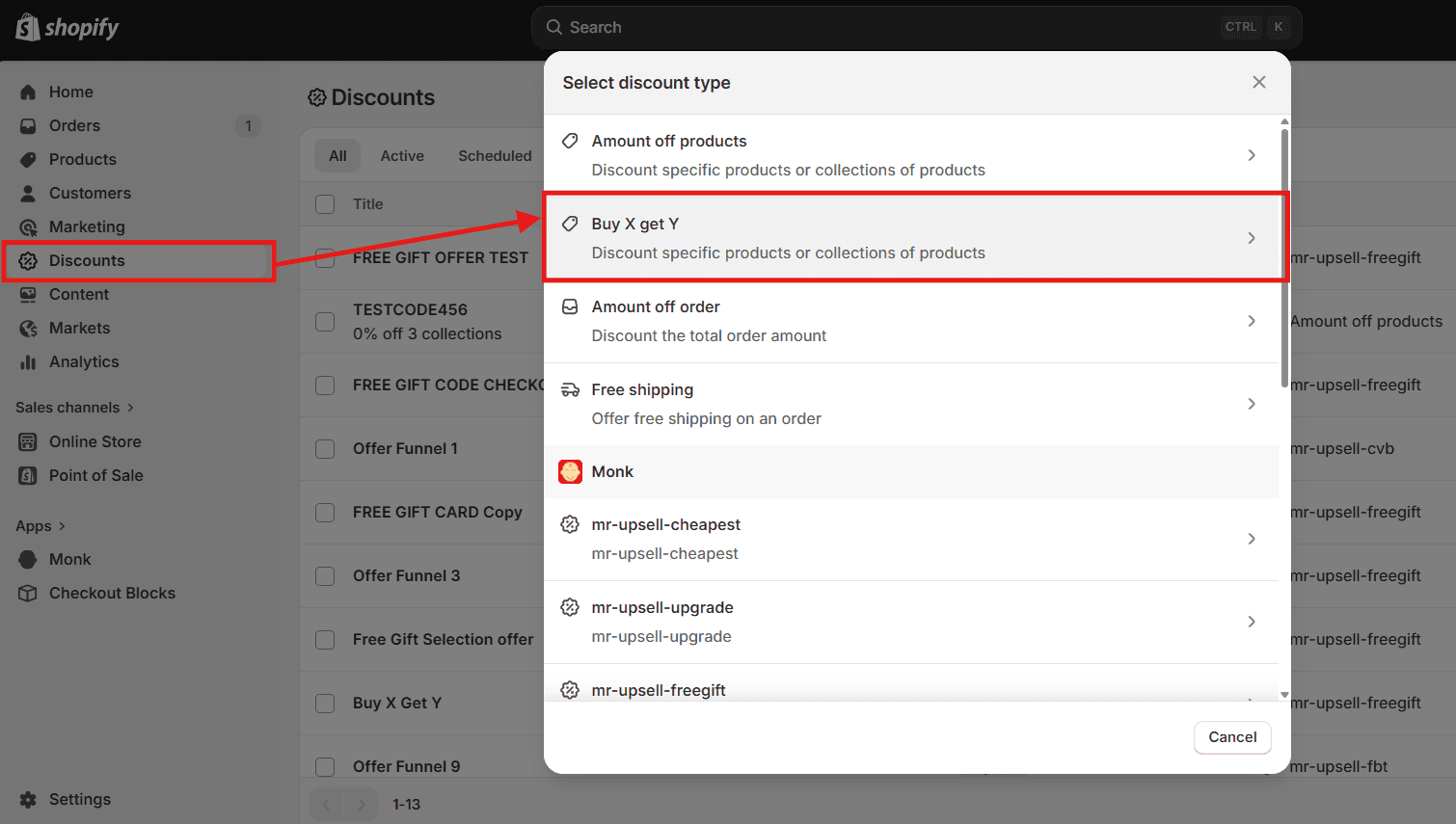
As you’re setting up a BOGO offer, it’s preferable to select both Product X, a.k.a., the trigger product, and Product Y, a.k.a., the gift product, as the same. However, you can also choose different products as X and Y, which will be similar to a Free Gift with Purchase on Shopify.
For the gift item to be ‘free,’ set the price to zero.
You can also set limits on how many times a customer can use the BOGO offer.
Set start and end dates, if applicable.
Save the offer and don’t forget to test before promoting.
Limitations:
Doesn’t support complex offer campaigns, advanced rules, funnels or progress bars
Gifts don’t get automatically added to the cart.
Basic reports and analysis
Method 2: Use a third-party BOGO app
Shopify App Store provides merchants with a wide range of third-party apps that overcome the limitations related to Shopify Free Gifting.
Third-party BOGO apps like Monk Free Gift and BOGO give you more control over the setup, a better user experience, automation, and thorough analytics.
Why Should You Choose Monk?
It automatically adds the gift product to the cart when the BOGO condition is justified.
You can choose to remove the gift product automatically upon any changes to the cart.
A complex BOGO setup can easily be done using Monk by adding an extra layer of conditions such as cart value, product count, specific products, specific collections, customer tags, etc.
To make the offers highly visible, you can leverage banners using Monk by placing them on the product pages and in the cart. These banners are highly customizable to suit your brand guidelines and colors.
24/5 priority support along with custom fixes for your store.

Steps to set up a BOGO offer using Monk Free Gift and BOGO:
Download the app from the Shopify App Store.
Enable the app and click on ‘Create New Offer."
Select the BOGO template, 'Buy X, get more of the same item for free,' to set up the offer
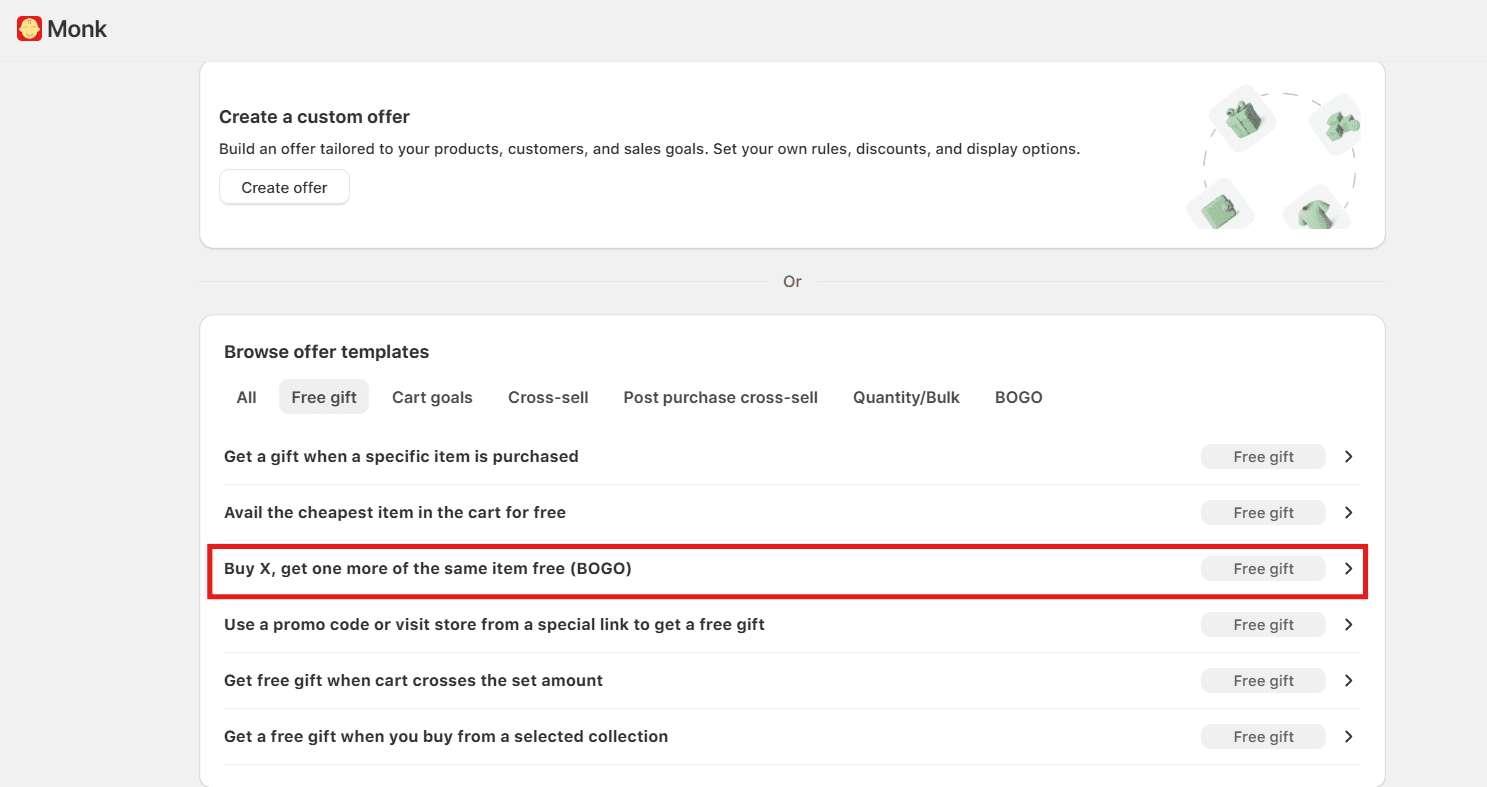
There are 2 parts to creating an offer inside Monk
Part 1: Set offer rules and placement
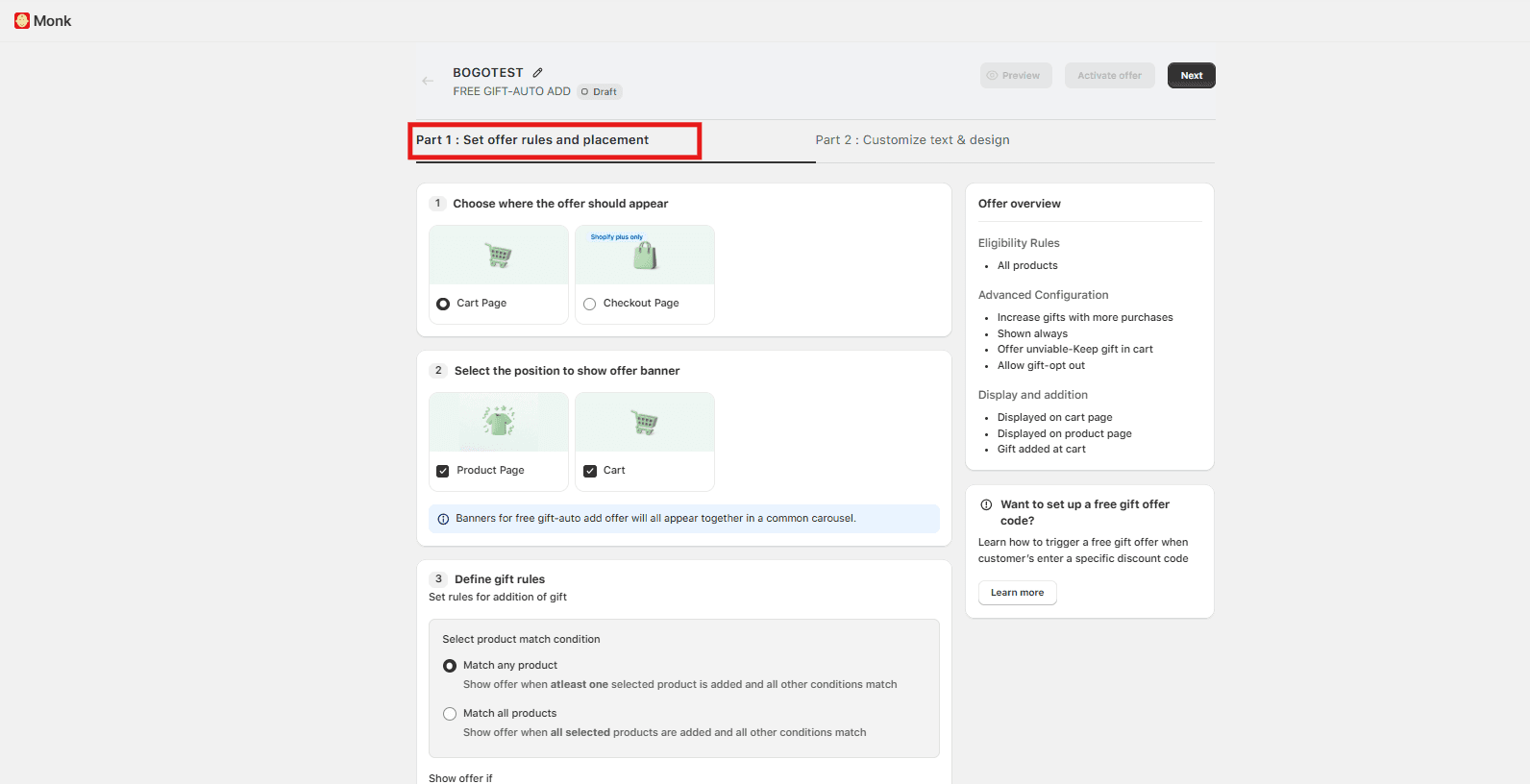
Select whether you want the gift product to be added in the cart or in the checkout (Shopify plus only)
Select whether you want to showcase banners and where.
Define the gift rules and products according to your BOGO strategy
Under ‘Offer Settings,' you can find more advanced options like auto-removing the gift and manual opting out, increasing gift quantity with more purchases, and setting a maximum gift limit.
Note:
Offers created in Monk can be combined with other discounts
You can set start and end dates for offers, if applicable.
Part 2: Customize Text & Design:
Monk is highly customizable to blend seamlessly with your store. You can edit the text, font and color of the banner to clearly notify the customers of the offer.
Click on "activate offer" and test out the offer in your live store.
Executing the BOGO Campaign Effectively
You cannot launch a BOGO campaign without planning beforehand. When executed properly BOGO campaigns can contribute to driving the Average Order Value (AOV) of your Shopify store.
Timing, messaging, and operational readiness directly affect customer experience and profitability.
Launch timing and duration
Your BOGO offer should launch during high-shopping periods such as weekends, paydays, holidays, or major sale events. Align the campaign with moments of strong buyer intent to maximize participation.
Keep the campaign short, ideally three to seven days, to create urgency and protect profitability. Test shorter campaigns first before extending the duration.
Use countdown timers and clear deadlines to encourage faster purchase decisions. Urgency often improves conversion rates.
Promotion channels (email, website banners, ads, push notifications)
Your BOGO offer should be promoted across multiple channels for maximum visibility. Consistent messaging strengthens trust and brand recall.
Use email campaigns to announce the launch and send reminders before the offer ends. Highlight the deal through homepage banners, product page placements, paid ads, and push notifications to capture both new and returning customers.
Clear messaging to avoid confusion
Confusing conditions lead to cart abandonment and support queries.
Use banners and pop-ups to notify customers clearly about the offers. Customers should instantly understand how the offer works.
Clearly state eligible products, whether the free item is auto-added or manually selected, and any order or customer limits. Mention if the discount applies only to items of equal or lesser value.
Coordinating inventory and fulfillment
BOGO campaigns can rapidly increase order volume. Without preparation, stockouts and delays can harm your brand reputation.
Forecast inventory for both purchased and free items, apply stock limits if needed, and coordinate with fulfillment teams in advance. Smooth operations ensure customer satisfaction and margin protection.
Optimizing Performance During the Campaign
Ensuring a campaign performs well after launch is just as important as planning it. Real-time monitoring and quick decision-making help protect margins and maximize results.
Monitoring sales and redemption rates
Do not rely only on total revenue to measure success. Track how many customers are redeeming the offer, daily order volume, average order value, product performance, and channel-level conversions.
This analysis shows whether the campaign is generating incremental sales or simply shifting existing demand.
Adjusting stock and messaging in real time
Promotions can change buying patterns quickly, so active monitoring is essential. If stock runs low, restock promptly or adjust the qualifying product to prevent disruption.
If customers seem confused, simplify the messaging immediately to reduce friction. Highlight best-performing products more prominently and reinforce urgency with limited-stock messaging where appropriate.
Small adjustments during the campaign can significantly improve overall performance.
Preventing misuse or loopholes
Some customers may attempt to exploit discount stacking or place bulk orders to maximize the benefit. Setting clear limits per customer or per order helps control risk.
Disable unnecessary discount combinations and monitor unusual purchasing patterns. Reviewing suspicious orders early can prevent revenue leakage.
Customer support readiness
Promotions typically increase support volume, so the team must fully understand the offer structure. They should know the eligibility criteria, how the reward is applied, and how to resolve checkout issues quickly.
Clear communication and fast resolution maintain trust, even during high-traffic sales periods.
Common Execution Mistakes to Avoid
Running a BOGO deal can help sales, but if something goes wrong, it can quickly hurt sales, stock, and customer happiness. These mistakes are easy to make and can negatively impact your advertising, customer satisfaction, and overall business goals:
Going live without trying the offer at checkout: Always do test orders before going live to make sure the prices are right and the free item works correctly.
Customers will leave their carts or call customer service if they don't understand how the BOGO works or if your product or cart message is unclear. Things are easier to understand when signs and cart messages are clear.
Free items can sell out quickly if you don't keep track of their stock. If you sell too many free items, you might need to cancel orders, which could damage your customer's trust.
Limit each customer or order: Otherwise, customers may take advantage of the deal, which could cost you money and stock.
Stacking discounts that cut into profits: If you let BOGO offers work with other discounts, you might have twice as many deals, which could hurt your results.
Promoting before the fulfillment teams are ready: The warehouse and packing teams should be told ahead of time so they can handle sudden orders without any problems.
Monitoring real-time sales and redemption data is critical to improving the effectiveness of your marketing messages, items, and stock.
Customer service responses may be slow at busy times: If you don't answer BOGO-related questions quickly, customers may leave their carts and leave bad reviews.
Measuring Results and Post-Campaign Analysis
After your BOGO sale ends, the real learning begins. Shopify sellers may employ post-campaign research to find out what worked and what didn't. They can then use that information to improve future promotions. You can make smarter marketing decisions by looking at factors like how well your sales are doing, how customers act, and how your business runs.
Things to Keep in Mind:
Total income and growth: To see how much the BOGO deal really benefited, look at how much money the campaign made compared to your baseline.
The rate at which people use their coupons: To see how enticing the bargain is, compare the number of consumers who used the BOGO offer to the number of customers who merely bought ordinary goods.
The average cost of an order: Find out if BOGO sales made the basket bigger or if they just took the place of full-price promotions.
How the item works: To make better choices in the future, find out which products led to conversions and which ones didn't function well.
Getting new consumers or getting them to buy from you again: Separate new consumers from recurring customers to see how long-term growth may affect the firm.
Profit margin: To find out how profitable your campaign truly is, you need to think about things like free items, offers, delivery, and ad spending.
What happens when you have too much inventory: To detect problems with overselling or bottlenecks, look at the amount of stock and how quickly orders are filled.
Customer reviews and help tickets: Find questions or issues that come up a lot so you may build on your communication and work next time.
Final Thoughts
Buy-one-get-one (BOGO) promotions can function as a powerful sales and marketing tool when executed with strategic insight. While these offers effectively enhance conversions, promote inventory turnover, and attract new customers, their implementation requires careful planning to protect both profitability and brand equity. When BOGO deals align with clearly defined business objectives, they can yield substantial advantages for both the retailer and the consumer.
Frequently Asked Questions
How do I set up a BOGO deal in Shopify?
The setup can be done on Shopify either by using their built-in discount feature or through third-party BOGO apps like Monk Free Gift + BOGO, which provide more features like banners, progress bars, and funnel-based offers along with better display customizations for running BOGO promotions seamlessly.
Which product works best for a BOGO campaign?
For a BOGO promotion on Shopify, the best products are usually everyday things that are cheaper, have a high profit margin, and encourage repeat purchases or stocking up.
For example:
Skin care products, supplements, accessories (like socks or phone cases), or slow-moving inventory that you want to get rid of.
These sell great in pairs, and the buy one, get one deal feels like a true deal without affecting your bottom line.
Should I offer “BOGO” or a percentage discount?
BOGO or a percentage discount depends on your gifting strategy and the products you sell.
A BOGO deal is the best way to get rid of extra stock, raise the average order value, or push items that sell well when bought together. This is because customers feel like they are getting more value.
You should use a percentage price, like 20% off, for storewide sales or items that cost more and have lower profit margins.
How do I prevent customers from misusing BOGO offers?
To stop Shopify BOGO offer abuse, be clear about your BOGO strategy, what needs to be bought, and how many times a customer can use the deal (for example, only once per customer).
Use automatic discounts instead of manual codes to stop people from stacking them.
When using third-party BOGO apps like Monk, enable auto-add with validation, cart rules, and automated item removal if conditions aren't met.
Can BOGO offers hurt profit margins?
Yes, if not structured carefully. Giving a free or discounted product increases perceived value, but it also reduces profit per order.
If your margins are already tight, high redemption rates can quickly impact overall profitability. However, BOGO can work for high-margin products, slow-moving inventory, or bundled items.
Before launching the offer, calculate your product cost, shipping cost, and expected discount impact. A simple margin check upfront helps prevent losses later.
How long should a BOGO campaign run?
Depending on your goal, a BOGO promotion should last between three and fourteen days.
Short BOGO campaigns (3–7 days) make people feel like they need to act quickly and get things done, which is great for flash sales or clearing out inventory.
Longer BOGO campaigns (10–14 days) are great for product launches or seasonal sales when you need to keep your brand in front of people.
Don't run BOGO deals for too long, because customers can grow to expect the discount, which could make the product seem less valuable.
Is BOGO better for acquiring new customers or clearing inventory?
BOGO can work for both acquiring new customers and clearing inventory depending on the strategy.
It usually works well for getting rid of stock, especially slow-moving or overstocked items, as it quickly boosts cart size and volume.
But if you market it as a limited-time, high-value deal through commercials or email campaigns, it can also help you get new customers.
If you want to sell stock quickly, BOGO is the way to go. If you want to gain new consumers, combine BOGO with effective marketing and a tiered gifting to get the most out of it.
How do I measure if my BOGO campaign is successful?
Monitor key factors of the BOGO offer in Shopify, such as total sales, incremental revenue, average order value (AOV), redemption rate, gross margin impact, and overall conversion rate.
A third-party BOGO app like Monk can give you more accurate data to measure your BOGO campaign growth.
How to Run a Profitable Buy One Get One Free (BOGO) Campaign in 2026
Feb 23, 2026
BOGO offers are a quick way to jumpstart sales, move inventory that's been sitting around, and draw in customers who are looking for a good deal.
From straightforward Buy X Get Y promotions to more complex Buy One Get One offers on Shopify, the right example can significantly boost conversions.
This guide explores various buy-one-get-one (BOGO) promotions and offers insights on how Shopify businesses may leverage them to boost their average order value.
What is the Buy One Get One Free Campaign?
Buy One Get One (BOGO) Free promotions are essentially offers for customers to buy a product from the store and get another item, either for free or at a reduced price. These offers aim to increase sales by creating a sense of value for shoppers.
For example,
A clothing retailer runs a "Buy 1 T-shirt, Get 1 Free" campaign. When a customer pays $50 for a T-shirt, they receive an additional one without any conditions!
These BOGO deals are a useful tool. They can boost the average order size, help clear out stock, and draw in bargain hunters. That's why they're a go-to sales tactic for both online and retail shops.
Industries where BOGO campaigns work the best
BOGO promotions do not work equally for every business. They perform best on Shopify stores that sell repeatable, complementary, or bundle-friendly products.
Since many Shopify brands operate on a DTC model, the key is aligning the BOGO structure with product type, purchase behavior, and margin capacity rather than applying it universally.
Here are the industries where BOGO campaigns are highly effective.
1. Beauty, Skincare & Personal Care Brands
This category responds well to BOGO because products are frequently repurchased and easy to bundle. Strong repeat purchase behavior makes promotional offers sustainable and scalable.
2. Apparel & Fashion Stores
Fashion brands use BOGO to encourage multi-item purchases and manage inventory efficiently. It works particularly well for essentials and accessories where customers are comfortable buying more than one item.
3. Health, Supplements & Wellness Brands
These products are often purchased in cycles, making them suitable for stock-up style promotions. With proper margin planning, BOGO campaigns can drive both acquisition and repeat purchases.
4. Home, Kitchen & Everyday Essentials
Practical household products lend themselves naturally to multi-unit buying. Customers are typically open to purchasing additional quantities when incentivized.
5. Print-on-Demand & Custom Products (Selective Use)
BOGO can work selectively in this space, provided margins allow flexibility. Structured variations are often more sustainable than aggressive discounting.
When BOGO Does Not Work Well on Shopify
BOGO is usually not suitable for:
High-ticket electronics
Luxury or premium brands
Highly customized products
Stores with already thin margins
In these cases, value-based bundles or tiered discounts may perform better than straight BOGO.
Planning a BOGO Campaign (Pre-Setup)
Before setting up a BOGO offer in Shopify, define the structure clearly. A promotion without margin planning can reduce profit instead of increasing revenue.
Define the Goal:
Choose one primary objective:
Increase order volume
Clear slow-moving inventory
Acquire new customers
Increase average order value
Your goals will influence both the choice of products and the strength of your campaign.
Select the Right Products:
BOGO performs best on:
High-margin products
Overstocked inventory
Low-cost add-ons
Review gross margin before finalizing. A “Buy 1 Get 1 Free” has a higher cost impact than “Buy 1 Get 1 at 50% Off.”
Ensure sufficient stock for both qualifying and free items.
Set Clear Eligibility Rules
Define the structure upfront:
What product qualifies
Whether the free item is fixed or selectable
Usage limits per order or customer
Whether discounts can stack
If needed, add a minimum cart value to protect margins. Clear rules reduce misuse and support issues.
Validate Profitability
Calculate the total promotional cost, including:
Cost of goods (free items included)
Shipping and fulfillment
Payment processing fees
Estimate expected redemption volume and confirm margins remain sustainable
Set a review checkpoint to evaluate performance mid-campaign
Step-by-Step Setup of a BOGO Deal
A Buy One Get One (BOGO) deal is a terrific method to get people to buy from you, but only if you do it right. From thinking out why you charge what you do to testing before you launch, every step is critical to keep consumers happy and prevent losing money. Most e-commerce platforms, such as Shopify, let you make BOGO deals with built-in discounts or discounts that you may add yourself. The goal is to have the offer work automatically and smoothly at checkout.
Make a rule that automatically offers a bargain or sale.
Choosing the right groupings or products, putting two products in the cart, is what sets the offer off.
Setting up the prize, which is a free thing or a discount
You can choose to add the free item automatically, but it's a good idea to do so.
To cut down on drop-offs, make the bargain easy to find on product pages and in the cart.
This is a step-by-step approach on putting up a seamless and profitable BOGO deal in both via Shopify and third-party apps.
Method 1 : Setting up BOGO deals on Shopify
Shopify doesn't have a real BOGO option, but you can construct one with native automatic discounts. In case you want the customer to enter the code at checkout manually to avail the BOGO offer, you can select the ‘discount code’ option.
Steps:
In Shopify Admin > Discounts > Create discount
Select ‘Buy X and Get Y’
As you’re setting up a BOGO offer, it’s preferable to select both Product X, a.k.a., the trigger product, and Product Y, a.k.a., the gift product, as the same. However, you can also choose different products as X and Y, which will be similar to a Free Gift with Purchase on Shopify.
For the gift item to be ‘free,’ set the price to zero.
You can also set limits on how many times a customer can use the BOGO offer.
Set start and end dates, if applicable.
Save the offer and don’t forget to test before promoting.
Limitations:
Doesn’t support complex offer campaigns, advanced rules, funnels or progress bars
Gifts don’t get automatically added to the cart.
Basic reports and analysis
Method 2: Use a third-party BOGO app
Shopify App Store provides merchants with a wide range of third-party apps that overcome the limitations related to Shopify Free Gifting.
Third-party BOGO apps like Monk Free Gift and BOGO give you more control over the setup, a better user experience, automation, and thorough analytics.
Why Should You Choose Monk?
It automatically adds the gift product to the cart when the BOGO condition is justified.
You can choose to remove the gift product automatically upon any changes to the cart.
A complex BOGO setup can easily be done using Monk by adding an extra layer of conditions such as cart value, product count, specific products, specific collections, customer tags, etc.
To make the offers highly visible, you can leverage banners using Monk by placing them on the product pages and in the cart. These banners are highly customizable to suit your brand guidelines and colors.
24/5 priority support along with custom fixes for your store.
Steps to set up a BOGO offer using Monk Free Gift and BOGO:
Download the app from the Shopify App Store.
Enable the app and click on ‘Create New Offer."
Select the BOGO template, 'Buy X, get more of the same item for free,' to set up the offer
There are 2 parts to creating an offer inside Monk
Part 1: Set offer rules and placement
Select whether you want the gift product to be added in the cart or in the checkout (Shopify plus only)
Select whether you want to showcase banners and where.
Define the gift rules and products according to your BOGO strategy
Under ‘Offer Settings,' you can find more advanced options like auto-removing the gift and manual opting out, increasing gift quantity with more purchases, and setting a maximum gift limit.
Note:
Offers created in Monk can be combined with other discounts
You can set start and end dates for offers, if applicable.
Part 2: Customize Text & Design:
Monk is highly customizable to blend seamlessly with your store. You can edit the text, font and color of the banner to clearly notify the customers of the offer.
Click on "activate offer" and test out the offer in your live store.
Executing the BOGO Campaign Effectively
You cannot launch a BOGO campaign without planning beforehand. When executed properly BOGO campaigns can contribute to driving the Average Order Value (AOV) of your Shopify store.
Timing, messaging, and operational readiness directly affect customer experience and profitability.
Launch timing and duration
Your BOGO offer should launch during high-shopping periods such as weekends, paydays, holidays, or major sale events. Align the campaign with moments of strong buyer intent to maximize participation.
Keep the campaign short, ideally three to seven days, to create urgency and protect profitability. Test shorter campaigns first before extending the duration.
Use countdown timers and clear deadlines to encourage faster purchase decisions. Urgency often improves conversion rates.
Promotion channels (email, website banners, ads, push notifications)
Your BOGO offer should be promoted across multiple channels for maximum visibility. Consistent messaging strengthens trust and brand recall.
Use email campaigns to announce the launch and send reminders before the offer ends. Highlight the deal through homepage banners, product page placements, paid ads, and push notifications to capture both new and returning customers.
Clear messaging to avoid confusion
Confusing conditions lead to cart abandonment and support queries.
Use banners and pop-ups to notify customers clearly about the offers. Customers should instantly understand how the offer works.
Clearly state eligible products, whether the free item is auto-added or manually selected, and any order or customer limits. Mention if the discount applies only to items of equal or lesser value.
Coordinating inventory and fulfillment
BOGO campaigns can rapidly increase order volume. Without preparation, stockouts and delays can harm your brand reputation.
Forecast inventory for both purchased and free items, apply stock limits if needed, and coordinate with fulfillment teams in advance. Smooth operations ensure customer satisfaction and margin protection.
Optimizing Performance During the Campaign
Ensuring a campaign performs well after launch is just as important as planning it. Real-time monitoring and quick decision-making help protect margins and maximize results.
Monitoring sales and redemption rates
Do not rely only on total revenue to measure success. Track how many customers are redeeming the offer, daily order volume, average order value, product performance, and channel-level conversions.
This analysis shows whether the campaign is generating incremental sales or simply shifting existing demand.
Adjusting stock and messaging in real time
Promotions can change buying patterns quickly, so active monitoring is essential. If stock runs low, restock promptly or adjust the qualifying product to prevent disruption.
If customers seem confused, simplify the messaging immediately to reduce friction. Highlight best-performing products more prominently and reinforce urgency with limited-stock messaging where appropriate.
Small adjustments during the campaign can significantly improve overall performance.
Preventing misuse or loopholes
Some customers may attempt to exploit discount stacking or place bulk orders to maximize the benefit. Setting clear limits per customer or per order helps control risk.
Disable unnecessary discount combinations and monitor unusual purchasing patterns. Reviewing suspicious orders early can prevent revenue leakage.
Customer support readiness
Promotions typically increase support volume, so the team must fully understand the offer structure. They should know the eligibility criteria, how the reward is applied, and how to resolve checkout issues quickly.
Clear communication and fast resolution maintain trust, even during high-traffic sales periods.
Common Execution Mistakes to Avoid
Running a BOGO deal can help sales, but if something goes wrong, it can quickly hurt sales, stock, and customer happiness. These mistakes are easy to make and can negatively impact your advertising, customer satisfaction, and overall business goals:
Going live without trying the offer at checkout: Always do test orders before going live to make sure the prices are right and the free item works correctly.
Customers will leave their carts or call customer service if they don't understand how the BOGO works or if your product or cart message is unclear. Things are easier to understand when signs and cart messages are clear.
Free items can sell out quickly if you don't keep track of their stock. If you sell too many free items, you might need to cancel orders, which could damage your customer's trust.
Limit each customer or order: Otherwise, customers may take advantage of the deal, which could cost you money and stock.
Stacking discounts that cut into profits: If you let BOGO offers work with other discounts, you might have twice as many deals, which could hurt your results.
Promoting before the fulfillment teams are ready: The warehouse and packing teams should be told ahead of time so they can handle sudden orders without any problems.
Monitoring real-time sales and redemption data is critical to improving the effectiveness of your marketing messages, items, and stock.
Customer service responses may be slow at busy times: If you don't answer BOGO-related questions quickly, customers may leave their carts and leave bad reviews.
Measuring Results and Post-Campaign Analysis
After your BOGO sale ends, the real learning begins. Shopify sellers may employ post-campaign research to find out what worked and what didn't. They can then use that information to improve future promotions. You can make smarter marketing decisions by looking at factors like how well your sales are doing, how customers act, and how your business runs.
Things to Keep in Mind:
Total income and growth: To see how much the BOGO deal really benefited, look at how much money the campaign made compared to your baseline.
The rate at which people use their coupons: To see how enticing the bargain is, compare the number of consumers who used the BOGO offer to the number of customers who merely bought ordinary goods.
The average cost of an order: Find out if BOGO sales made the basket bigger or if they just took the place of full-price promotions.
How the item works: To make better choices in the future, find out which products led to conversions and which ones didn't function well.
Getting new consumers or getting them to buy from you again: Separate new consumers from recurring customers to see how long-term growth may affect the firm.
Profit margin: To find out how profitable your campaign truly is, you need to think about things like free items, offers, delivery, and ad spending.
What happens when you have too much inventory: To detect problems with overselling or bottlenecks, look at the amount of stock and how quickly orders are filled.
Customer reviews and help tickets: Find questions or issues that come up a lot so you may build on your communication and work next time.
Final Thoughts
Buy-one-get-one (BOGO) promotions can function as a powerful sales and marketing tool when executed with strategic insight. While these offers effectively enhance conversions, promote inventory turnover, and attract new customers, their implementation requires careful planning to protect both profitability and brand equity. When BOGO deals align with clearly defined business objectives, they can yield substantial advantages for both the retailer and the consumer.
Frequently Asked Questions
How do I set up a BOGO deal in Shopify?
The setup can be done on Shopify either by using their built-in discount feature or through third-party BOGO apps like Monk Free Gift + BOGO, which provide more features like banners, progress bars, and funnel-based offers along with better display customizations for running BOGO promotions seamlessly.
Which product works best for a BOGO campaign?
For a BOGO promotion on Shopify, the best products are usually everyday things that are cheaper, have a high profit margin, and encourage repeat purchases or stocking up.
For example:
Skin care products, supplements, accessories (like socks or phone cases), or slow-moving inventory that you want to get rid of.
These sell great in pairs, and the buy one, get one deal feels like a true deal without affecting your bottom line.
Should I offer “BOGO” or a percentage discount?
BOGO or a percentage discount depends on your gifting strategy and the products you sell.
A BOGO deal is the best way to get rid of extra stock, raise the average order value, or push items that sell well when bought together. This is because customers feel like they are getting more value.
You should use a percentage price, like 20% off, for storewide sales or items that cost more and have lower profit margins.
How do I prevent customers from misusing BOGO offers?
To stop Shopify BOGO offer abuse, be clear about your BOGO strategy, what needs to be bought, and how many times a customer can use the deal (for example, only once per customer).
Use automatic discounts instead of manual codes to stop people from stacking them.
When using third-party BOGO apps like Monk, enable auto-add with validation, cart rules, and automated item removal if conditions aren't met.
Can BOGO offers hurt profit margins?
Yes, if not structured carefully. Giving a free or discounted product increases perceived value, but it also reduces profit per order.
If your margins are already tight, high redemption rates can quickly impact overall profitability. However, BOGO can work for high-margin products, slow-moving inventory, or bundled items.
Before launching the offer, calculate your product cost, shipping cost, and expected discount impact. A simple margin check upfront helps prevent losses later.
How long should a BOGO campaign run?
Depending on your goal, a BOGO promotion should last between three and fourteen days.
Short BOGO campaigns (3–7 days) make people feel like they need to act quickly and get things done, which is great for flash sales or clearing out inventory.
Longer BOGO campaigns (10–14 days) are great for product launches or seasonal sales when you need to keep your brand in front of people.
Don't run BOGO deals for too long, because customers can grow to expect the discount, which could make the product seem less valuable.
Is BOGO better for acquiring new customers or clearing inventory?
BOGO can work for both acquiring new customers and clearing inventory depending on the strategy.
It usually works well for getting rid of stock, especially slow-moving or overstocked items, as it quickly boosts cart size and volume.
But if you market it as a limited-time, high-value deal through commercials or email campaigns, it can also help you get new customers.
If you want to sell stock quickly, BOGO is the way to go. If you want to gain new consumers, combine BOGO with effective marketing and a tiered gifting to get the most out of it.
How do I measure if my BOGO campaign is successful?
Monitor key factors of the BOGO offer in Shopify, such as total sales, incremental revenue, average order value (AOV), redemption rate, gross margin impact, and overall conversion rate.
A third-party BOGO app like Monk can give you more accurate data to measure your BOGO campaign growth.

Wish to know how Monk can help increase AOV?
Average Order Value
$120
25%
with Monk
without Monk
Wish to know how Monk can help increase AOV?
Average Order Value
$120
25%
with Monk
without Monk