Monk vs EG: A Complete Comparison of Features, Performance, Pricing and Performance Breakdown
Summary
Monk is an all-in-one Shopify conversion app that combines free gifts, BOGO, upsells, cross-sells, discounts, and tiered rewards across the entire customer journey. It supports advanced personalization using rules like cart value, products, customer tags, and location, with flexible placement on product pages, cart, checkout, and post-purchase. EasyGift (EG) focuses on simple automation for free gifts and BOGO offers using basic rule-based triggers like cart value or product selection. Monk is more feature-rich, customizable, and scalable for complex campaigns, while EG is simpler, faster to set up, and suited for basic gifting needs. Both support Shopify promotions, but differ in depth, flexibility, and use case complexity.

Ravish (RV)
Senior Content Writer
Ravish is an ecommerce and SaaS marketing expert with 6+ years of experience in Shopify and ecommerce and 10+ years of experience in marketing, and growth strategy. He has worked closely with Shopify merchants to solve real ecommerce challenges and shares practical, research-backed insights, industry best practices, and emerging trends.
Key Takeaways
Monk is an all-in-one Shopify conversion app that combines free gifts, BOGO, upsells, cross-sells, discounts, and tiered rewards across the entire customer journey. It supports advanced personalization using rules like cart value, products, customer tags, and location, with flexible placement on product pages, cart, checkout, and post-purchase. EasyGift (EG) focuses on simple automation for free gifts and BOGO offers using basic rule-based triggers like cart value or product selection. Monk is more feature-rich, customizable, and scalable for complex campaigns, while EG is simpler, faster to set up, and suited for basic gifting needs. Both support Shopify promotions, but differ in depth, flexibility, and use case complexity.
What Is Monk?
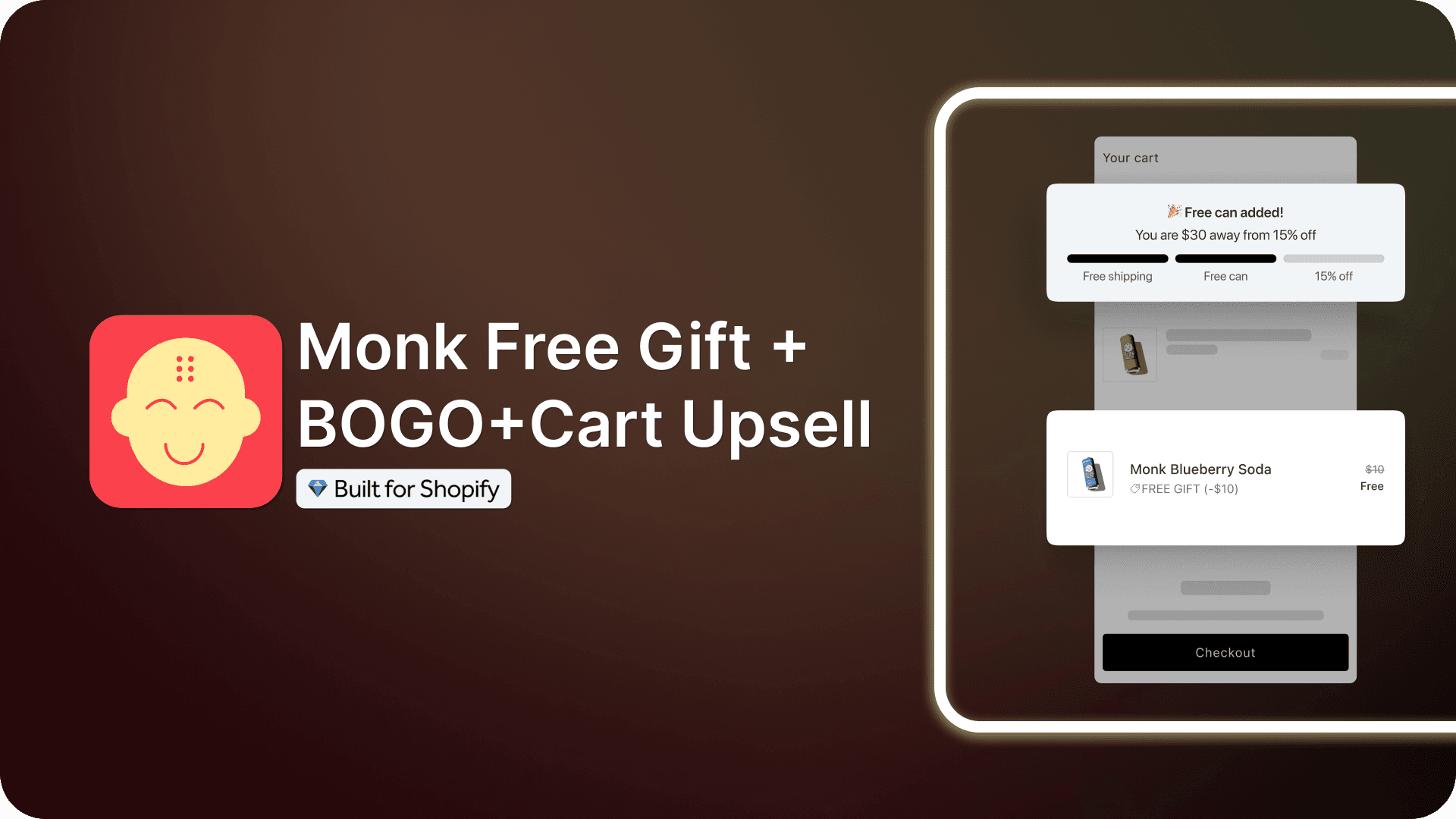
Monk is a unified conversion and sales optimization app for Shopify stores. It helps stores increase revenue by showing free gift offers, BOGO deals, upsells, cross-sells, and discounts across the entire buying journey, from product pages to cart, checkout, and post-checkout.
Key Features of Monk
Combined free gifts, BOGO, upsells, and cross-sell in one app
Personalized offers using a flexible eligibility system
Improved cart conversion with tiered rewards and progress bars
Drives measurable ROI through incremental sales

Strengths & Limitations of Monk
Strengths:
All-in-one offer system
Highly customizable
Complex and personalized offer based on item count, cart value, specific product, collection, customer tag, geographic location and language
Flexible offer placement: product pages, in the cart, at checkout, and post-checkout
Dynamic cart progress bar, that shows live progress towards rewards
Track campaign performance and impact on sales, further categorized based on the nature of the offer campaign.
Limitations:
Monk is a feature-rich solution for stores that require only basic promotions.
Offers multiple customization options, which may take some time to set-up.
May require some initial setup and rule configuration to fully utilize its advanced features.
What Is EasyGift (EG)?
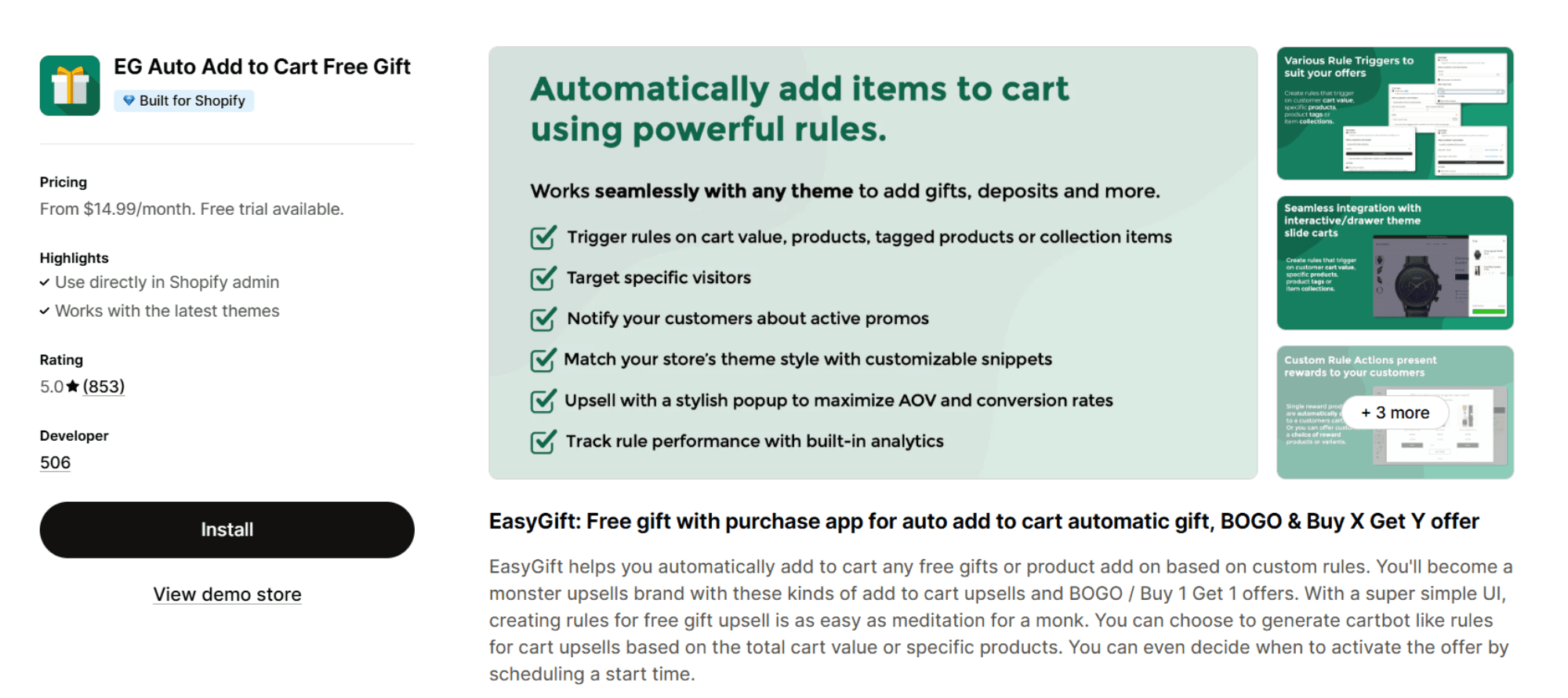
EasyGift (EG) is a Shopify app focused on free gifts and BOGO offers. It automatically adds free gifts or product add-ons to the cart based on simple rules like cart value, products, or collections.
Key Features of EG
Automatic free gift add-to-cart based on cart value or specific products
Simple BOGO and Buy X Get Y offer setup
Rule-based triggers for products, collections, or cart totals
Scheduled campaigns with start and end dates
Strengths & Limitations of EG
Strengths:
Automatic add-to-cart gifts
Simple BOGO & Buy X Get Y
Schedule offers to run
Simple trigger-based offers for flexible targeting like cart value, purchased products or specific collections
Limitations:
Limited offer types: free gifts, BOGO, Buy X Get Y
Less customizable design option for widgets and offers
Fewer placement options for showcasing offers throughout the buying journey like checkout or post-checkout
No built-in analytics
Less personalization
Monk vs EG
To make the Monk vs EasyGift comparison simple, here’s a clear side-by-side overview.
This table highlights the features, pricing, and flexibility that matter most.
Parameter | Monk | EasyGift (EG) |
|---|---|---|
Features | Combined free gifts, BOGO, upsells, cross-sells, tiered progress bars, personalized offers | Free gift auto add-to-cart, BOGO, Buy X Get Y, rule scheduling |
Pricing | Typically premium, reflecting advanced all-in-one capabilities | Generally simpler, often lower-cost for basic gifting offers |
Performance | Strong performance across the entire buying journey with multiple widgets and eligibility rules | Good performance focused on gift and BOGO triggers; less breadth of offer types |
User Experience | Flexible and customizable UI; may require some setup time | Simple and intuitive UI designed for quick rule creation |
Integrations | Broad placement options across product pages, cart, checkout, post-checkout | Cart and product trigger placements; limited deeper integrations |
Support | Support tailored to complexs setups, campaigns, and best practices | Basic support for rule setup and troubleshooting |
Scalability | Built for growing stores with evolving offer strategies | Suited to stores needing straightforward gifting/BOGO rules |
Security | Standard Shopify security compliance; works within Shopify ecosystem | Standard Shopify security compliance |
Customization | High Design and text control for widgets and popups | Basic Limited design flexibility for offer displays |
Monk vs EG: Feature-by-Feature Analysis
Performance & Speed:
Monk is built to handle multiple offer types, free gifts with purchase, BOGO, upsells, and cross-sells at once, without slowing down the shopping experience. Its widgets are optimized to show relevant offers quickly based on eligibility rules.
EasyGift focuses mainly on gift and BOGO rules. It performs well for those use cases but does not deliver a rich set of offer experiences across the entire journey.
Ease of Use & UI
Monk offers many features, so there is a slight learning curve for the users at the beginning. The UI, however, is well-organized and allows control over offer placement and design once you are familiar with it.
EG’s interface is straightforward and easy to pick up, especially for merchants who want simple gift and BOGO setups. The rule builder is intuitive and clean.
Scalability & Flexibility
Monk is highly scalable as it supports complex offer logic, tiered rewards, and personalized experiences. It can grow with store needs as promotions become more advanced.
EasyGift scales well within a narrow range: gift add-to-cart, BOGO, and Buy X Get Y. It is flexible for those rule types but doesn’t extend into upsells, cross-sells, or more layered reward mechanics.
Integrations & Compatibility
Monk works across all the key areas of a store, product pages, cart, checkout, and post-checkout, and blends seamlessly with most Shopify themes and setups.
EG integrates well where it matters: automatic gift insertion and BOGO triggers. It is compatible with standard Shopify stores but does not extend deeply into advanced upsell/cross-sell placements.
Security & Data Protection
Both Monk & EasyGift adhere to Shopify’s secure standard. Neither introduces notable security risk when used as intended.
Customer Support & Documentation
Monk provides detailed support resources, best-practice guidance, and quick one-on-one assistance for more complex campaign setups. Monk’s support often goes deeper due to the app’s broader feature set.
EasyGift offers straightforward support and documentation focused on rule building and basic offer management. It is helpful for quick setup questions.
Pricing Comparison
Monk Pricing Plans
Monk offers simple, transparent pricing with access to all core features in each paid tier:
$49/month- for stores doing 1000 online orders for month
$149/month- for stores with over 1000 online orders per month
7-day free trial- available on both plans
Both plans include features like free gifts, BOGO, upsells, cross-sells, cart progress bars, personalized rules, and a full customization option via widgets along with priority support. All features are available across plans; pricing scales with store volume rather than feature access.
EG Pricing Plans
EasyGift’s pricing is more entry-level and rule-based:
Standard- $14.99/month: to 3 active rules, basic triggers, minor customization
Unlimited- $29.99/month: Unlimited rules, advanced triggers, more customization, priority support
5-day free trial available on both tiers
EasyGift’s tiers are focused on increasing rule capacity and targeting options as you move up from the base plan.
Which One Offers Better Value?
Monk:
Best for stores looking for a full suite of tools in one app.
Pricing is comparatively higher but includes all features in each paid tier and scales with store volume rather than limiting functionality.
This is an excellent choice for those seeking enhanced customization and the capacity to manage intricate, multi-phase incentive campaigns.
EasyGift:
EasyGift provides a more affordable entry point for stores that primarily require free gift auto-add and basic BOGO/Buy X Get Y offers.
The lower starting price may appeal to smaller stores or those with simpler promotional needs.
It offers excellent basic volume for free gifts and cart rules but lacks advanced upsell and conversion optimization features.
To sum it up, EG is cost-effective if your priority is basic gifts and BOGO logic, whereas Monk offers broader promotional power and better ROI potential for stores aiming to boost AOV, conversions, and cross-sell performance, especially as sales scale.
Use Cases: When to Choose Monk vs. EG?
When to Choose Monk
Choose Monk if you want a deeper, more strategic promotional engine:
You need combined free gifts, BOGO, upsells, and cross-sells in one place
You want personalized offers based on rules and eligibility
You are aiming to increase average order value consistently
You want tiered rewards and visual progress bars to motivate buyers
You need to show offers across the entire buyer journey: product page, cart, checkout, and post-checkout.
You plan to run complex campaigns that evolve over time
You want customizable design and messaging to match your brand
Best for:
Growing stores with varied promotional needs, stores focused on conversion optimization, and merchants who want measurable ROI from incentives.
When to Choose EasyGift
Choose EasyGift if your main goals are focused and simple:
You want automatic free gifts that add to cart without customer action
You need basic BOGO and Buy X Get Y offers set up quickly
Your promotions are based on cart value and specific products/collections
You want a simple UI with minimal setup time
You prefer a lower monthly cost for basic promotional rules
You do not need advanced upsell, cross-sells, or tiered incentives
Best for:
Small to medium stores, seasonal campaigns, and stores with straightforward gifting logic.
Quick Decision Guide:
Merchant Goal | Preferred Option |
|---|---|
Basic free gift and BOGO offers | EasyGift (EG) |
Automation with minimal setup | EasyGift (EG) |
Multi-type promotions (gifts + upsells + cross-sells) | Monk |
Conversion optimization strategy | Monk |
Personalized buyer experiences | Monk |
Full control over design & messaging | Monk |
Ideal Use Case Scenarios:
Choose Monk when:
You want a progress bar that says, “Spend $100 more for a free gift.”
You want to recommend upsells and cross-sells in the cart and checkout
You want offers that change based on product categories or customer behavior
Choose EG when:
You want to auto-add a free tote bag once the cart hits $75
You want Buy 1 Get 1 deals running this weekend
You want scheduled gift rules for a short campaign
Monk vs EG: Final Verdict
Monk and EasyGift both support free gifts and BOGO offers, but they serve different levels of promotional strategy.
EasyGift is ideal if you want a simple, reliable way to auto-add gifts and run Buy X Get Y campaigns without added complexity. It covers the essentials and is easy to manage.
Monk is better suited for stores that want more than just basic gifting. By combining free gifts, upsells, cross-sells, tiered rewards, and personalized rules, it gives you more control over how and where you influence buying decisions.
So, the choice comes down to intent.
If your needs are basic and focused, EasyGift is enough.
If you’re looking to build a more thoughtful, scalable conversion strategy, Monk gives you the room to grow.
FAQs:
Which is better: Monk or EG?
It depends on your needs. EasyGift (EG) is great for straightforward free gifts and BOGO offers. Monk offers a broader set of promotion tools, making it better for stores that want upsells, cross-sells, and tiered rewards in addition to gifts.
Is Monk more affordable than EG?
Not usually. EasyGift generally starts at a lower cost and is simpler. Monk costs more but includes more features and flexibility. Value depends on how many promotional tools you need.
Which one is better for beginners?
EasyGift is typically easier for beginners because it focuses on simple gift and BOGO rules with a clean interface. Monk has more features, so it may take a bit more setup time.
Does Monk offer better integrations than EG?
Monk offers broader placement options across product pages, cart, checkout, and post‑checkout. EasyGift focuses on cart and product triggers. So Monk supports more touchpoints across the buying journey.
5. Is there a better alternative to Monk or EG?
There are other apps with specific strengths (e.g., dedicated upsell apps, loyalty programs, or discount engines). But for gift‑centric offers paired with BOGO/upsells in one place, Monk and EasyGift are among the most complete options on Shopify.
6. Does Monk offer better integrations than EG?
Yes. Monk can show offers across product pages, carts, checkout, and post-checkout. EasyGift mainly focuses on product and cart triggers. Monk covers more touchpoints, which helps increase conversions across the buying journey.
7. Can I use Monk or EG for holiday or seasonal promotions?
Both apps support seasonal campaigns. EasyGift lets you schedule BOGO and gift rules easily. Monk can run more complex seasonal campaigns with tiered rewards, upsells, and cross-sells for maximum impact along with scheduling.
8. How customizable are the offers in Monk and EG?
EasyGift offers basic design options for free gifts and BOGO pop-ups. Monk allows full customization of widgets and pop-ups, including text, style, and placement, giving your promotions a branded feel.
9. Do I need technical skills to use Monk or EG?
EasyGift requires minimal setup and is beginner-friendly. Monk offers more advanced features, but the interface is designed for non-technical users, with tutorials and support available.
Monk vs EG: A Complete Comparison of Features, Performance, Pricing and Performance Breakdown
Summary
Monk is an all-in-one Shopify conversion app that combines free gifts, BOGO, upsells, cross-sells, discounts, and tiered rewards across the entire customer journey. It supports advanced personalization using rules like cart value, products, customer tags, and location, with flexible placement on product pages, cart, checkout, and post-purchase. EasyGift (EG) focuses on simple automation for free gifts and BOGO offers using basic rule-based triggers like cart value or product selection. Monk is more feature-rich, customizable, and scalable for complex campaigns, while EG is simpler, faster to set up, and suited for basic gifting needs. Both support Shopify promotions, but differ in depth, flexibility, and use case complexity.
What Is Monk?
Monk is a unified conversion and sales optimization app for Shopify stores. It helps stores increase revenue by showing free gift offers, BOGO deals, upsells, cross-sells, and discounts across the entire buying journey, from product pages to cart, checkout, and post-checkout.
Key Features of Monk
Combined free gifts, BOGO, upsells, and cross-sell in one app
Personalized offers using a flexible eligibility system
Improved cart conversion with tiered rewards and progress bars
Drives measurable ROI through incremental sales
Strengths & Limitations of Monk
Strengths:
All-in-one offer system
Highly customizable
Complex and personalized offer based on item count, cart value, specific product, collection, customer tag, geographic location and language
Flexible offer placement: product pages, in the cart, at checkout, and post-checkout
Dynamic cart progress bar, that shows live progress towards rewards
Track campaign performance and impact on sales, further categorized based on the nature of the offer campaign.
Limitations:
Monk is a feature-rich solution for stores that require only basic promotions.
Offers multiple customization options, which may take some time to set-up.
May require some initial setup and rule configuration to fully utilize its advanced features.
What Is EasyGift (EG)?
EasyGift (EG) is a Shopify app focused on free gifts and BOGO offers. It automatically adds free gifts or product add-ons to the cart based on simple rules like cart value, products, or collections.
Key Features of EG
Automatic free gift add-to-cart based on cart value or specific products
Simple BOGO and Buy X Get Y offer setup
Rule-based triggers for products, collections, or cart totals
Scheduled campaigns with start and end dates
Strengths & Limitations of EG
Strengths:
Automatic add-to-cart gifts
Simple BOGO & Buy X Get Y
Schedule offers to run
Simple trigger-based offers for flexible targeting like cart value, purchased products or specific collections
Limitations:
Limited offer types: free gifts, BOGO, Buy X Get Y
Less customizable design option for widgets and offers
Fewer placement options for showcasing offers throughout the buying journey like checkout or post-checkout
No built-in analytics
Less personalization
Monk vs EG
To make the Monk vs EasyGift comparison simple, here’s a clear side-by-side overview.
This table highlights the features, pricing, and flexibility that matter most.
Parameter | Monk | EasyGift (EG) |
|---|---|---|
Features | Combined free gifts, BOGO, upsells, cross-sells, tiered progress bars, personalized offers | Free gift auto add-to-cart, BOGO, Buy X Get Y, rule scheduling |
Pricing | Typically premium, reflecting advanced all-in-one capabilities | Generally simpler, often lower-cost for basic gifting offers |
Performance | Strong performance across the entire buying journey with multiple widgets and eligibility rules | Good performance focused on gift and BOGO triggers; less breadth of offer types |
User Experience | Flexible and customizable UI; may require some setup time | Simple and intuitive UI designed for quick rule creation |
Integrations | Broad placement options across product pages, cart, checkout, post-checkout | Cart and product trigger placements; limited deeper integrations |
Support | Support tailored to complexs setups, campaigns, and best practices | Basic support for rule setup and troubleshooting |
Scalability | Built for growing stores with evolving offer strategies | Suited to stores needing straightforward gifting/BOGO rules |
Security | Standard Shopify security compliance; works within Shopify ecosystem | Standard Shopify security compliance |
Customization | High Design and text control for widgets and popups | Basic Limited design flexibility for offer displays |
Monk vs EG: Feature-by-Feature Analysis
Performance & Speed:
Monk is built to handle multiple offer types, free gifts with purchase, BOGO, upsells, and cross-sells at once, without slowing down the shopping experience. Its widgets are optimized to show relevant offers quickly based on eligibility rules.
EasyGift focuses mainly on gift and BOGO rules. It performs well for those use cases but does not deliver a rich set of offer experiences across the entire journey.
Ease of Use & UI
Monk offers many features, so there is a slight learning curve for the users at the beginning. The UI, however, is well-organized and allows control over offer placement and design once you are familiar with it.
EG’s interface is straightforward and easy to pick up, especially for merchants who want simple gift and BOGO setups. The rule builder is intuitive and clean.
Scalability & Flexibility
Monk is highly scalable as it supports complex offer logic, tiered rewards, and personalized experiences. It can grow with store needs as promotions become more advanced.
EasyGift scales well within a narrow range: gift add-to-cart, BOGO, and Buy X Get Y. It is flexible for those rule types but doesn’t extend into upsells, cross-sells, or more layered reward mechanics.
Integrations & Compatibility
Monk works across all the key areas of a store, product pages, cart, checkout, and post-checkout, and blends seamlessly with most Shopify themes and setups.
EG integrates well where it matters: automatic gift insertion and BOGO triggers. It is compatible with standard Shopify stores but does not extend deeply into advanced upsell/cross-sell placements.
Security & Data Protection
Both Monk & EasyGift adhere to Shopify’s secure standard. Neither introduces notable security risk when used as intended.
Customer Support & Documentation
Monk provides detailed support resources, best-practice guidance, and quick one-on-one assistance for more complex campaign setups. Monk’s support often goes deeper due to the app’s broader feature set.
EasyGift offers straightforward support and documentation focused on rule building and basic offer management. It is helpful for quick setup questions.
Pricing Comparison
Monk Pricing Plans
Monk offers simple, transparent pricing with access to all core features in each paid tier:
$49/month- for stores doing 1000 online orders for month
$149/month- for stores with over 1000 online orders per month
7-day free trial- available on both plans
Both plans include features like free gifts, BOGO, upsells, cross-sells, cart progress bars, personalized rules, and a full customization option via widgets along with priority support. All features are available across plans; pricing scales with store volume rather than feature access.
EG Pricing Plans
EasyGift’s pricing is more entry-level and rule-based:
Standard- $14.99/month: to 3 active rules, basic triggers, minor customization
Unlimited- $29.99/month: Unlimited rules, advanced triggers, more customization, priority support
5-day free trial available on both tiers
EasyGift’s tiers are focused on increasing rule capacity and targeting options as you move up from the base plan.
Which One Offers Better Value?
Monk:
Best for stores looking for a full suite of tools in one app.
Pricing is comparatively higher but includes all features in each paid tier and scales with store volume rather than limiting functionality.
This is an excellent choice for those seeking enhanced customization and the capacity to manage intricate, multi-phase incentive campaigns.
EasyGift:
EasyGift provides a more affordable entry point for stores that primarily require free gift auto-add and basic BOGO/Buy X Get Y offers.
The lower starting price may appeal to smaller stores or those with simpler promotional needs.
It offers excellent basic volume for free gifts and cart rules but lacks advanced upsell and conversion optimization features.
To sum it up, EG is cost-effective if your priority is basic gifts and BOGO logic, whereas Monk offers broader promotional power and better ROI potential for stores aiming to boost AOV, conversions, and cross-sell performance, especially as sales scale.
Use Cases: When to Choose Monk vs. EG?
When to Choose Monk
Choose Monk if you want a deeper, more strategic promotional engine:
You need combined free gifts, BOGO, upsells, and cross-sells in one place
You want personalized offers based on rules and eligibility
You are aiming to increase average order value consistently
You want tiered rewards and visual progress bars to motivate buyers
You need to show offers across the entire buyer journey: product page, cart, checkout, and post-checkout.
You plan to run complex campaigns that evolve over time
You want customizable design and messaging to match your brand
Best for:
Growing stores with varied promotional needs, stores focused on conversion optimization, and merchants who want measurable ROI from incentives.
When to Choose EasyGift
Choose EasyGift if your main goals are focused and simple:
You want automatic free gifts that add to cart without customer action
You need basic BOGO and Buy X Get Y offers set up quickly
Your promotions are based on cart value and specific products/collections
You want a simple UI with minimal setup time
You prefer a lower monthly cost for basic promotional rules
You do not need advanced upsell, cross-sells, or tiered incentives
Best for:
Small to medium stores, seasonal campaigns, and stores with straightforward gifting logic.
Quick Decision Guide:
Merchant Goal | Preferred Option |
|---|---|
Basic free gift and BOGO offers | EasyGift (EG) |
Automation with minimal setup | EasyGift (EG) |
Multi-type promotions (gifts + upsells + cross-sells) | Monk |
Conversion optimization strategy | Monk |
Personalized buyer experiences | Monk |
Full control over design & messaging | Monk |
Ideal Use Case Scenarios:
Choose Monk when:
You want a progress bar that says, “Spend $100 more for a free gift.”
You want to recommend upsells and cross-sells in the cart and checkout
You want offers that change based on product categories or customer behavior
Choose EG when:
You want to auto-add a free tote bag once the cart hits $75
You want Buy 1 Get 1 deals running this weekend
You want scheduled gift rules for a short campaign
Monk vs EG: Final Verdict
Monk and EasyGift both support free gifts and BOGO offers, but they serve different levels of promotional strategy.
EasyGift is ideal if you want a simple, reliable way to auto-add gifts and run Buy X Get Y campaigns without added complexity. It covers the essentials and is easy to manage.
Monk is better suited for stores that want more than just basic gifting. By combining free gifts, upsells, cross-sells, tiered rewards, and personalized rules, it gives you more control over how and where you influence buying decisions.
So, the choice comes down to intent.
If your needs are basic and focused, EasyGift is enough.
If you’re looking to build a more thoughtful, scalable conversion strategy, Monk gives you the room to grow.
FAQs:
Which is better: Monk or EG?
It depends on your needs. EasyGift (EG) is great for straightforward free gifts and BOGO offers. Monk offers a broader set of promotion tools, making it better for stores that want upsells, cross-sells, and tiered rewards in addition to gifts.
Is Monk more affordable than EG?
Not usually. EasyGift generally starts at a lower cost and is simpler. Monk costs more but includes more features and flexibility. Value depends on how many promotional tools you need.
Which one is better for beginners?
EasyGift is typically easier for beginners because it focuses on simple gift and BOGO rules with a clean interface. Monk has more features, so it may take a bit more setup time.
Does Monk offer better integrations than EG?
Monk offers broader placement options across product pages, cart, checkout, and post‑checkout. EasyGift focuses on cart and product triggers. So Monk supports more touchpoints across the buying journey.
5. Is there a better alternative to Monk or EG?
There are other apps with specific strengths (e.g., dedicated upsell apps, loyalty programs, or discount engines). But for gift‑centric offers paired with BOGO/upsells in one place, Monk and EasyGift are among the most complete options on Shopify.
6. Does Monk offer better integrations than EG?
Yes. Monk can show offers across product pages, carts, checkout, and post-checkout. EasyGift mainly focuses on product and cart triggers. Monk covers more touchpoints, which helps increase conversions across the buying journey.
7. Can I use Monk or EG for holiday or seasonal promotions?
Both apps support seasonal campaigns. EasyGift lets you schedule BOGO and gift rules easily. Monk can run more complex seasonal campaigns with tiered rewards, upsells, and cross-sells for maximum impact along with scheduling.
8. How customizable are the offers in Monk and EG?
EasyGift offers basic design options for free gifts and BOGO pop-ups. Monk allows full customization of widgets and pop-ups, including text, style, and placement, giving your promotions a branded feel.
9. Do I need technical skills to use Monk or EG?
EasyGift requires minimal setup and is beginner-friendly. Monk offers more advanced features, but the interface is designed for non-technical users, with tutorials and support available.
Ravish (RV)
Co-Founder, Monk Commerce
Ravish is an ecommerce and SaaS marketing expert with 6+ years of experience in Shopify and ecommerce and 10+ years of experience in marketing, and growth strategy. He has worked closely with Shopify merchants to solve real ecommerce challenges and shares practical, research-backed insights, industry best practices, and emerging trends.
Contents
Related Articles
10 Best Shopify Apps for Increasing Revenue
10 Best Upsell Apps for Shopify to Boost Sales & AOV in 2026
Top 10 Shopify Apps to Raise Average Order Value
Get Monk Free Gift app for just $1/month this Black Friday
First month: $1 after your 7-day free trial. All features included. Offer live!
Claim offer now

Get Monk Free Gift app for just $1/month this Black Friday
First month: $1 after your 7-day free trial. All features included. Offer live!
Claim offer now
Get Monk Free Gift app for just $1/month this Black Friday
First month: $1 after your 7-day free trial. All features included. Offer live!
Claim offer now